Digital Twin in Pharmaceutical Manufacturing: A Complete Guide
By James C on May 29, 2026
A biologics manufacturer was losing nearly a quarter of its batches. Novartis reported a 22% batch-failure rate on a monoclonal-antibody line — driven by unpredictable cell-metabolism shifts and harvest-timing decisions made on glucose and lactate readings taken only every six hours. The process was flying half-blind between measurements. The fix was not more sensors alone; it was a model that could see the future of the batch and act before the window closed. That is what a digital twin does: a living virtual replica of the process, fed by real-time data, that predicts critical quality attributes across every unit operation and lets engineers test a change in silico before risking a single physical run. Done well, a pharma digital twin delivers double-digit yield gains — this guide covers how to design, build, and operate one.
iFactory Process Intelligence
Digital Twin in Pharmaceutical Manufacturing: A Complete Guide
From bioreactor to whole facility — how pharma digital twins predict failures, lift yield, and accelerate first-time-right launches, plus the architecture, data, and regulatory path to build one.
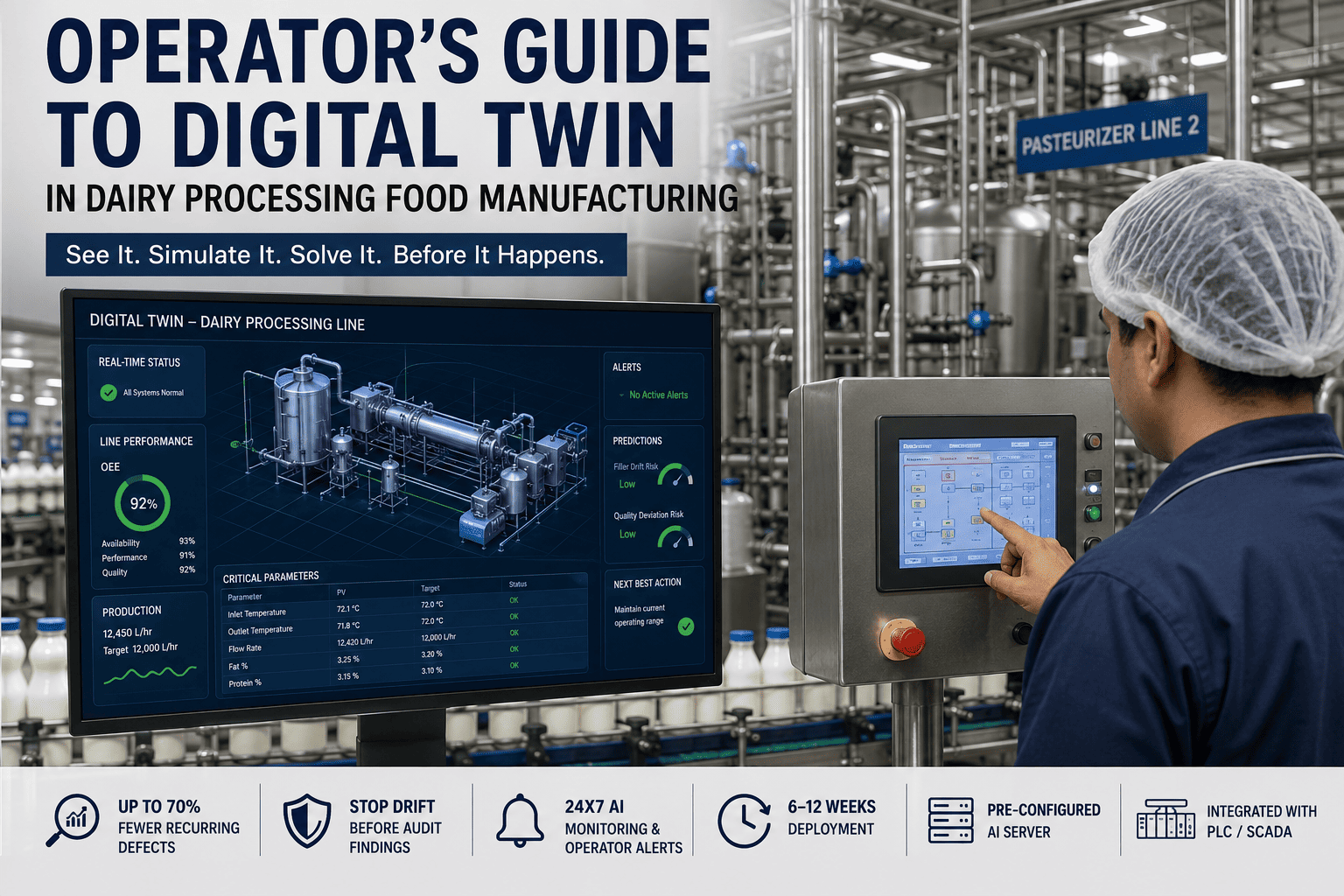
A digital twin is not a 3D model and not a dashboard. It is a dynamic, data-driven virtual replica of a physical entity — a bioreactor, a fill-finish line, a cleanroom, or an entire facility — that mirrors its real-world counterpart in real time. The defining feature is that it is bidirectional: live data updates the virtual model, and the model's insights feed back to control or improve the physical system. It runs on a continuous diet of sensor, PAT, and MES data, and uses AI and simulation to predict what the process will do next.
Virtual Representation
High-fidelity models of CAD designs, process logic, material flows, and system dynamics — the math of the real process.
Live Data Link
Continuous feed from IoT sensors, PAT, and MES keeps the twin synchronized with the physical asset, moment to moment.
Predictive Feedback
AI and simulation forecast CQAs and deviations, then push insight back to adjust temperature, pH, or harvest timing.
The Three Levels of a Digital Twin
Not every twin models a whole plant — and you should not try to build that first. Digital twins exist at three scopes, each with its own payoff. Most successful pharma programs start narrow, prove value on one asset, then widen. Knowing which level you are building is the first design decision.
Level 1Equipment Twin
A single asset — a bioreactor, a lyophilizer, a fill needle. Models that one unit's behavior to predict maintenance, drift, and performance. The fastest place to prove ROI.
Scope: one machine
Level 2Process Twin
An integrated chain of unit operations — cell culture through purification to fill. Predicts critical quality attributes across the whole process, the level where yield gains live.
Scope: a process chain
Level 3Plant / Facility Twin
The full site — equipment, utilities, scheduling, CIP/SIP, material flow. Used to find unused capacity, optimize run rates, and model changeovers across the whole operation.
Scope: entire facility
Not sure which level fits your fastest win — equipment, process, or plant? Book a 30-minute scoping session and we'll map a phased twin to your highest-value process.
How the Twin Loop Works
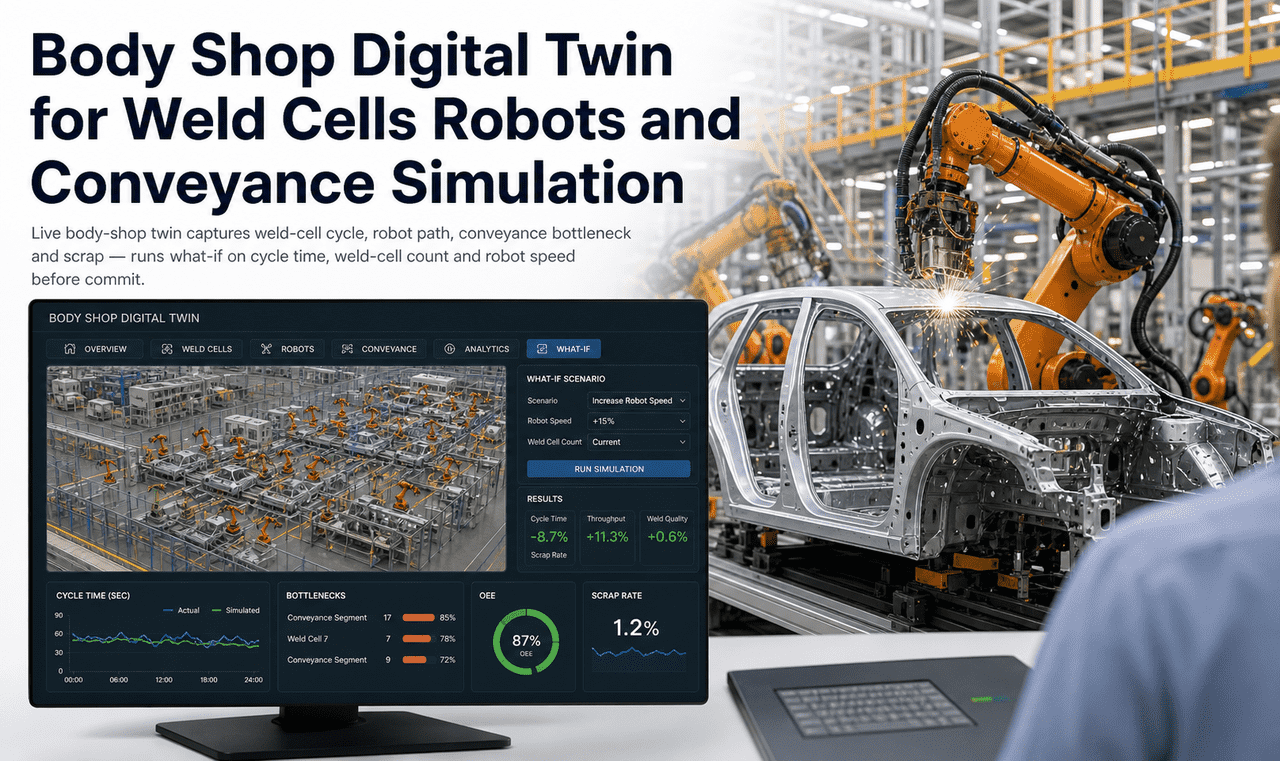
The power of a digital twin is the closed loop. The physical process generates data, the twin ingests and models it, the model predicts and recommends, and the insight returns to the floor — continuously. This is what shifts pharma from reactive correction after a deviation to predictive control before one.
The Bidirectional Digital Twin Loop
Data up — sensors and PAT stream the real process state into the twin
Insight down — predicted CQAs and setpoint recommendations return to control
What It Delivers — The Numbers
The business case is not speculative. Across early adopters, digital twins are producing measurable gains in yield, batch reliability, changeover speed, and time to market. These figures come from pharma and biopharma digital-twin market research and published implementations.
51%
Higher first-pass yield
in flexible small-batch cell and gene therapy production
39%
Lower batch-failure rate
through real-time deviation detection and correction
60%
Faster product switchovers
critical for shorter lifecycles and frequent changeovers
30%
Shorter cycle times
in biopharma through AI-integrated twins
Proof in Production
Digital twins have moved from pilots to production-scale tools, with named results from major manufacturers. These are not lab demonstrations — they are deployed processes.
Pfizer
Used a digital-twin approach to cut the number of required experiments and provide a roadmap for bioreactor scale-up — bringing drugs to market faster.
GSK
Applied digital twins to vaccine production, tracking every process step in real time to spot and correct discrepancies on the fly rather than at post-production inspection.
Hybrid CHO Model
A hybrid model optimizing a perfusion CHO cell-culture process in silico delivered a 50% increase in volumetric productivity, with reliable extrapolation to larger 5L bioreactors.
How to Build One — A Practical Path
The fastest way to fail is to attempt a full-facility twin in one leap. Successful programs follow a phased path: start narrow, validate, then scale. Even small teams of four to sixteen people have reported ROI in under a year by sequencing it this way.
From Scope to Scaled Twin
1
Scope
Pick One Asset
Choose a high-value, well-instrumented process — usually a single bioreactor or line
2
Connect
Harmonize Data
Integrate PAT, IoT, and MES feeds into a clean, aggregated data layer
3
Model
Build & Validate
Develop the hybrid model, validate against historical and live batches
4
Scale
Close the Loop
Move from monitoring to predictive control, then widen to process and plant
The Regulatory Reality
In a GxP environment, a model that influences quality decisions is a validated system — and digital twins raise questions traditional CSV was not built to answer. There is no DT-specific regulation yet, so programs lean on established frameworks. Getting this right early is what separates a twin that ships from one that stalls in qualification.
CSV & GAMP 5
Computerized-system validation principles apply; the ISPE GAMP working group has outlined a maturity-based basis for validating AI systems in GxP use.
ISO 23247
The digital-twin framework standard — a twin should support information continuity across design, planning, manufacturing, and maintenance.
FDA 21 CFR 211.110
The January 2025 guidance update explicitly supports advanced tech, real-time quality monitoring, PAT, and continuous manufacturing.
Data Integrity (ALCOA+)
The data feeding and produced by the twin must meet the same integrity standards as any GMP record — attributable, accurate, auditable.
Knowing the obstacles up front is half the battle. The barriers are real but well understood, and most are falling as platforms mature. The two that most often stall projects are data integration and cybersecurity.
5.6 mo
Added by integration
multi-vendor legacy and regulated OT systems extend timelines; 50% cite interoperability as the top obstacle
36%
Rise in cyber incidents
attacks targeting pharma digital twins in 2024 deterred 61% of potential adopters
No DT rule
Regulatory gap
no twin-specific guideline yet — programs must map to existing CSV and data-integrity principles
Frequently Asked Questions
How is a digital twin different from a simulation or a 3D model?
A simulation runs offline against assumptions; a 3D model is static geometry. A digital twin is bidirectional and live — continuously fed by real sensor and PAT data, and pushing insight back to the physical process. The defining feature is the closed loop between the real asset and its virtual replica in real time.
Where should we start — what gives the fastest ROI?
Start at the equipment or single-process level on a high-value, well-instrumented asset, not a full facility. Proving value on one bioreactor or line is the lowest-risk path, and even small teams have reported payback in under a year before scaling to process and plant twins.
Will regulators accept a digital twin in a GMP process?
There is no digital-twin-specific regulation yet, so you validate against established frameworks — CSV and GAMP 5 for the computerized system, ISO 23247 for the twin framework, and ALCOA+ for data integrity. The FDA's 2025 update to 21 CFR 211.110 explicitly supports advanced technologies and real-time quality monitoring, which favors well-validated twins.
What data does a digital twin actually need?
Continuous, harmonized feeds from Process Analytical Technology, IoT sensors, and the MES, plus development and historical batch data to train the model. The hardest part is usually not the model — it's aggregating and cleaning data across multi-vendor legacy systems, which is why integration adds months if underestimated.
Is this only for big pharma and biologics?
No. While biologics and cell and gene therapy see the largest gains because of process variability, equipment and line twins apply across small-molecule, fill-finish, and CDMO operations. The market is expanding fast precisely because the entry point — a single-asset twin — is accessible to smaller operations and CDMOs.
From Reactive to Predictive.
See a Digital Twin Built on Your Process — in 30 Minutes
Bring a process you suspect is leaving yield on the table. We'll show how a twin ingests your PAT and MES data, predicts critical quality attributes across the chain, and closes the loop to control — with a phased, CSV-ready path from one asset to the full plant.