Every factory runs on a model of itself. The only question is whether that model is living inside the operations director's head, scribbled on a whiteboard, or running as a data-linked digital replica that mirrors what is happening on the floor every second. For most of the last century, the first two were the only options — and they worked well enough when production was slower, supply chains were forgiving, and downtime was measured in hours rather than hundred-thousands of dollars. That equation has changed. The global digital twin market grew from $24.5 billion in 2025 to a projected $149 billion by 2030, a 47.9% CAGR that tracks almost perfectly with the economic pain of running blind. McKinsey documents digital twins cutting development time by up to 50%, reducing labor costs by 10%, and improving consumer-promise fulfillment by 20% — with ROI of 15–30% and payback periods under 24 months. This page does not tell you digital twins are always the right answer. It tells you exactly where they beat traditional operations, where traditional still wins, and how to know which fight you are actually in.
Comparison Deep Dive · High-Intent Reader
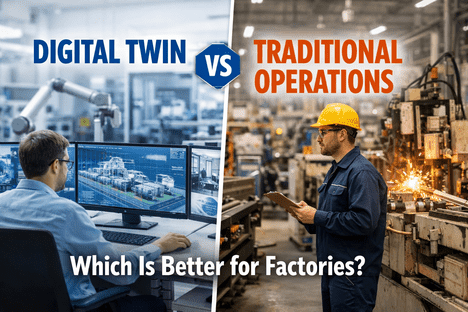
Digital Twin vs Traditional Operations — A Brutally Honest Comparison
A head-to-head look at how digital twins and traditional operations stack up on cost, risk, speed, and ROI — plus a decision framework for knowing which approach your plant should actually be running.
$149B
Digital twin market size projected by 2030
47.9%
Annual growth rate — fastest-growing industrial tech
15–30%
Typical ROI within first few years of deployment
< 24 mo
Payback period for targeted pilot projects
Sources: MarketsandMarkets 2026 · McKinsey · Deloitte · Gartner Digital Twin Report · Mitsubishi Manufacturing Guide 2026 · iFactory Deployment Data
First — What Each Approach Actually Is
Before running comparisons, make sure we are comparing the right things. "Traditional operations" and "digital twin" get used loosely in vendor marketing. Here is what each actually means when deployed on a real plant floor.
Traditional Operations
Human Knowledge + Spreadsheets + Reports
Tribal knowledge from senior operators and engineers
Periodic reports built from shift logs and ERP extracts
Calendar-based PM schedules and reactive maintenance
Decisions made from yesterday's data or gut feel
What-if analysis done in spreadsheets or planning meetings
The factory exists in two places: the physical floor, and someone's mental model of it.
Digital Twin Operations
Live Virtual Replica + Real-Time Data + Simulation
Virtual model mirrors physical assets second-by-second
Continuous sensor data keeps the twin synchronized live
AI predicts failures, bottlenecks, and quality drift in advance
Decisions tested in the virtual twin before the physical line
Institutional knowledge captured in the model, not in heads
The factory exists as a living data model that every decision can be tested against first.
The Head-to-Head Scorecard
Seven rounds. Each category scored on real-world outcomes documented in McKinsey, Deloitte, Gartner, and Siemens research — not marketing claims. This is where the comparison stops being theoretical and starts being financial.
Round
Traditional
Digital Twin
Winner
01Failure Prediction
Reactive, after failure occurs
30–90 days ahead at 88–97% accuracy
Digital Twin
02Decision Testing
Spreadsheet models and gut feel
Simulated in virtual twin first
Digital Twin
03Data Latency
Hours to days old
Seconds-fresh, continuous stream
Digital Twin
04Upfront Investment
Near-zero, uses existing systems
$50K–$2M depending on scope
Traditional
05Implementation Speed
Already running today
2 weeks to 12 months by scope
Traditional
06Knowledge Capture
Walks out when experts retire
Encoded in the model permanently
Digital Twin
07Scalability
Linear with headcount growth
Same model scales across sites
Digital Twin
Final Score
Traditional wins on upfront cost and speed to start. Digital twin wins on every outcome that compounds over time.
What Each Approach Actually Sees
The most important difference between the two is not the technology — it is the field of view. A traditional operation sees a snapshot of yesterday. A digital twin sees a live window into every asset, every process, and every possible future state. That gap is where every cost difference on the scorecard actually comes from.
Traditional Ops Sees
Production Report
Yesterday, 11:47 PM
Line 1 OEE78%
Line 2 OEE69%
Downtime Events7
Total Output14,820
Static · Historical · Incomplete
Yesterday's data, not today's reality
Aggregated numbers, no root causes
No visibility into tomorrow's problems
Cannot test changes before making them
Digital Twin Sees
Live Twin · Plant 01
LIVE
Plant OEE Now81.4%
Next Shift Forecast78.9%
Active Anomalies2
Scenario A Result+5.2 pts
Living · Predictive · Simulating
Second-fresh actuals from every machine
Predictive view 2 hrs to 90 days ahead
Root causes auto-surfaced, not guessed
Every decision simulated before execution
Want to see your own plant as a live twin? Book a 30-minute walkthrough.
The ROI Math — Where They Break Even
Traditional operations feel cheap because the costs are hidden inside downtime, wasted PM hours, scrap, and decisions you would have made differently in hindsight. Digital twins feel expensive because the costs are visible upfront. Here is what the actual break-even looks like for a typical mid-sized plant.
Traditional · Annual Hidden Costs
Unplanned downtime
$40.0M
Calendar-based PM waste
$2.8M
Quality rework & scrap
$3.4M
Bad-decision overhead
$1.9M
Total invisible cost
$48.1M
Digital Twin · After Year 1
Downtime recovered (35%)
+$14.0M
PM optimization saved
+$0.9M
Quality loss recovered
+$1.4M
Platform investment
-$0.2M
Net year-one value
+$16.1M
Where Traditional Still Wins
This is the part of the comparison most vendors skip. Digital twins are not always the right answer. There are five specific scenarios where traditional operations are genuinely the smarter bet — at least for now.
01
Very Small Operations
Under 25 employees with a single production line. Payback math does not work until you have enough equipment to justify instrumentation costs.
02
Stable, Low-Variability Processes
Equipment that runs continuously for years with minimal changeovers, predictable throughput, and rare failures. Less to simulate, less to gain.
03
Pre-Connectivity Plants
Facilities where the data foundation (PLC connectivity, sensor coverage, network infrastructure) is not yet in place. Fix that first, then deploy the twin.
04
Short-Term Decisions
A facility scheduled for retirement or major retooling within 18 months. Payback horizon does not fit the deployment window.
05
Highly Manual Operations
Artisanal or custom-job-shop work where human judgment dominates and production varies dramatically between orders. Models struggle with low repeatability.
The Decision Framework
Skip the vendor pitches. Run your plant through these five questions. If you answer "yes" to four or more, digital twin operations deliver documented ROI on your specific plant. If you answer "no" to three or more, traditional operations are still the right choice — for now.
Q1
Does an hour of unplanned downtime cost you more than $10,000?
If yes, predictive prevention has a big dollar target. If no, traditional may still be fine.
Q2
Do you run at least 10 critical, instrumentable assets?
Below this threshold the sensor and model investment does not concentrate enough to pay back quickly.
Q3
Are your processes changing or scaling frequently?
High-variability operations get the most value from simulating decisions before executing them.
Q4
Do you have 3–6 months of historical machine data?
Twins need past data to build baselines. Less than this and models will need more time to stabilize.
Q5
Is your plant keeping institutional knowledge for the next decade?
If your senior experts are retiring and tribal knowledge is walking out the door, digital twins are the answer.
4–5 yes
Digital twin delivers clear ROI · Start with a pilot on one asset or line
2–3 yes
Hybrid path · Condition monitoring first, full twin in 12 months
0–1 yes
Stay traditional for now · Revisit in 18 months as conditions change
Not sure where your plant scores? Book a free readiness assessment.
Start Small — The Pilot Pattern That Works
Gartner reports that 75% of manufacturers who deploy digital twins struggle to scale beyond the initial pilot. The single biggest reason is trying to build a full-plant twin on day one. The successful pattern is the opposite — a tight-scope pilot on one high-value asset, validated ROI in one quarter, then aggressive scale-out from proven wins.
Phase 1
Single Asset Twin
Weeks 1–4
Pick the most expensive bottleneck asset. Instrument it. Build the twin. Measure baseline. Total cost $30K–80K.
Phase 2
Line-Level Twin
Months 2–4
Extend to the full production line feeding that bottleneck. Capture interdependencies. First ROI validated.
Phase 3
Process-Level Twin
Months 5–9
Connect related lines and upstream/downstream processes. Begin cross-line scenario simulation and optimization.
Phase 4
Full Plant Twin
Months 10–18
Plant-wide operational twin running continuously. Cross-site benchmarking enabled. Institutional knowledge now encoded permanently.
What You Actually Get — Outcome by Outcome
50%
Reduction in product development time per McKinsey
20%
Improvement in consumer promise fulfillment
30%
Reduction in operating expenses at mature adopters
70%+
Of aerospace, automotive, electronics now piloting
Frequently Asked Questions
What is the core difference between a digital twin and a traditional simulation?
A traditional simulation is a what-if tool run with theoretical data in an offline environment during design or planning. A digital twin is a what-is and what-will-be tool — it runs continuously, fed by live data from the physical asset, so the model stays synchronized with reality and can be used for live decision-making. Traditional simulations are one-time tests; digital twins are living replicas.
Book a demo to see a live twin in action.
How much does a digital twin actually cost to deploy?
Asset-level digital twins for 10–20 critical machines typically run $50K–$200K and deliver ROI within 3–6 months. Process-level twins take 2–3 months to build. Full plant twins cost $500K–$2M but typically reduce total manufacturing costs by 5–8%. Subscription-based cloud platforms are dramatically lowering entry costs for mid-sized plants.
Is traditional operations ever actually better than digital twin?
Yes — specifically for very small operations, highly stable low-variability processes, plants without existing PLC connectivity, facilities scheduled for retirement within 18 months, and highly manual artisanal operations where models struggle with low repeatability. Digital twins need enough equipment, enough variability, and enough payback horizon to be worth the investment.
How long does a digital twin take to implement?
Asset-level digital twins can be operational in 2–4 weeks with modern platforms. Process-level twins take 2–3 months. Full plant-level twins take 6–12 months. The successful pattern is starting with a single high-value asset, proving ROI within one quarter, then scaling in planned phases rather than attempting full-plant rollout on day one.
Do we need data scientists on staff to run a digital twin?
Not for most modern platforms. Pre-built models now ship for common manufacturing equipment, and the platforms are designed for automation engineers, process engineers, and plant managers — not data scientists. What you do need is clean machine data, an IT/OT integrator for connectivity, and a plant champion to drive adoption.
Ask support about our deployment model.
Why do 75% of digital twin projects struggle to scale beyond the pilot?
According to Gartner, the top failure modes are: trying to build a full-plant twin on day one, underestimating data integration complexity, neglecting the team that has to use it, and launching without clear success metrics. Every successful deployment starts narrow with a defined bottleneck, proves ROI in one quarter, and scales from validated wins — not theoretical plans.
The Comparison Is Over. Time to Decide.
Traditional Operations Worked for 100 Years. They Cost More Than Ever to Run Now.
Book a 30-minute session with an iFactory digital twin specialist. We will run the 5-question readiness framework on your actual plant, calculate the financial break-even for your specific equipment, and show you the narrowest possible pilot path that proves ROI in one quarter.
7 Rounds
Head-to-head · Digital twin wins 5
5 Questions
Decision framework for your specific plant
4 Phases
Pilot to full twin · 18-month horizon
< 24 mo
Documented payback on targeted deployments
-syncs-back-to-mes-and-spc-in-real-time.png)