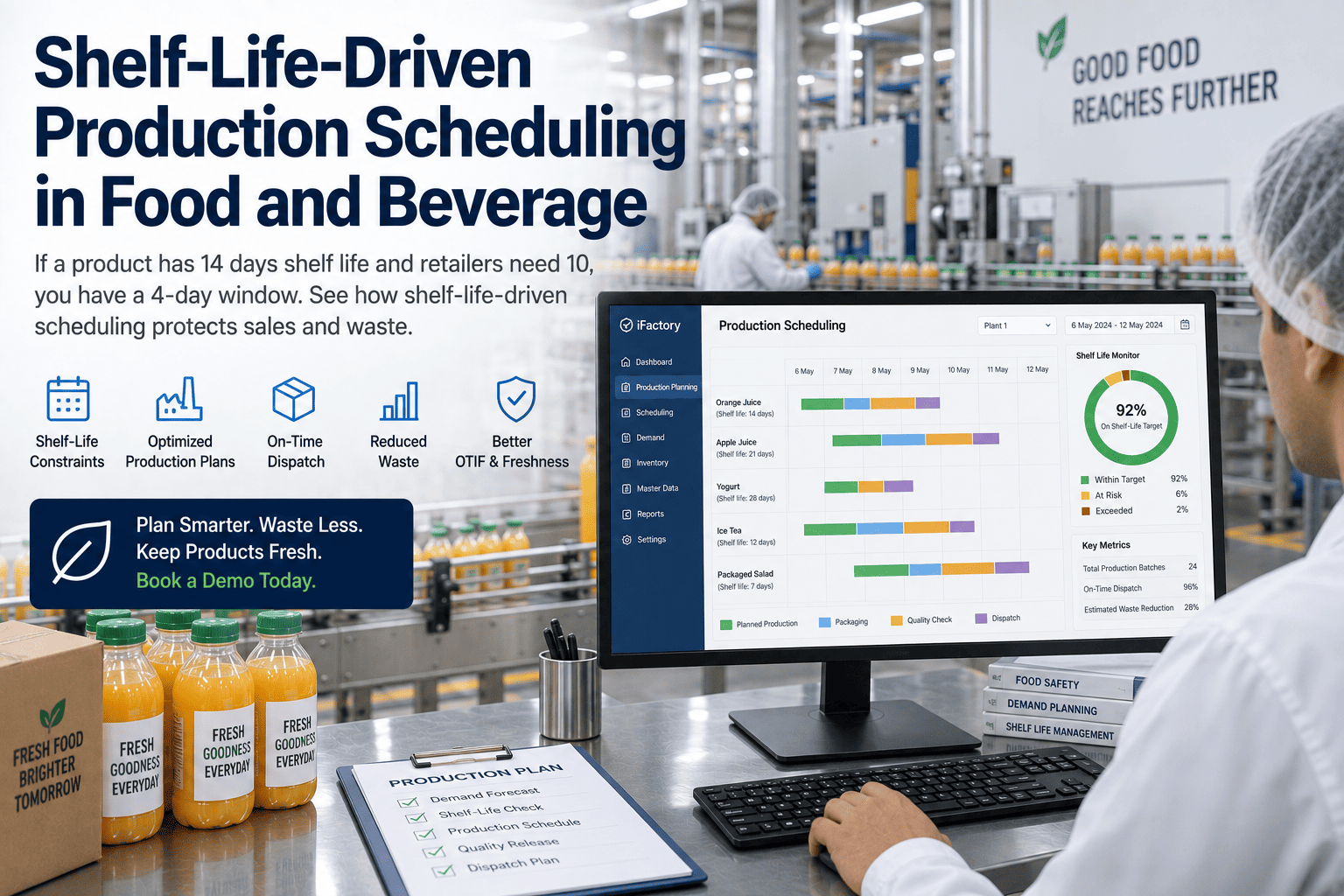
On Monday the schedule says Line 2 runs a nut-free product first, then a nut-containing one, then back again. By Tuesday a late packaging delivery has shifted the order, a rush request has arrived and two batches are closer to their dispatch shelf-life limit than anyone planned. Food and beverage scheduling is hard because the limits are real: shelf life, allergens, cleaning time and demand that swings with the season. A plan that ignores them looks fine on screen and fails on the floor. This guide shows how to schedule food production around those limits, sequence runs to cut changeover and keep the plan feasible when things change. To apply it to your own lines, book a scheduling walkthrough.
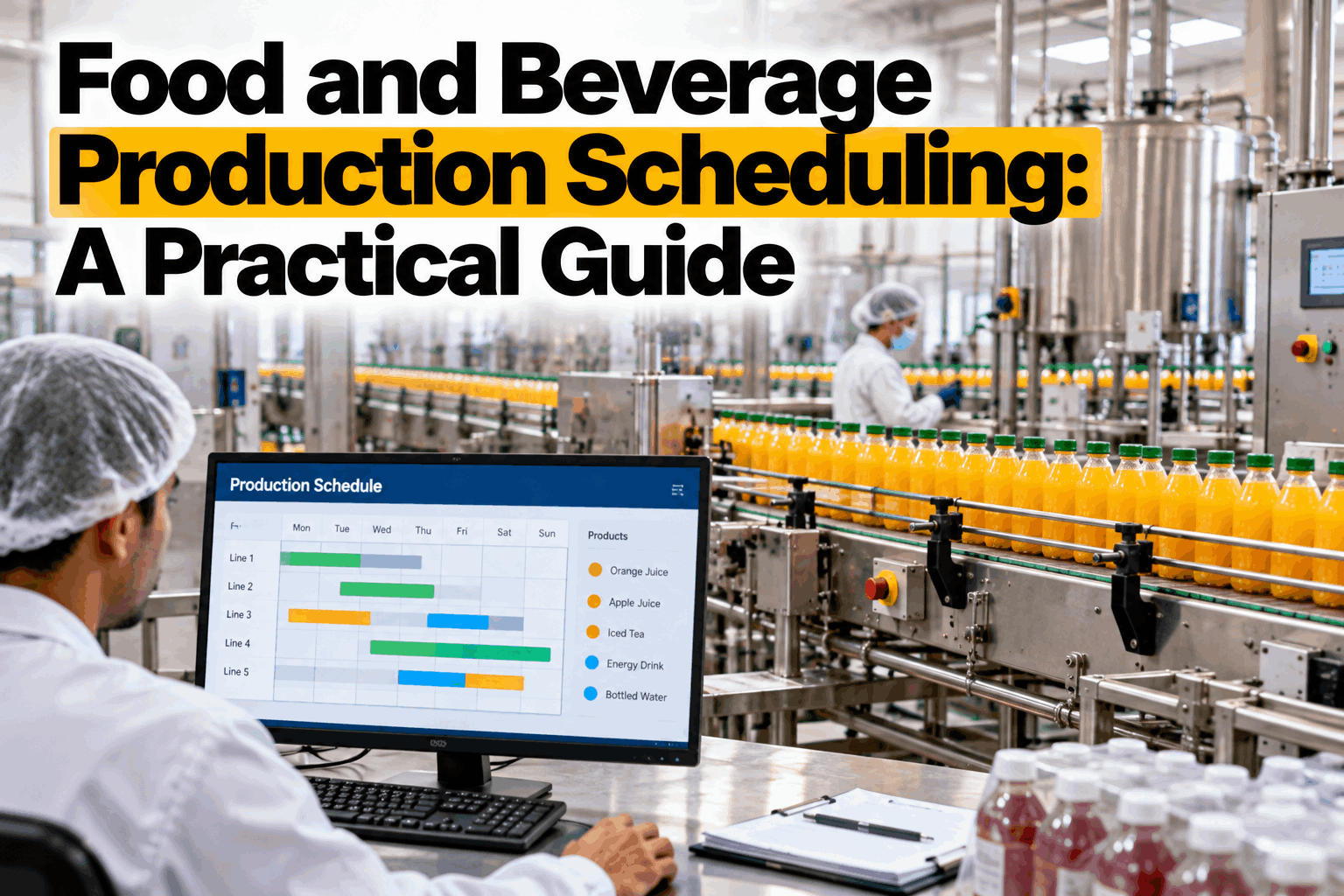
Food and Beverage Production Scheduling: A Practical Guide
A practical guide for planning teams: how to build a schedule that respects shelf life and allergens, sequence runs to cut changeover and re-plan quickly when orders, materials or lines change.
- How to plan around shelf life, allergens and cleaning time
- How to sequence runs to cut changeover hours
- How to keep the plan feasible when something changes
Four causes explain more than 85% of the lost hours, and the top three are planning problems, not machine problems. The dashed line marks where the cumulative share passes 80%.
What Food Production Scheduling Really Is
A schedule decides what to make, in what order and on which line, inside limits that cannot be bent.
Scheduling sits between the demand plan and the shop floor. The demand plan says how much of each product is needed. The schedule turns that into runs on specific lines, with start times, sequence, cleaning steps and material needs. In food and beverage, the sequence is a food safety and quality decision as well as an efficiency one. Our planning team can show how this looks on your own orders and lines.
Start from real orders
Orders, forecast and stock, with dates that matter.
Apply the rules
Shelf life, allergens, cleans and line capacity.
Order the runs
Group products to cut changeover and risk.
Re-plan fast
Update the plan when orders, materials or lines move.
Check feasibility before you try to optimize. A short changeover sequence that breaks an allergen rule or a shelf-life limit is not a better plan, it is an invalid one.
The Limits That Shape the Plan
Each limit needs a rule, not a reminder.
Most food plants carry these limits in the heads of experienced planners. That works until someone is away or the product range grows. Turn each limit into a rule the schedule can check, and the plan stops depending on who built it. To review which rules your plan already enforces, book a planning rules review.
Keep the rules in one place that the whole planning team uses: allergen order, minimum shelf life, cleaning times and line limits. When a rule changes, the schedule changes with it.
Sequence Runs to Cut Changeover
The right order can remove hours without adding a single machine.
Changeover time depends on which product follows which. A good sequence puts similar products together so cleaning is short and, where food safety allows, simple. These rules are common starting points. Your own cleaning validation and product range decide which apply.
The shortest changeover sequence can conflict with shelf life or a customer date. Weigh the rules together, and treat food safety and shelf-life limits as hard limits that changeover savings never override.
What Better Scheduling Is Worth
A few hours of changeover can look small in a weekly plan. Multiplied across a year of production and the value of a line hour, they become a number worth acting on.
From Orders to a Schedule That Holds
A good plan is one the floor can follow and the planner can change quickly.
The first schedule is the easy part. The real test comes when an order moves, a delivery is late or a line stops. A schedule that holds is built from real data, checked against the rules and re-planned in minutes, not rebuilt over an afternoon.
Demand
Orders, forecast and stock in one view.
Check
Materials, capacity and rules confirmed.
Sequence
Runs ordered to cut changeover.
Release
Plan sent to lines with start times.
Track
Actuals compared with the plan.
Re-plan
Plan updated when reality moves.
Common Scheduling Mistakes
Most failed schedules were infeasible from the start.
Scheduling errors are rarely about the sums. They come from planning to an ideal day, treating hard limits as preferences or never updating the plan. A few checks keep the schedule honest.
Good practice
- Plan to finite line capacity and real run rates
- Treat allergen and shelf-life rules as hard limits
- Re-plan as soon as actuals drift from the plan
Common mistakes
- Planning to ideal speeds in a spreadsheet
- Treating an allergen clean as a flexible step
- Freezing the weekly plan despite late materials
Compare the plan with what actually ran, every shift. The gap shows whether the problem is the rules, the run rates or the way the floor works, and tells you what to fix first.
How iFactory Production Scheduling Works
Orders and line data in, a feasible plan out.
iFactory's production scheduling reads orders, stock and line status, then builds a sequence that respects your allergen, shelf-life, cleaning and capacity rules. It shows what-if options when a rush order or a late delivery arrives and updates the plan when a line stops or runs slow. It runs on an on-prem server inside your network, with one view across lines and sites. Questions on fit go to our support desk.
Orders and line data
Orders, stock and line status from your existing systems.
Your rules
Allergen order, shelf life, cleans and capacity.
Feasible plans
Runs ordered to cut changeover within the rules.
What-if and re-plan
Options ready when orders, materials or lines change.
Results depend on your lines, product range and how closely the plan is followed. We measure changeover, plan adherence and shelf-life outcomes on your own data during the pilot, rather than promising a general figure.
Turnkey AI: Delivered, Connected and Live in 6–12 Weeks
You do not build this. It arrives ready.
iFactory ships as a pre-configured NVIDIA AI server with the software pre-loaded. Rack it, plug in power and Ethernet, and the AI is live on your network. Our team handles cabling, network setup, ERP and line system integration, team training and 24×7 remote monitoring. Data stays on your own network. For a scope matched to your plant, request a turnkey quote.
Ship, network and data
Server installed. Orders, stock and line data connected for the pilot lines.
Rules and first schedules
Allergen, shelf-life and cleaning rules modelled. First schedules checked with your planners.
Go-live and training
Scheduling live. Planners trained. 24×7 remote monitoring begins.
Frequently Asked Questions
What is food production scheduling?
It is the process of turning demand into runs on specific lines, with a sequence, start times, cleaning steps and material needs, while respecting shelf life, allergen and capacity limits.
Why is scheduling harder in food and beverage?
Because the limits are fixed by safety and product life. Allergen cleans cannot be skipped, short-dated product cannot wait and demand often swings with the season, so the sequence matters as much as the quantity.
What is APS in food manufacturing?
Advanced planning and scheduling software builds a schedule from orders, capacity and rules, then updates it when something changes. In food it also applies sequencing, cleaning and shelf-life rules.
How should we schedule around allergens?
Treat the allergen order and the validated clean as hard rules. Group products by allergen profile, run allergen-free products first where possible and build the clean time into the plan instead of adding it afterwards.
Is a spreadsheet enough for food plant scheduling?
It can work with a few lines and stable demand. It becomes hard to trust when several limits interact, when rush orders are frequent or when the plan must change within the shift.
How do we start?
With one or two lines that are hardest to plan, usually those with many products or frequent allergen changes. A 6-week pilot connects the data, models your rules and shows the first feasible schedule. To plan it, contact our team.
Build a Schedule That Holds on the Floor
In thirty minutes we look at your lines, your rules and how you build the plan today. You keep the notes whether or not you go further with iFactory.
- 1This week's schedule and what actually ran
- 2Changeover and cleaning times by product pair
- 3Your allergen matrix and shelf-life rules
- 4A year of demand history, with seasonal peaks
- 5The line or product family hardest to plan