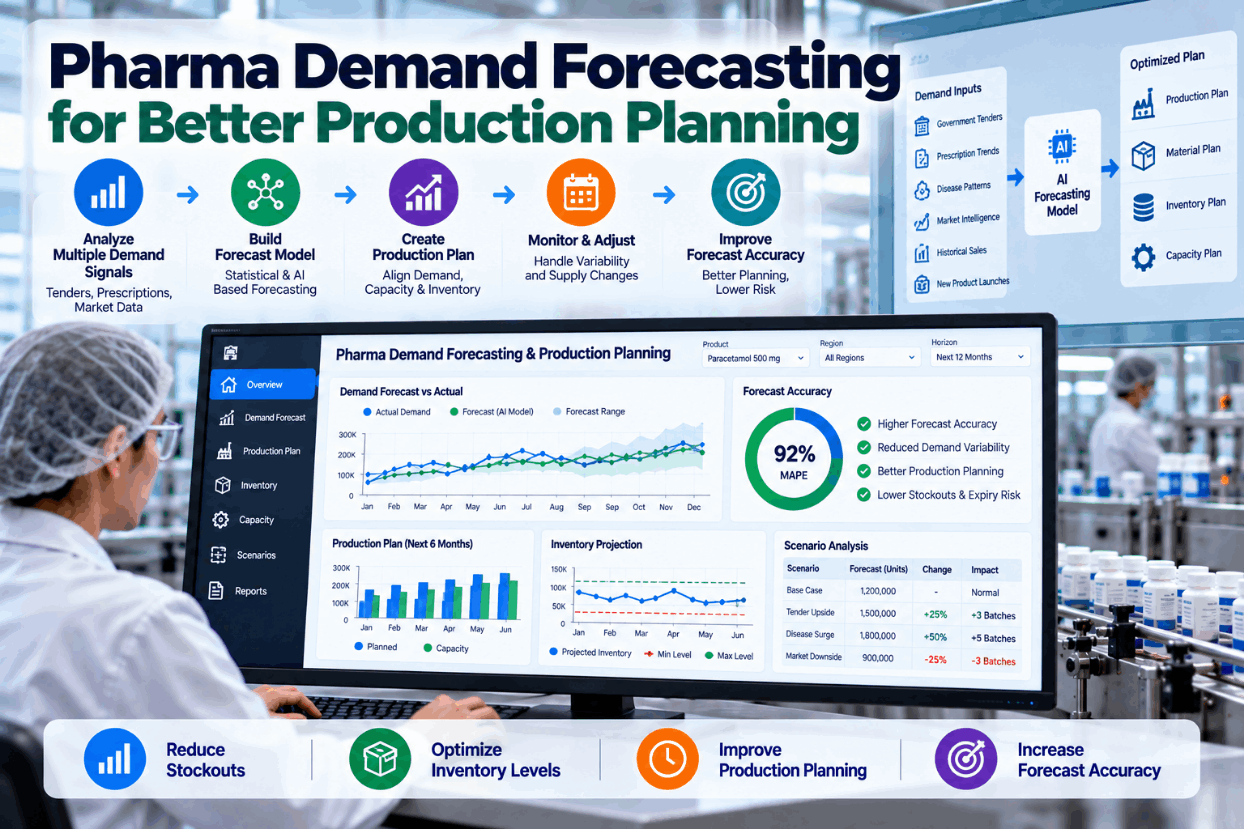
A production planner at a mid-size automotive parts manufacturer spends Monday morning rebuilding the week's schedule — again. A rush order came in Friday afternoon, two machines went down for unplanned maintenance over the weekend, and a raw material shipment is delayed by three days. By the time the new plan is finalized on Tuesday, the floor has already lost 16 hours of productive capacity. This cycle repeats every week in factories worldwide. It is not a planning problem — it is a speed problem. Human planners manage 5 to 10 variables at a time. AI manages thousands — simultaneously, in real time, recalculating optimal schedules in seconds when disruptions hit. Manufacturers using AI-driven production planning are reporting scheduling time reductions of up to 96%, on-time delivery rates above 90% even during disruptions, and double-digit output gains from the same equipment. The planning spreadsheet era is over.
AI-Powered Planning
AI-Driven Production Planning and Scheduling in Industries
Replace static plans with real-time intelligent scheduling — balance demand, capacity, materials, and workforce across every line, every shift, automatically.
96%
Reduction in production scheduling time with AI optimization
40%+
Of manufacturers adopting AI scheduling by 2026
$9.3B
Production planning software market projected by 2035
15%
Additional capacity unlocked from existing equipment
Sources: EasyFlow · IDC Manufacturing FutureScape · Business Research Insights · Deloitte Smart Manufacturing Survey
Why Traditional Production Planning Is Broken
Production planning has always been complex. But today's manufacturing environment has pushed traditional methods past their breaking point. Product mix is expanding, batch sizes are shrinking, supply chains are volatile, and customers demand shorter lead times. Spreadsheets and static MRP runs cannot keep up — and the cost of falling behind is measured in missed deliveries, idle capacity, and lost customers.
01
Manual Replanning Loops
Planners spend 60%+ of their time reacting to disruptions — rebuilding schedules that are already outdated by the time they are distributed to the floor.
02
Siloed Decision-Making
Sales, procurement, maintenance, and production operate from separate data. A rush order enters without visibility into machine health or material availability.
03
Capacity Blindness
Without real-time OEE integration, planners schedule against theoretical capacity — not actual. The result: overcommitted lines, bottlenecks, and missed delivery dates.
04
Changeover Waste
Poor sequencing creates unnecessary changeovers — each one consuming 30 to 90 minutes of productive time. Across a month, this compounds into days of lost output.
05
Demand-Supply Mismatch
Forecast errors cascade into overproduction (tying up working capital) or stockouts (losing revenue and customer trust) — with no real-time correction mechanism.
06
No Disruption Response
When a machine breaks, a supplier is late, or a priority shifts — the schedule collapses. Recovery takes hours or days. AI reschedules in seconds.
How AI Transforms Production Planning and Scheduling
AI does not replace planners — it gives them superpowers. Instead of managing constraints manually, AI ingests live data from every corner of your operation and generates optimized schedules that balance competing objectives simultaneously. When conditions change, the schedule adapts in real time — not next Monday.
The Seven Capabilities That Define AI-Driven Planning
AI scheduling is not a single feature — it is a system of interconnected capabilities that compound in value. Each one solves a specific planning challenge; together, they create a self-optimizing production engine.
Demand-Linked Scheduling
Production schedules build from live sales orders and demand forecasts — not last month's plan. When demand shifts, schedules adjust automatically, keeping production aligned with what customers actually need.
Capacity-Aware Planning
Every machine's available capacity updates in real time from OEE data, maintenance schedules, and sensor health readings. A machine flagged for bearing wear automatically reduces its capacity allocation in the production plan.
Changeover Optimization
AI sequences similar products to minimize transition time, models optimal changeover paths via digital twin, and pre-stages tooling instructions — turning a 90-minute changeover into a 30-minute routine.
Multi-Resource Balancing
AI simultaneously balances machines, operators, materials, tooling, and energy across multiple lines and shifts — finding feasible combinations that no manual process can compute.
Scenario Simulation
Run what-if scenarios in seconds: What happens if a machine goes down? If a rush order arrives? If a supplier delays by 48 hours? AI evaluates thousands of alternatives and recommends the best response.
Predictive Maintenance Integration
Maintenance windows schedule during non-production hours — not when a line is running at full speed. Predictive alerts feed directly into the scheduling engine, so planned interventions never surprise the production plan.
Touchless Forecasting
AI tracks demand signals and makes planning decisions without human input for routine forecasts. One manufacturer reported 96% of demand forecasts requiring zero manual adjustment after AI deployment.
Want to see how AI scheduling handles your specific production constraints? Book a free planning capability demo.
Documented Results from AI Production Planning
These are not projections — they are documented outcomes from real manufacturers who deployed AI-driven scheduling systems. The results span industries from food manufacturing to steel production to automotive assembly.
96%
Scheduling Time Reduction
A global agribusiness manufacturer reduced production scheduling time by 96% and unlocked $1.5 million in additional savings in 16 weeks using AI schedule optimization.
1,000+
Tons Additional Output
A national steel manufacturer increased net production by over 1,000 tons of additional finished goods and achieved $4 million in annual benefits with AI scheduling.
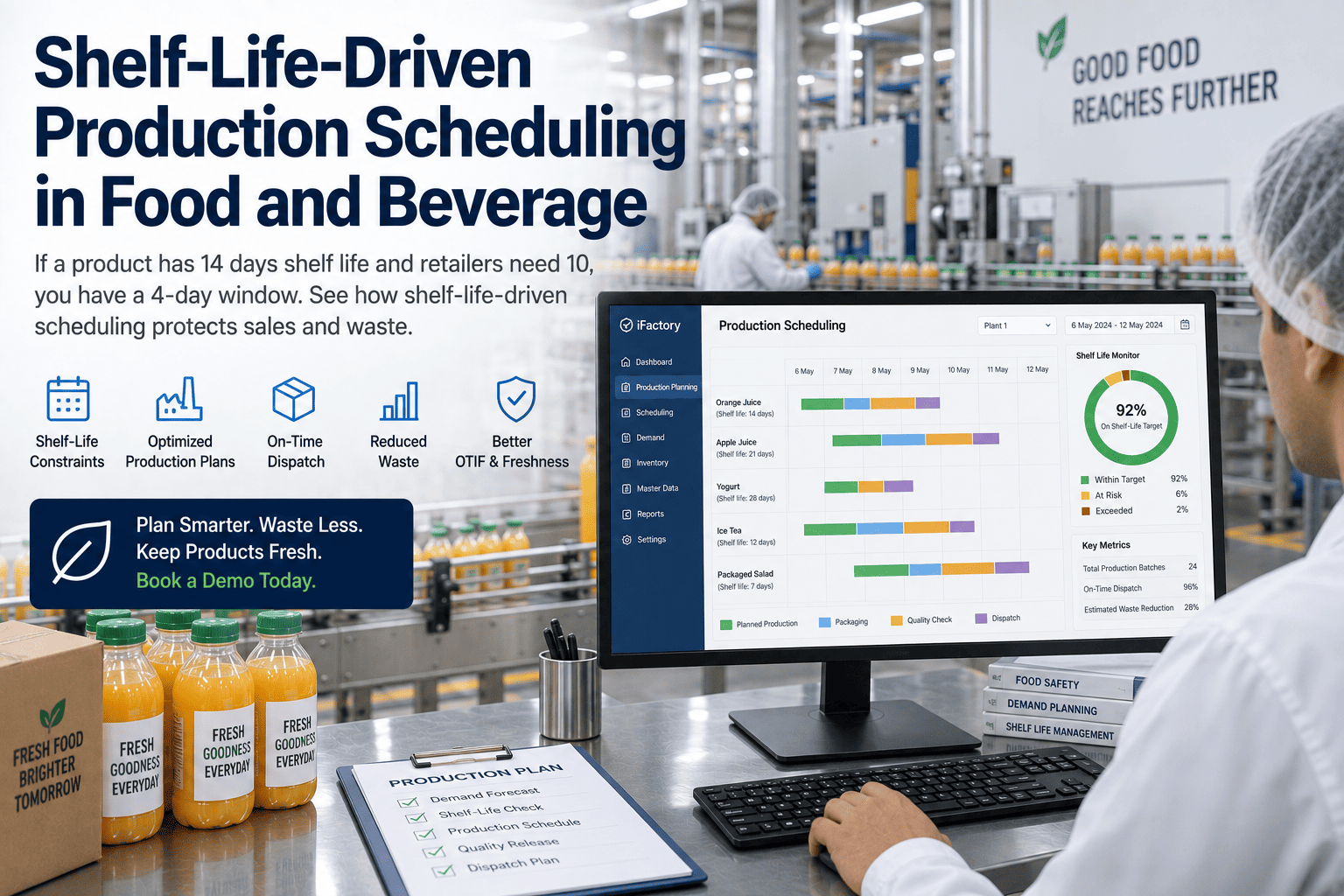
A food manufacturer achieved waste-aware production planning, reducing finished goods waste by 35% while improving production efficiency through optimized changeover sequencing.
Dynamic scheduling adjustments driven by AI maintain on-time delivery above 90% even during supply disruptions or demand spikes — converting unreliable delivery into a competitive advantage.
20-40%
Efficiency Improvement
AI-driven manufacturing systems deliver efficiency improvements of 20-40% by processing vast amounts of data, identifying bottleneck patterns, and optimizing operations in real time.
Companies using AI for production planning reported up to 15% more unlocked capacity — from the same floor space, same workforce, same machines — according to Deloitte's Smart Manufacturing Survey.
Industry Applications
AI scheduling adapts to any manufacturing model — discrete, process, batch, or hybrid. But the specific value it delivers varies by industry because each faces different planning constraints and disruption patterns.
Just-in-time production with multi-model flexible lines demands constant resequencing. AI optimizes assembly order, balances takt time across stations, and reroutes work instantly when a supplier delivery slips — keeping line stoppages near zero.
Perishable inputs, strict batch traceability, and seasonal demand swings create planning chaos. AI sequences production to minimize waste from ingredient expiry, optimizes CIP (clean-in-place) cycles, and adapts to daily demand volatility.
Regulatory batch tracking, cleanroom scheduling, and validation requirements add layers of constraint. AI balances compliance requirements with throughput goals, ensuring every batch is audit-ready while minimizing equipment idle time.
Furnace scheduling, rolling mill sequencing, and cooling cycle optimization require balancing energy costs against delivery commitments. AI optimizes heat sequences to minimize energy per ton while hitting grade specifications.
High product variety, rapid changeovers, and tight yield targets across hundreds of tools. AI matches wafer lots to optimal chambers, sequences processes to minimize contamination risk, and dynamically reallocates capacity across fabs.
Long production cycles, complex BOMs, and strict quality gates at every stage. AI coordinates multi-year program schedules with short-term shop floor execution, ensuring critical path items never stall downstream assembly.
$9.3B
Production planning software market by 2035 at 7.8% CAGR
$155B
AI in manufacturing market projected by 2030 at 35.3% CAGR
28%
Of manufacturers have moved AI past the pilot stage so far
95%
AI model accuracy reduction in man-hours for scheduling setup
How iFactory Deploys AI Production Scheduling
iFactory layers AI scheduling intelligence on top of your existing ERP, MES, and CMMS — connecting the data you already collect into a unified planning engine that optimizes production in real time.
Week 1–2
System Integration & Data Mapping
Connect iFactory to your ERP (SAP, Oracle, etc.), MES, CMMS, and IoT sensor infrastructure via standard APIs. Map production routes, BOMs, machine constraints, labor rules, and changeover matrices. Zero disruption to running operations.
Week 3–4
Baseline Learning & Constraint Calibration
AI learns your facility's actual production rates, changeover durations, yield patterns, and demand cycles. ML models build constraint maps specific to your equipment and products — not generic industry averages.
Week 5–6
AI Scheduling Activation
Activate AI-generated production schedules. Planners review and approve AI recommendations via dashboard — maintaining human oversight while eliminating manual replanning loops. Disruption response runs in real time.
Week 7–8
ROI Measurement & Scaling
Quantify on-time delivery improvement, changeover reduction, throughput gains, and planning time savings. Present board-ready ROI analysis. Decide which additional facilities or product families to bring online next.
Ready to replace reactive planning with predictive scheduling? Schedule your free planning assessment.
Frequently Asked Questions
What is AI-driven production planning and scheduling?
AI-driven production planning uses machine learning and optimization algorithms to generate, adjust, and improve production schedules in real time. Unlike static MRP runs that update weekly, AI ingests live data from ERP, MES, sensors, and demand signals to continuously rebalance machine loads, labor, materials, and delivery commitments — managing thousands of constraints simultaneously.
Book a demo to see it in action.
How much can AI reduce production scheduling time?
Documented results show reductions of up to 96% in scheduling time. A global food manufacturer cut scheduling from days to minutes while unlocking $1.5 million in savings within 16 weeks. The time saved frees planners to focus on strategic decisions rather than constant firefighting.
Does AI scheduling work with our existing ERP and MES systems?
Yes. iFactory integrates with SAP, Oracle, Microsoft Dynamics, and other ERP/MES platforms via standard REST API, OPC-UA, and MQTT connections. AI scheduling layers on top of your existing infrastructure — it does not replace your ERP. Your teams continue using familiar tools while AI adds the intelligence layer.
How does AI handle unexpected disruptions like machine breakdowns?
When a disruption occurs — machine failure, material delay, rush order, or workforce absence — AI recalculates the optimal schedule in seconds. Jobs reroute automatically across available machines, priorities rebalance, and affected teams receive instant alerts. Manufacturers using dynamic AI scheduling maintain on-time delivery above 90% even during disruptions.
Schedule a demo to see disruption response in action.
What ROI can we expect and how fast?
Most manufacturers see measurable gains within the first 3 to 6 months: improved on-time delivery, reduced changeover time, increased throughput, and planning time savings. Deloitte reports double-digit output gains and up to 15% more unlocked capacity from the same equipment. A steel manufacturer achieved $4 million in annual benefits with AI scheduling.
Your Plan Is Already Obsolete. Your Schedule Doesn't Have to Be.
Turn Every Disruption Into a Rescheduling Opportunity — Not a Crisis
iFactory connects to your ERP, MES, and CMMS to deliver real-time AI scheduling that balances demand, capacity, materials, and maintenance — so your production plan stays optimized even when everything changes.
Seconds
To recalculate optimal schedule after any disruption
8 Weeks
From integration to measurable scheduling ROI
96%
Scheduling time reduction documented by manufacturers
Zero
ERP replacement required — layers on top of existing systems