For most of the last decade, smart manufacturing was a conference panel. In 2026 it becomes a survival requirement. Global AI-in-manufacturing spend is tracking from $33.48 billion in 2024 to a projected $366.24 billion by 2032 — a 36% compound annual growth rate that dwarfs almost every other enterprise technology market. And yet the same Redwood Software survey that found 98% of manufacturers now exploring AI also found that only 20% are fully prepared to deploy it. That 78-point gap is the defining story of this year. The factories closing it are unlocking productivity gains of 20–30%, cutting machine downtime by up to 50%, and reclaiming 25% on energy costs — according to McKinsey, Deloitte, and the World Economic Forum's Global Lighthouse Network. The ones that don't are falling behind at a rate that compounds quarterly. This report walks through the six forces actually driving industrial transformation in 2026 — what they are, why they matter, and what separates the plants capturing the upside from the ones watching it go by.
2026 Industry Outlook · Thought Leadership
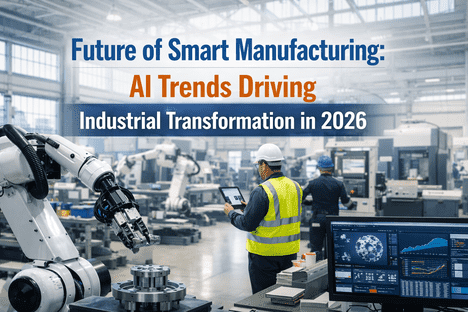
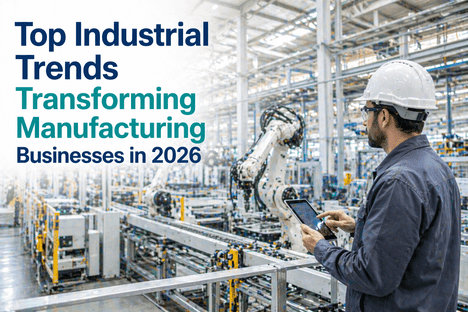
The Future of Smart Manufacturing — Six Forces Rewriting the Factory Floor in 2026
From agentic AI and generative design to the silver tsunami and Equipment-as-a-Service — a clear-eyed look at the trends separating the plants capturing this transformation from those losing ground.
$366B
Projected AI in manufacturing market size by 2032
36% CAGR
Annual growth rate from 2026 to 2032 globally
98% vs 20%
Exploring AI vs fully prepared to deploy it
20–30%
Productivity gains from smart factory adoption — McKinsey
Sources: Verified Market Research 2026 · Redwood Software Manufacturing Outlook · McKinsey · Deloitte Industry 4.0 · WEF Global Lighthouse Network · A3 Association · NAM Manufacturing Trends 2026
The Market Is Not Growing. It's Compounding.
The AI-in-manufacturing market is one of the fastest-expanding enterprise technology categories in the world. Verified Market Research tracks it from $33.48 billion in 2024 to a projected $366.24 billion by 2032 — a tenfold expansion driven by Industry 4.0 adoption, smart factory deployments, and the accelerating shift from manual to autonomous operations.
Global AI in Manufacturing Market · 36.12% CAGR · 10x expansion in 8 years
Six Forces Defining Industrial Transformation
These are the trends that will separate 2026's winners from everyone else. They are not speculative. Every one of them is already active across leading factories today — the only question is which side of the adoption curve your plant lands on.
01
Agentic AI
From AI Assistant to AI Agent
Systems that once recommended now act. AI agents autonomously adjust equipment parameters, create work orders, and re-sequence schedules without waiting for human sign-off.
4x growth in agentic system use predicted by 2027
02
Predictive Everything
Prediction Moves from Luxury to Default
Predictive maintenance is no longer a showcase deployment. It is the minimum bar — driving OEE gains of 5–10% and cutting unplanned downtime by 30–50% at mature adopters.
30–50% downtime reduction at scale
03
Digital Twins
Virtual Factories Running in Parallel
Real-time digital twins simulate every production decision before it happens. Changeover resequencing, speed adjustments, and capacity plans all tested virtually first.
WEF Lighthouse plants report 20–30% productivity gains
04
Industry 5.0
Human-Machine Collaboration Goes Mainstream
The pivot from machine-centric automation back toward augmenting human expertise. Cobots, wearables, and AI-guided workflows turn novice technicians into expert-level operators.
20–50% productivity gain on routine diagnostics
05
Generative Design
AI Designs the Products Now
Feed in specifications, performance targets, and cost constraints — get an optimized design in hours. Moves from prototype to production use across multiple industries in 2026.
Moving from pilot to production at scale this year
06
Equipment-as-a-Service
Buyers Pay for Uptime, Not Assets
Industrial buyers shift from purchasing equipment to paying for guaranteed performance. Manufacturers using EaaS capture profit margins 2x higher than traditional sales.
80% of manufacturers now allocating 20%+ budget to smart tools
The 98-to-20 Gap — The Defining Story of 2026
The Redwood Software 2026 outlook surveyed 300 manufacturing professionals and uncovered the sharpest adoption gap in industrial technology history. Nearly every manufacturer is now exploring AI. Only one in five is actually ready to deploy it. The gap between the two numbers is where the next five years of competitive advantage will be won or lost.
98%
Exploring AI
Running pilots, evaluating vendors, sitting in steering committees, commissioning proof-of-concepts.
The Gap
78 pts
Where competitive advantage is being made and lost in 2026
20%
Fully Prepared
Data foundations in place, integration built, workforce trained, ROI validated on first deployments.
Not sure where your plant sits on the readiness curve? Book a free readiness assessment.
The Three Eras of Factory AI
Most plants are living in the wrong era. The transition from AI-as-assistant to AI-as-agent to fully autonomous operations is not a gradual slope — it is three step changes, each with a radically different operating model. Knowing which era your factory is actually in determines the next move.
Era 1 · Assistant
2020–2024
AI Answers Questions
Chatbots, dashboards, analytics tools. Humans ask, AI responds. Every action still requires human approval and execution.
"What caused yesterday's downtime?"
Era 2 · Agent
2025–2028
AI Solves Problems
Agents take multi-step actions. Auto-generate work orders, trigger maintenance, resequence shifts. Humans supervise outcomes, not steps.
"Reschedule all bearing PMs before Thursday."
Era 3 · Autonomous
2028+
AI Runs Operations
End-to-end autonomous manufacturing. AI senses, responds, and optimizes across plants with minimal human intervention. Humans set strategy only.
Plant-wide optimization 24/7, self-correcting.
What's In, What's Out for 2026
The A3 industry survey tracks where manufacturer investment priorities are actually shifting year over year — not speculation, but where budget is being reallocated right now. The movements in 2026 are some of the sharpest on record.
Rising Priorities
Investment gaining momentum
Large Language Models
16% to 35%
Agentic AI Systems
4x by 2027
Humanoid Robots
13% interest
Collaborative Robots
Packaging leads
Equipment-as-a-Service
2x margins
Generative Design
Pilot to production
Stabilizing Priorities
Already mainstream, growth leveling
AI Machine Vision
41% priority
Predictive Maintenance
Baseline
IoT Sensor Deployment
Commodity
Real-Time OEE Dashboards
Minimum bar
Cloud Analytics Platforms
Default
MES / ERP Modernization
Ongoing
Fading Approaches
Losing ground or being displaced
Manual OEE Tracking
Obsolete
Paper Shift Logs
Being retired
Calendar-Based PM
Replaced by CBM
Siloed System Architectures
Losing favor
Wait-and-See Strategy
Riskier than ever
On-Premise Heavy MES
Cloud-first winning
The Workforce Shift Nobody Can Outrun
The silver tsunami is not coming — it has arrived. Manufacturing faces a structural shortage of nearly 4 million jobs, with decades of operational expertise walking out the door as seasoned experts retire. The plants navigating this best are using AI not to replace workers, but to turn novice technicians into expert-level operators through AI-guided workflows and institutional-memory capture.
4M
Projected US manufacturing jobs shortage
425K
Current unfilled labor gap in 2026
20–50%
Productivity gain from AI-augmented technicians
86%
Employers view AI as dominant transformation driver
See how iFactory captures and scales expert operational knowledge automatically. Book a 30-minute demo.
What This Means for Plants Deciding Now
The strategic implication of 2026 is simple: doing nothing is the most expensive option on the table. The wait-and-see approach that worked in 2018 and survived 2021 does not survive this cycle. Here is what the plants closing the 98-to-20 gap are doing differently — and what the rest need to decide in the next 12 months.
01
Start With Data Foundation, Not Tools
AI readiness starts with clean, connected machine data. Plants succeeding in 2026 invested in connectivity in 2024 — everyone else is playing catch-up on plumbing while paying for analytics.
02
Treat AI as a Workforce Strategy, Not a Tech Strategy
The winning framing is not "how do we deploy AI" but "how do we scale our best operators using AI." Institutional memory capture and AI-guided workflows solve the silver tsunami problem directly.
03
Prioritize Agentic Over Analytic Platforms
Dashboards are table stakes now. The 2026 differentiator is platforms that act, not just report. Agentic AI closes the loop from signal to action without human routing.
04
Measure Uptime, Not Output
Industrial buyers are shifting from purchasing assets to paying for performance. Plants still optimizing for units produced are building for a business model that is quietly being retired.
05
Deploy Small, Scale Relentlessly
The plants gaining the most run 2–3 month tight-scope deployments that prove ROI on one line, then scale aggressively across every line and site within 18 months.
Where iFactory Fits In All This
Every trend in this report intersects with real-time production intelligence. Predictive maintenance needs live OEE data. Agentic AI needs a platform to act on. Digital twins need actual production history to simulate against. Workforce scaling needs captured expert behavior. iFactory sits at the foundation layer that makes every other 2026 trend executable on your specific plant.
Agentic AI
Auto-generates work orders from anomaly detection with zero manual routing
Predictive Maintenance
Failure forecasts 48–72 hrs ahead from fused condition signals
Digital Twins
Live production history feeds simulation models continuously
Industry 5.0
AI-guided prompts turn novice operators into expert-level responders
Generative Design
Real production performance data feeds back to R&D teams
Equipment-as-a-Service
Uptime metrics and cost-to-serve tracked contract-by-contract
Frequently Asked Questions
What are the most important smart manufacturing trends to watch in 2026?
Six forces dominate 2026: agentic AI (moving from assistant to action), predictive-everything becoming the default, real-time digital twins, the shift to Industry 5.0 human-machine collaboration, generative design reaching production use, and Equipment-as-a-Service business models displacing traditional equipment sales.
Book a strategy session to map these to your plant.
How big is the AI in manufacturing market, and how fast is it growing?
Verified Market Research tracks the AI in manufacturing market from $33.48 billion in 2024 to a projected $366.24 billion by 2032, representing a 36.12% compound annual growth rate. That makes it one of the fastest-expanding enterprise technology segments in the world, driven by Industry 4.0 adoption, smart factory deployment, and workforce-shortage pressure.
What is the difference between Industry 4.0 and Industry 5.0?
Industry 4.0 focused on machine intelligence — automation, IoT, and data-driven decision-making. Industry 5.0 reframes innovation around human work, emphasizing human-machine collaboration, cobots, wearables, AI-guided workflows, and sustainable use of technology. Most plants in 2026 operate across both frameworks simultaneously.
What is agentic AI and why does it matter for manufacturers?
Agentic AI refers to systems that take autonomous multi-step action rather than just providing analysis or recommendations. In manufacturing, an agent detects an anomaly, creates the work order, reserves parts, alerts the technician, and logs the outcome — all without human routing. Predictions suggest agentic system use will quadruple in manufacturing by 2027.
Ask support about iFactory's agentic capabilities.
Why is the 98% vs 20% adoption gap so significant?
The Redwood Software 2026 survey found 98% of manufacturers are exploring AI but only 20% are fully prepared to deploy it. That 78-point gap represents the competitive window of 2026 — plants closing it gain productivity advantages of 20–30% and downtime reductions of up to 50% per McKinsey, while plants stuck in exploration mode fall behind at a compounding rate.
How do manufacturers actually start the smart transformation without massive risk?
The successful pattern is a tight-scope 60–90 day deployment on one production line — proving real OEE and downtime improvements before scaling. Plants that run these controlled pilots typically see ROI validation within 90 days and full plant rollout within 12–18 months. The failure pattern is trying to transform everything at once without validated wins.
The Future Is Not Coming. It's Here.
Don't Be the Plant Explaining in 2028 Why You Waited Until 2027.
Book a 30-minute strategy session with an iFactory transformation specialist. We will map your plant against the 2026 readiness framework, identify your highest-leverage first move, and show you exactly where the competitive advantage is available right now.
6 Forces
Driving industrial transformation in 2026
3 Eras
From AI assistant to autonomous operations
10x
Market expansion between 2024 and 2032
78 pts
Adoption gap between exploring and ready