In a busy mixing room, the batch record is often the last thing anyone thinks about. Operators have sticky hands, gloves on and three ingredients to add before the next temperature check, so weights and lot numbers get written later from memory. When QA reviews the record, half the questions are about handwriting. Voice batch records let operators speak each addition as it happens. The AI checks it against the recipe, flags variances and builds a complete, timestamped record ready for QA release. Plan yours in a batch record review.
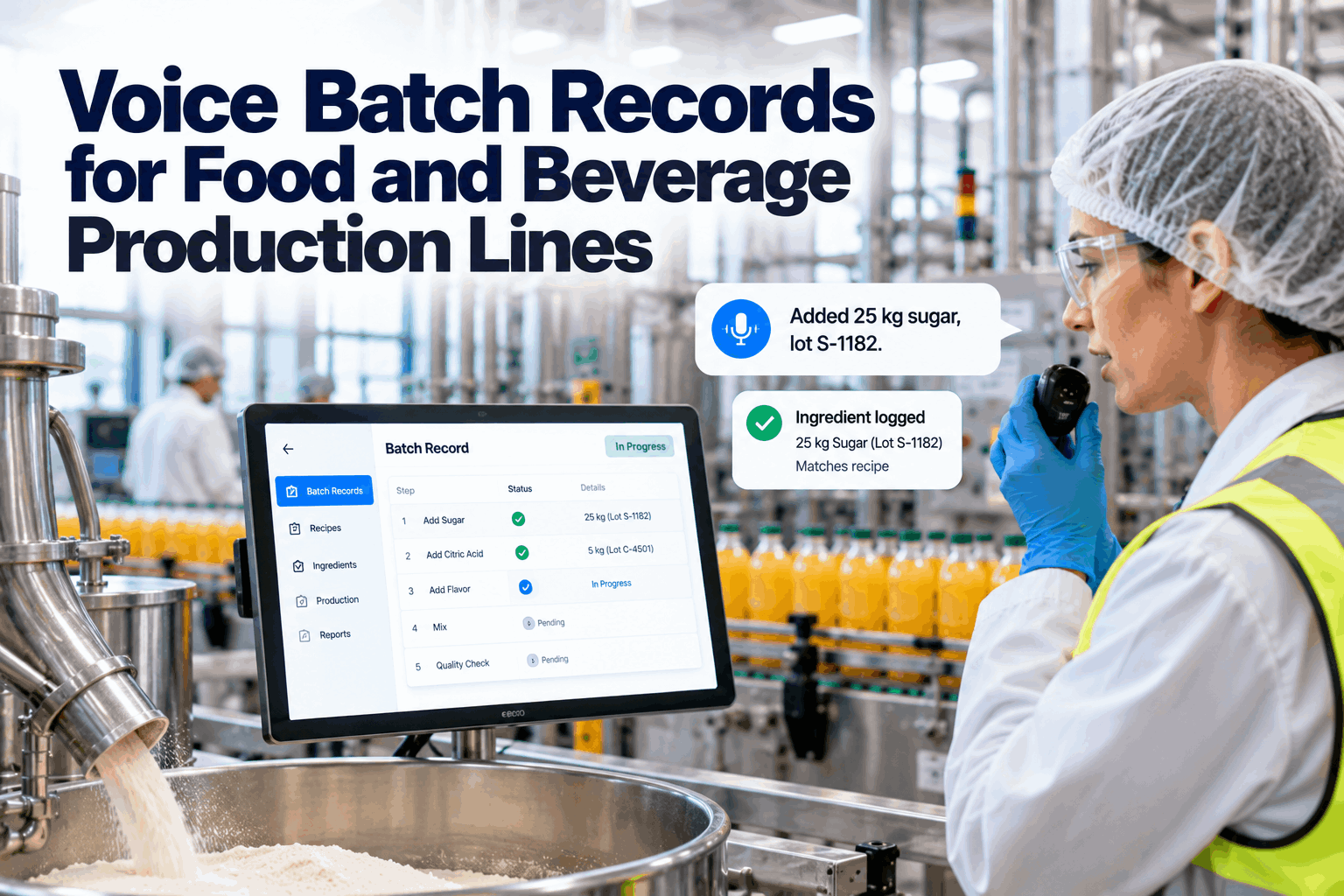
Voice Batch Records for Food and Beverage Production Lines
Operators say what they added, how much and from which lot. The AI checks it against the recipe on the spot and builds the electronic batch record as the batch is made.
- Why paper batch records slow release
- How voice entries are checked against the recipe
- Records that meet FDA record rules and speed QA review
Why Paper Batch Records Slow Release
Records written after the fact are slow to check and easy to question.
FDA's preventive controls rule sets clear expectations for records in 21 CFR 117.305. Records must contain the actual values and observations obtained, be accurate, indelible and legible, be made at the same time as the activity they document, and be as detailed as necessary to show the history of the work. Paper batch sheets filled in at the end of a step, or at the end of the shift, struggle to meet that standard in practice, and QA ends up chasing missing weights and unclear lot numbers before a batch can be released. Our QA specialists can review your current batch sheets.
Written later
Values filled in from memory or scale tickets.
Hard to read
Wet, smudged or rushed handwriting.
Errors found late
Wrong weights spotted at QA review, not at the tank.
Slow release
Batches wait while QA chases answers.
How Voice Batch Records Work
Speak it, check it, record it, before the next step.
The operator wears a headset or carries a rugged handheld. At each step, they say what they added, how much and the lot number. The AI turns the speech into structured data, checks it against the recipe and the material's specification, and reads back a confirmation. If something is wrong, the operator hears it straight away, while the batch can still be corrected. That is the real change from paper: errors are caught at the tank, in seconds, instead of at QA review hours or days later when the batch has already moved on. See it in a live demo.
Speak
"Added 25 kg sugar, lot S-1182."
Parse
Ingredient, weight, unit and lot extracted.
Check
Against recipe, tolerance and approved lots.
Confirm
Read back to the operator, or flagged.
Record
Stored with time, operator and source.
Where a connected scale is used, the weight should come from the scale, not from the operator's voice. The operator then only needs to confirm the ingredient and lot. The record notes which values came from instruments and which were spoken, so QA knows how each was captured.
What Gets Checked at Every Step
The recipe becomes a live checklist, not a sheet on the wall.
Each spoken entry is compared with the master recipe and with the rules around it. The grid below shows the checks most food and beverage plants use. Set your rules with our implementation team.
Lot Capture and Traceability
Every ingredient lot linked to every finished lot, as the batch is made.
Lot numbers are where paper records most often fail, and where traceability depends on them most. A single misread digit can break the chain between a supplier recall and the finished products it affects. Voice capture records the lot at the moment of addition and checks it against stock that has been received and released. The batch record then links each ingredient lot to the finished product lot, which is the information needed for a fast recall or for transformation records under the FDA's food traceability rule. Ask our traceability team how records link to your ERP.
Captured at each addition
- Ingredient and supplier lot
- Quantity and unit
- Time and operator
- Equipment or tank used
Available instantly afterwards
- Every finished lot that used a given ingredient lot
- Every ingredient lot in a given finished lot
- Full batch history for an audit
- Quantities used against quantities received
Batch Records Built as the Batch Is Made
Hands-free entries, live recipe checks and complete records ready for QA, without transcription at the end of the shift.
Handling Variances on the Floor
The AI flags. People decide.
When an entry is out of tolerance, the operator hears it immediately and the supervisor is notified. The supervisor decides whether to adjust, hold or continue, and that decision is recorded with the reason. The AI never approves a deviation on its own. Over time, the variance log also shows which ingredients, recipes or shifts produce the most corrections, which is often a sign that a recipe tolerance, a scale or a training step needs attention. Talk through variance rules with our QA team.
Faster QA Review and Release
Review by exception, sign by name.
Because every entry is checked as it is made, QA no longer needs to read every line hunting for problems, and the questions that used to go back to the floor about handwriting or missing lots largely disappear. The record shows a summary of variances, corrections, held lots and out-of-limit readings, so the reviewer can focus on what changed. Release is always a named QA decision with an electronic signature. Records and signatures used for FDA requirements fall under 21 CFR Part 11, so access control, audit trails and signature rules are set up with your QA team. Plan review rules in a QA workshop.
Quick review
No variances, all checks passed. QA confirms and signs.
Focused review
QA reviews each flagged item and the decision taken.
Held
Unresolved deviations keep the batch on hold until closed.
How Voice Records Support 21 CFR 117.305
Each records requirement, matched to how voice capture handles it.
The grid below sets the general records requirements of 21 CFR 117.305 beside the way a voice batch record addresses each one. It is a guide for discussion with your QA and regulatory teams, not legal advice. Review it with our compliance team.
Getting Operators on Board
Voice only works if people find it easier than paper.
Operators adopt voice quickly when it saves them effort and slowly when it feels like surveillance. Start with the people who fill in the batch sheets today, let them help word the prompts and keep the commands short and natural. Plan training in a rollout call.
What helps
- Short, natural phrases operators already use
- Instant read-back so they trust the entry
- A quick way to correct a misheard word
- Champions on each shift
What gets in the way
- Long, formal command words
- No feedback after speaking
- Headsets that hurt to wear all shift
- Rollout without operator input
Voice in a Real Mixing Room
Built for noise, gloves and washdown.
Mixing and batching rooms are noisy, wet and busy. The right hardware matters as much as the software. Noise-cancelling headsets or push-to-talk handhelds rated for washdown are tested in your rooms during the pilot. Ask our hardware team about options.
Noise-cancelling headsets
Clear capture beside mixers and pumps.
Washdown-rated devices
Made for wet, sanitised areas.
Multiple languages
Operators speak in the language they work in.
Screen fallback
Entries can be typed if voice is not practical.
Voice Batch Record Mistakes to Avoid
Going paperless is not the same as getting better records.
These are the common problems when plants move batch records from paper to voice or screens. A short readiness review can spot them.
What works
- Master recipes cleaned before go-live
- Scale values captured directly
- Lots checked against released stock
- Release always signed by QA
What fails
- Copying old paper errors into the system
- Allowing entries after the step is done
- No supervisor path for variances
- Skipping hardware tests in real rooms
How iFactory Runs Voice Batch Records
Voice Batch Agent, on your own network.
iFactory's Voice Batch Agent captures spoken ingredient additions, weights and lot numbers, checks them against the recipe, flags variances and builds the electronic batch record for QA release. It runs on an on-prem AI server inside your plant and connects to scales, ERP and quality systems. Fit questions go to our solutions team.
Voice capture
Ingredient, amount and lot spoken hands-free.
Recipe checks
Every entry checked against spec and tolerance.
Lot control
Only received and released lots accepted.
Variance alerts
Supervisor notified before the next step.
Electronic batch record
Complete and timestamped for review.
QA release
Named sign-off for every batch.
iFactory supports your batch record and release procedures. QA keeps responsibility for review and release decisions.
Turnkey AI: Delivered, Connected and Live in 6–12 Weeks
You do not build this. It arrives ready.
iFactory ships as a pre-configured NVIDIA AI server with the software pre-loaded, racked and ready. Rack it, plug in power and Ethernet, and the AI is live on your network. Our team handles cabling, network setup, PLC, SCADA, DCS and CMMS integration, scale, ERP and QA links, operator training and 24×7 remote monitoring. Data stays on your network. For a scope matched to your plant, request a turnkey quote.
Ship, network and data
Server installed. Recipes, scales, stock and QA systems connected. Headsets tested.
Model training and pilot
Recipe checks and variance rules tuned. Voice records run beside paper in one room.
Go-live and training
Voice batch records live. Operators and QA trained. 24×7 monitoring begins.
Frequently Asked Questions
What are voice batch records?
Electronic batch records built from operators' spoken entries, such as ingredient, weight and lot number, checked against the recipe and stored with time and operator as each step is done.
Do voice records meet FDA record requirements?
They are designed to support 21 CFR 117.305, which requires records with actual values, made at the time of the activity, accurate, indelible and legible. Your QA team confirms how they fit your records program.
What happens if an amount is wrong?
The operator hears an alert straight away and the supervisor is notified. The supervisor decides what to do, and the decision is recorded.
Can it read weights from our scales?
Yes. Connected scales send weights directly, and the operator confirms the ingredient and lot by voice.
How are lot numbers checked?
Against stock that has been received and released. Lots on hold or not in stock are rejected.
What if the system mishears an entry?
Every entry is read back to the operator. If something is wrong, the operator says so and repeats it, and the correction is kept in the audit trail with the original entry.
Who releases the batch?
Always a named QA reviewer with an electronic signature. The AI prepares the record but never releases product.
Will voice work in a noisy batching room?
Yes, with noise-cancelling headsets or push-to-talk handhelds, tested in your rooms during the pilot.
How do we start?
Start with one mixing room and a few high-volume recipes. A 6-week pilot connects recipes, scales and stock, and runs voice records beside paper. To plan it, contact our team.
Release Batches Faster With Records You Trust
In thirty minutes we walk through one of your batch sheets and show how it would run as a voice batch record. You keep the notes either way.
- 1A completed paper batch sheet
- 2The matching master recipe
- 3Your batch release procedure
- 4Scale and ERP systems in use
- 5One batch that was slow to release