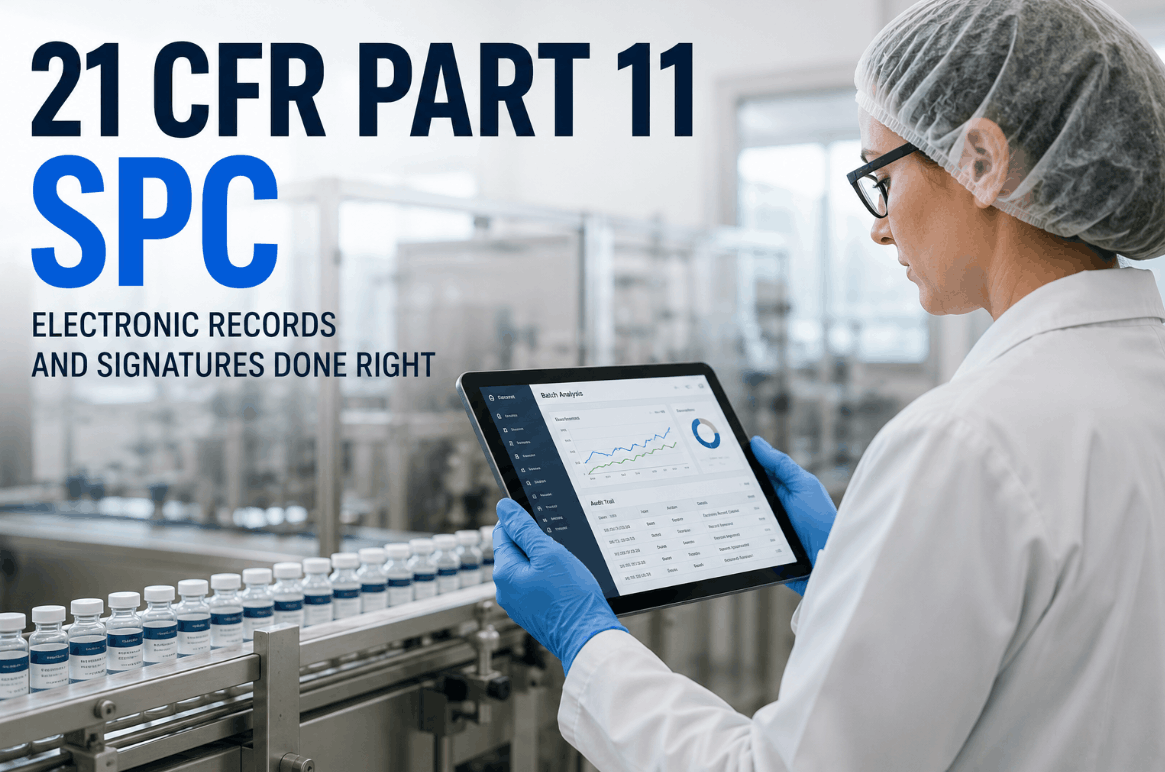
FDA inspections do not fail because a pharmaceutical manufacturer lacks a quality system. They fail because the electronic records that quality system generates cannot be demonstrated as trustworthy, authentic, and unaltered during a live inspection. Under 21 CFR Part 11, every electronic record created, modified, maintained, or transmitted under an FDA predicate rule — batch production records, in-process SPC data, deviation approvals, equipment calibration logs — must meet specific criteria for validation, audit trail integrity, electronic signature controls, and role-based access before the FDA will treat those records as equivalent to paper. In FY 2023, approximately 31% of FDA inspections ended with Voluntary or Official Action Indicated findings, the majority driven by documentation gaps: missing audit trails, improperly verified electronic signatures, and SPC data that could not be traced from the control chart back to the specific batch and operator. iFactory's 21 CFR Part 11 validated mode closes exactly that compliance gap — delivering an SPC platform where every process measurement, every control chart record, and every approval action is captured in an immutable, time-stamped audit trail with two-factor electronic signatures and role-based access controls designed from the ground up for FDA inspection. Pharma compliance officers who have deployed iFactory's Part 11 validated SPC platform report passing FDA inspection with zero Part 11 observations and cutting audit preparation time by 61% within the first year of operation.
The Pharma SPC Platform Built for FDA Inspection — Not Retrofitted for It
iFactory's 21 CFR Part 11 validated mode delivers immutable audit trail, two-factor e-signatures, role-based access, and lot-linked SPC records — the complete evidence chain FDA investigators require at every inspection.
What 21 CFR Part 11 Actually Requires from an SPC Platform — and Where Most Systems Fall Short
21 CFR Part 11 establishes four technical pillars that any electronic system managing regulated pharmaceutical records must satisfy: system validation, immutable audit trails, electronic signature controls, and access security. For an SPC platform specifically, these requirements are not abstract compliance checkboxes — they define precisely what your in-process quality data must demonstrate during an FDA inspection. An SPC system that records Cpk values, Western Electric Rule violations, and out-of-specification events but does not capture who acknowledged each alert, what action was taken, and whether that record has been altered since creation is not a Part 11-compliant system. It is a liability.
The most common FDA Form 483 observations in pharma manufacturing environments involve exactly this failure mode: SPC and process monitoring data that was collected but not governed. Control charts accessible to multiple users under shared credentials. Audit trails that record data entry but not data modifications. Electronic signatures that are a typed name rather than a two-factor authentication event. iFactory's Part 11 validated mode was designed against these specific inspection failure modes — not as a retrofit of a general-purpose SPC tool, but as a validated platform built for pharmaceutical manufacturing from the architecture level. When your compliance team needs to Book a Demo, the platform demonstration walks through every Part 11 requirement against live system evidence — the same way an FDA investigator would.
System Validation
iFactory's Part 11 validated mode ships with IQ/OQ/PQ documentation support, validation protocols, and a Software Development Life Cycle package suitable for a pharma quality system. The platform is built and tested to demonstrate that it produces accurate, reproducible results under the conditions of intended use.
Immutable Audit Trail
Every data entry, record modification, alert acknowledgment, and approval action is written to an append-only audit log with operator ID, timestamp, and before/after values. The audit trail cannot be altered, deleted, or disabled by any user — including system administrators.
Electronic Signatures
Two-component electronic signatures — unique user ID plus password or biometric — required for all regulated record approvals. Each signature is permanently bound to the specific record it signs, with printed name, date, time, and the meaning of the signature captured and stored in the audit trail.
Role-Based Access Control
System access limited to authorized individuals through role-based permissions — operators, QC analysts, quality managers, and read-only auditors each assigned only the functions their role requires. Shared credentials are architecturally prevented; every action is attributed to a unique authenticated user.
How iFactory's Part 11 Validated Mode Maps to Every FDA Inspection Requirement
The table below maps each core 21 CFR Part 11 requirement to the specific iFactory platform capability that satisfies it — and documents what FDA inspectors verify in practice for each element. This is the compliance architecture that separates a platform that passes an FDA inspection from one that generates Form 483 observations.
| 21 CFR Part 11 Requirement | Clause | iFactory Platform Capability | What FDA Investigators Verify | Compliance Status |
|---|---|---|---|---|
| System Validation | §11.10(a) | IQ/OQ/PQ documentation, validation protocols, SDLC package, change control log | Evidence that system produces accurate, consistent results under production conditions | Validated |
| Accurate Record Copies | §11.10(b) | Exportable audit-ready PDF and CSV reports with complete record metadata and signature evidence | System can produce legible, complete copies of records on demand during inspection | Validated |
| Record Protection | §11.10(c) | Encrypted storage, automated backup, write-protected record retention with configurable retention period | Records protected from accidental or unauthorized alteration or destruction throughout retention period | Validated |
| Access Limitation | §11.10(d) | Role-based access control; unique user ID mandatory; shared credentials architecturally blocked | Each action attributed to a unique, authenticated individual; no shared accounts in audit trail | Validated |
| Audit Trail | §11.10(e) | Append-only, time-stamped, tamper-evident log; captures creates, modifications, deletions with before/after values | Audit trail is secure, available for review, and cannot be altered or disabled | Validated |
| Operational System Checks | §11.10(f) | Sequence enforcement for batch release, deviation approval, and OOS investigation workflows | System enforces the permitted sequencing of events and operations | Validated |
| Electronic Signature — Unique Identity | §11.100 / §11.200 | Two-component e-signature: unique user ID + password required for every regulated record approval | Signatures are unique to one individual and not reusable by or transferable to anyone else | Validated |
| Signature Manifestations | §11.50 | Signature record captures printed name, date/time, and meaning (e.g., "Approved," "Reviewed") bound to the record | Signed records display the printed name, date/time, and meaning of signature when displayed or printed | Validated |
From In-Process Measurement to FDA-Inspection-Ready SPC Evidence — How iFactory Closes the Chain
The compliance risk in pharmaceutical SPC is not in the control chart itself — it is in the distance between the process measurement and the auditable evidence record that proves that measurement was captured, reviewed, and acted upon by an identified, authorized individual. iFactory's Part 11 validated SPC platform covers every step of that chain, from the moment a measurement is entered or automatically captured from a connected instrument to the point where a quality manager's electronic signature approves the batch record that incorporates it. Pharma compliance officers looking to close this gap can Book a Demo to see the complete SPC evidence chain demonstrated against your specific process characteristics and predicate rule requirements.
Measurement Capture — Instrument Integration or Manual Entry
Process measurements enter iFactory via direct instrument integration (balance, pH meter, HPLC, particle counter) or validated manual entry. Every data point is immediately time-stamped and attributed to the authenticated operator — no unattributed data can enter the SPC record.
Real-Time SPC Analysis with Part 11 Alert Attribution
Control charts, Western Electric Rule violations, and out-of-specification detections are generated in real time. Every alert is logged with the specific rule triggered, the data point value, the control limits in effect, and a mandatory acknowledgment workflow — no unacknowledged SPC alert can remain open without an audit trail entry.
Alert Acknowledgment with Electronic Signature
OOS events and WE Rule violations require a two-component electronic signature from an authorized quality reviewer — capturing the reviewer's ID, timestamp, the action taken (investigate, accept, reject), and their rationale. This signature is permanently bound to the specific SPC alert record in the immutable audit trail.
Batch-Level SPC Summary — Lot-Linked Cpk Records
At batch completion, iFactory generates a lot-linked SPC summary: Cpk per critical quality attribute, control chart history, all alert events and their dispositions, and the electronic signatures associated with each review action. This summary is the SPC section of the electronic batch record — traceable to every measurement that contributed to it.
Batch Release Approval and Audit-Ready Export
Batch release approval requires a quality manager electronic signature that incorporates the SPC summary into the batch release record. The complete Part 11 evidence package — SPC history, alert audit trail, e-signatures, role assignments — is exportable as an audit-ready PDF or structured data file for FDA inspection or customer audit on demand.
The Six Part 11 Compliance Gaps That Generate FDA Form 483 Observations in Pharma SPC
The patterns in FDA Form 483 observations related to SPC and process monitoring in pharmaceutical manufacturing are consistent across facility types and product categories. Understanding these specific gaps before a platform selection — or before your next inspection — is the most direct way to close the compliance exposure that generates regulatory action. iFactory's Part 11 validated mode was designed against every one of these documented failure modes.
SPC systems where multiple operators log in under a shared account produce audit trails that cannot attribute individual actions to identified persons — a direct Part 11 §11.10(d) violation cited in the majority of process monitoring 483 observations.
Audit trails that can be modified by system administrators, or that can be temporarily disabled during data entry, do not meet §11.10(e) requirements. Any record whose complete change history cannot be demonstrated is treated as untrustworthy by FDA investigators.
A typed name in a text field is not a Part 11-compliant electronic signature. §11.200 requires at least two distinct identification components — and the signature must be uniquely linked to the individual, not reusable by others on the same system.
Process monitoring data that exists in a standalone SPC application with no traceable link to the batch production record cannot be offered as objective evidence of in-process quality control during an FDA inspection — creating a documentation gap that can jeopardize batch release validity.
Software updates, control limit changes, or configuration modifications applied to an SPC system without a documented change control and re-validation assessment void the system's validated state — a finding that calls the integrity of every record produced after the change into question.
Out-of-specification events and statistical process control alerts that are visible in the system but have no documented review, disposition, or e-signature acknowledgment represent open, unresolved quality events — a pattern that FDA investigators specifically look for during data integrity reviews.
Closing these gaps before your next inspection — not after a 483 observation forces corrective action — is the difference between a successful inspection and a Warning Letter. Compliance officers at pharma facilities across the U.S. regularly Book a Demo to benchmark their current SPC environment against iFactory's Part 11 validated architecture before their next surveillance cycle.
What FDA Investigators Expect to See in a Part 11-Compliant SPC System — and What They Find Instead
In pharmaceutical manufacturing inspections, process monitoring and SPC data have become one of the primary areas where data integrity findings originate. The pattern is always the same: the facility has a statistical process control program, they have control charts, they can show you Cpk values. What they cannot show you is the audit trail that proves those values haven't been changed since they were recorded. They cannot show you who acknowledged the out-of-specification event that appeared on the chart three weeks ago, or what decision was made about the batch that generated it. They have data. What they don't have is evidence. The distinction is critical, because under 21 CFR Part 11, data without a secure, attributable audit trail is not a regulated record — it's a number in a spreadsheet. The electronic systems that pharma facilities use for in-process quality monitoring must be validated to produce records that are trustworthy, not just useful. When I review a facility's Part 11 compliance posture, the first question I ask is not "do you have SPC?" — it's "can you show me, right now, the complete audit trail for any data point on any control chart, including who acknowledged every alert and what they decided?" If the answer takes more than 30 seconds, the inspection finding is already being written.
Part 11 SPC Compliance Is Not a Feature You Add — It's an Architecture You Build From
The pharmaceutical manufacturers that pass FDA inspections without Part 11 observations are not running more inspections or more control charts than facilities that receive 483 findings. They are running SPC on a platform where every data point, every alert, and every approval action is governed by the technical controls that 21 CFR Part 11 requires — immutable audit trail, two-factor electronic signatures, role-based access, and validated system behavior — from the moment data is captured to the moment a batch is released.
iFactory's 21 CFR Part 11 validated mode delivers exactly that architecture: SPC records that are audit-ready by design, not assembled for inspection. Electronic signatures that satisfy §11.200 requirements, not typed names in a text box. Audit trails that an FDA investigator can review in real time, directly in the system, without a multi-day evidence assembly process. The platform does not retrofit compliance onto a general-purpose SPC tool — it is built from the ground up for the regulatory environment your team works in every day. Book a Demo to see iFactory's Part 11 validated SPC architecture applied to your facility's specific process characteristics and predicate rule requirements.
21 CFR Part 11 SPC Compliance — Common Questions Answered
Yes — iFactory's Part 11 validated mode ships with IQ/OQ/PQ protocol templates, a validation summary report, and a Software Development Life Cycle package compatible with pharma QMS requirements.
Every OOS event and Western Electric Rule violation triggers a mandatory e-signature acknowledgment workflow — the alert cannot be dismissed without an authenticated reviewer signing off with a documented disposition in the immutable audit trail.
No — the audit trail is append-only and architecturally tamper-evident; no user, including system administrators, can alter, delete, or disable it. This satisfies the §11.10(e) requirement for a secure, computer-generated audit trail.
Every SPC data point is captured against the batch/lot number that generated it — at batch close, iFactory automatically generates a lot-linked Cpk summary with full alert history and e-signatures, forming the SPC section of the electronic batch record.
Most pharma facilities reach fully validated, inspection-ready operation within 8–14 weeks — including IQ/OQ/PQ execution, user role configuration, SPC characteristic setup, and QA team training.
Ready to Make Your SPC Records FDA Inspection-Ready — by Design, Not by Preparation?
iFactory's 21 CFR Part 11 validated SPC platform delivers electronic records, e-signatures, immutable audit trail, and role-based access — the complete compliance architecture for pharma manufacturing quality.