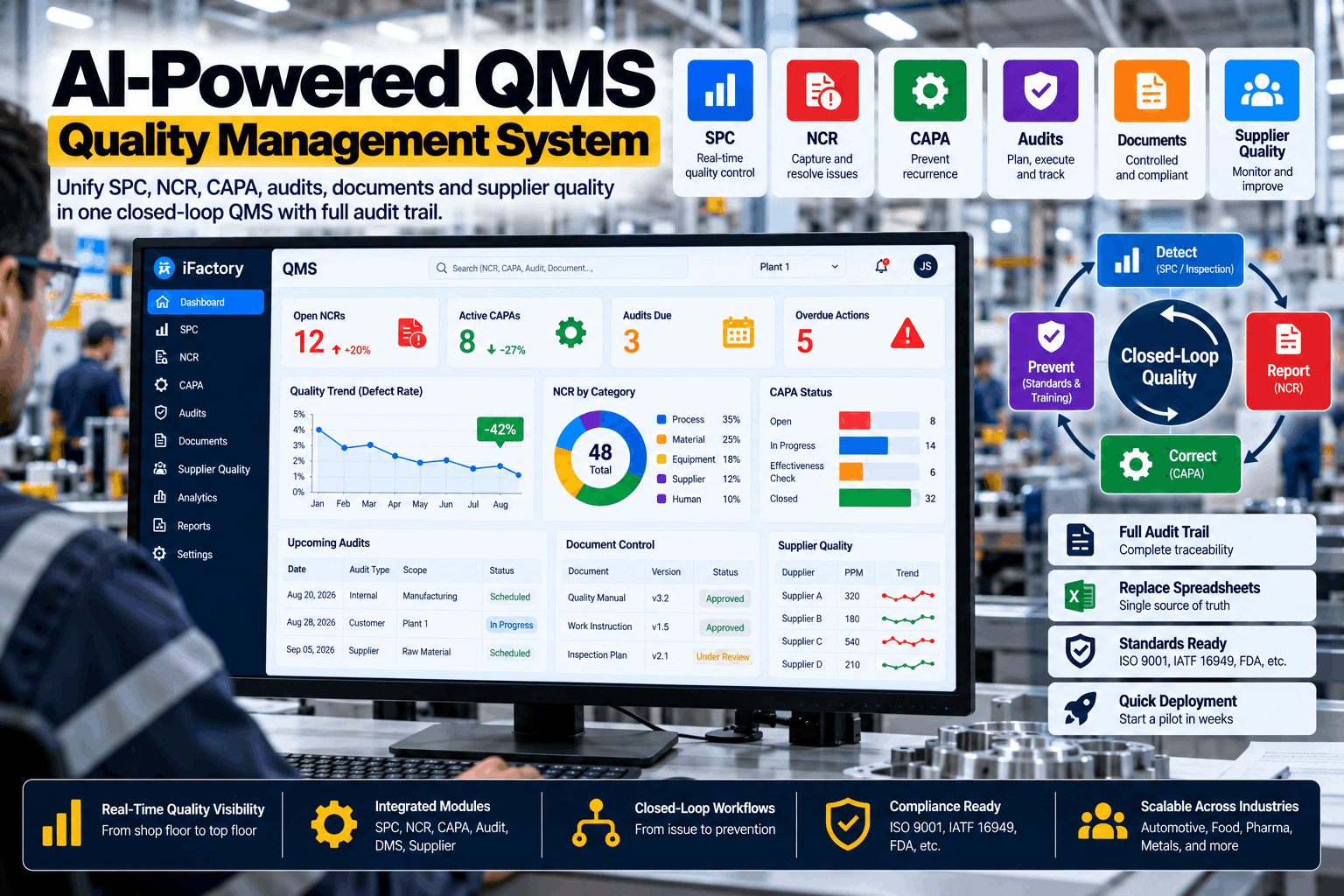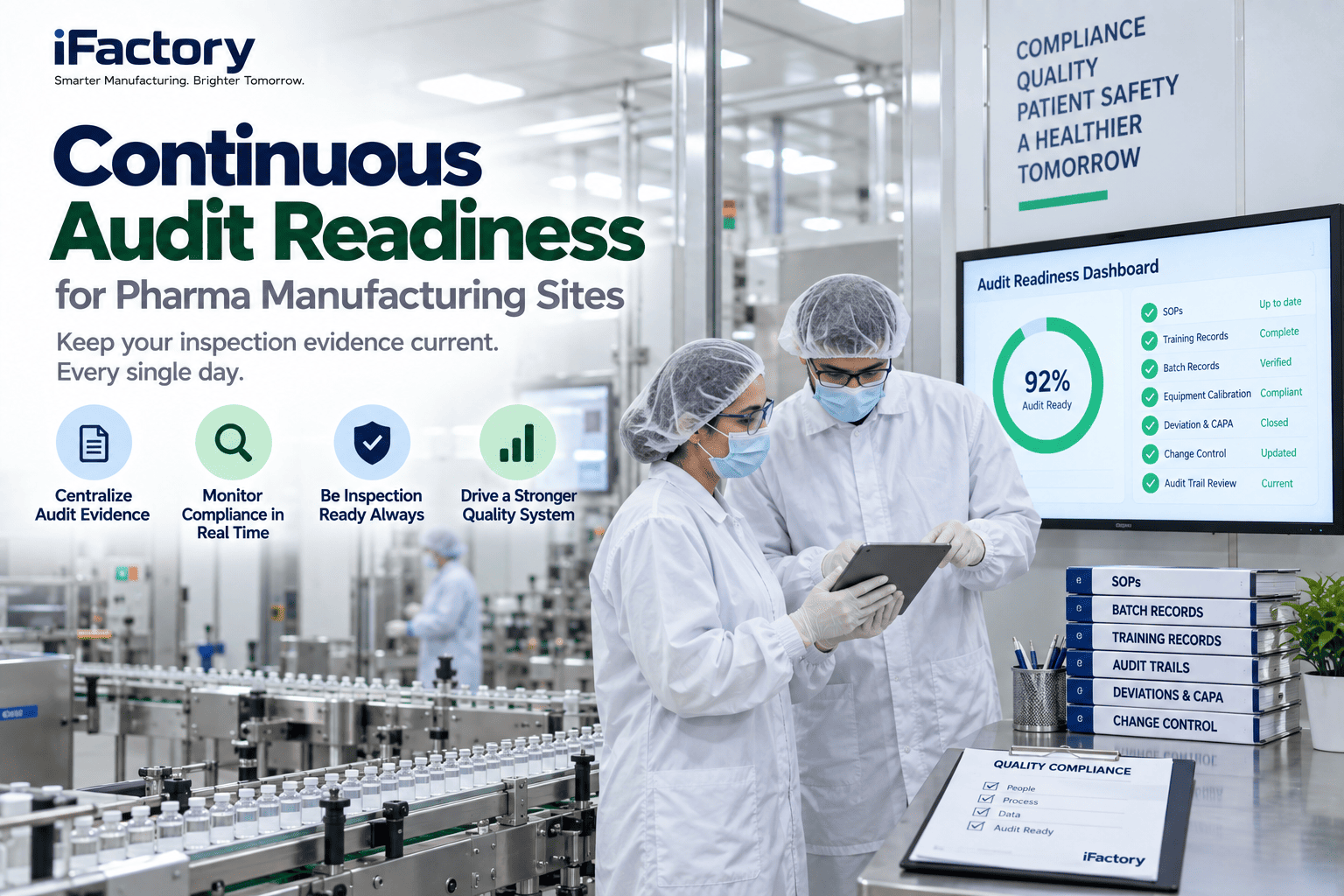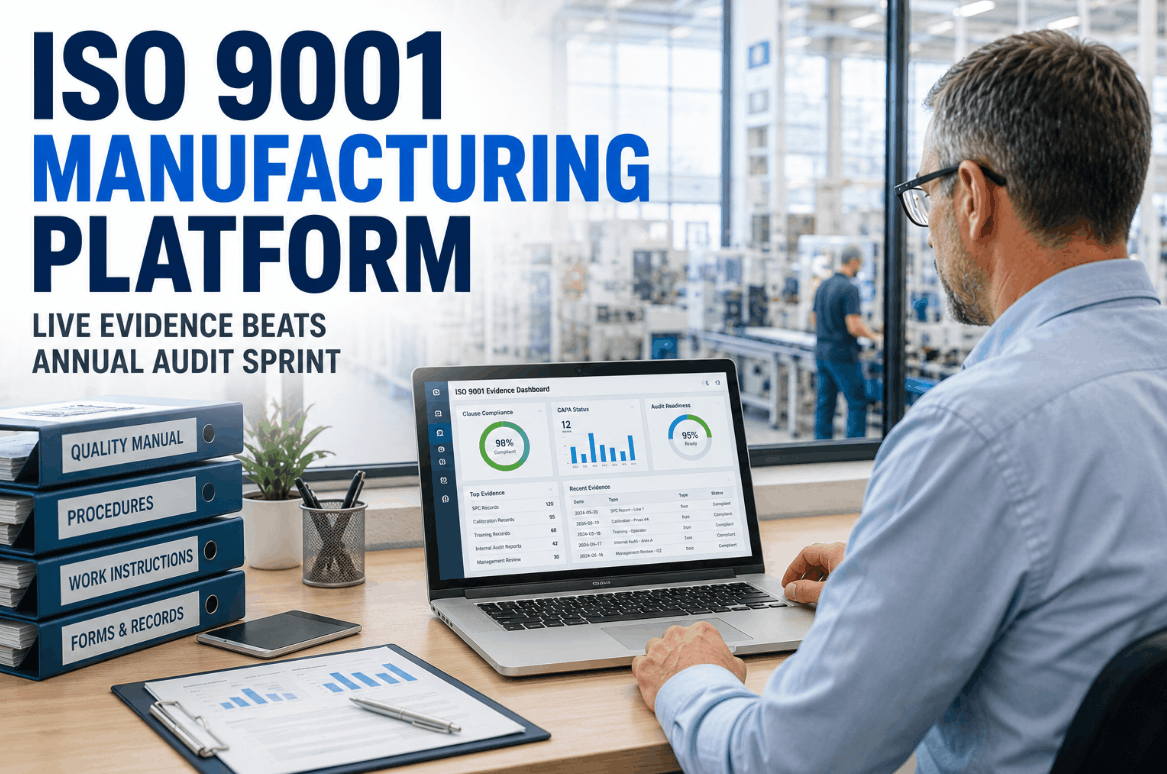
ISO 9001 certification is not the hard part. Staying certified — while running production — is where most U.S. manufacturing quality managers quietly burn through engineering time that should be on the floor. The annual audit sprint is the industry's most accepted inefficiency: three to five weeks of quality engineers pulling records from disconnected systems, assembling evidence packages clause by clause, and producing documentation that reflects what the organization did 11 months ago, not what it is doing right now. Auditors notice the difference. Registrars notice it. Customers notice it. The organizations that consistently pass ISO 9001 surveillance audits without major nonconformances are not preparing harder than everyone else — they are maintaining live system outputs that satisfy every auditable clause continuously, so the audit is a review of current performance, not a reconstruction of past events. iFactory's ISO 9001 evidence engine delivers exactly that capability: every auditable clause mapped to live SPC data, recipe audit records, CAPA workflows, and document control outputs — available on demand, updated with every production event, and exportable as a complete audit package without a single week of manual assembly. Manufacturing quality managers who have deployed iFactory's evidence engine report a 64% reduction in audit preparation labor and zero major nonconformances in their first surveillance audit post-deployment.
Why the Annual Audit Sprint Is a Structural Failure — Not a Planning Problem
The audit sprint happens because most manufacturing quality systems are built for compliance events, not continuous compliance. Your SPC data lives in one system. Your CAPA records live in another. Document control is in a shared drive or a legacy DMS with no live connection to production records. When the registrar arrives, your quality team's job is to manually bridge all of these disconnected sources into a coherent evidence package — clause by clause, for every auditable requirement in ISO 9001:2015. At a typical mid-size U.S. manufacturer, that bridge-building exercise consumes 80 to 140 quality engineer hours per audit cycle. It produces a snapshot of past compliance. And it guarantees that the first time anyone systematically reviews whether CAPA records, SPC data, and document revisions are all current and consistent is three weeks before the audit.
The structural fix is not a better checklist or a more organized shared drive. It is an evidence engine that maintains the connection between live production data and ISO 9001 clause requirements automatically — so the audit package is not assembled before the audit, it is simply exported. iFactory's platform maintains that connection across every auditable clause, updating evidence records with each production event, work order close, CAPA action, or document revision. Quality managers at iFactory-deployed facilities can Book a Demo to see what a clause-by-clause live evidence dashboard looks like before their next surveillance audit.
ISO 9001:2015 Clause Mapping — How iFactory's Evidence Engine Covers Every Auditable Requirement
ISO 9001:2015 organizes its auditable requirements across Clauses 4 through 10. The gap at most manufacturers is not missing procedures — it is missing live evidence linking those procedures to actual production activity. The table below maps each auditable clause to the iFactory platform output that satisfies it, and documents what registrar auditors verify in practice for each requirement.
| ISO 9001:2015 Clause | Requirement Summary | iFactory Evidence Output | What Auditors Verify | Evidence Status |
|---|---|---|---|---|
| Clause 6.1 — Risk Management | Identify and address risks and opportunities affecting QMS conformity | Risk register linked to process characteristics; auto-flagged on SPC degradation or process change | Risk register is current and connected to actual production data, not a static document | Live |
| Clause 7.5 — Document Control | Documented information must be controlled, current, and available at point of use | Version-controlled work instructions, control plans, and procedures linked to work orders; revision audit trail automatic | Documents at point of use match current approved revision; change history auditable | Live |
| Clause 8.5.1 — Production Control | Controlled conditions for production including documented information, monitoring and measurement | Digital work orders, real-time SPC charts per characteristic per lot, recipe parameter monitoring | Process parameters monitored and within control limits; deviations recorded and dispositioned | Live |
| Clause 8.5.2 — Traceability | Identify outputs and maintain records enabling traceability where required | Lot-linked records: material, process parameters, inspection results, and operator ID at every production step | Any delivered product traceable back to its material lot, process conditions, and inspection records | Live |
| Clause 8.7 — Nonconforming Output | Ensure nonconforming outputs are identified and controlled to prevent unintended use | Automated NCR generation on SPC alert or inspection failure; quarantine workflow with disposition record | Every nonconforming output has a documented identification, segregation, and disposition action | Live |
| Clause 9.1 — Monitoring & Measurement | Monitor, measure, analyze, and evaluate QMS performance against planned results | Real-time SPC, Cpk by characteristic by lot, OEE, yield, and defect rate dashboards updated continuously | Performance data is current and demonstrates whether quality objectives are being met | Live |
| Clause 9.2 — Internal Audit | Conduct internal audits at planned intervals; maintain audit records and findings | Scheduled internal audit workflows; digital audit checklists; finding records linked to CAPA automatically | Audit program is executed on schedule; findings are documented and CAPA is initiated without delay | Live |
| Clause 10.2 — CAPA | React to nonconformities; implement corrective actions; evaluate effectiveness | CAPA workflow with root cause analysis, action assignment, due-date tracking, and effectiveness verification linked to post-action SPC data | CAPA records show thorough root cause analysis, completed actions, and verified effectiveness — not recurrence | Live |
The Five Operational Gaps That Generate ISO 9001 Nonconformances in Manufacturing
Registrar auditors reviewing manufacturing facilities follow patterns developed across thousands of audit cycles. The same five gaps appear with consistent frequency in findings at U.S. manufacturers across industry sectors — each one directly preventable with a live evidence engine that keeps clause-relevant records current between audits. Closing these gaps before your next surveillance cycle is the single highest-return activity your quality team can undertake. Book a Demo to see how iFactory's evidence engine addresses each one.
Stale Document Control — Work Instructions Not Matching Current Practice
The most common Clause 7.5 finding: work instructions at the point of use are not at the current approved revision. Operators are following a process that has changed since the last document update, and the training record does not reflect the new version. iFactory's document control module version-locks work instructions to work orders — operators cannot access an outdated procedure, and every document access event is logged against the operator ID and timestamp.
CAPA Without Effectiveness Verification — Clause 10.2 Repeat Findings
1 in 5 ISO audit findings recurs from a prior cycle. In every reviewed case, the root cause traces to CAPA actions that were marked complete without a documented effectiveness check against production data. iFactory links every CAPA closure to post-action SPC performance for the affected characteristic — the system will not mark a CAPA effective if the process metric has not demonstrated improvement over a configurable verification period.
SPC Data Disconnected from Nonconforming Output Records — Clause 8.7 Gap
When SPC lives in a standalone system, out-of-control signals do not automatically generate nonconforming output records. The result is an SPC chart that shows a process instability and an NCR log that is blank for the same date range — a finding that calls the entire monitoring program into question. iFactory's SPC module auto-generates an NCR on any WE Rule violation or Cpk breach, with product identification, operator, and lot linked in the same record.
Management Review Without Live Performance Data — Clause 9.3 Gap
ISO 9001 Clause 9.3 requires management review inputs to include actual quality performance data — Cpk trends, CAPA status, audit findings, and customer satisfaction indicators. Reviews conducted from stale monthly reports do not satisfy this requirement. iFactory's management review module pulls live dashboard data — current Cpk by characteristic, open CAPA aging, internal audit completion rate — into a structured management review record at the time of the meeting.
Risk Register Not Updated After Process Changes — Clause 6.1 Finding
A risk register built for initial certification and not reviewed since the last process change is a static document masquerading as a live risk management system. Auditors ask: "What changed in production since your last risk review, and how did you update your risk register?" iFactory auto-flags risk register entries for review when a process change, new supplier, or Cpk degradation event occurs on a linked characteristic — ensuring the register reflects the current risk profile of the facility. Book a Demo to see risk register automation in action.
From Annual Audit Sprint to Continuous Evidence — What iFactory Delivers Clause by Clause
The operational difference between a facility that passes ISO 9001 surveillance without major findings and one that spends weeks in preparation is not the quality of their procedures. It is whether their production system maintains live evidence of procedure compliance between audits. The four iFactory modules below form the core of the ISO 9001 evidence engine — each one producing clause-relevant records continuously, linked to the production events that generated them.
Real-Time SPC — Clauses 8.5.1, 9.1, 8.7
Control charts, Cpk records, and Western Electric Rule violations captured per characteristic per lot in real time. Every data point traceable to the operator, machine, and lot. OOS events auto-trigger NCR workflow — no unacknowledged process instability enters the audit period without a documented disposition.
Recipe & Process Parameter Audit — Clause 8.5.1
Every production run generates a recipe audit record comparing actual process parameters to approved nominal values. Deviations are flagged in real time, attributed to the operator, and linked to the affected lot. The approved recipe version is locked at run start — no unauthorized parameter change can occur without an auditable deviation record.
CAPA Workflow — Clause 10.2
Every NCR and internal audit finding auto-initiates a CAPA workflow with root cause analysis, action assignment, and due-date tracking. CAPA effectiveness is verified against post-action SPC data for the affected characteristic — a CAPA cannot be closed as effective without a verification period outcome. Recurrence prevention is documented and auditable.
Document Control — Clause 7.5
Work instructions, control plans, and quality procedures version-controlled and linked to work orders. Operators at the point of use can only access current approved documents. Revision history, approval signatures, and training acknowledgments are stored against each document version — complete and exportable for Clause 7.5 evidence on demand.
Expert Review: What ISO 9001 Registrar Auditors Look for — and Where Quality Systems Consistently Fall Short
"In ISO 9001 surveillance audits at U.S. manufacturing facilities across metals, plastics, electronics, and industrial equipment, the finding pattern is predictable regardless of facility size. The quality manual describes a compliant system. The procedures are written correctly. Where the system falls apart — where findings are written — is always the same place: the distance between the documented procedure and the live production evidence that proves the procedure is being followed right now, not six months ago when someone last looked. A CAPA program that cannot demonstrate effectiveness with current process data is not a CAPA program. A document control system where the latest approved revision is not the one operators are using on the floor is a daily nonconformance. A risk register that has not been reviewed since a major equipment change is a document, not a risk management system. The facilities that consistently pass surveillance audits with zero major findings share one operational characteristic: their quality system outputs are live. When I ask to see the Cpk trend for a critical characteristic over the last 90 days, they show me a live chart, not an export they pulled before I arrived. When I ask for the last three CAPA effectiveness verifications, they show me system records with post-action SPC data attached, not a narrative summary written by the quality manager. The gap between a passing audit and a major finding is almost never a procedure gap. It is always an evidence gap.
— T. Garfield, CQA, RABQSA Lead Auditor — ISO 9001:2015 Surveillance and Certification Audits, 19 Years, U.S. Manufacturing Sectors
Conclusion: ISO 9001 Compliance Is Continuous — Your Evidence Engine Should Be Too
The manufacturing quality organizations that stop running annual audit sprints are not the ones with the most thorough pre-audit preparation. They are the ones that stopped needing to prepare, because their production system maintains live ISO 9001 evidence continuously. SPC records that are current to the last production lot. CAPA workflows that auto-initiate on every NCR and close only when effectiveness is verified with production data. Document control that locks operators to current approved procedures at the point of use. Risk registers that update when process changes occur, not when the next audit cycle arrives.
iFactory's ISO 9001 evidence engine delivers that operational state across every auditable clause in the standard — SPC, recipe audit, CAPA, and document control all producing live, linked, exportable evidence records updated with every production event. The audit package that previously required three to five weeks of manual assembly becomes an on-demand export. The major finding that originated from a CAPA program that could not demonstrate effectiveness becomes a risk your quality system actively prevents. Book a Demo to see iFactory's ISO 9001 evidence engine mapped to your facility's current clause coverage and audit exposure.