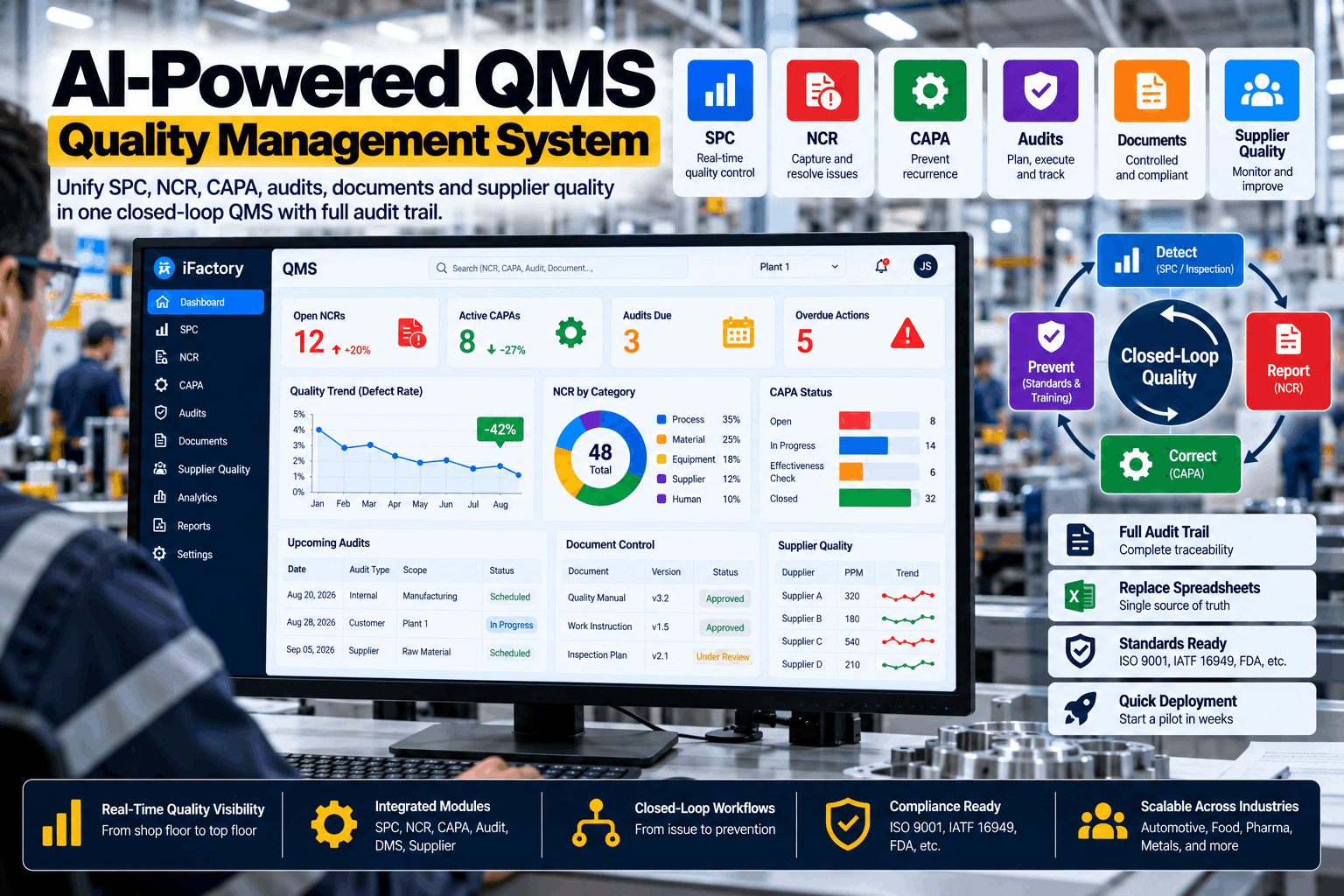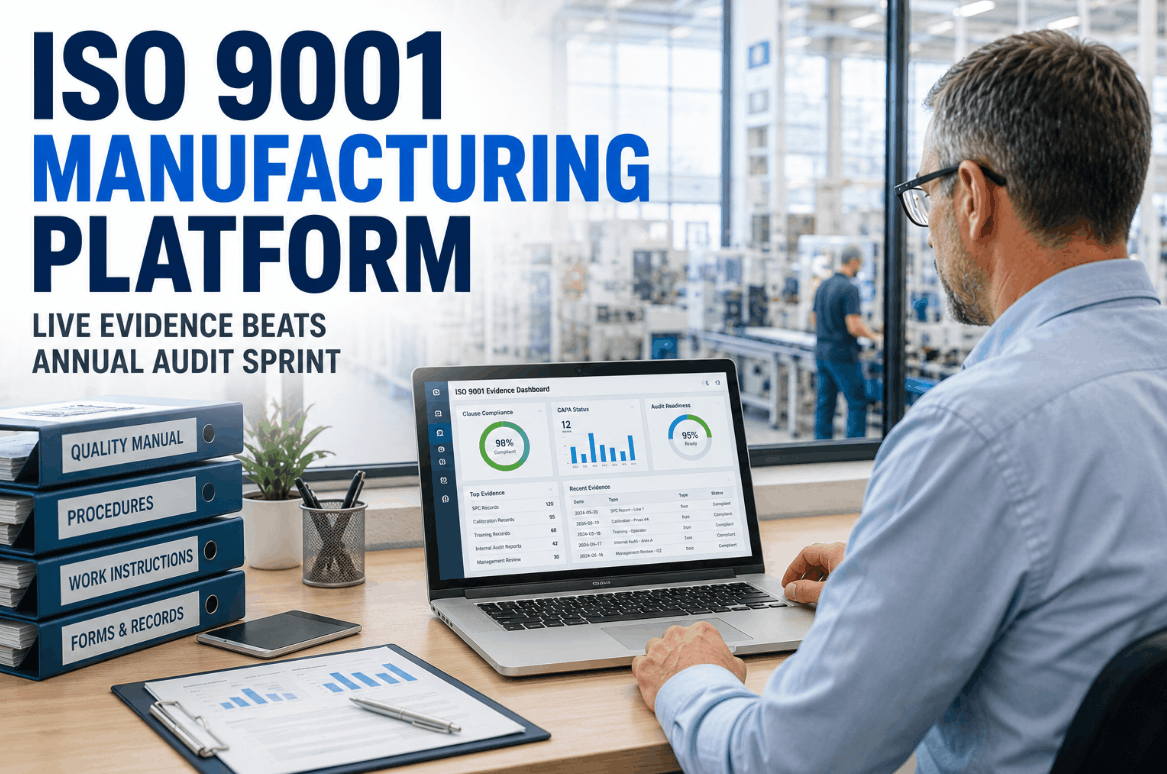
AS9100D compliance does not fail at the audit — it fails months before, when the evidence that auditors require is scattered across disconnected systems with no live link between process data and compliance documentation. The pattern is consistent across U.S. aerospace manufacturers of every size: a First Article Inspection report that cannot be tied to the lot-level SPC data generated during production; a risk register that was built for the initial certification and has not been updated since the last configuration change; a counterfeit material log that lives in a spreadsheet outside the quality system; configuration records that diverge from the physical build state because change control did not propagate downstream. Auditors do not just check that procedures exist — they verify that what is written is actually being executed, with objective evidence linking every compliance element to live production records. The gap between a documented procedure and a demonstrated process is exactly where AS9100D nonconformances are written. iFactory's AS9100 compliance platform closes that gap by digitizing the full AS9100D evidence chain — risk register, FAI documentation, counterfeit material controls, configuration management, and SPC — on a single platform where every record is linked to the lot, the part number, and the production event that generated it. Aerospace suppliers who have deployed iFactory's AS9100 compliance platform report a 74% reduction in audit finding exposure and 58% faster audit preparation cycles within the first six months of live operation.
Why AS9100D Audit Failures Are a Data Integration Problem, Not a Documentation Problem
Most aerospace quality organizations that receive AS9100D nonconformances during surveillance audits are not missing procedures. They have a risk management process, a counterfeit parts prevention procedure, and a configuration management plan. What they are missing is demonstrable, real-time evidence that those procedures are connected to actual production events. An auditor reviewing a risk register that was last updated 14 months ago — while production has processed 23 new part numbers, two supplier changes, and one significant process modification — is not reviewing a risk register. They are reviewing a historical document that no longer reflects the current risk profile of the facility.
The same disconnect appears in SPC and First Article Inspection. AS9100D Clause 8.5.2 requires traceability of product to its measurement results — not just to the lot number, but to the specific inspection data generated during that production run. When Cpk data lives in a standalone SPC system and FAI reports live in a separate document management tool, neither system knows what the other contains, and the connection that auditors require cannot be demonstrated without manual assembly that takes days and introduces transcription risk. iFactory eliminates the integration gap by linking SPC control charts, Cpk trends, FAI records, risk register entries, and counterfeit material logs to the part-lot-supplier combination that generated them — so every compliance element is traceable to the production event it documents.
The Five AS9100D Evidence Pillars iFactory Digitizes and Links to Live Production
AS9100D compliance is an evidence problem, not a procedure problem. Each of the five clauses most frequently cited in audit findings requires not just a documented process but an active, traceable record that can be verified against production events at the time of audit. iFactory's AS9100 evidence engine addresses each pillar individually and connects them into a single compliance record linked to part number, lot, and supplier.
Operational Risk Register — Clause 8.1.1
AS9100D Clause 8.1.1 requires a risk-based approach to manufacturing planning that is active, updated, and traceable to production decisions — not a static document assembled for certification. iFactory maintains a live risk register for each active part number, automatically flagging entries for review when process parameters, supplier qualifications, or inspection results change in ways that alter the risk profile. Risk entries are linked to the process steps, control plans, and SPC charts that govern the affected characteristic, so auditors can trace every risk determination back to the production data that informed it.
First Article Inspection — AS9102 / Clause 8.5.1
AS9102 First Article Inspection requires documented measurement results for every drawing characteristic on the first production article — and AS9100D requires that FAI records remain traceable to the production lot and process conditions under which the first article was produced. iFactory digitizes the full FAI workflow: balloon drawing import, characteristic-by-characteristic result entry, objective evidence attachment, and automatic Cpk calculation from first-article measurement data. FAI records are stored against the part-revision-supplier combination and linked to the SPC baseline established at first production.
Counterfeit Material Prevention — Clause 8.1.4
AS9100D Clause 8.1.4 requires active controls — not just a procedure — to prevent counterfeit or suspect material from entering the aerospace supply chain. This means verified traceability from received material back to the original or authorized manufacturer, documented verification methodology for each incoming lot, and a quarantine and reporting process for suspect material findings. iFactory manages counterfeit prevention at the lot level: every incoming material receipt is logged against the approved supplier list, Certificate of Conformity is attached and linked to the lot record, and suspect material findings trigger an automatic quarantine workflow with nonconformance record generation.
Configuration Management — Clause 8.1.2
AS9100D Clause 8.1.2 requires that product configuration be controlled and traceable through the production lifecycle — every unit produced must be traceable to the design revision, process revision, and approved materials that were in effect at the time of manufacture. Unauthorized or undocumented configuration changes are among the most common causes of aerospace contract termination and customer-source approval suspension. iFactory maintains a configuration record for every serialized unit and every production lot, linking build records to the drawing revision, work instruction revision, tooling configuration, and approved supplier status current at time of manufacture.
SPC and Lot-Level Traceability — Clauses 8.5.2 & 8.1.1
AS9100D Clause 8.5.2 requires product traceability to its measurement results — Cpk data and SPC records must be linkable to the specific production lot, the process conditions at the time of manufacture, and the inspection results that accepted the lot. iFactory's SPC module captures real-time process data at the machine level, calculates Cpk per characteristic per lot, and links every control chart data point to the part-lot record in the AS9100D evidence chain. When a customer or registrar audit requires traceability from a delivered part back to its SPC history, iFactory delivers a complete evidence package in minutes, not days.
AS9100D Compliance: Traditional Approach vs. iFactory Live Evidence Engine
The compliance gap at most aerospace manufacturers is not in the quality manual — it is in the distance between documented procedures and verifiable production evidence. The table below compares how each AS9100D compliance element is managed under a traditional document-centric approach versus iFactory's live evidence model, and what the audit risk difference is in practice. Book a Demo to see how iFactory maps to your current AS9100D compliance architecture.
| AS9100D Element | Traditional Approach | iFactory Live Evidence Engine | Audit Risk Difference |
|---|---|---|---|
| Risk Register (8.1.1) | Static Word/Excel document, updated manually before audit cycle | Auto-updated on process change, Cpk shift, or supplier event — always current | Eliminates "stale register" finding — the most common 8.1.1 nonconformance |
| FAI / AS9102 | Paper forms, PDF scans, stored in separate document management system | Digital FAI linked to drawing rev, lot record, and SPC baseline at part number level | Re-FAI triggers enforced automatically — no un-triggered design revisions entering production |
| Counterfeit Prevention (8.1.4) | Spreadsheet approved source list, CoC filed in paper folder by PO | Receipt blocked if supplier not on approved list; CoC attached to lot record; quarantine workflow automated | Zero unapproved source receipts; every lot has documented CoC traceability to OEM |
| Configuration Management (8.1.2) | Drawing revisions tracked in ERP; build records not linked to configuration baseline at unit level | Unit-level configuration record linking design rev, process rev, tooling, and material lot at manufacture | Any delivered unit traceable to its exact approved configuration — no configuration audit exposure |
| SPC Traceability (8.5.2) | SPC data in standalone software; lot acceptance records in separate inspection system | SPC control charts linked to lot; Cpk calculated per characteristic per lot; complete evidence exportable on demand | Customer or registrar traceability request answered in minutes, not days — with no manual assembly |
| Audit Preparation | 3–5 day manual assembly of objective evidence across disconnected systems | Single-click audit package: all linked evidence for any part-lot-date range | Auditors receive complete, traceable evidence on the day of audit — no "we'll send it after" findings |
The AS9100D Evidence Flow: How iFactory Connects Every Compliance Record to Production
The structural challenge in AS9100D compliance is not the volume of requirements — it is the fact that the evidence those requirements demand spans multiple systems that do not naturally communicate. iFactory's AS9100 evidence engine is built around a single integration principle: every compliance record is anchored to the part number, revision, and lot that generated it, so the compliance chain is as current as the production data it documents.
Expert Review: What Aerospace Auditors Actually Look For — and Where Quality Systems Consistently Fall Short
In AS9100D audits across commercial aviation, defense, and space supply chains, the finding pattern is consistent regardless of the size or sophistication of the organization. The quality manual describes a compliant process. The procedures are written correctly. What fails is the demonstration that the procedure is connected to actual production events in real time. A risk register that was current at the last audit but has not been reviewed since a major process change is not a risk register — it is a historical document. A counterfeit prevention procedure that describes a verification methodology but cannot produce a lot-level CoC traceability record for material currently in production is a documented gap waiting to be cited. The organizations that consistently perform well in AS9100D surveillance audits share one characteristic: their compliance evidence is live. Their risk register updates when production data changes. Their FAI records link directly to the SPC charts that confirm ongoing process control. Their configuration baseline is current to the last work order, not the last engineering change notice. The question I always ask in an opening meeting is straightforward: if I ask you to show me the complete compliance evidence chain for a specific production lot — CoC, FAI, SPC history, risk register entry, and configuration baseline — can you produce it before the end of this conversation? The answer tells me everything I need to know about where the audit is going.
Conclusion: AS9100D Compliance Is a Live Data Problem — and iFactory Solves It at the Production Level
The aerospace quality organizations that pass surveillance audits without findings are not running more comprehensive procedures than organizations that receive nonconformances. They are running procedures that are demonstrably connected to live production data. Their risk registers reflect current process performance. Their FAI records are linked to the SPC baselines that confirm ongoing control. Their counterfeit prevention records are maintained at the lot level, not at the procedure level. Their configuration baselines are current to the last production event, not the last engineering change.
iFactory's AS9100 compliance platform delivers that capability across all five AS9100D evidence pillars — risk, FAI, counterfeit material, configuration management, and SPC — on a single platform where every compliance record is anchored to the part number, revision, and production lot that generated it. Audit preparation that previously required 3–5 days of manual evidence assembly across disconnected systems becomes a minutes-long export of a complete, traceable evidence package. The platform does not replace your AS9100D quality system — it connects the data that system was always supposed to be documenting. Book a Demo to see iFactory's AS9100D evidence engine applied to your facility's compliance architecture and current audit exposure.
Frequently Asked Questions
iFactory links live SPC, FAI, risk register, and counterfeit records directly to the production lot — so compliance evidence is always current, not assembled manually before each audit. A document management system stores procedures; iFactory stores production-linked evidence.
When a drawing revision or approved process change is logged, iFactory automatically flags affected characteristics for re-FAI and generates a work order — preventing any revised part number from entering production without a current FAI on record.
Yes — iFactory's approved supplier list covers both direct material receipts and sub-tier component flows, with CoC traceability and GIDEP advisory cross-reference applied at every incoming lot regardless of supply tier.
Every SPC data point is captured against the production lot that generated it, so Cpk history and control chart records are directly traceable to the specific lot, process conditions, and material at time of manufacture — exactly what Clause 8.5.2 requires.
Most aerospace manufacturers reach full AS9100D evidence engine operation — risk register, FAI, SPC, counterfeit controls, and configuration management all live and linked — within 8–12 weeks of deployment start.