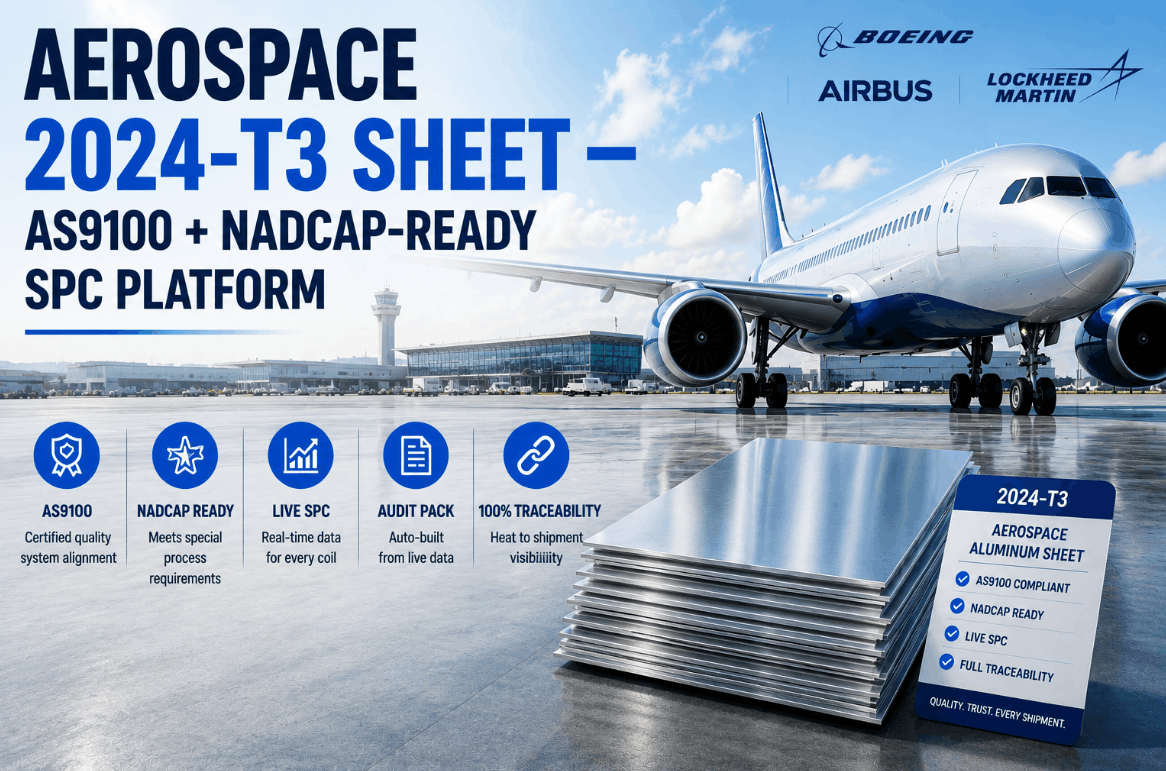
Aerospace supplier quality for 2024-T3 aluminum sheet is not a documentation exercise that happens at the end of the production run — it is a continuous discipline that Boeing, Airbus, and Lockheed Martin expect to see embedded in the process itself. Every shipment of 2024-T3 sheet against an AMS 4037 or AMS 4035 purchase order arrives with an implied audit package: live SPC data demonstrating process control across tensile strength, yield strength, thickness, and flatness; a recipe audit log showing that the heat treatment cycle that produced T3 temper was executed within the qualified parameter envelope; and traceability evidence that satisfies both AS9100 Rev D Clause 8.5.2 and the customer's own quality clauses. Most aerospace sheet suppliers are building that audit package manually, from historian exports and spreadsheet Cpk calculations, in the days before a scheduled audit. iFactory builds it automatically, from live data, every shift. Book a Demo to see an AS9100 + Nadcap audit pack generated in real time from your own production data — no quarterly Excel rebuild required.
Stop Rebuilding Your Audit Pack the Week Before the Boeing Survey. Run It Live Instead.
iFactory monitors every 2024-T3 heat treat cycle and rolling pass in real time, auto-builds your AS9100 + Nadcap evidence package from live SPC and recipe audit data, and delivers it to your quality team as a shipment-ready document — every time, not just audit time.
The Process Control Challenges Unique to 2024-T3 Aerospace Sheet Production
2024-T3 aluminum — solution heat treated, cold worked, and naturally aged — is the workhorse structural sheet of commercial and defense aerospace: aircraft skins, fuselage panels, wing surfaces, and rib structures where tensile strength in the 400–430 MPa range and fatigue resistance under sustained cyclic loading are non-negotiable. The T3 temper is produced by a sequence of process steps — solution treatment temperature and hold time, quench rate, cold work percentage, and natural aging period — each of which must execute within a qualified parameter envelope or the mechanical property specification fails. AMS 4037 and AMS 4035 define those limits precisely, and Boeing BMS 7-305, Airbus AIMS 03-01-002, and Lockheed quality clauses layer customer-specific tightened requirements on top of the base specifications.
The SPC challenge for 2024-T3 is that the most critical quality-determining process parameters — solution treatment temperature uniformity across the furnace load, quench delay time from furnace exit to immersion, and cold work uniformity across the sheet width — are process variables, not final product measurements. By the time a tensile specimen is pulled and the property is confirmed, the sheet has already been rolled, stretched, or cut. The only way to demonstrate prospective conformance — the kind of evidence that satisfies a Nadcap AC7110 auditor on heat treating or an AS9100 Clause 8.5 surveillance visit — is continuous, documented process control on the parameters that determine the outcome before the outcome can be independently verified.
Solution Treatment Uniformity
Temperature uniformity survey (TUS) compliance per AMS 2750 is required for every Nadcap-qualified furnace. iFactory monitors every thermocouple zone in real time, with automated TUS interval tracking and furnace classification status maintained continuously.
Quench Delay Control
Maximum allowable quench delay for 2024-T3 is typically 5–10 seconds from furnace exit to quench immersion. iFactory captures and records actual quench delay for every heat treat load, with SPC control charts and out-of-spec escalation in real time.
Mechanical Property SPC
Tensile strength, yield strength, and elongation data from destructive testing plotted on X-bar/R and individual moving range charts. Cpk reported by lot, by temper, and by furnace load — ready for AS9100 Clause 8.5.1 process control evidence requirements.
Dimensional & Flatness SPC
Thickness, width, and flatness (I-unit or cross-bow) tracked per AMS 2242 tolerances and customer-specific tighter requirements. Gauge control and measurement system analysis maintained per AS9100 Clause 7.1.5 with MSA records auto-linked to SPC charts.
What Boeing, Airbus, and Lockheed Actually Inspect When They Audit a 2024-T3 Sheet Supplier
Aerospace OEM supplier quality surveys for 2024-T3 sheet suppliers are not random compliance checks — they follow a structured evidence trail that maps directly to AS9100 Rev D requirements and, for suppliers performing heat treatment, to Nadcap AC7110 audit criteria. Understanding exactly what evidence the auditor will request — and whether your quality management system can produce it on demand versus under emergency reconstruction — is the difference between a clean survey and a findings report that triggers a supplier corrective action request. Quality managers who Book a Demo with iFactory consistently discover that their current systems can produce the required evidence, but only through a multi-day manual assembly process that introduces error risk and version control failures.
| Audit Evidence Requirement | Standard / Clause | What the Auditor Requests | Traditional Approach | iFactory Approach |
|---|---|---|---|---|
| Heat Treat Process Control Records | Nadcap AC7110 / AMS 2770 | Time-temperature charts for every lot, furnace load ID, operator, equipment ID | Paper charts scanned manually; incomplete for some lots | Auto-generated PDF per load from live historian data; 100% complete |
| Temperature Uniformity Survey Status | AMS 2750E / Nadcap AC7110 | Current TUS report, furnace class certification, next TUS due date | Spreadsheet tracked; lapse risk between surveys | Interval auto-tracked; 90/30/14-day advance alerts; TUS status on dashboard |
| SPC Cpk Evidence by Characteristic | AS9100 Clause 8.5.1 | Control charts, Cpk by lot, trend analysis, out-of-control response records | Quarterly Excel rebuild from historian exports; not current at audit | Live Cpk dashboard; historical control charts by lot; response log auto-linked |
| Material Traceability — Lot to Certificate | AS9100 Clause 8.5.2 | Linkage from finished sheet coil ID to heat number, ingot source, cert of conformance | Manual ERP lookup; linkage gaps for split coils | Full lot genealogy maintained; split coil traceability preserved through rolling sequence |
| Nonconformance & SCAR Records | AS9100 Clause 8.7 / 10.2 | Open NCR log, SCAR response status, verification of corrective action effectiveness | CMMS records; closure status manually updated | NCR-to-SCAR workflow tracked; effectiveness verification date auto-flagged |
| First Article Inspection Records | AS9102 Rev C | FAIR package for qualified part number, linked to current revision | PDF archive; revision linkage not maintained after re-design | FAIR records linked to drawing revision; delta FAI scope auto-identified on revision change |
The Recipe Audit Log + Live SPC Architecture That Eliminates Manual Audit Preparation
The core capability that differentiates iFactory from a standard SPC software deployment is the recipe audit log: a continuous, tamper-evident record of every process parameter set point, every actual value executed, every deviation from the qualified recipe, and every operator acknowledgment or override — tied to the production lot and available for extraction as a formatted audit document at any point. For 2024-T3 sheet production, the recipe audit log covers the full heat treat cycle from solution treatment through quench and the cold work sequence through rolling and stretching, giving the Nadcap AC7110 auditor and the AS9100 surveillance auditor a single document that demonstrates both process execution and process control across the entire temper development sequence.
Recipe Parameter Capture at Every Process Step
iFactory connects to furnace controllers, quench system PLCs, rolling mill SCADA, and stretcher controls via OPC-UA or direct historian integration. Every process parameter — furnace zone temperatures, quench delay timers, cold work percentage, aging time — is captured at the qualified setpoint and actual value level for every production lot.
Real-Time SPC Against Customer-Specific Tolerance Bands
AMS 4037 and AMS 4035 base tolerances are configured as the SPC specification limits, with Boeing, Airbus, and Lockheed customer-specific tighter requirements applied as separate control limit overlays. Cpk is calculated continuously at the lot, shift, and heat treat load level — not rebuilt quarterly from exports.
Deviation Detection and Documented Response
Any recipe parameter executing outside the qualified envelope triggers an immediate alert to the process engineer and shift supervisor, with a required response logged against the lot. The response record — action taken, disposition of affected material, root cause — becomes part of the audit package for that lot automatically.
Audit Pack Assembly — Automated at Shipment or On Demand
At shipment or at any point in the production cycle, iFactory generates the complete AS9100 + Nadcap audit pack: heat treat records with furnace charts, TUS status, SPC Cpk by characteristic, lot traceability linkage, deviation and response log, and certificate of conformance — formatted to the specific customer's audit evidence requirements and delivered as a single PDF package.
Continuous Nadcap Readiness — Not Just Pre-Audit Compliance
Nadcap AC7110 audits for heat treating occur every 12–24 months and can include a surveillance visit at any time. iFactory maintains Nadcap readiness continuously: TUS interval tracking, System Accuracy Test records, furnace qualification status, and conformance to the approved Process Specification — so there is no "audit mode" preparation sprint.
How iFactory Maps to Boeing, Airbus, and Lockheed Supplier Quality Requirements for 2024-T3 Sheet
The three largest aerospace OEMs impose overlapping but non-identical supplier quality requirements on 2024-T3 sheet. Each customer's quality clauses, supplier quality requirements document, and approved supplier list qualification criteria define specific evidence deliverables that must accompany every shipment and be available for on-site survey. Aerospace supplier quality professionals managing multiple OEM customers spend significant time maintaining parallel evidence trails for overlapping requirements that could be served from a single live data source. iFactory unifies that data source and generates customer-specific formatted output. Book a Demo to see how the platform handles multi-customer quality clause management for a single 2024-T3 production program.
"In fifteen years of AS9100 and Nadcap auditing for aluminum sheet suppliers, the finding that generates the most corrective action requests is not failed mechanical properties — it is the inability to demonstrate prospective process control. The OEM auditor arrives and asks for the SPC control charts showing that the heat treat parameters were in control on the date the lot was produced. In the majority of cases, the supplier can provide a certificate of conformance and a tensile test result — but not a continuous control chart showing that the solution treatment temperature uniformity was within AMS 2750 Class 2 limits for every load in that lot. iFactory solves exactly that problem: the recipe audit log is continuous, the SPC is live, and the audit pack is assembled automatically. When the Boeing supplier quality engineer calls and says they want to come in next Tuesday, the answer is 'come whenever you want' — not 'give us a week to prepare.'"
The Audit Pack That Ships With Every Lot Is the Competitive Advantage That Retains Aerospace Customers
For aerospace 2024-T3 sheet suppliers, the compliance baseline has shifted. Boeing, Airbus, and Lockheed no longer view an AS9100 certificate and a Nadcap accreditation as sufficient evidence of quality system effectiveness — they want to see live process control data demonstrating that the recipe that produces T3 temper is executing within the qualified envelope on every lot, and they want that evidence formatted and available on demand, not reconstructed under deadline pressure for a scheduled survey. The gap between suppliers who can produce that evidence automatically and those who cannot is widening every year as OEM digital quality programs mature.
iFactory closes that gap through a purpose-built combination of recipe audit logging, live SPC across all 2024-T3 critical characteristics, Nadcap AC7110 readiness monitoring, and automated audit pack assembly. The platform does not add a documentation burden to production — it converts the process data already being generated by furnace controllers, rolling mill SCADA, and measurement systems into audit-ready evidence that satisfies AS9100 Clause 8.5, Nadcap AC7110 process control requirements, and Boeing, Airbus, and Lockheed customer quality clause evidence deliverables simultaneously. Book a Demo to see your own 2024-T3 production data run through the audit pack generator.
2024-T3 AS9100 + Nadcap SPC Platform — Common Questions
Yes — iFactory captures furnace time-temperature records, quench delay logs, and AMS 2750 TUS interval tracking for Nadcap AC7110, and simultaneously runs SPC control charts against AS9100 Clause 8.5.1 requirements, with both evidence sets assembled into a single lot-level audit document.
iFactory tracks the TUS interval and due date for every qualified furnace, issues 90/30/14-day advance work orders for scheduling, and automatically flags any lot processed in a furnace with an expired TUS for hold pending re-survey — maintaining Nadcap compliance between audit cycles without manual calendar tracking.
Yes — each customer's quality clauses, Cpk minimums (Boeing ≥1.33, Lockheed ≥1.67 for flight-critical), and report format requirements are configured as separate output templates applied to the same live SPC data, so one production run generates compliant deliverables for multiple OEM customers without duplicate data entry.
iFactory maintains a full lot genealogy tree from ingot heat number through rolling sequence to every finished coil ID, preserving the heat number-to-product linkage required by AS9100 Clause 8.5.2 and Airbus's ingot-level traceability requirement even when a single heat produces dozens of finished sheet IDs across multiple gauges.
A full deployment covering heat treat recipe audit logging, SPC across mechanical and dimensional characteristics, TUS interval tracking, and audit pack generation typically reaches live operation in 8–12 weeks — with the first automated audit pack deliverable available within 30 days of historian and furnace controller connection. Book a Demo for a scoping session specific to your furnace and rolling mill configuration.
Deploy iFactory's AS9100 + Nadcap-Ready SPC Platform for 2024-T3 Sheet Production
Eliminate quarterly audit pack rebuilds. Run live Cpk across tensile, yield, thickness, and flatness. Auto-generate your Boeing, Airbus, and Lockheed evidence package from the same data source that runs your process.





-—-live-spc-for-tier-1-oem-programs.png)