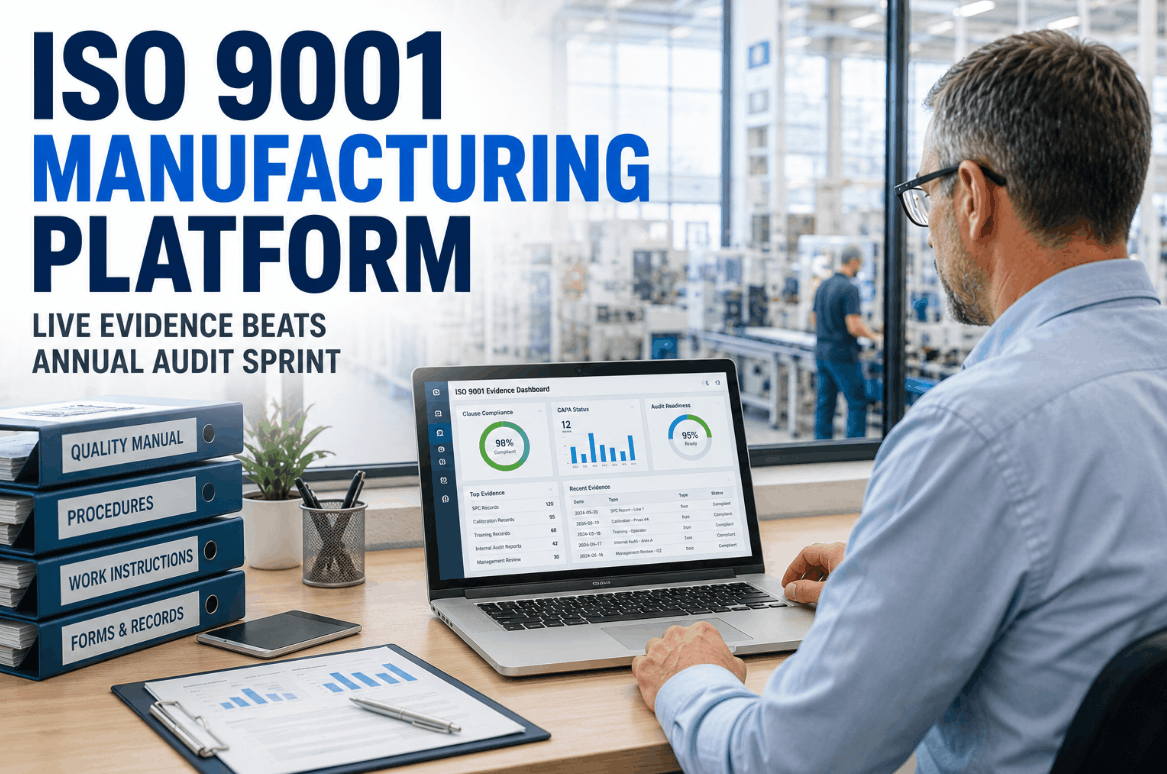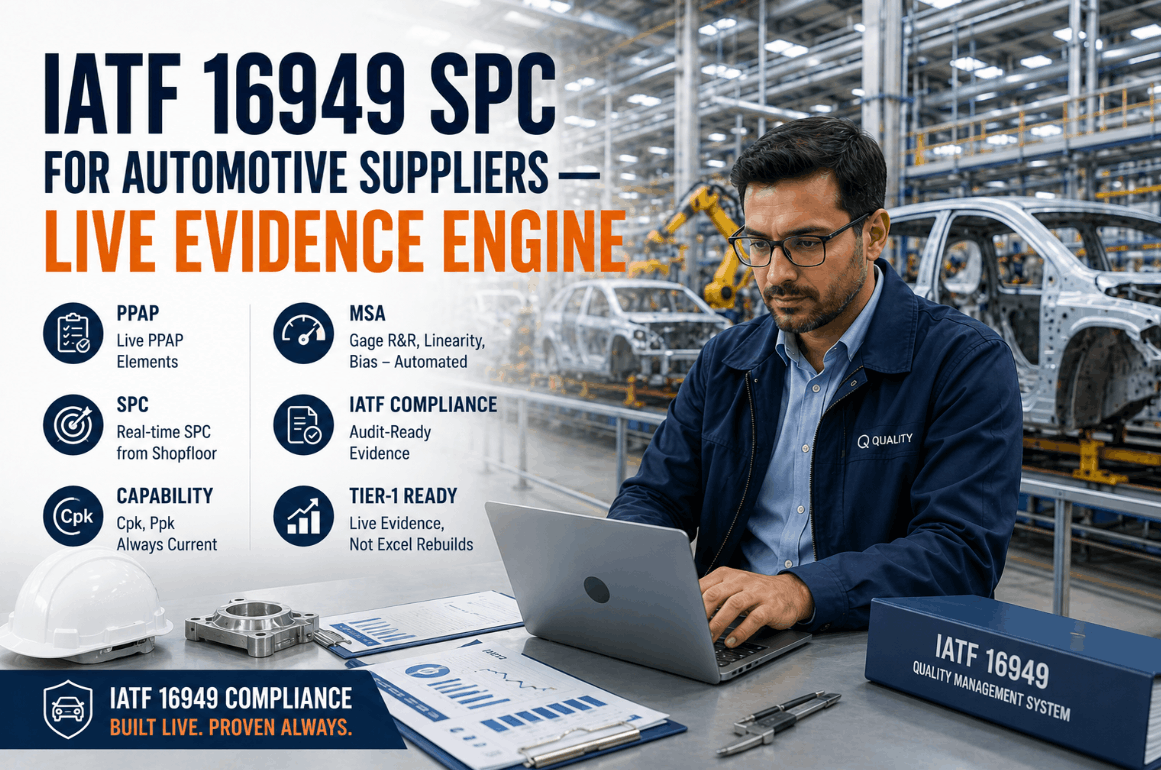
A customer audit notification arriving on a Monday morning for a Wednesday walkthrough is not an anomaly in manufacturing — it is the operating rhythm of global supply chains. For quality teams that maintain disciplined documentation, it is a straightforward request. For teams relying on spreadsheets, shared drives, and paper logs, it triggers a 48-hour fire drill that diverts engineering resources from production, exposes documentation gaps, and produces an audit binder assembled under pressure. The difference between these two outcomes is not the quality of the underlying work. It is the existence of a system that can package that work into an audit-ready format on demand. iFactory's one-click 90-day audit export compresses SPC charts, recipe change records, CAPA closure documentation, operator inspection logs, PLC parameter write history, and the full AI Copilot Q&A trail into a single zipped audit pack — generated in seconds, not days. For audit leads who want to turn customer walkthroughs from a stress event into a routine procedure, Book a Demo to see the one-click export in action.
The Real Cost of Audit Unreadiness — and the One-Click Solution
Every customer audit is a test of two things: the quality of your manufacturing process and the quality of your documentation system. Most plants pass the first test and fail the second. The gap is not in the work being done — it is in the work being recorded in a format that can be assembled, reviewed, and presented under the time pressure of an announced audit. When a quality team spends 40 hours compiling an audit binder rather than running production, the documentation burden is reducing capacity directly. When an audit finding cites missing records that actually exist but could not be located in time, that finding becomes a corrective action requirement that consumes additional engineering time for the next 90 days. iFactory eliminates this cycle by making every production record, quality metric, equipment parameter change, and compliance action instantly exportable in a single, organized package. Audit leads who Book a Demo consistently report that the one-click export alone recovers 30–50 engineering hours per audit cycle.
What a Complete Customer Audit Pack Requires — Across Every Audit Framework
Customer audit documentation requirements vary by industry — IATF 16949 for automotive, AS9100D for aerospace, GMP for medical and pharmaceutical, ISO 9001 for general quality systems — but the underlying document categories are remarkably consistent. Auditors need to see process control evidence, production record integrity, equipment configuration traceability, and corrective action completeness. The tabs below break down what each category contains and how iFactory's one-click export packages every required element automatically.
SPC Charts, Cpk Reports, and Process Control Documentation
Every customer audit includes a request for evidence of process control. SPC charts must show control limits, trend analysis, and out-of-control action records. Cpk values must be calculated per part number per production period. iFactory's export packages all SPC data per part number — control charts with annotated out-of-control points, capability reports with Cpk and Ppk for every dimension, and the associated operator actions recorded at the moment of each out-of-control event.
Recipe Change History, Operator Logs, and Production Traceability
Auditors require evidence that production was executed according to approved recipes and that any deviation was documented with authorized approval. Operator logs must show that prescribed inspection routes were completed at the required frequency. iFactory's export includes every recipe version change with author, approver, effective timestamp, and reason code — plus all operator inspection logs with timestamps, findings, and photo attachments captured via mobile app.
PLC Parameter Write History and Equipment Configuration Records
Auditors increasingly require evidence that equipment parameters were set correctly and that any changes were made with proper authorization. PLC parameter write history is one of the most frequently requested — and most difficult to produce — audit artifacts in modern manufacturing. iFactory captures every PLC parameter write event — timestamp, user identity, previous value, new value, and authorization reference — and packages the complete history into the audit export as a structured data file.
Corrective Action Records, Audit Response History, and AI Copilot Trail
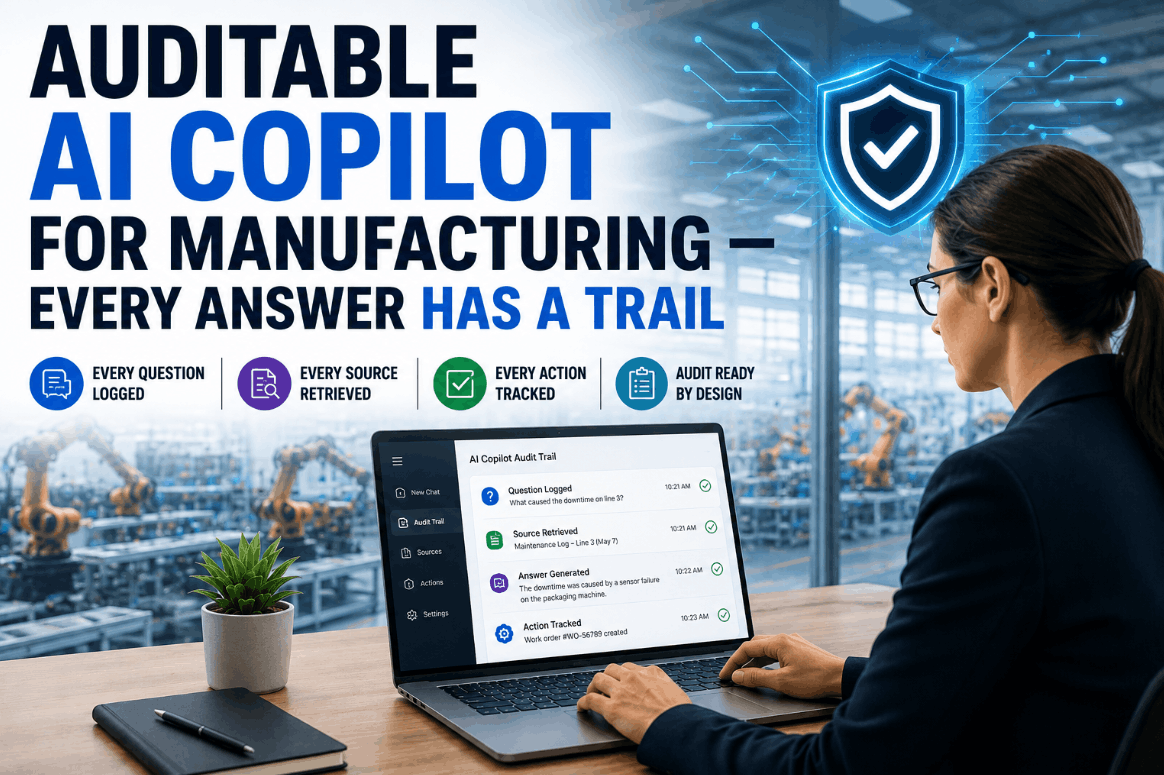
The compliance trail — CAPA records, previous audit response documentation, and the decision history captured by the AI Copilot — is what separates a passing audit from a finding-heavy one. Auditors want to see not just that problems were fixed but that the organization has a systematic method for identifying, documenting, and preventing recurrence. iFactory's export includes the full CAPA lifecycle and the complete AI Copilot Q&A history for the audit window.
How the One-Click Audit Export Works — From Selection to Delivery
The engineering time cost of audit preparation is not in the export itself — it is in the hunting. Finding the right SPC chart for the right part number across the right date range. Locating the recipe change approval for a specific production event. Confirming that a CAPA was closed before the audit date. iFactory eliminates the hunting by structuring every data element around the part number, the production event, and the timestamp — so the export engine knows exactly where every document lives. The workflow below shows how six minutes of configuration replaces 40 hours of manual compilation. Quality managers who Book a Demo typically generate their first complete audit pack during the demo session.
Beyond the Audit Pack — Continuous Audit Readiness as a Operational Discipline
The organizations that pass customer audits with minimal disruption are not the ones with the best audit preparation process. They are the ones that never need to prepare because their documentation is always audit-ready. The difference is structural: audit-ready plants design their data collection, storage, and access systems around the requirement that any record must be locatable and exportable within minutes. iFactory's platform embeds this discipline into daily operations — every SPC chart is stored with its metadata, every recipe change is logged with its approval chain, every PLC write is recorded with its authorization — so that the audit pack is a byproduct of normal operations rather than a frantic compilation effort. The table below compares the traditional audit prep approach with the continuous readiness model that the one-click export enables.
| Audit Element | Traditional Approach | iFactory Continuous Readiness | Time Saved | Finding Risk |
|---|---|---|---|---|
| SPC Documentation | Print control charts from historian, manually annotate out-of-control points | One-click SPC module — annotated charts with linked action records per part number | 6–10 hours | Eliminated |
| Recipe Change Evidence | Search email threads and shared drive folders for approval records | Auto-logged recipe version history with author, approver, and reason code per change | 4–8 hours | Eliminated |
| Operator Inspection Records | Collect paper logs from binders, scan, organize by date | Mobile app inspection records with timestamps, photos, and GPS — exportable by date range | 8–12 hours | Eliminated |
| PLC Parameter Changes | Request PLC audit trail from controls engineer, manually correlate to work orders | Full write history with user, timestamp, old value, new value, and authorization reference | 6–10 hours | Eliminated |
| CAPA Closure Records | Find CAPA in separate system, download attachments, verify closure dates | Full CAPA lifecycle in audit pack — root cause, actions, verification, effectiveness check | 4–6 hours | Eliminated |
| AI Copilot Decision Trail | Not available — decisions made in meetings without record | Copilot Q&A history with sources cited, response generated, and actions taken | Not previously possible | Eliminated |
The operational shift is significant: organizations using continuous audit readiness report that their quality teams spend 85% less time on audit preparation and 100% more time on process improvement — because the documentation system is no longer a separate workflow but an integrated output of production execution. For internal audit leads building the business case for this transition, Book a Demo to see how the continuous readiness model works across multiple audit frameworks simultaneously.
Expert Review: Why Audit Readiness Is a Data Architecture Problem, Not a Documentation Problem
I have led over 200 supplier audits across automotive, aerospace, and medical device manufacturing. The finding I write most frequently is not that the supplier's process is out of control. It is that the supplier cannot produce the documentation to prove the process was in control during the audit window. The data exists. It is in the SCADA system, the CMMS, the operator log sheets, the email inbox of the engineer who approved the recipe change. But it is distributed across systems that do not share a common index, a common timestamp standard, or a common export format. The audit becomes an archaeological dig through disconnected data sources, and the supplier loses credibility not because the work was wrong but because the evidence could not be assembled. When I see iFactory's one-click export — generating a structured, indexed, complete audit pack from a platform that was already collecting the data for operational reasons — I recognize it as the correct solution to the most common root cause of audit findings in manufacturing. The technology exists to make every plant audit-ready by default. The question is whether leadership will invest in connecting the systems that already hold the data.
Conclusion: Make Every Customer Walkthrough a Routine Procedure
The difference between an audit that disrupts production for three days and one that is handled in under an hour is not the quality of the manufacturing operation. It is the presence of a documentation system that can package that quality into an audit-ready format on demand. iFactory's one-click 90-day audit export delivers SPC charts, recipe change records, CAPA documentation, operator inspection logs, PLC parameter write history, and AI Copilot Q&A trail in a single zipped file — generated in seconds, organized by part number and date, and ready for customer delivery. The engineering time that was previously consumed by binder assembly is returned to process improvement. The documentation gaps that generated findings are closed because every record is collected and stored at the moment of the event. For audit leads who are ready to eliminate the pre-audit fire drill, Book a Demo to generate your first complete audit pack — during the demo, with your data, in under six minutes.
Frequently Asked Questions
SPC charts, Cpk reports, recipe change history, operator inspection logs, PLC parameter writes, CAPA lifecycle records, and AI Copilot Q&A history for the selected date range.
The one-click export defaults to 90 days, with the option to extend to any custom date range via the advanced export interface.
Yes. The pack is structured to align with IATF 16949, AS9100D, GMP, and ISO 9001 documentation requirements out of the box.
You can select specific modules — SPC and Cpk only, recipes and operator logs, or the full audit pack — before generating.
The full audit pack generates in under 30 seconds for a standard 90-day window across all document categories.