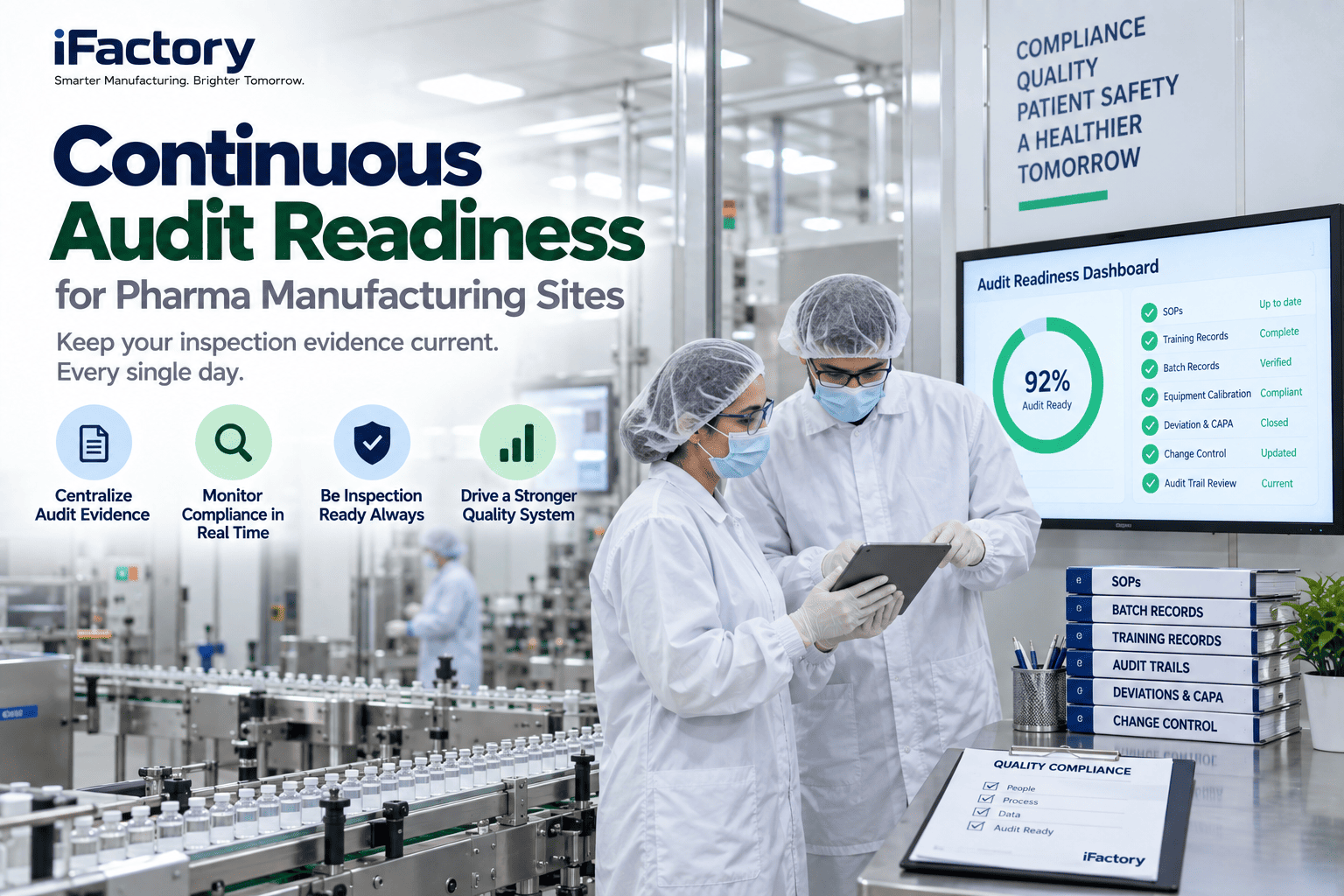
A pharma quality function that begins audit preparation three weeks before an inspection is admitting the system is not continuous. Data integrity remains the most-cited cause of FDA warning letters and Form 483 observations, and MHRA, WHO, and PIC/S have all reinforced ALCOA+ as the standard against which GMP records are judged. Continuous audit readiness means treating every day as inspection day — audit trail reviews on cadence rather than in preparation windows, deviation and CAPA closure metrics reviewed monthly rather than assembled quarterly, training records current rather than back-filled. It is not preparation intensity that determines inspection outcomes; it is the steady-state posture the inspector walks into.
iFactory / Continuous audit readiness
Every Day Is Inspection Day — Not a Three-Week Preparation Sprint
Continuous compliance posture with daily audit trail review, deviation and CAPA closure metrics on cadence, training records current, and inspection evidence generated as by-product of routine QA — aligned to ALCOA+, 21 CFR Part 11, and EU GMP Annex 11.
SCRAMBLE MODE
3-week burst → gaps stay hidden between
CONTINUOUS
Daily evidence → audit is a normal day
21 CFR Part 11
+ EU Annex 11
PIC/S · MHRA · WHO
aligned
The Problem in Audit Readiness Practice
A typical pharma site handles an FDA, EMA, or MHRA inspection by activating an audit-response mode three weeks out — pulling batch records for review, reconciling audit trails, back-filling training gaps, closing deviations that have aged too long. The team works nights. The site scores acceptable and returns to steady-state until the next scheduled inspection. In between, deviations age past target, audit trails remain unreviewed, training assignments drift out of date, and CAPA closure slips. When an unannounced inspection arrives, or when a for-cause inspection follows a complaint, the site is caught in steady-state posture — and steady-state is exactly what the inspector examines. The gap between preparation-mode compliance and every-day compliance is where 483 observations originate.
Where Audit Findings Actually Originate
FDA 483 and warning-letter finding patterns are consistent across recent enforcement history. Each traces to a specific steady-state compliance gap.
Audit trail neglect
Electronic system audit trails not reviewed on the cadence procedures require. Inspector samples trails; finds unreviewed periods. Warning letter cites 21 CFR Part 11 audit trail control failure.
Deviation age drift
Deviations open beyond target closure time. Backlog of aged deviations at time of inspection. Inspector cites lack of timely investigation and CAPA under 21 CFR 211.192.
Training back-fill
Training completion assignments drifted past due dates. Records back-filled ahead of inspection. Trail shows same-day completion of dozens of overdue trainings. Data integrity finding.
CAPA effectiveness gap
CAPA closed without documented effectiveness verification. Same deviation recurs. Inspector traces repeat and cites failure to demonstrate CAPA effectiveness.
What Good Looks Like in Audit Readiness
A working continuous readiness posture holds four disciplines together — daily audit trail review on cadence, deviation age tracked and escalated, training current in real time, and inspection evidence generated as by-product.
Trail Review Cadence
Audit trails for GMP-critical systems reviewed on the cadence procedures require — daily for high-risk, weekly for routine. Review captured in evidence trail readable in inspection.
Cadence, not campaign
Deviation Age Live
Deviation age tracked live with escalation on approach to target closure. Aged deviations surfaced daily to QA leadership. Backlog kept small enough that any inspection window is defensible.
Age never accumulates
Training Current
Training assignments and completions tracked live with escalation before overdue. Compliance percentage a leading indicator rather than an audit-prep exercise.
Real-time compliance
Evidence as By-Product
Inspection evidence generated as by-product of routine QA activity — self-inspection records, management review outputs, effectiveness verification. Nothing assembled ad-hoc for the inspector.
By-product, not exhibit
How iFactory AI Fits
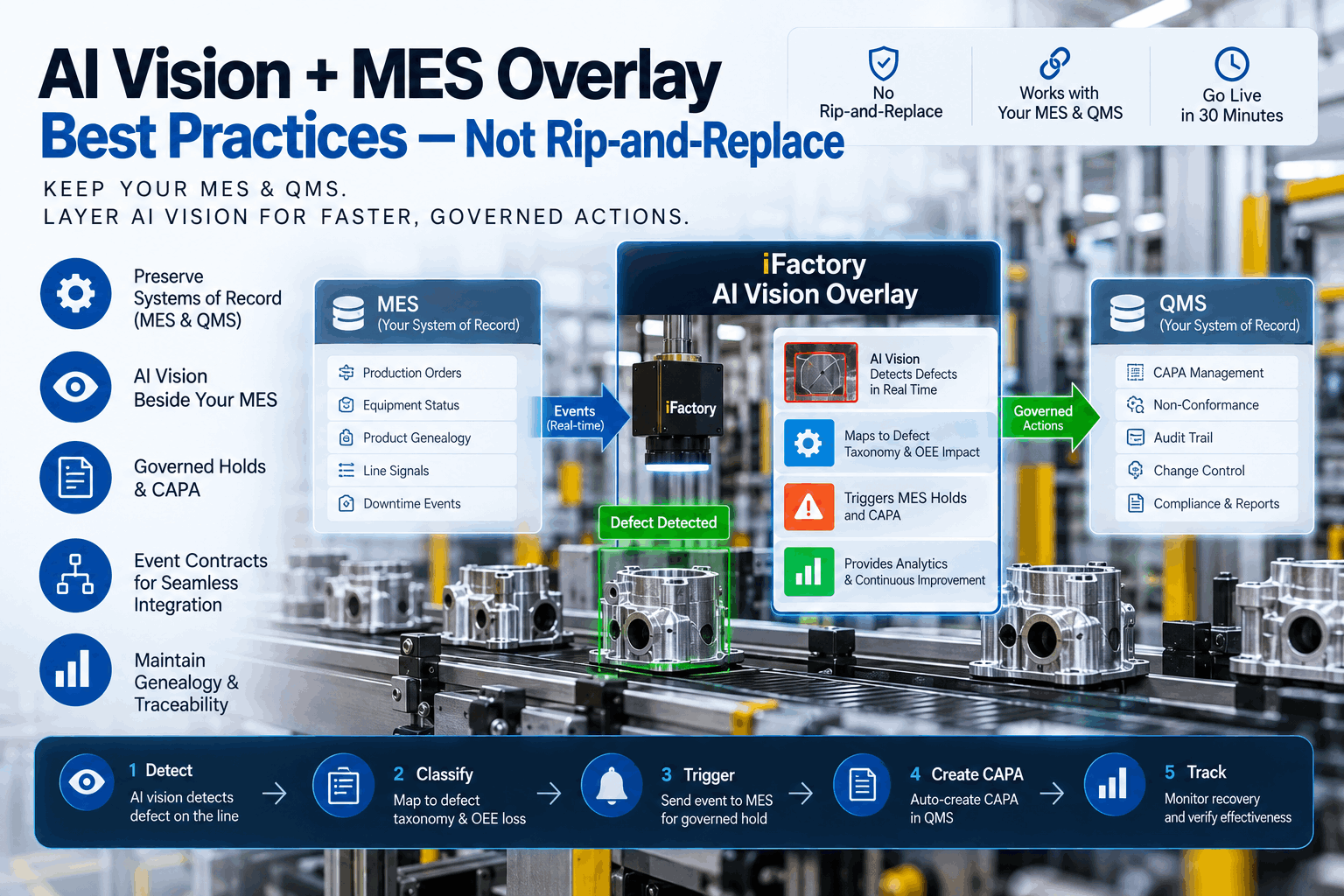
iFactory AI overlays your QMS (Sparta TrackWise, ETQ, MasterControl, Veeva Vault), LMS, and GMP-critical systems (MES, LIMS, DCS) — providing the continuous readiness layer that turns steady-state operations into audit-ready evidence.
Trail Reviewer
Readiness Layer
Cadence-based audit trail review across GMP-critical systems. Review evidence captured with reviewer, timestamp, and findings. Sample-based review for large trails, full review for high-risk changes.
Deviation Watch
Readiness + QMS
Live deviation age tracking with escalation before target closure. Aged deviation trend on QA leadership dashboard. Chronic aging patterns surfaced for systemic response.
Training Live
Readiness + LMS
Training compliance percentage tracked live against role-based requirements. Approach-due and overdue escalation. No back-fill patterns visible in audit trail.
Evidence Archive
Readiness + Compliance
All routine QA activities generate inspection-ready evidence — self-inspection outputs, management review, CAPA effectiveness verification, complaint trend review. Export for inspection response in minutes.
Ask your QA compliance manager how many days ago the last GMP-critical system audit trail review was completed, and how many open deviations are past target closure. If either answer is uncomfortable, the site is running scramble mode and an unannounced inspection would land badly. Book a compliance posture review.
12-Week Continuous Readiness Rollout
One site, twelve weeks. The pilot activates cadence-based audit trail review, live deviation and training tracking, and produces the first month of continuous evidence.
Weeks 1–3
Baseline Posture
Baseline current audit trail review cadence, open deviation age distribution, and training compliance. Identify highest-risk GMP systems for daily trail review priority.
Weeks 4–7
Cadence Active
Trail review cadence activated with named reviewers. Deviation age escalation live. Training approach-due notifications flowing. First month of continuous evidence generated.
Weeks 8–10
Mock Inspection
Internal mock inspection using inspection-response export from continuous evidence. Gaps identified and addressed within days rather than weeks.
Weeks 11–12
Steady-State Ready
Steady-state readiness posture established. Rollout to sister sites and additional GMP systems scoped based on inspection-response export quality.
Who Owns the KPI
Continuous readiness crosses QA, operations, IT, and site leadership. Each function owns a specific KPI or the posture reverts to pre-audit scramble.
QA Compliance Manager
Trail review cadence adherence %
Owns the audit trail discipline — the share of GMP-critical systems reviewed on the cadence procedures require. 100% is the requirement, not the target.
QA Investigations Lead
Deviations past target age
Owns the deviation velocity — the count of open deviations past target closure. Backlog visible daily. Chronic aging by category prompts systemic review.
Training Coordinator
Training compliance %
Owns the training currency — the share of assigned training completed by due date across the site. Trend is a leading indicator of inspection posture.
Site Head
Inspection response time
Owns the site posture — the time to produce inspection-response evidence when requested. Hours is acceptable; days is exposure. Steady-state is what determines outcomes.
FAQ
How does this align with ALCOA+ specifically — is the framework enough?
ALCOA+ (Attributable, Legible, Contemporaneous, Original, Accurate, plus Complete, Consistent, Enduring, Available) is the framework FDA, MHRA, WHO, and PIC/S all cite when evaluating data integrity. The continuous readiness posture directly operationalises each principle — audit trails prove Attributable and Contemporaneous, cadence review proves Legible and Available, evidence archive proves Enduring and Complete. Where the framework leaves interpretation open (what constitutes adequate cadence, what evidence is sufficient), the workflow applies your organisation's specific procedures consistently every day rather than for-inspection. That consistency is what closes the gap between passing framework and inspection resilience.
What about EU GMP Annex 11 — does the same posture handle Annex 11 as well as Part 11?
Yes. 21 CFR Part 11 (US) and EU GMP Annex 11 (EU) overlap substantially — electronic records, electronic signatures, audit trail, validation, access control, and change management. Where they differ (Annex 11 references PIC/S guidance more directly; Part 11 references FDA guidance for industry), the workflow supports both regimes from the same underlying evidence — because the underlying evidence is the same continuous operational posture. Sites that supply both markets configure once and satisfy both. Where a site's supplied markets extend to MHRA (post-Brexit UK), TGA (Australia), Health Canada, or other authorities, the underlying ALCOA+ foundation carries.
Book a demo to see the multi-regime evidence view.
How does this handle GMP-critical spreadsheets — those are the classic Part 11 gap?
GMP-critical spreadsheets remain a recognised risk category — spreadsheets that generate, process, or store GMP-critical data without the audit trail, access control, and validation that Part 11 requires. The readiness workflow inventories GMP-critical spreadsheets, evaluates each against Part 11 criteria, and either brings them under controlled system governance or documents the compensating controls (validated template, controlled access, printed-and-signed output). Where the volume of GMP-critical spreadsheets is high, the workflow drives a migration program to systems that natively meet Part 11 — LIMS extensions, MES modules, purpose-built compliance platforms. Nothing changes overnight, but nothing is ignored either.
Stop treating audit readiness as a three-week sprint.
Turn Steady-State Operations into Continuous Inspection Evidence
Bring your last inspection response, current audit trail review cadence, open deviation age distribution, and training compliance status. We'll walk the current posture, quantify the scramble-vs-steady-state gap, and demonstrate the continuous evidence workflow.