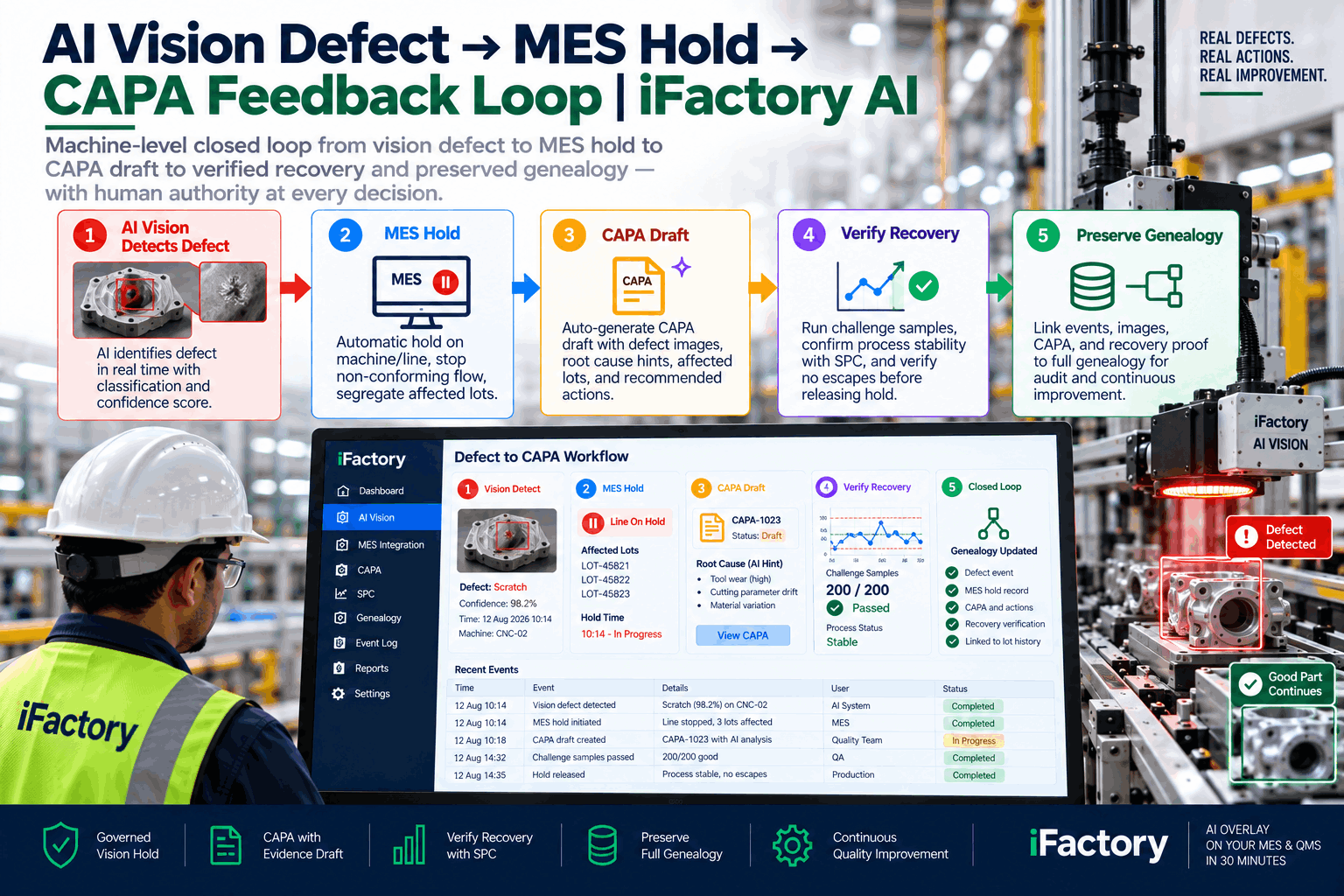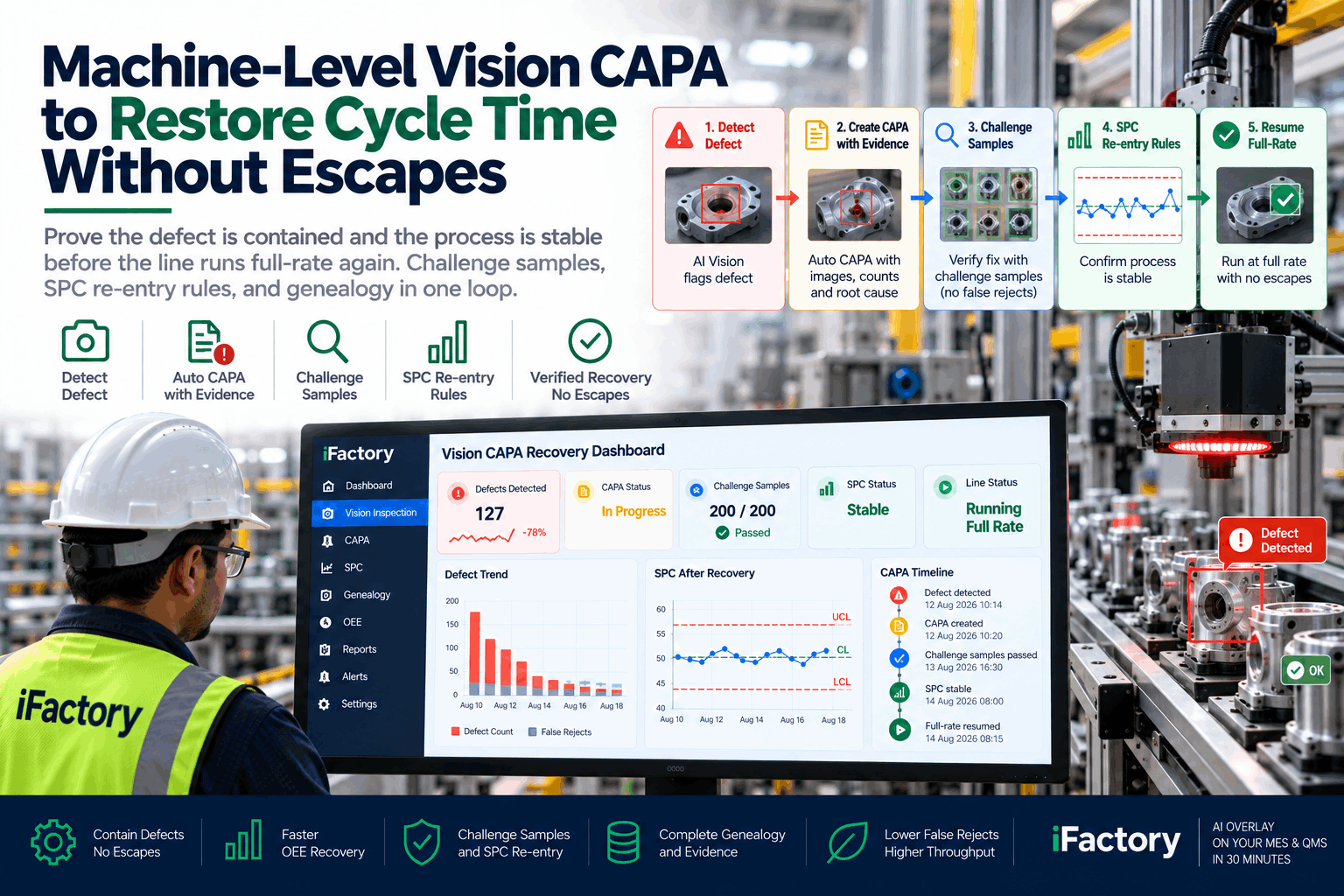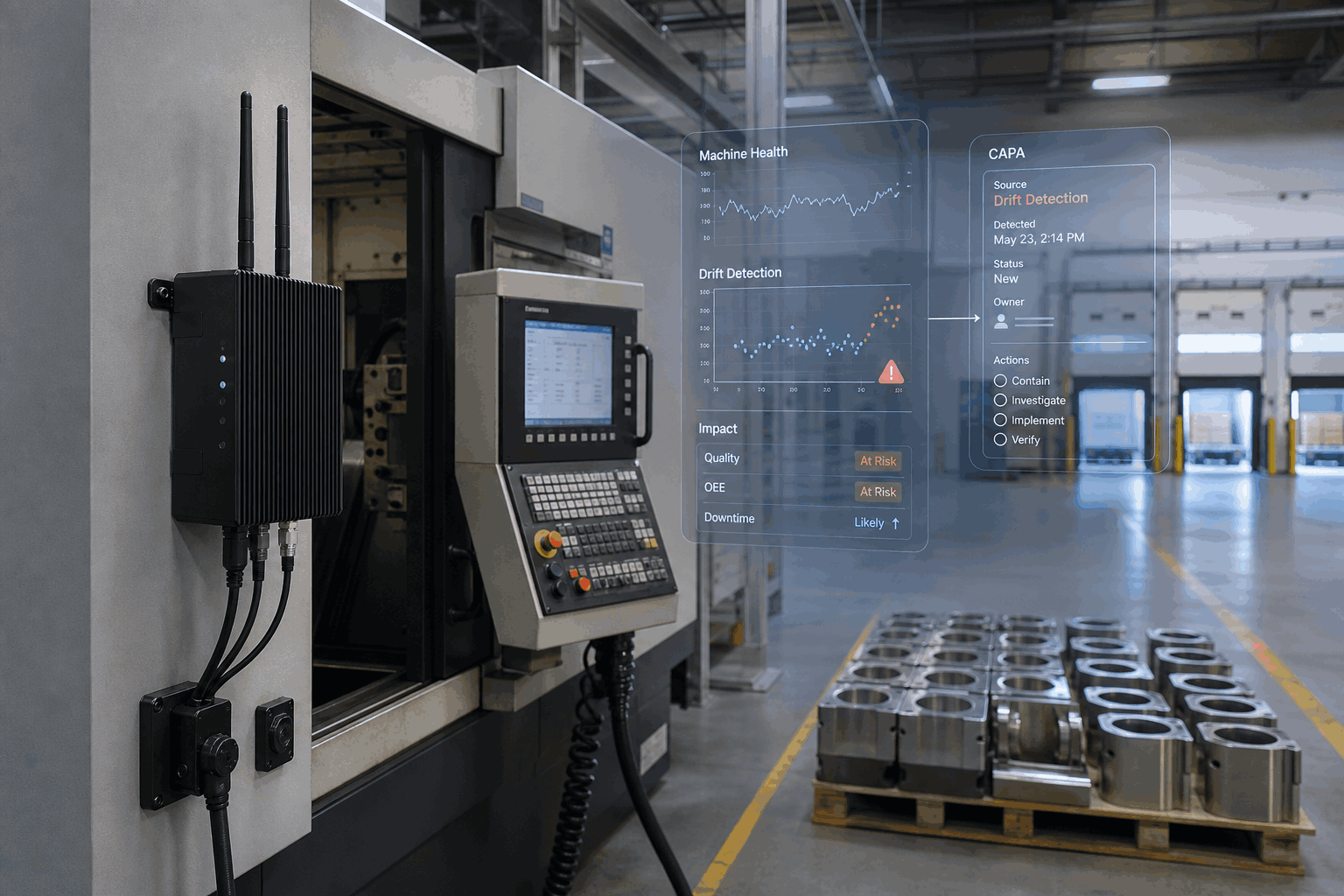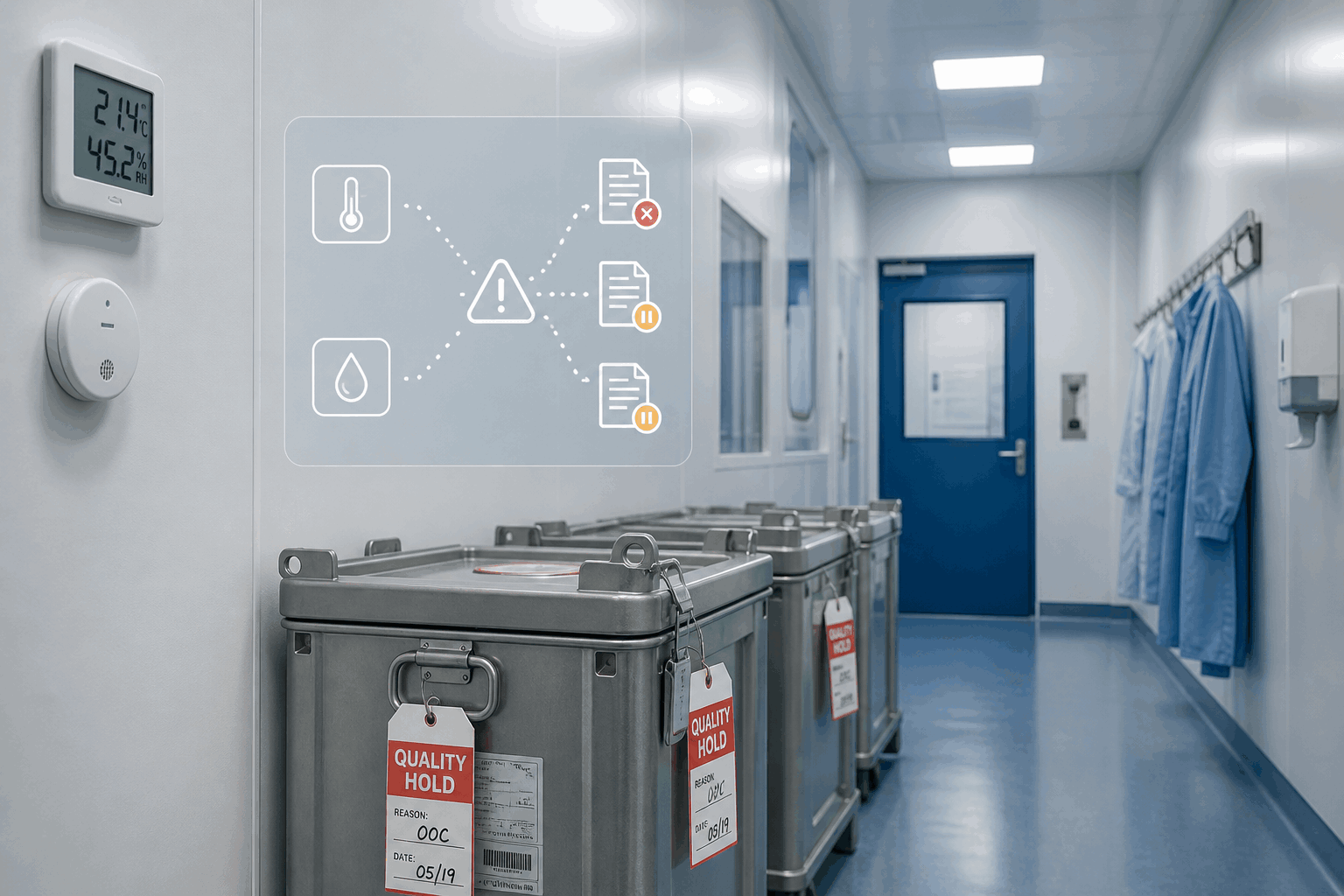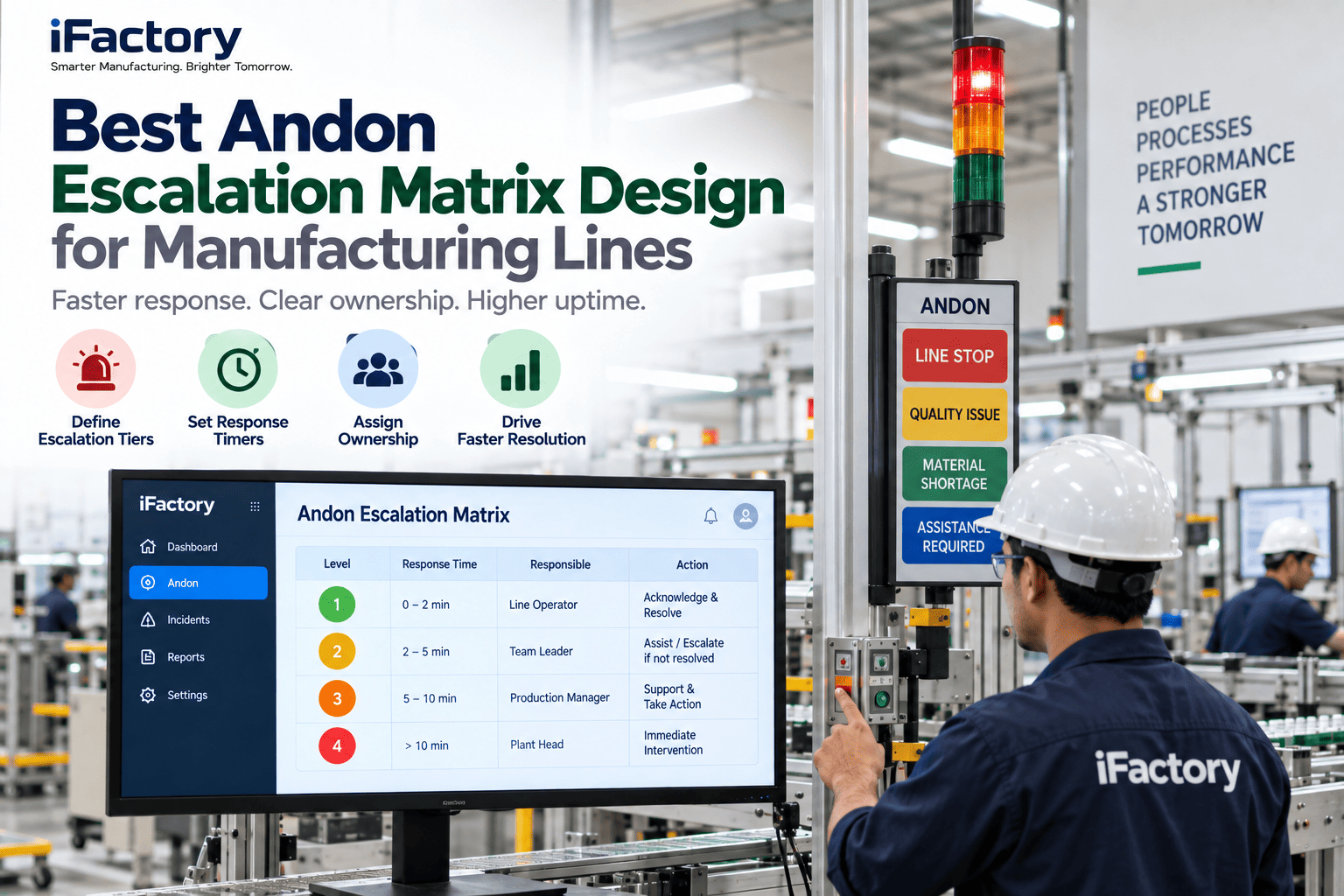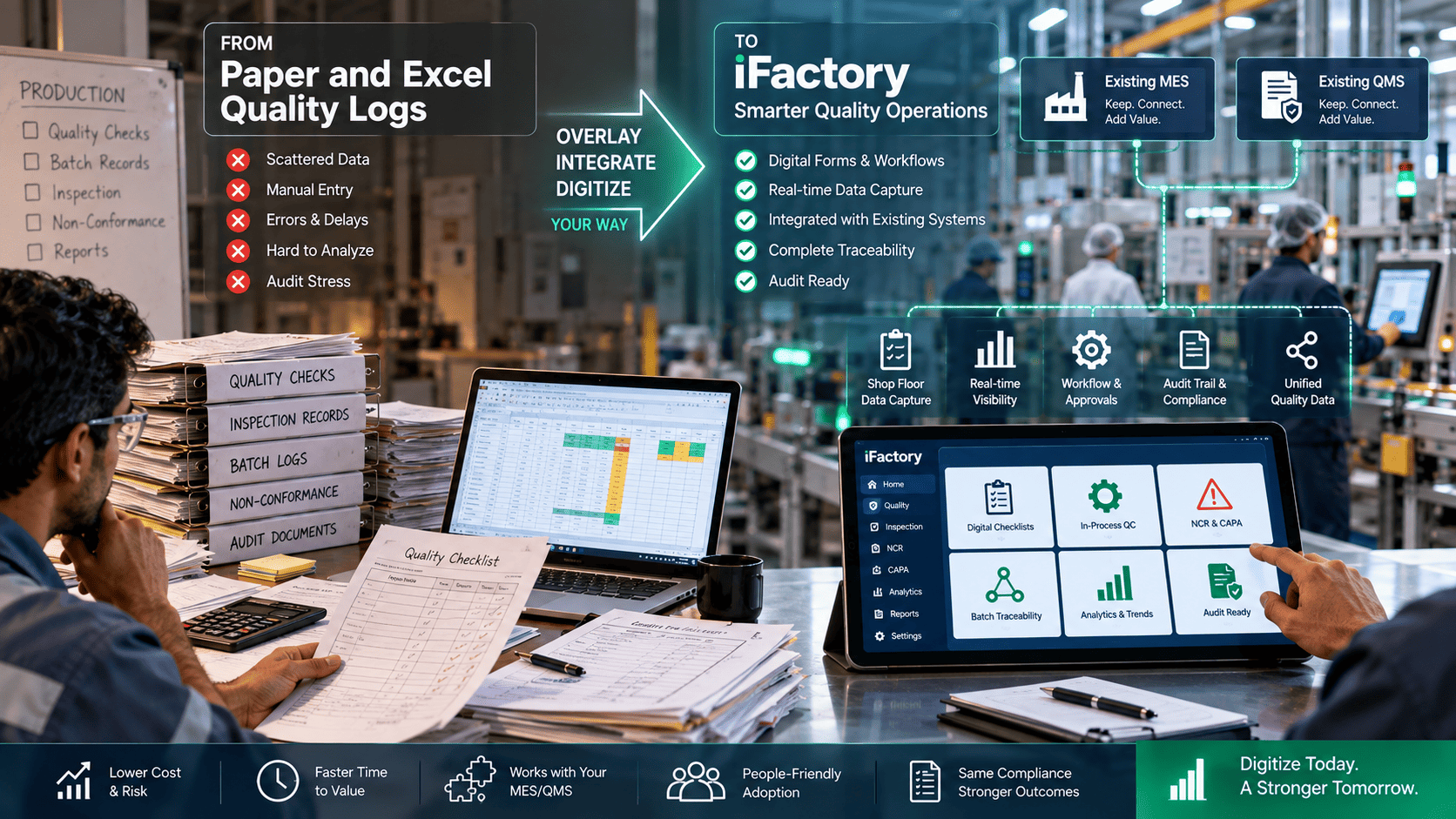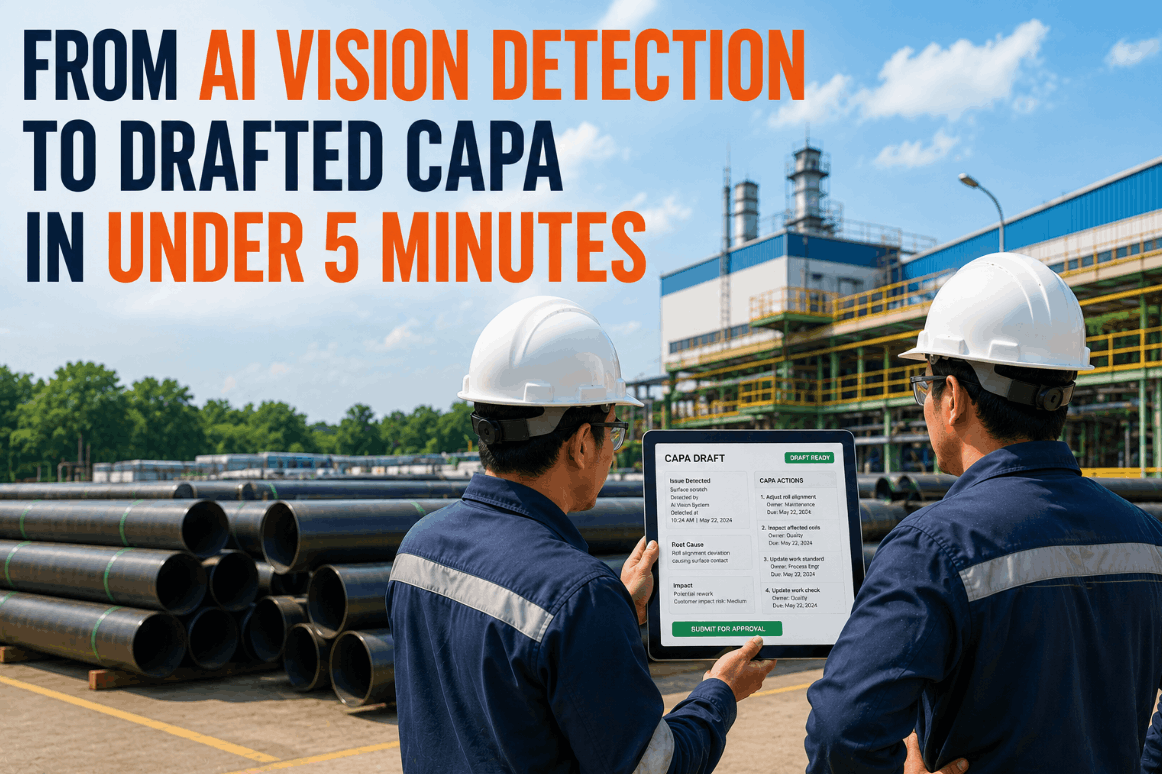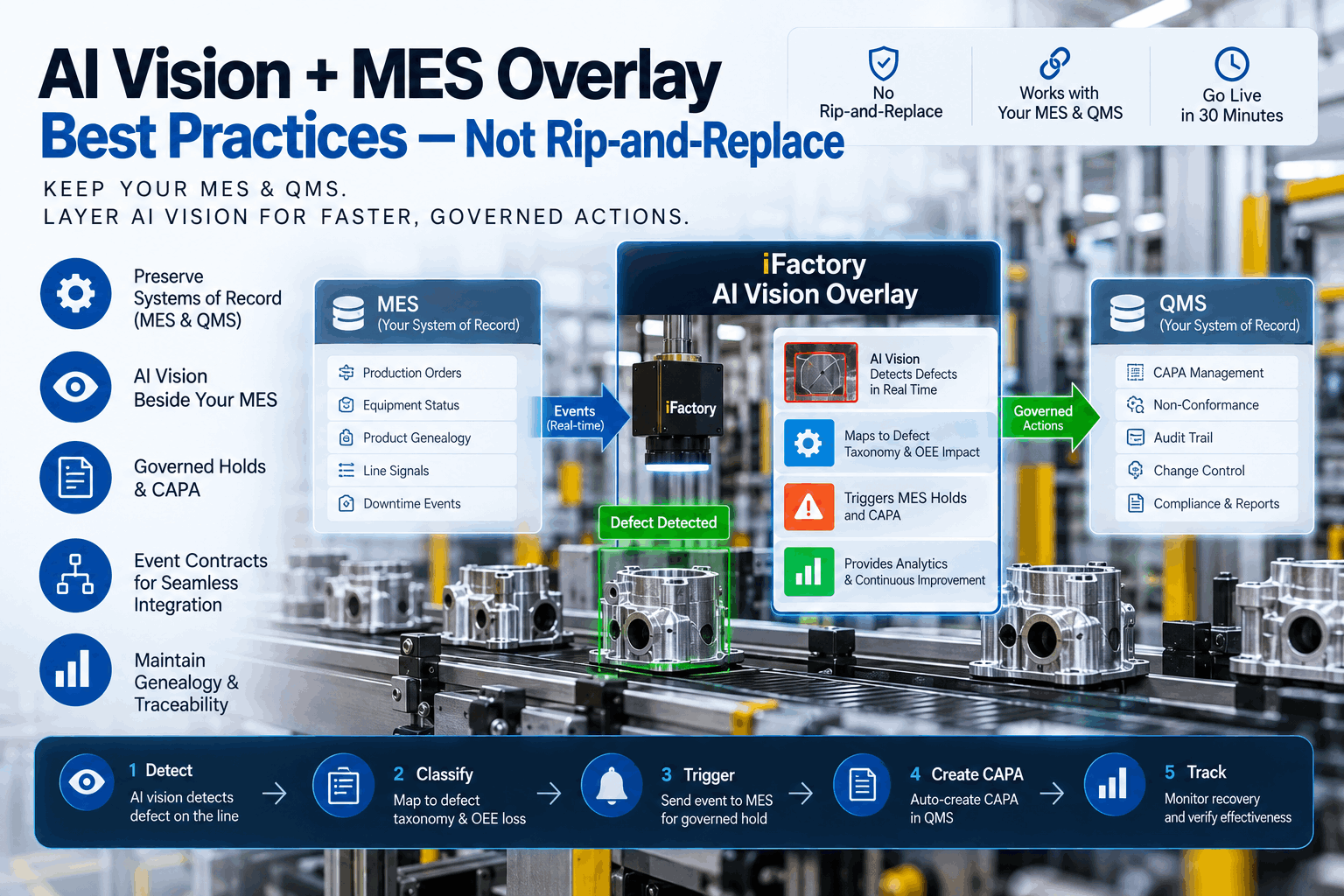
An AI camera can detect a defect in milliseconds, but if the alert never becomes a hold, a genealogy link, and a CAPA-ready record, it is just another dashboard notification. The real question behind AI vision and MES overlay best practices is whether your stack can act fast enough to prevent quarantine lag, false-reject storms, and quality loss from turning into an OEE problem. iFactory AI is the closed-loop overlay that ties vision events to SPC, genealogy, and OEE recovery — without replacing the MES or QMS that already runs your plant. See the overlay pattern in a 30-minute walkthrough.
Preserve MES and QMS as the systems of record. Layer AI vision beside them so signals become governed action, not more notifications.
At a Glance
What AI Vision and MES Overlay Best Practices Really Means
For manufacturing IT and digital quality teams, the phrase is less about camera performance and more about control flow. AI vision can detect scratches, mislabels, missing components, contamination, and alignment issues. But unless that signal becomes a controlled MES and QMS action, it does not improve containment.
Best practice means the vision system is not asked to replace MES, QMS, SPC, or genealogy. Instead, it becomes a quality intelligence overlay that feeds those systems with structured, trustworthy events. The MES still owns production context. The QMS still owns disposition and corrective action. The vision layer adds faster detection, richer evidence, and better traceability. That distinction matters because most plants already have signals. What they often lack is a consistent way to convert those signals into action.
Why Rip-and-Replace Fails in Quality Operations
Rip-and-replace sounds clean in a slide deck and painful in a plant. MES is usually deeply embedded in routing, work instructions, dispatch, holds, label control, and genealogy. Replacing it to add AI vision is rarely necessary — and the failure modes are predictable.
- Alert without authority — the camera flags a defect, but nothing places material on hold
- Hold without context — production stops, but the event lacks station, recipe, shift, and machine state
- CAPA without evidence — the corrective action is written manually and hard to defend later
- OEE without causality — quality loss is recorded, but the root signal is buried elsewhere
- Too much automation, not enough governance — false rejects create quarantine and distrust
- Vision events become structured records the MES can consume
- Holds carry full production context automatically
- CAPA drafts inherit evidence, not manual reconstruction
- OEE loss ties back to the exact signal that triggered it
- Governance layer routes by severity and confidence, not blanket rules
The better pattern is to preserve your MES and QMS as the system of record and layer intelligence around it. That is the core of overlay best practice — modernize the decision flow without destabilizing the production backbone.
Event Contracts — The Backbone of Vision to MES Integration
If the integration is vague, the outcome is vague. A vision event should not be defect detected and little else. It should be a structured manufacturing record that downstream systems can trust. A strong event contract makes the difference between a noisy dashboard and a governed workflow.
Class, sub-class, and confidence score so downstream logic can distinguish severity and route accordingly.
Camera or station ID, machine state, timestamp, product, recipe, and shift for full traceability.
Serial, lot, tray, pallet, or batch identifier so the event ties to a real piece of inventory.
Image or frame reference the reviewer can open without leaving the workflow.
Operator response, quality review status, and current disposition — visible in one place.
Whether a soft or hard hold is active, and what release criteria must be met before it clears.
Walk through a structured event contract, a hold decision, a CAPA draft, and a verified release — beside your existing MES.
Hold Authority, False Rejects, and Human Sign-Off
One of the most important best practices is deciding who can hold product and who can release it. In some plants the answer may be an automated threshold. In others, a rules engine inside MES. In higher-risk environments, a quality manager or MRB reviewer may need to approve the action before release. Most operations need a hybrid approach.
- High confidence and critical defect — automatic hard hold
- Moderate confidence and ambiguous defect — soft hold and human review
- Low confidence and low severity — flag for monitoring, not immediate stop
- Repeated borderline events — escalate to quality engineering
That governance matters because false-reject storms are expensive in ways that are not always visible. They create quarantine backlog, add manual sorting, increase operator frustration, and can make people ignore the next real signal. Best practice is not more automation everywhere — it is the right automation with the right override path.
Genealogy-First Containment and CAPA Traceability
If you cannot trace the defect to the product history, you do not really have containment. You have an alert. Genealogy-first design means every vision event should attach to the correct material identity — serial number, lot or batch, tray, carton, pallet, or unit — along with upstream machine conditions, downstream packaging or shipping status, and the rework or disposition record.
That gives quality teams a real containment path. A defect is not just an image. It becomes a traceable event that can be quarantined, reviewed, dispositioned, and linked to corrective action. This is also where CAPA gets stronger — a CAPA packet is more useful when it includes the defect image, station and machine context, related process settings, nearby SPC behavior, release or hold decision history, and evidence of recurrence or isolation.
Frequently Asked Questions
No. The overlay works beside your MES and QMS by consuming and enriching the events they already produce. It reduces manual reconciliation, not adds to it.
Because without one, every vision station produces a different shape of alert. Governance breaks down and the MES cannot apply consistent hold logic across the plant.
In practice, high-confidence critical defects can trigger an automatic hard hold. Release should always involve human approval, especially in regulated environments.
By attaching defect image, station context, process settings, SPC behavior, and disposition history to the CAPA record automatically, so the team is not reconstructing from memory.
From unfiltered automation. Without severity routing and human review paths, borderline calls create quarantine backlog and erode trust in the vision system.
The best AI vision programs preserve MES and QMS as systems of record and add a governance layer that turns detection into contained, verified action.