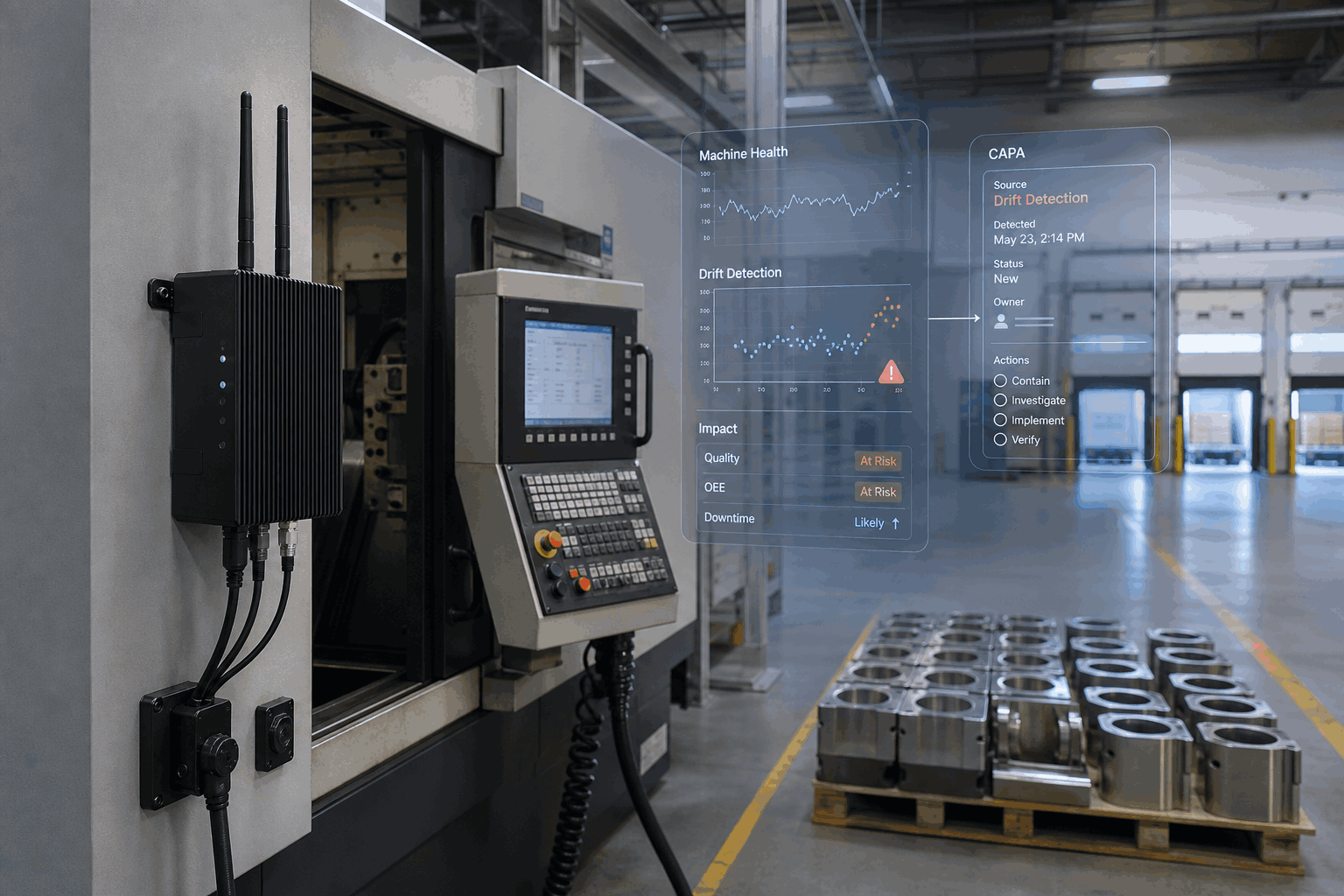
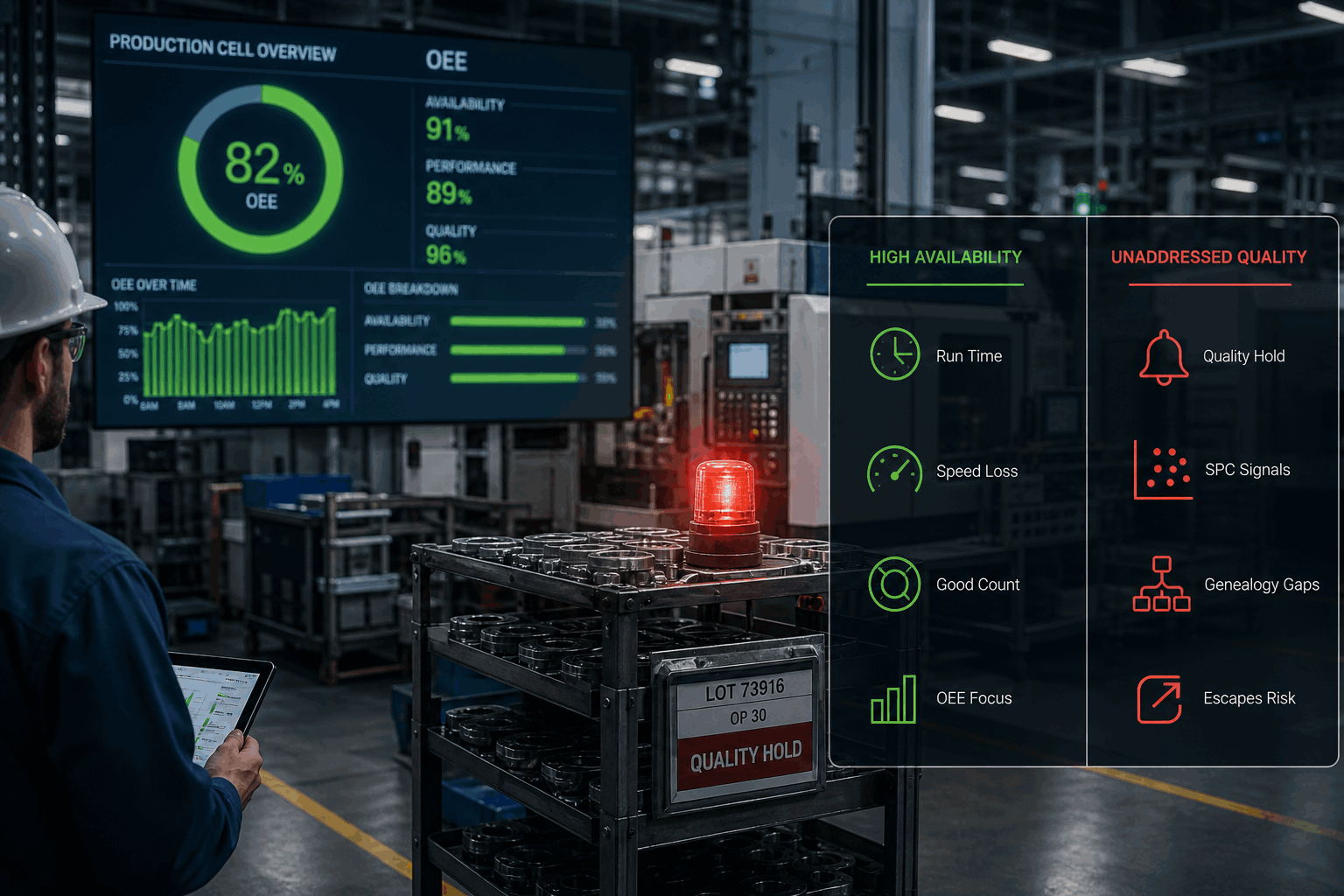
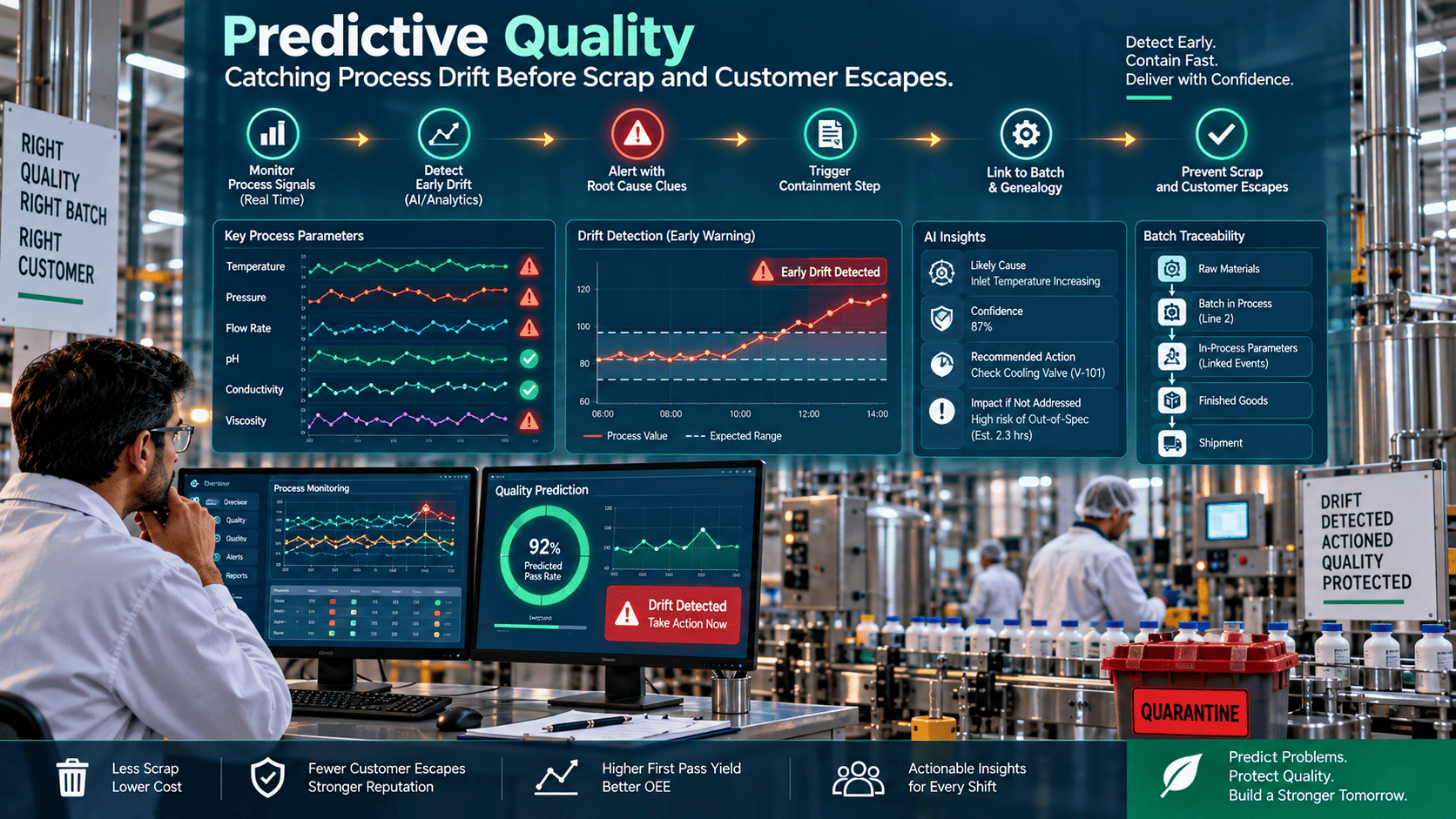
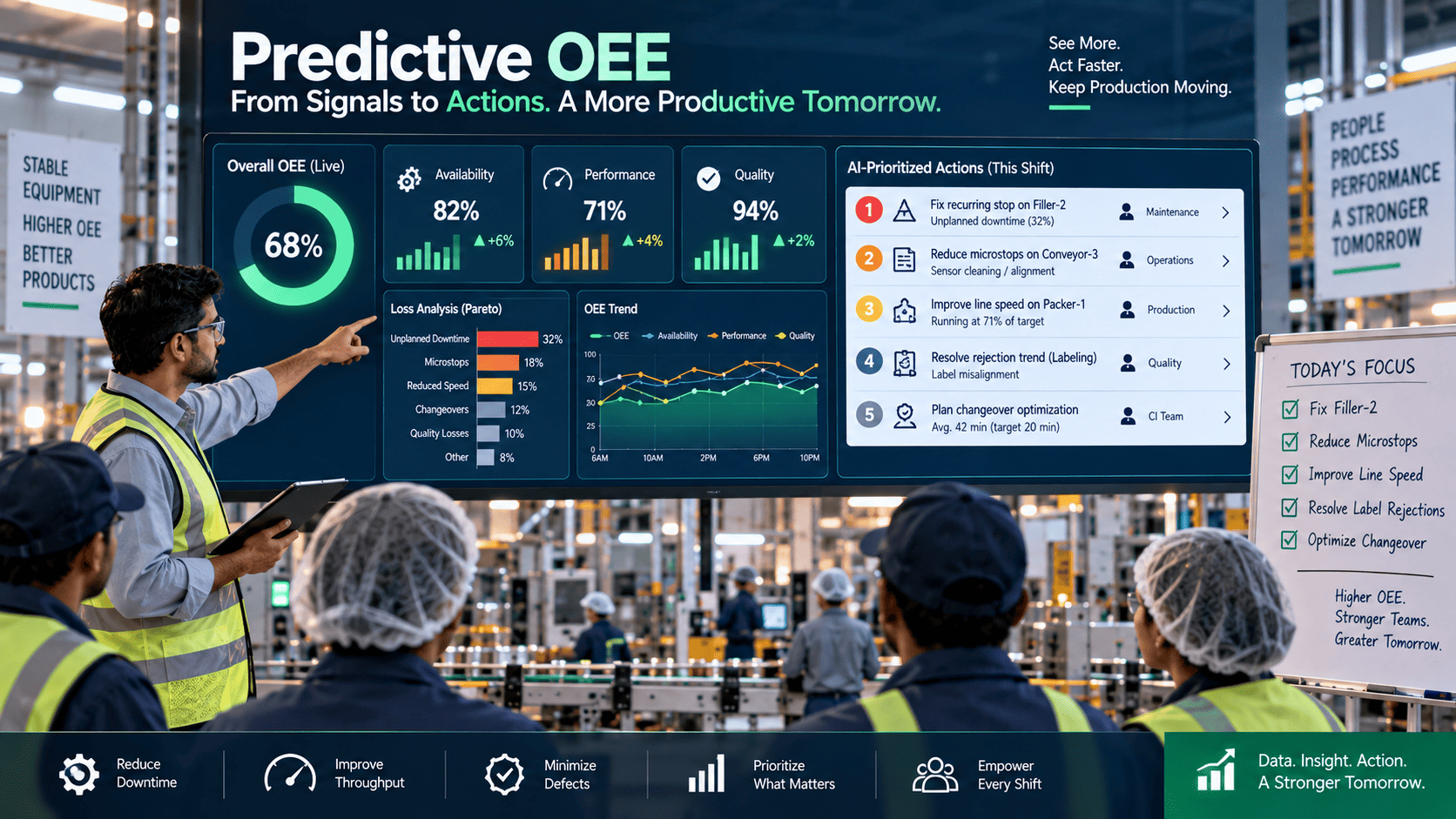
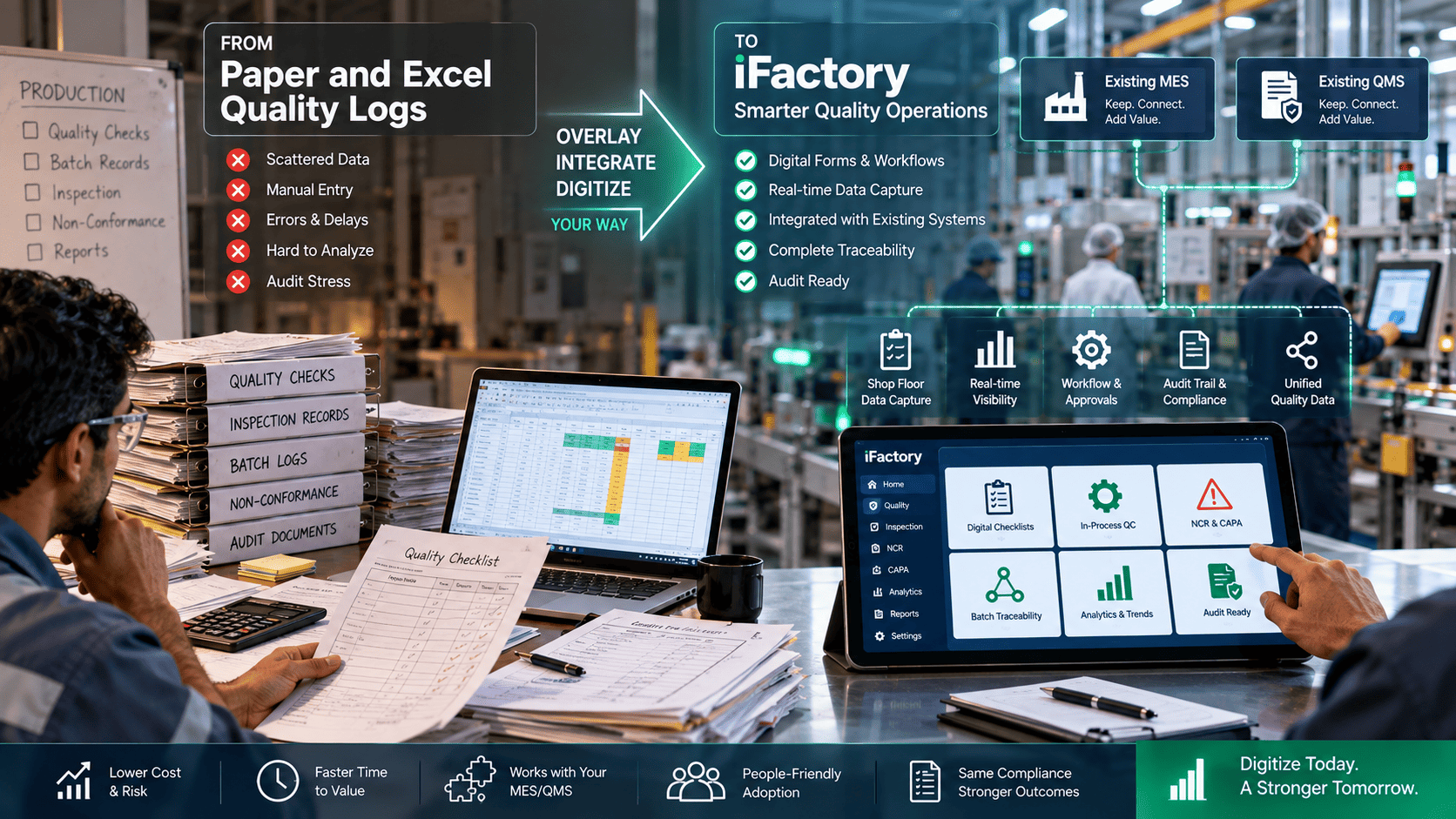
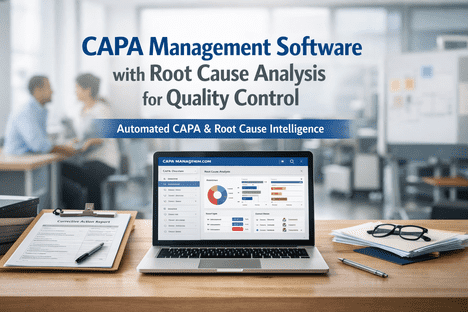
A supervisor discovers a suspect lot on the shipping dock two hours before customer pickup — SPC flagged the drift last shift but the alarm sat in the historian while material kept moving. The gap between detection and enforcement is measured in shifts because SPC rules run on plant historian at plant-server latency and containment depends on someone acting on the chart. Edge computing runs the SPC rules at the machine, at millisecond latency, and drives containment deterministically before the part leaves the cell — while writing hold flags back to MES so the system of record stays authoritative. Enforcement at the source; MES intact.
iFactory / Edge quality overlay
Enforce Quality at the Machine — Not in the Historian Two Shifts Later
Edge computing running SPC rules and pattern detection at machine-side latency, driving deterministic lot holds and CAPA workflows before parts leave the cell — while writing hold flags and CAPA references back to MES/QMS so the enterprise system of record stays authoritative.
Edge node · at machine
SPC + Nelson · latency ~ms · deterministic
↑ ↓
Overlay · plant
Rule orchestration · CAPA workflow · genealogy index
↑ ↓
MES + QMS · system of record
Hold flag writeback · CAPA reference · audit preserved
Edge SPC
ms-latency at machine
MES writeback
authoritative record
The Problem in Historian-Latency Quality Enforcement
A typical plant runs SPC on the plant historian — sensor data streams from PLCs and machines up to the historian, SPC rules evaluate on a server, alarms surface to operators or supervisors on dashboards. The architecture is well understood but slow: sensor-to-historian latency is measurable, rule evaluation runs on a batch cadence, alarm-to-operator-attention is human-paced, and containment depends on the operator or supervisor deciding to act on the chart. By the time enforcement happens, the part has moved down the line, the batch has been packaged, or the shift has ended. The historian-latency architecture is comfortable and familiar; it just isn't fast enough when quality escapes are measured in single-part events.
Where Historian-Latency SPC Actually Fails
Historian-based SPC failure modes are consistent across plants running mature SPC programs. Each is a specific latency gap that edge SPC closes.
Sensor-to-server delay
Sensor data batched at PLC, transmitted at cycle, buffered at historian. Latency of 30 seconds to minutes. SPC rule fires after the affected part has moved to next station.
Chart-to-operator lag
Rule fires on dashboard; operator on other side of cell doesn't see it for minutes. Batch continues; containment happens too late for the cell that caused it.
Server-side rule cadence
SPC rule evaluation runs on scheduled cadence at historian server, not continuously per sample. Detection lag adds to alarm lag.
MES sync friction
Historian-detected event needs manual entry into MES to create hold or CAPA. Sync friction adds hours to the loop, or breaks it entirely when operator forgets.
What Good Looks Like in Edge Quality
A working edge quality architecture holds four disciplines together — SPC at machine, deterministic containment locally, CAPA at edge with MES sync, and full audit preserved.
SPC at Machine
SPC rules (Nelson, Western Electric, custom) computed at edge node adjacent to machine. Sample-by-sample evaluation at millisecond latency. No historian dependency for detection.
ms, not minutes
Deterministic Local
Rule fire drives hold locally — machine interlock, cell exit inhibit, downstream feeder halt. Deterministic response; not dependent on operator action.
Deterministic, not advisory
CAPA with MES Sync
CAPA record created at edge with local evidence; syncs to enterprise QMS via MES with lot IDs and evidence attached. Enterprise system remains authoritative.
Local action, enterprise record
Audit Preserved
Every edge signal, containment, and CAPA step timestamped with machine and lot context. Audit trail flows through MES to QMS — same audit posture, faster enforcement.
Audit intact
How iFactory AI Fits
iFactory AI runs edge agents at machines with SPC and pattern detection, and orchestrates through overlay to MES (SAP ME/MII, Rockwell FactoryTalk, Siemens Opcenter, GE Proficy, Werum PAS-X) and QMS — deterministic enforcement at source, MES writeback for authoritative record.
Edge Agent
Machine Layer
Edge computing node at machine reading PLC tags, vision inspection output, and gauge data directly. SPC rules (Nelson, Western Electric) compute locally with ms-latency response.
Local Enforcement
Edge + Machine
Rule fire drives local hold — machine interlock, cell exit inhibit, feeder halt. Deterministic response. Operator informed with rule and cell context on local HMI.
MES Bridge
Edge + MES
Hold flag written to MES lot record with edge event reference. Standard MES transaction. Downstream MES workflows (release gating, next-station notification) unchanged.
CAPA Sync
Edge + QMS
CAPA created at edge with local sensor data, PLC state, and operator observations. Syncs to enterprise QMS (Sparta TrackWise, MasterControl, ETQ, Veeva) for authoritative record.
Ask your quality systems lead where the last SPC escape actually leaked — at the historian latency, at the operator response, or at the MES sync. Each of those gaps is what edge SPC closes, and the pilot data typically shows one of the three as dominant. Book an edge quality walkthrough.
8-Week Edge Quality Pilot on One High-Risk Line
One high-risk line with frequent SPC alarms, eight weeks. The pilot deploys edge agents at machines, activates local SPC and enforcement, connects MES and QMS sync, and closes the first month of ms-latency quality loop.
Weeks 1–2
Edge Deploy
Edge nodes deployed at pilot line machines. PLC tag connections tested. Baseline current-state SPC alarm-to-hold cycle time from historian-based system.
Weeks 3–4
Local SPC Live
SPC rules active at edge. Local hold enforcement tested. Rule accuracy calibrated against historian-based baseline; false-fire rate under threshold.
Weeks 5–6
MES + CAPA Sync
MES hold flag writeback active. CAPA sync to QMS live. Enterprise systems remain authoritative; edge drives the immediate loop.
Weeks 7–8
Escape Baseline
Full month of edge-driven containment measured against historian-baseline. Escape rate change quantified. Rollout to remaining lines scoped.
Who Owns the KPI
Edge quality crosses manufacturing IT, quality systems, plant OT, and production. Each function owns a specific KPI or the loop stays at historian latency.
Quality Systems Lead
Detection-to-enforcement latency
Owns the loop outcome — time from SPC signal to physical containment. Edge cuts from minutes to milliseconds where it matters.
Manufacturing IT
Edge-MES-QMS sync reliability
Owns the integration outcome — edge event sync to MES hold flags and QMS CAPA records. High reliability enterprise-record integrity.
Plant OT Lead
Edge node uptime + PLC connect
Owns the operational reliability — edge node availability, PLC connection stability, no adverse machine performance impact.
Production Manager
Escape prevented at cell
Owns the outcome — parts caught at cell instead of at downstream inspection or customer. Direct escape prevention.
FAQ
Does the edge node compromise our validated MES environment?
No — edge node runs alongside the machine, not on the MES infrastructure. MES connection is read-write through documented API, same as any other MES integration. Validation impact per site's CSV process for the MES writeback interface only.
What happens if the edge node fails — does production stop?
Fail-safe design. Edge node failure returns the machine to its pre-overlay operational state — historian-based SPC continues to run, operator continues to see alarms on dashboards. Enforcement latency reverts to baseline; production doesn't halt.
How does this integrate with our historian and existing SPC investment?
Complementary, not replacement. Historian continues to collect data for enterprise analytics, trending, and regulatory reporting. Edge SPC runs the same rules for enforcement latency. Where the historian-based SPC surfaces the same event, the two agree; where the edge catches something the historian would surface later, enforcement happens earlier —
book a demo to see the timing difference.
Stop losing quality escapes to historian latency.
Deploy Edge SPC on One Line — Live
Bring one high-risk line's last month of SPC alarm history, current historian-to-hold cycle time, and MES/QMS in use. We'll walk what edge SPC would have caught at ms-latency, and demonstrate the MES writeback preserving authoritative record.