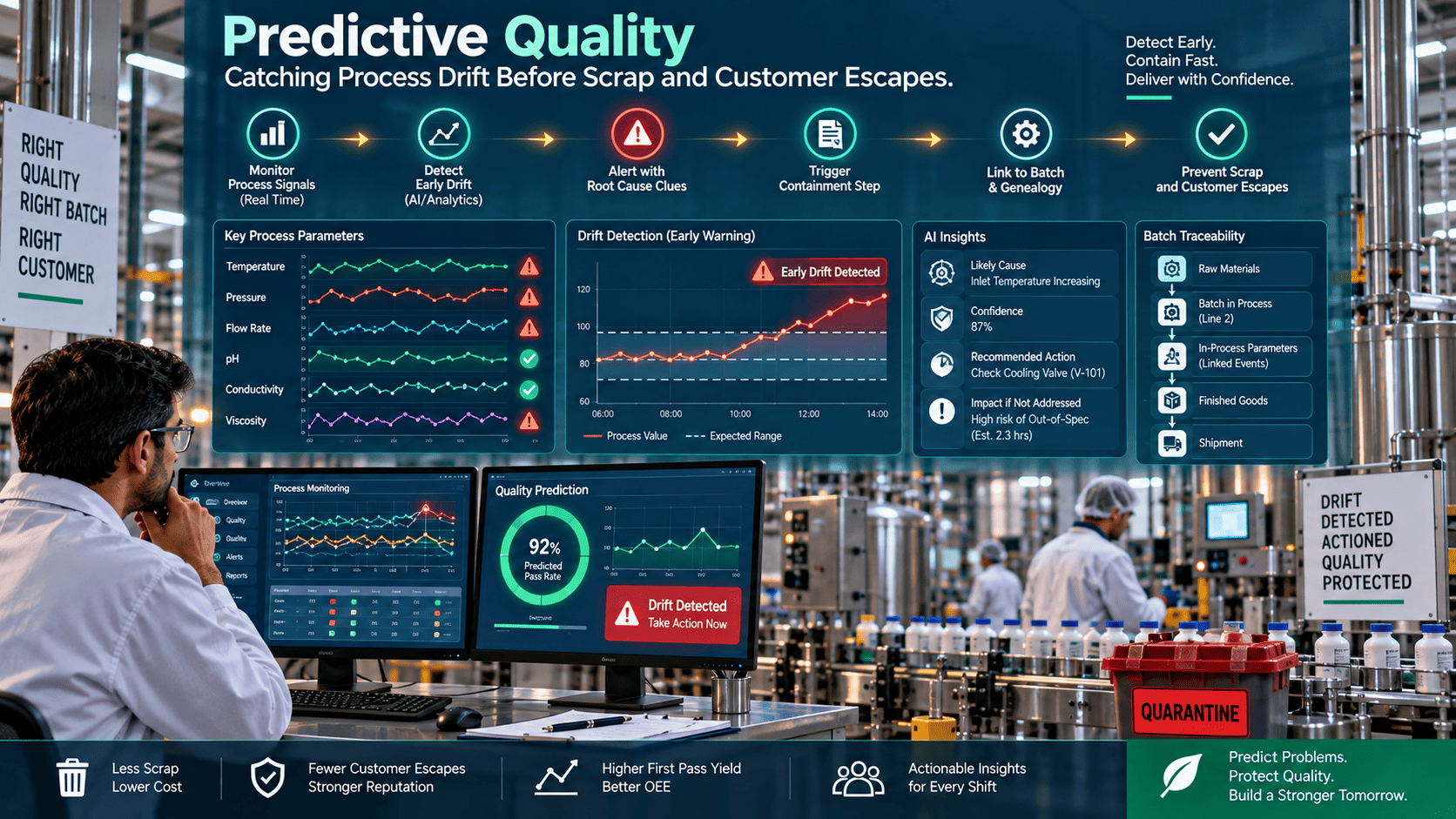
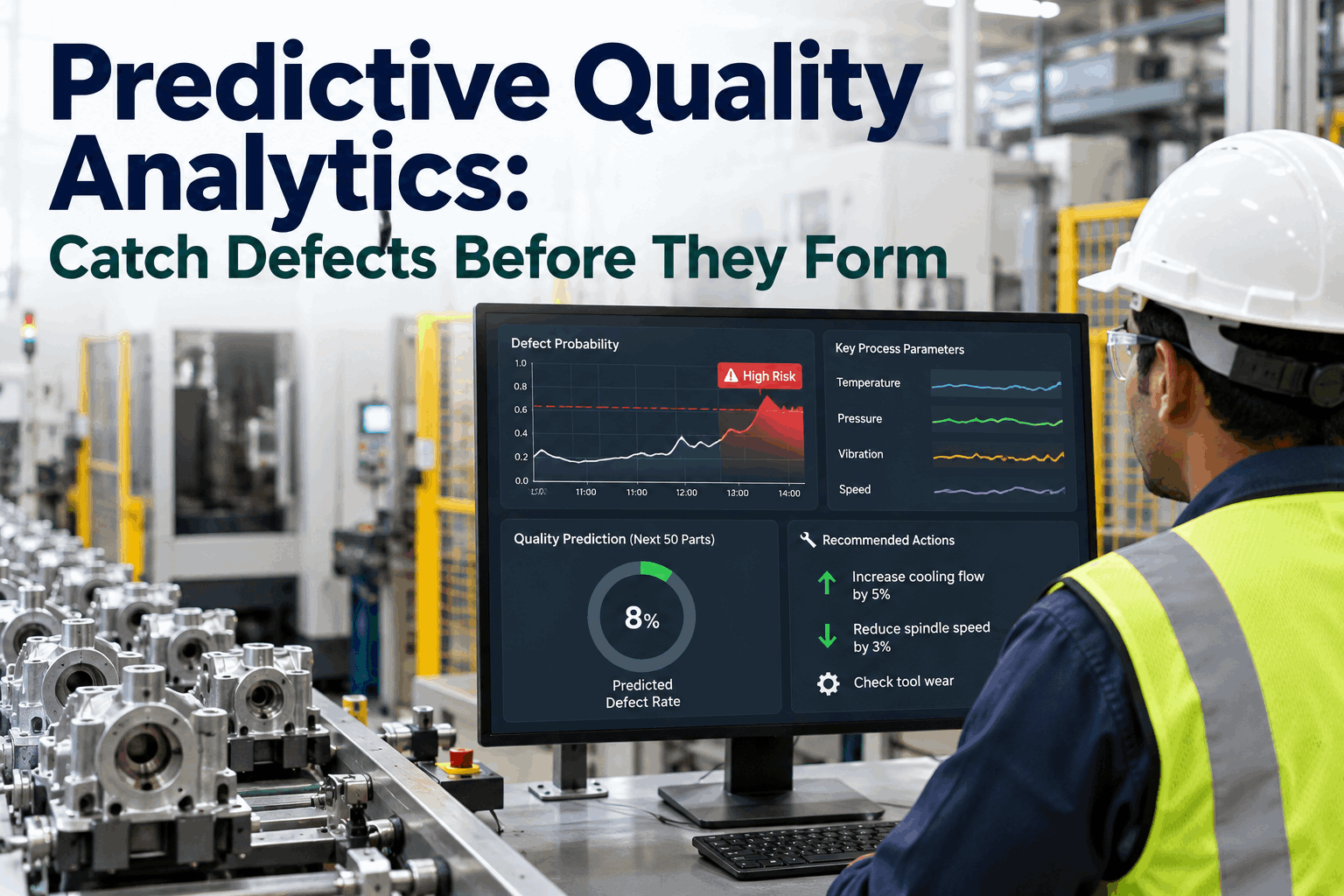
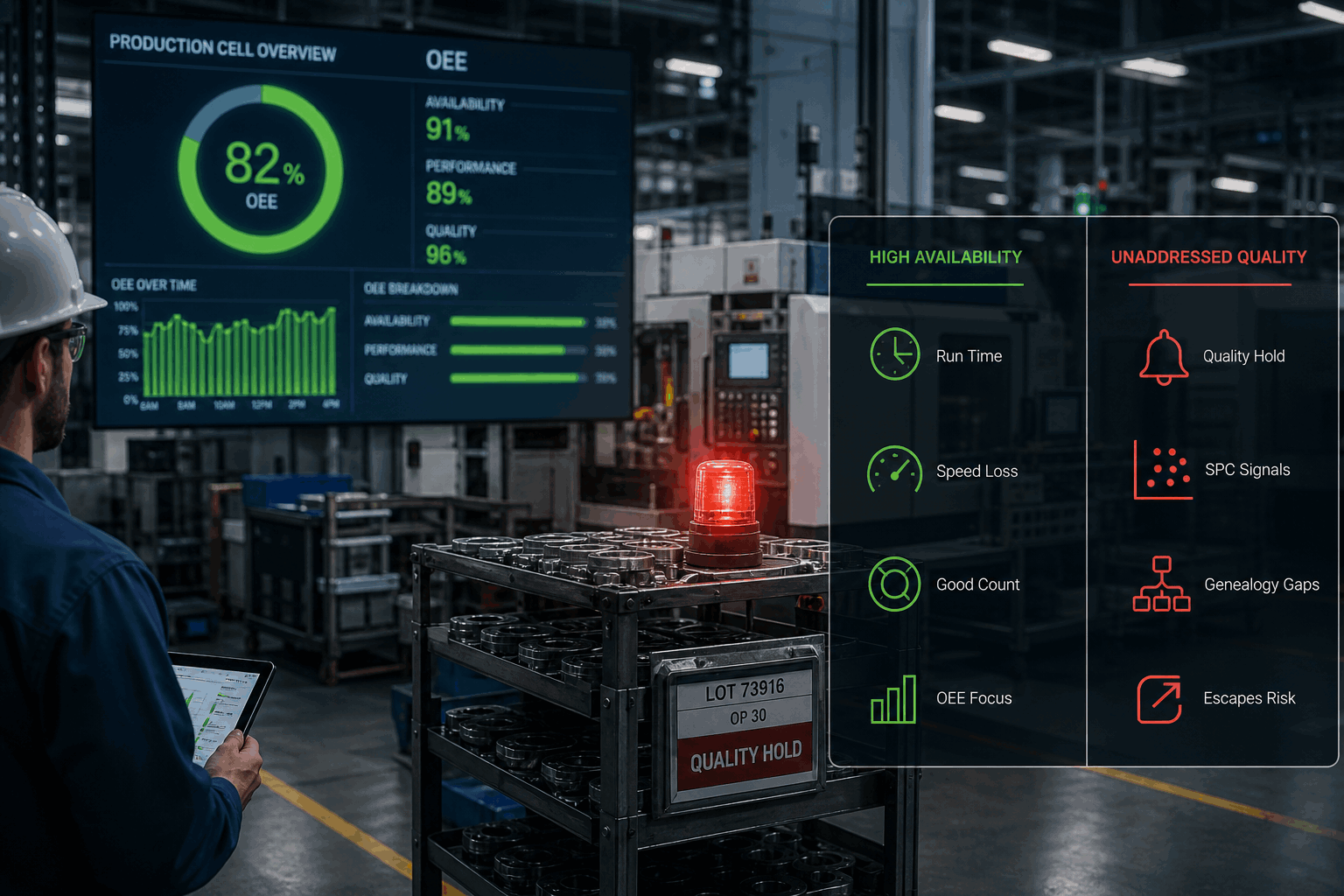
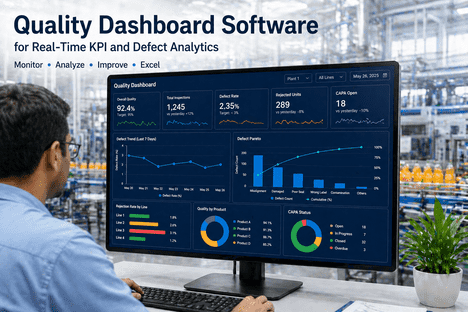
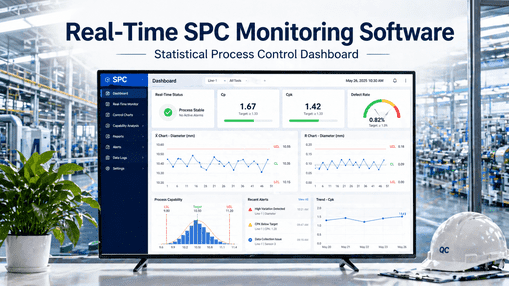
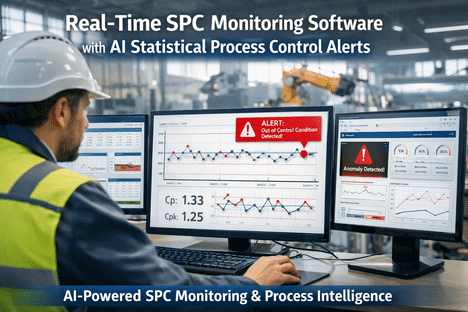
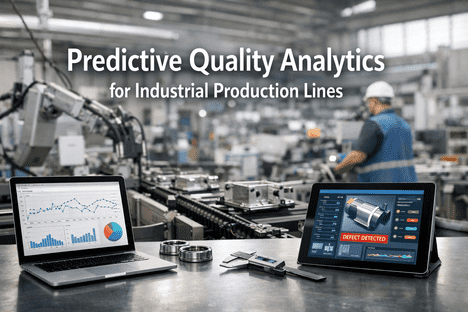
As the morning shift begins, a quality manager reviews a rising trend in fill weights on an in-process dashboard. Instead of waiting for out-of-spec units or a customer call, her team is prompted to check an upstream valve before costly scrap accrues. That is the whole shift in modern quality work — away from reacting to finished-product failures, toward acting on drift signals while the process is still recoverable. It means capturing subtle in-process changes, linking them to batch genealogy, and guiding proportional containment without drowning operators in alarms.
iFactory / Predictive quality & process drift
Catch the Drift While the Process Is Still Recoverable
An overlay detection layer that watches critical in-process parameters against running baselines, ties each drift event to its batch, and prompts a specific containment step — not another red light on a dashboard.
Early drift detected
FILL WT · +1.8%
↓
Pattern matched
PUMP-WEAR · prior events
↓
Batch linked
BATCH-1243 · Line B
↓
Prompted action
Purge · swap cartridge
Drift-first
not out-of-spec-first
Shadow mode
validate before enforcing
Overlay
no rip-and-replace
The Problem on the Floor
Most plants still trigger quality action on lagging indicators — a failed end-of-line inspection, a customer complaint, an out-of-spec audit result. By the time any of those arrive, the cost of scrap, rework, and potential escapes is already locked in. The early signals were there: slow pump wear, a gradual heater overshoot, a torque trend. They were simply scattered across PLC tags, historians, spreadsheets, and operator notebooks with nothing to join them. And the plants that do alert often over-alert, so operators learn to ignore frequent low-value warnings and genuine deterioration slips past with them.
Where Drift Detection Breaks Down
The failure modes are consistent across plants, and each one is addressable once it is named.
Lagging triggers
Action starts at failed inspections and customer complaints, by which point scrap, rework, and escape costs are already committed.
Scattered signals
Early indicators live in PLC tags, historians, spreadsheets, and notebooks. Without an overlay they never become a timely alert.
Alarm fatigue
Poorly tuned thresholds produce constant low-value warnings, so operators stop reading them and real deterioration goes unnoticed.
Vague alerts
“Alert: out of control” tells a floor team nothing. Without a specific check to perform, the signal produces hesitation rather than action.
What Good Predictive Quality Looks Like
Predictive quality is not a black box. It is an operational layer that closes the signal-to-action gap with a few specific behaviors, and it coexists with the MES, QMS, and historians you already run so adoption stays incremental.
Running Baselines
Continuous monitoring of critical in-process parameters against short- and long-term baselines that respect shifts, changeovers, and cyclic variation.
Discipline: contextual limits
Risk-Weighted
Thresholds factor in actual process variation and product risk, avoiding one-size-fits-all SPC limits that trigger constant noise.
Discipline: tuned sensitivity
Specific Prompts
Not “out of control” but “verify dosing pump flow and suction filter; if flow is below X, replace the seal.” The alert names the check.
Discipline: named action
Shared Surface
Drift signals are visible to production, engineering, and quality together rather than siloed in a specialist analytics screen.
Discipline: no silos
Overlay Approach vs Rip-and-Replace
Predictive capability does not require a new plant stack. iFactory AI is designed to sit on top of existing infrastructure — MES, QMS, historians, even manual recording — and tap live tags, read historian snapshots, and accept operator input from tablets or the screens already in use. That matters because it makes the rollout reversible: pilot one line, run in shadow mode where the overlay detects and logs without triggering mandatory action, review the alerts with production and engineering, and expand only as trust builds. No all-or-nothing cutover, and no period where the plant is more exposed than it was before.
How iFactory AI Fits
Mechanically, drift detection combines SPC and SQC concepts with pattern matching and domain-aware rules. Four capabilities carry most of the value:
Multi-Source Ingest
Overlay Layer
Reads PLC tags, SCADA historians, test stands, lab systems, and operator-entered values — focusing on the parameters that most often precede failures.
Sustained-Trend Logic
Detection
Looks for sustained trends, accelerated drift, and multivariate patterns that historically preceded defects, rather than single points that are often harmless.
Genealogy Enrichment
Trace Model
Tags each signal to the current batch, recipe, supplier lot, and recent maintenance events so containment is targeted rather than plant-wide.
Feedback Loop
Action Layer
Captures whether the action was taken and whether quality later degraded, using that record to tune sensitivity and cut false positives over time.
Try this on your highest-scrap line. Pick the last defect that reached end-of-line inspection and work backwards: was there a measurable parameter that moved first, and how long before the defect did it move? If there was a window and nobody saw it, that window is what drift detection buys back. Book a demo and bring that one failure — we’ll map it to the signals you already collect.
An Illustrative Scenario — Line B, Two Hours of Drift
On Line B, fill weights have climbed 1.8% over the last two hours. iFactory AI flags the drift because the pattern matches past pump-wear events, and links the affected units to Batch 1243. An on-screen action suggests inspecting the pump suction filter and performing a two-minute purge, with a threshold: if flow drops below 12 L/min, swap the pump cartridge. The operator logs the check, replaces the cartridge, and weight returns to baseline. The recorded response reinforces the pattern for next time. This scenario is illustrative — it shows how detection, genealogy, and guided action can work together. Actual outcomes depend on sensor coverage and the real process.
Five Steps to Get Started
The sequence matters more than the speed. Shadow mode in step three is what earns operator trust, and skipping it is the most common reason pilots stall.
Step 1
Pick a High-Value Pilot
Choose a process with measurable parameters and frequent or costly downstream failures — mixing tanks, filling lines, thermal processes.
Step 2
Define Critical Signals
List the parameters you already measure and add low-friction sensors only where a real gap exists in a known failure mode.
Step 3
Run in Shadow Mode
Let the overlay detect and log drift without triggering mandatory action. Review every alert with production and engineering to validate relevance.
Step 4
Tune Thresholds
Refine what counts as meaningful drift for this process and codify the containment steps into short, specific instructions.
Step 5
Expand and Institutionalize
Roll to more lines, link outputs into QMS records, and include drift logs in CAPA and root cause workflows so the learning compounds.
Step 6
Review Sensitivity
Revisit false-positive and false-negative rates on a fixed cadence with the operators who respond to the alerts, not just the analytics owner.
Where Predictive Quality Meets SPC, Genealogy and OEE
Drift detection is strongest as one layer among several reading the same underlying record. Each adds a dimension the others cannot supply alone.
SPC / SQC
Statistical rules plus pattern history
Control charts catch the excursion; drift models catch the slope that precedes it. Together they cover both acute breaches and slow deterioration.
Genealogy
Drift tied to a specific lot
When drift is detected, the overlay ties the event to the current lot or batch so containment, recall-risk assessment, and root cause stay targeted.
OEE
Quality loss before it becomes scrap
Drift that is contained early never becomes a quality loss on the OEE tree, which is where the operational benefit actually shows up.
QA / Compliance
Documented containment decisions
Operator responses, checks performed, and outcomes are recorded against the drift event, feeding CAPA and root cause with real evidence.
What This Cannot Do
Sensor coverage sets the ceiling. Drift detection is only as good as the signals available, and if a key parameter is not measured, that failure mode will be missed. Sensitivity is a genuine trade-off: catching more early issues raises alarm noise, and tuning is ongoing work that depends on operator feedback rather than a setting you choose once. The system recommends containment and documents actions — it does not remove the need for qualified QA judgement. And not every drift leads to a defect; some deviations self-correct with no downstream impact. The value is in prioritizing likely risk, not in eliminating uncertainty.
FAQ
Will predictive drift detection create too many false positives?
It can if deployed without tuning. iFactory AI balances sensitivity using contextual history, risk-weighted thresholds, and operator feedback. Start in shadow mode to learn the right sensitivity for your process before automating alerts.
Book a demo to see how shadow mode is set up.
Do I need to replace my MES, QMS, or historian?
No. iFactory AI is designed as an overlay. It reads live signals and exchanges context with MES, QMS, and historians so you can add predictive capability incrementally rather than through a cutover.
How long does setup take, and what data is needed as a minimum?
Setup time varies. For a focused pilot with existing digital signals, you can start detecting basic drift patterns in days to a few weeks. If many signals are on paper or in spreadsheets, plan for a longer initial data-collection and mapping phase. The minimum is timestamps, key parameter values such as temperature, pressure, or flow, and batch identifiers.
What if most of my data is in spreadsheets or on paper?
You can begin with hybrid workflows — manual mapping of spreadsheet columns and operator-entered checks. iFactory AI supports incremental digitization, so you start with the highest-risk signals and expand over time.
Can detected drift be linked back to specific batches for traceability?
Yes. Genealogy integration is central. When drift is detected, the overlay ties the event to the current lot or batch so containment, recall risk assessment, and root cause analysis are targeted rather than broad.
See it in the context of your line.
Bring One Recurring Defect — We’ll Look for Its Early Signal
Predictive quality is best judged against a failure you already know. Bring one recurring defect from a mixing, filling, or packaging line and we’ll walk through how drift detection would overlay your existing signals and genealogy.
Shadow first
validate before enforcing
Batch-linked
targeted containment