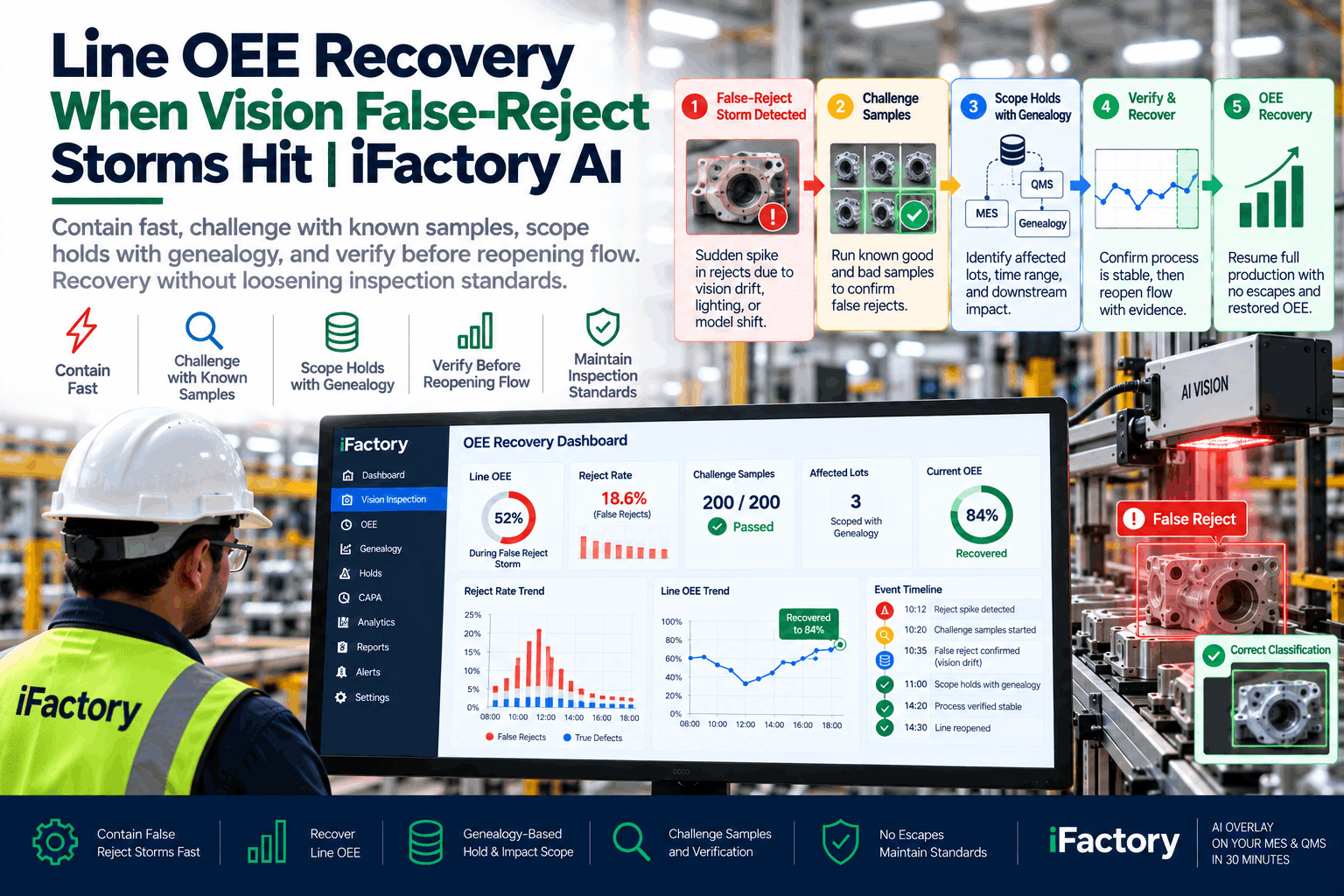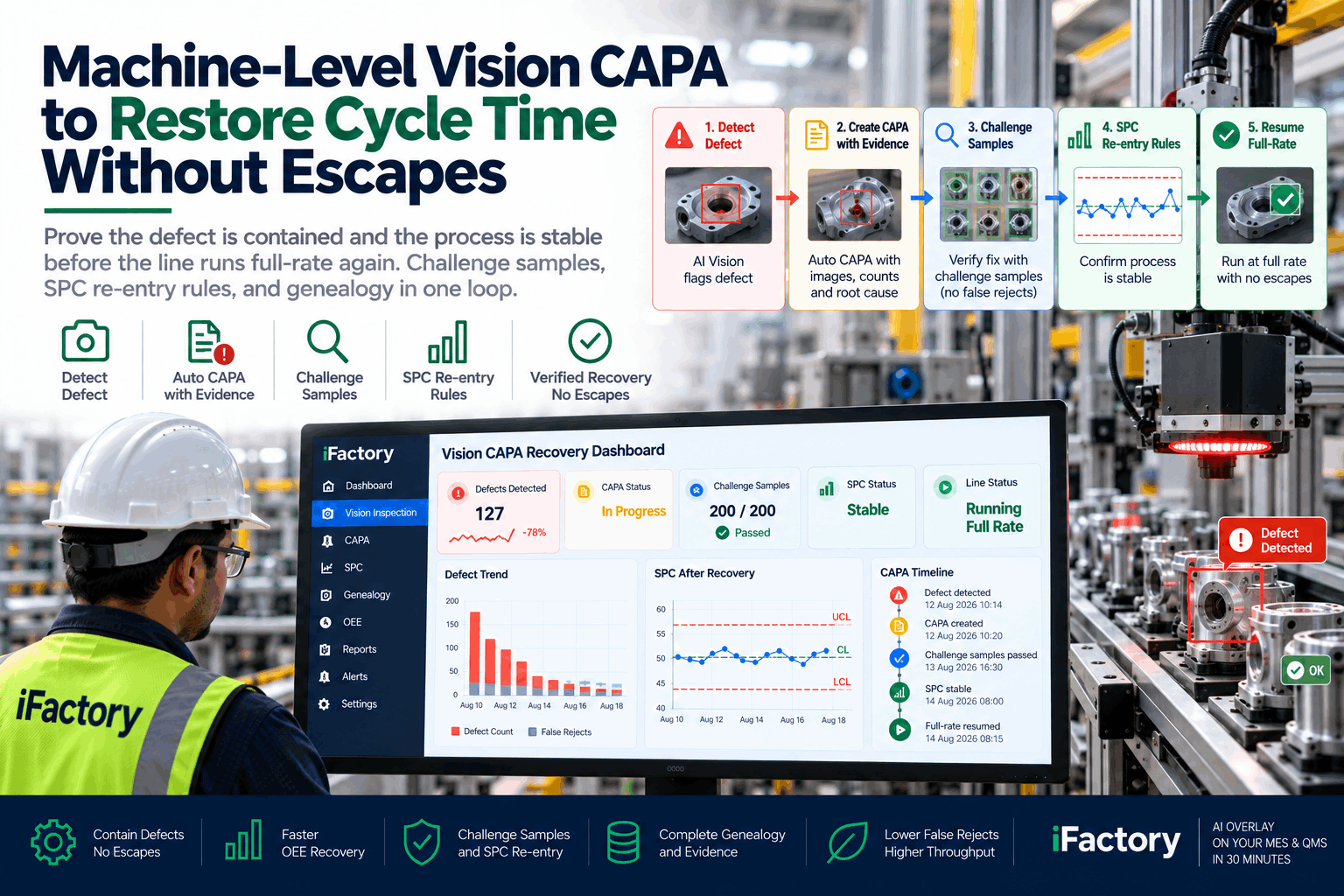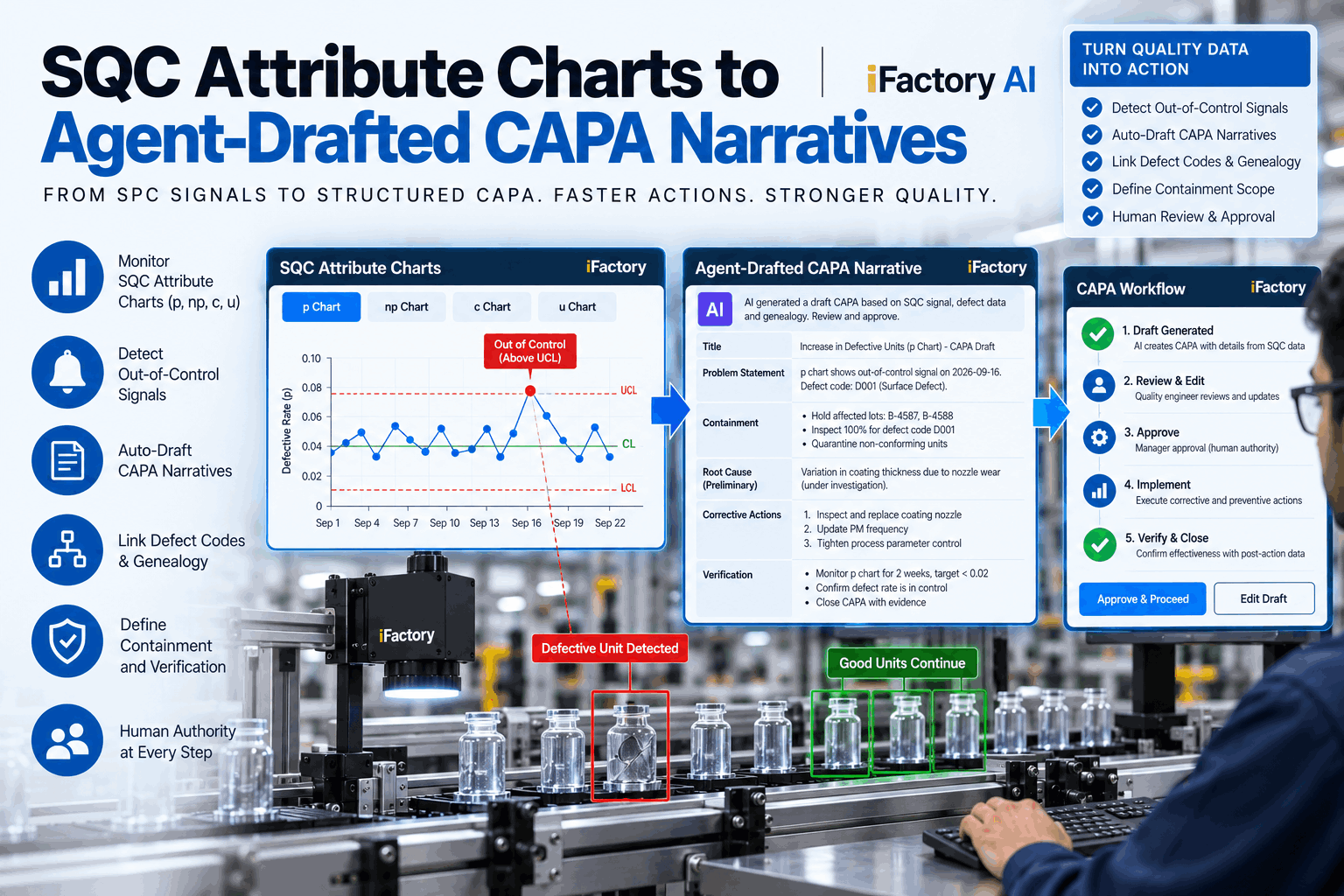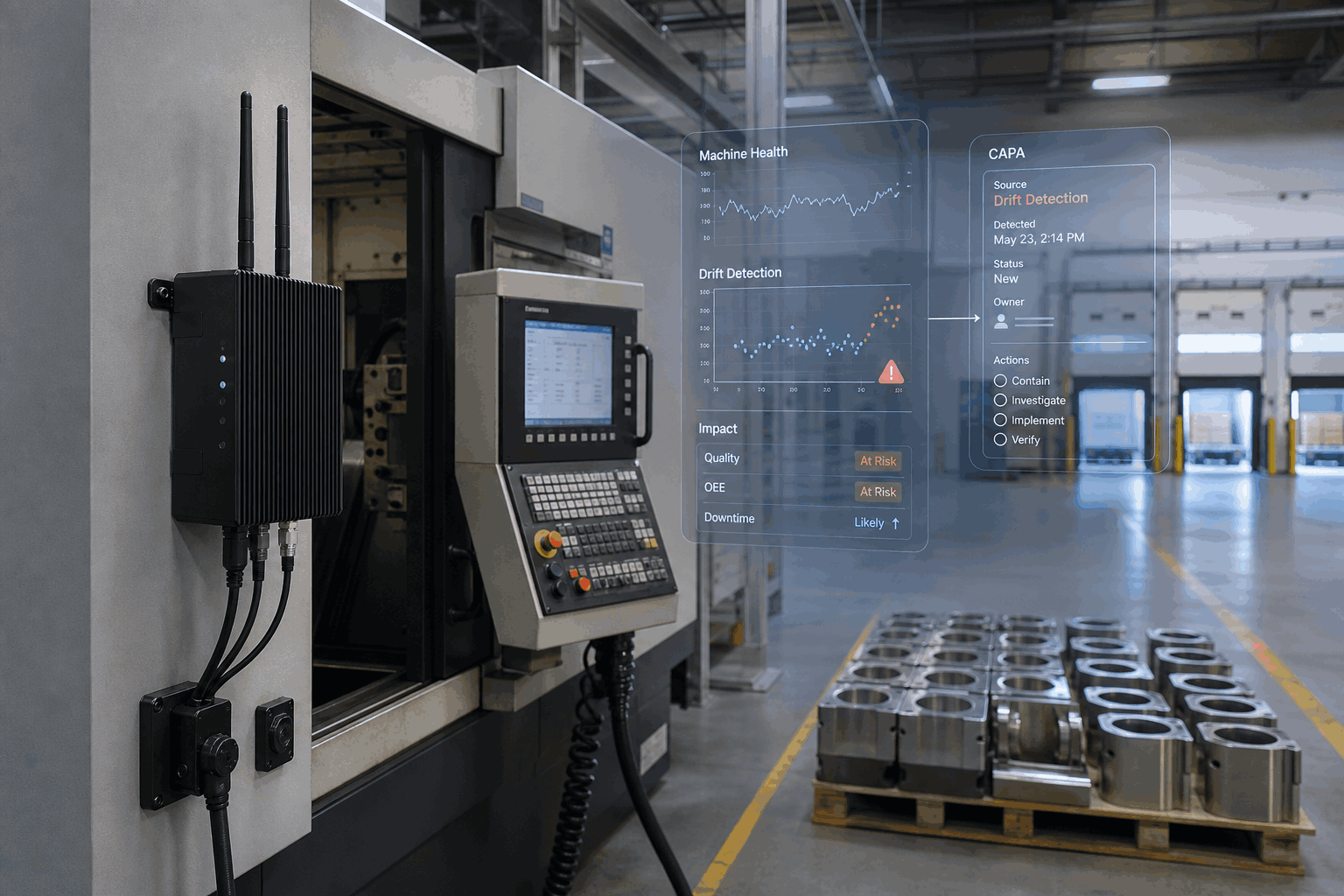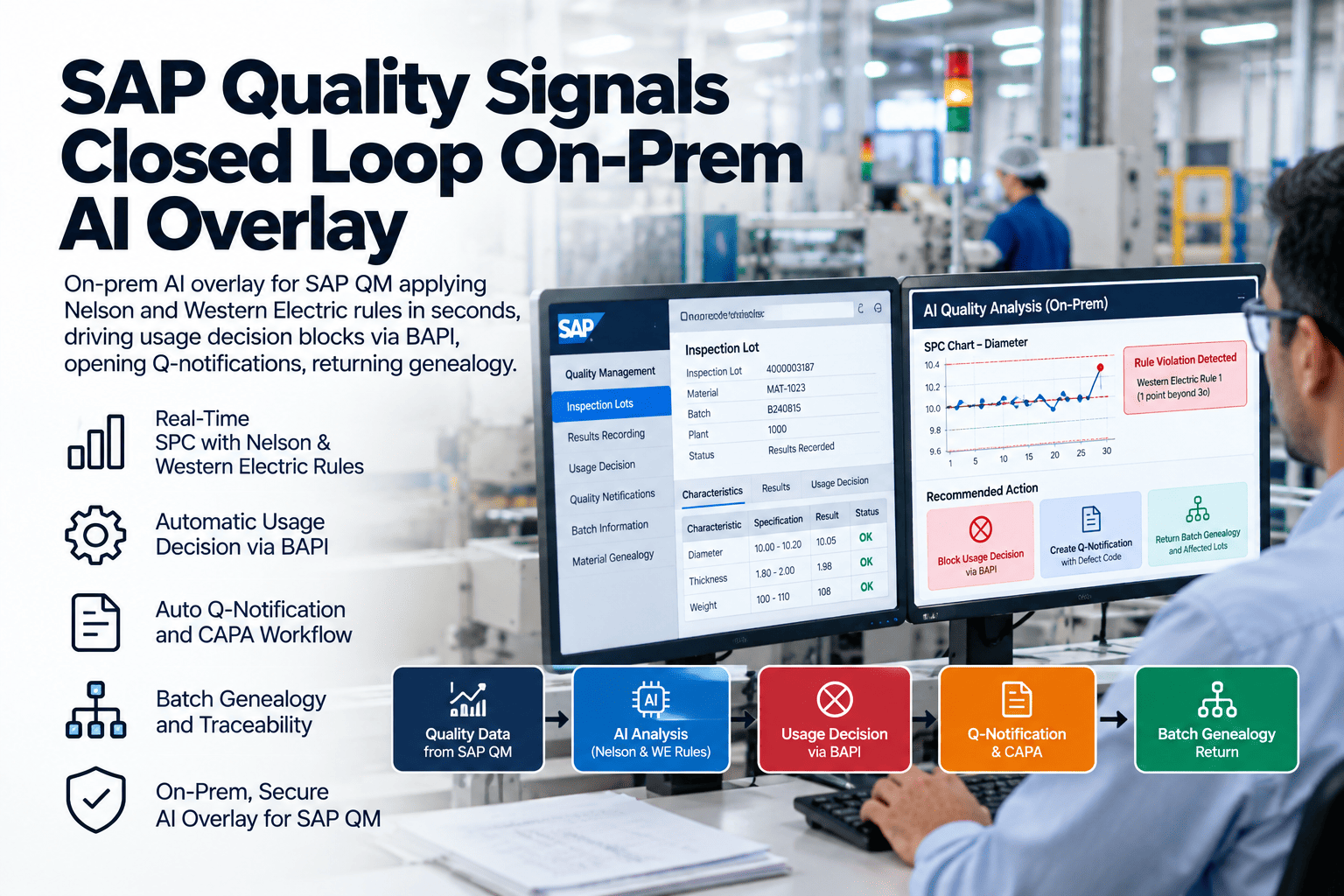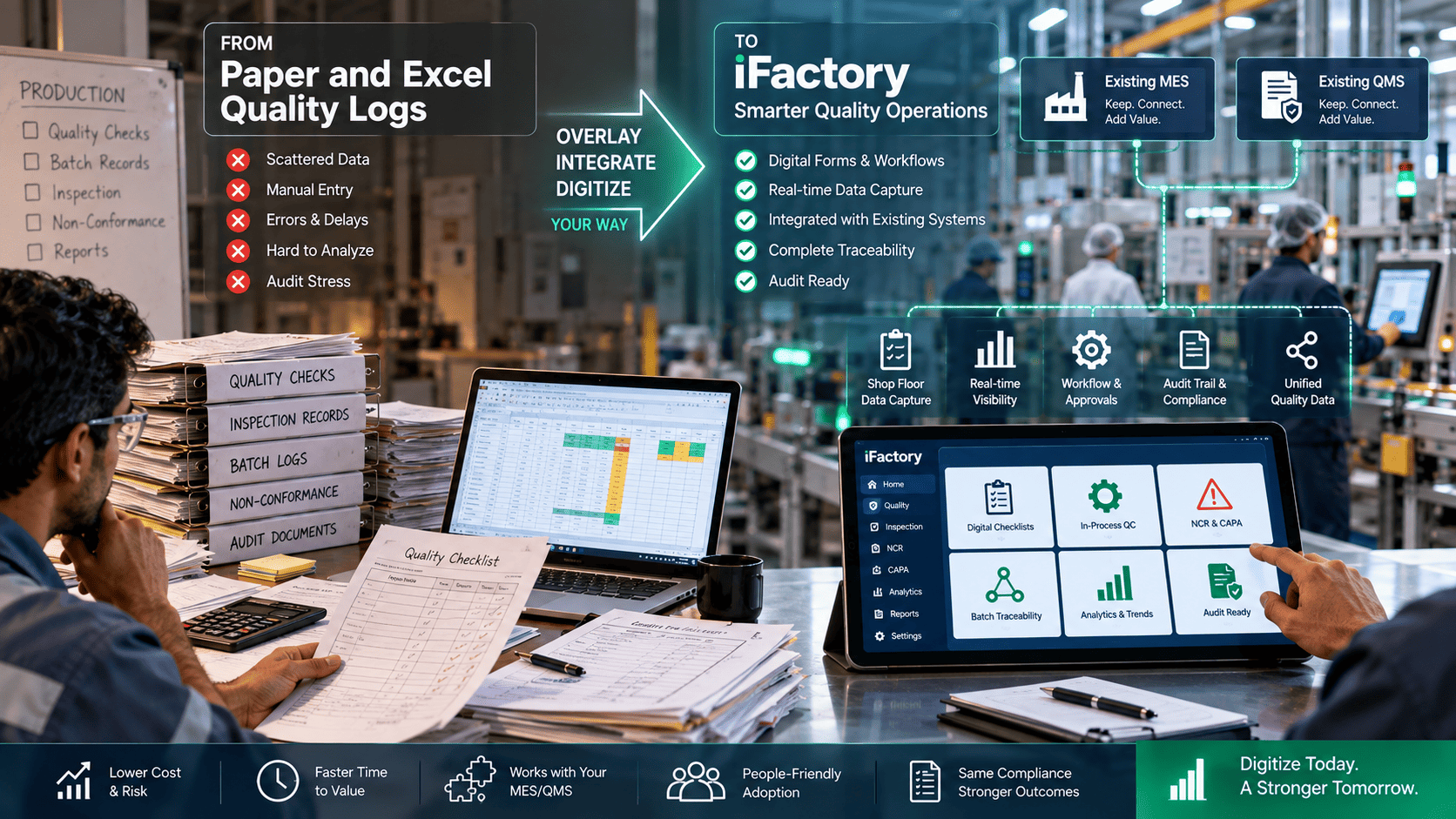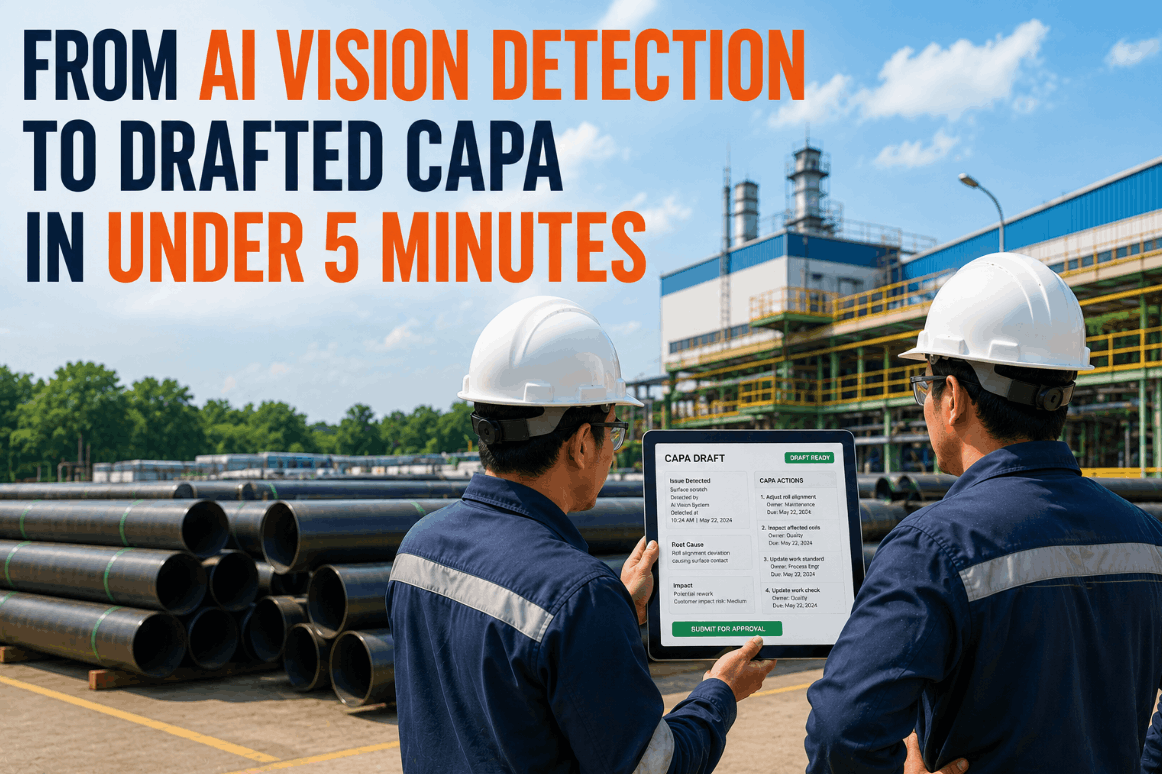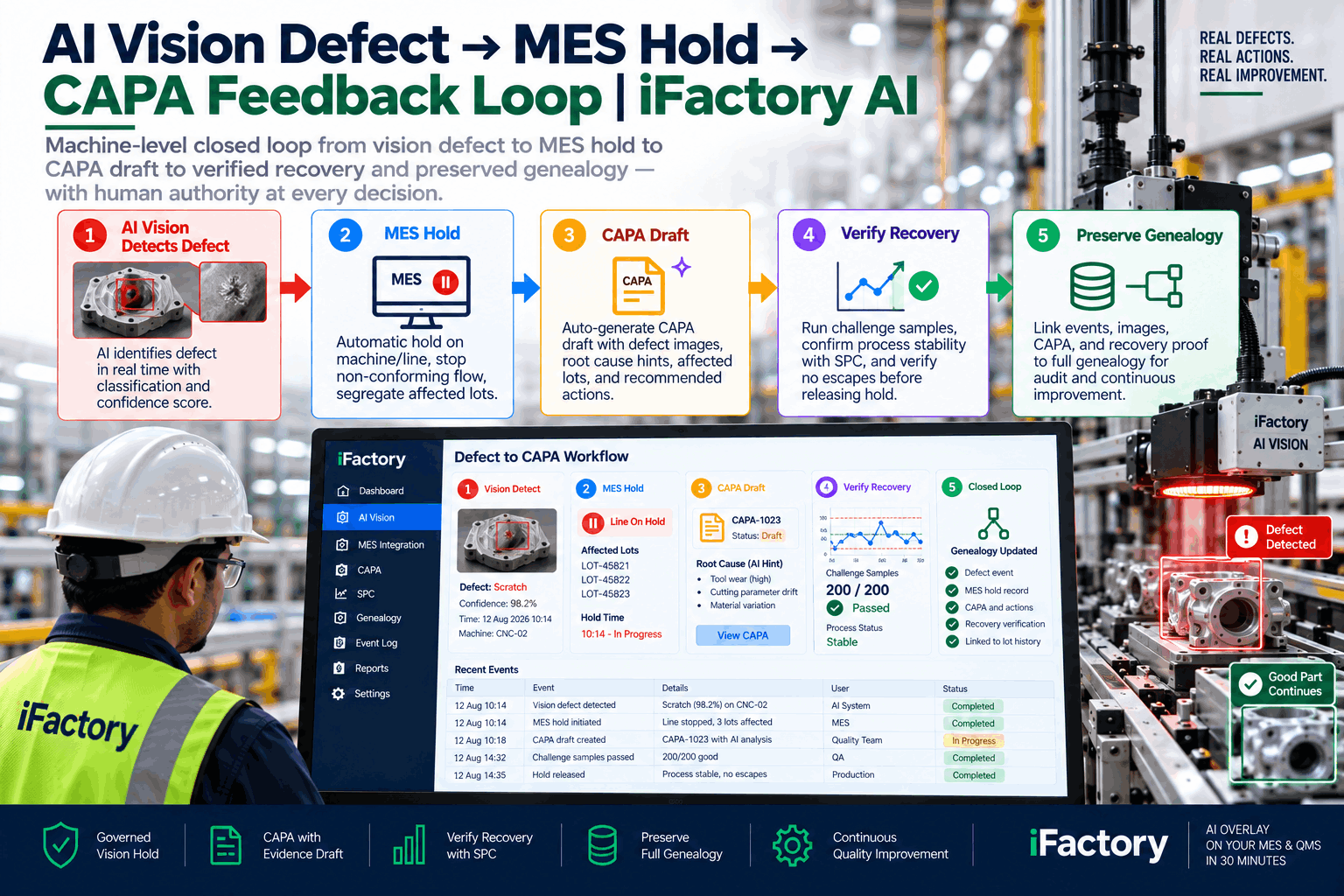
A defect can be detected in milliseconds, yet the bad WIP still moves, the hold reaches the MES too late, and the shift team ends up chasing mystery scrap instead of controlling it. That gap is where the AI vision defect to MES hold to CAPA feedback loop has to work — signal, quarantine, corrective action, verify, genealogy, and recovery, at the machine level. iFactory AI overlays your existing MES, QMS, historian, and SPC stack with the orchestration layer that turns detection into governed containment, evidence-linked CAPA drafts, and verified recovery — without replacing the systems already running your plant. See the machine-level closed loop in 30 minutes.
Turn a vision defect event into a machine-scoped MES hold, a review-ready CAPA draft, verified recovery, and clean genealogy — with human authority preserved throughout.
At a Glance
Why Defect Detection Alone Is Not Enough
Most plants do not struggle to see defects. They struggle to close the loop fast enough. A camera can classify a flaw instantly, but if that event stays trapped in a vision dashboard, the line keeps producing bad parts, the operator keeps guessing, and quality has to reconstruct the story later. By the time someone writes the CAPA, the evidence is scattered across images, shift notes, lot records, and manual comments.
That is the core problem behind many quality losses: the defect is known but containment is delayed, the hold exists but is not scoped tightly enough, the cause is suspected but genealogy is incomplete, the CAPA is written but lacks process context, and the fix is applied but recovery is never verified. In other words, the plant has visibility without governed action. The AI vision defect to MES hold to CAPA feedback loop is meant to change that by moving from we saw it to we contained it, corrected it, and confirmed the line recovered.
The Eight-Step Machine-Level Loop
The best closed-loop design starts at the machine, not the enterprise dashboard. Each step preserves evidence for the next one, so containment, correction, and recovery all trace back to the same defect event.
AI vision flags a surface flaw, missing feature, contamination, misalignment, label issue, or other defect class in milliseconds.
Attach station ID, machine ID, SKU, lot, timestamp, shift, recipe, and image evidence so the event is more than a bare alert.
MES receives a machine-scoped event and places the right WIP segment on hold or quarantine — narrow enough to protect throughput, broad enough to protect quality.
The event package pre-populates the quality record with defect class, station context, genealogy, trend history, and supporting images.
Quality or manufacturing engineering confirms disposition, overrides if needed, and approves the next action with authority preserved.
Depending on risk, the plant releases material, expands hold scope, or escalates to a broader containment action.
The system watches post-action defect rate, reject rate, and line behavior to confirm the correction actually worked.
The defect, hold, CAPA, and disposition become part of the traceability record so future recurrence is easier to spot.
Why Hold and CAPA Have to Move Together
A hold without a CAPA becomes a pause. A CAPA without a hold becomes paperwork. The value appears when both are connected through the same event. For plant quality teams the MES hold should do more than block material — it should carry enough structure to answer which machine triggered the event, which defect class was detected, which lot or serial is affected, what evidence supports the hold, who approved the disposition, and what change was made to prevent recurrence.
That is why machine-level scoping matters. If the hold is too broad you create unnecessary disruption. If it is too narrow you miss contaminated WIP. The right loop applies containment with enough precision to protect quality while limiting operational noise. The CAPA should then inherit the same context so the team is not manually re-entering the story from scratch.
Walk through the eight-step loop with real MES, QMS, and genealogy context — human authority preserved throughout.
Where OEE Is Actually Recovered
Quality events do not just hit the quality bucket. They can affect all three OEE components at once. When vision defects are contained late the line often keeps making poor output longer than necessary — and that is where OEE quietly erodes.
- Scrap, rework, false rejects
- Bad product continuation
- Downstream customer risk
- Line stops for containment
- Quarantine delays
- Intervention and review time
- Guard-band slowdowns
- Manual checks and verification
- Operator hesitation
A proper feedback loop helps recover OEE by shortening the time between detection and action — and it prevents the secondary problem of false-reject storms that flood the plant with nuisance alarms.
Best Practices for a Governed Overlay, Not a Rip-and-Replace
Plants already have MES, QMS, historians, and often SPC tools. The right approach is to overlay intelligence on top of what is already there. That overlay should do five things well.
- Standardize event contracts — defect events need a consistent structure so the MES can consume them reliably
- Scope holds at the machine level — containment follows the process path, not a vague sitewide rule
- Preserve human authority — AI is not the final arbiter of irreversible plant decisions
- Enrich genealogy automatically — every hold and disposition attaches to the material record with image evidence
- Verify recovery after action — a closed loop is incomplete if no one checks whether the action worked
Frequently Asked Questions
The vision system detects a defect class, then sends a structured event with machine, lot, timestamp, and evidence. MES applies a governed hold rule, usually with human review depending on policy — the hold is machine-scoped and auditable, not a generic alarm.
Yes, if the model is monitored and tuned with operational feedback. The closed loop tracks reject patterns, compares them to downstream verification, and supports threshold adjustment when the system drifts.
It gives CAPA a better starting point. Instead of writing corrective action from memory, the team uses defect evidence, genealogy, station data, and trend history from the same event.
Quality loss through scrap and false rejects, availability through quarantine delay and intervention time, and performance through slowdowns caused by extra checks or uncertainty.
No. iFactory AI is an overlay beside your existing MES, QMS, historian, and SPC stack — orchestrating events, enriching context, and closing the loop between detection, holds, CAPA, genealogy, and recovery verification.
The real value of vision is not the image — it is the decision that follows. When a defect becomes a governed hold, a useful CAPA draft, and a verified recovery signal, quality stops being reactive and becomes operational.