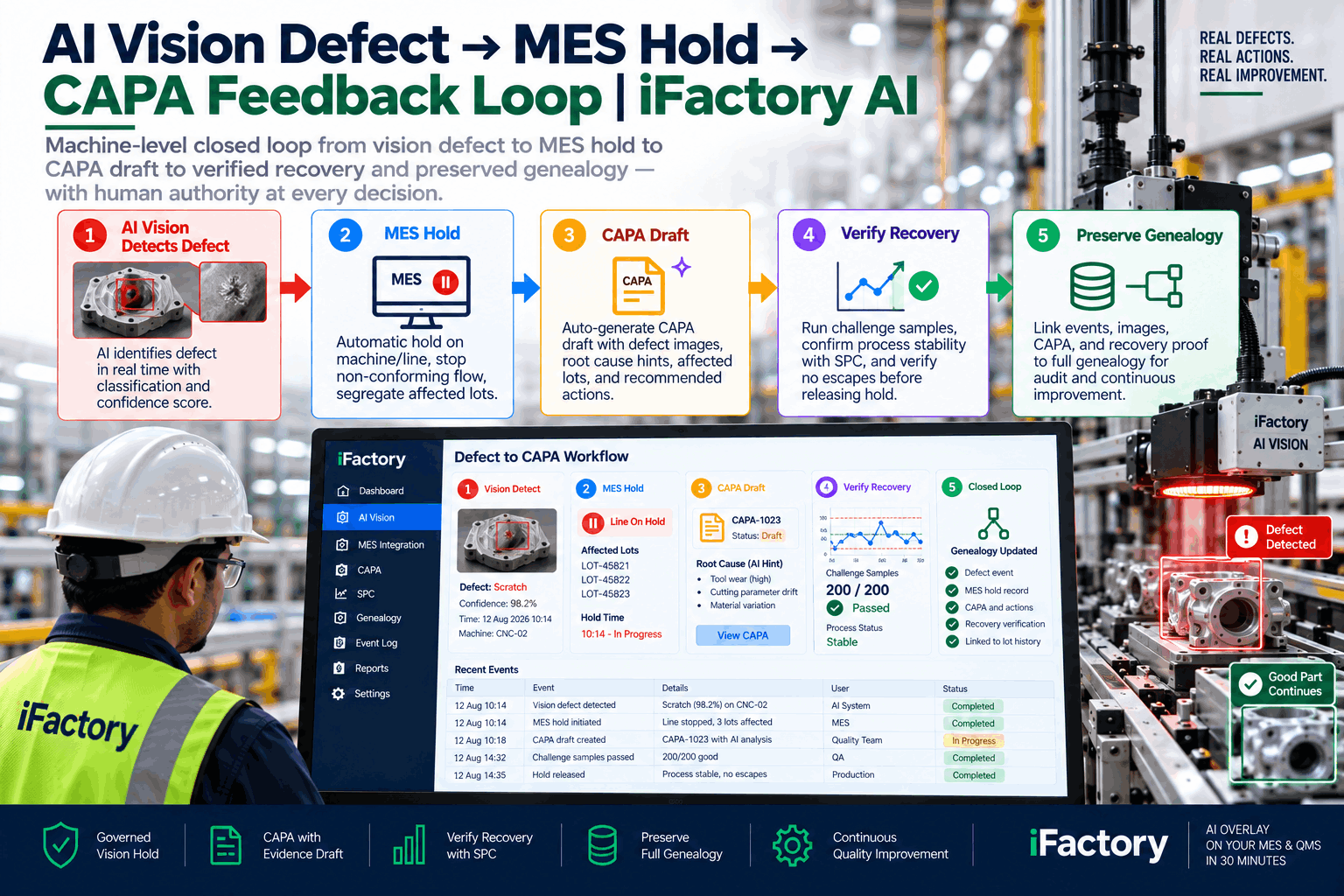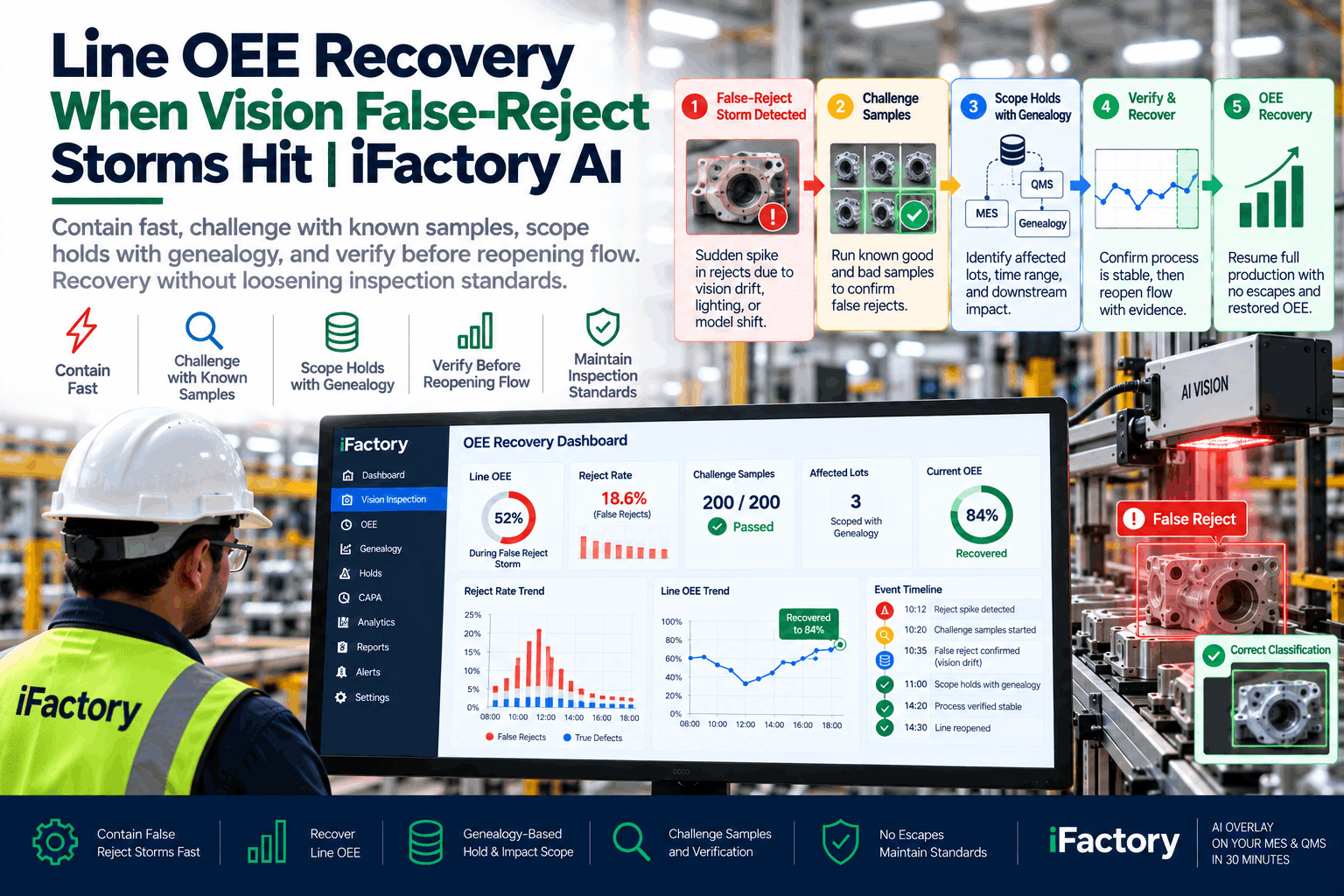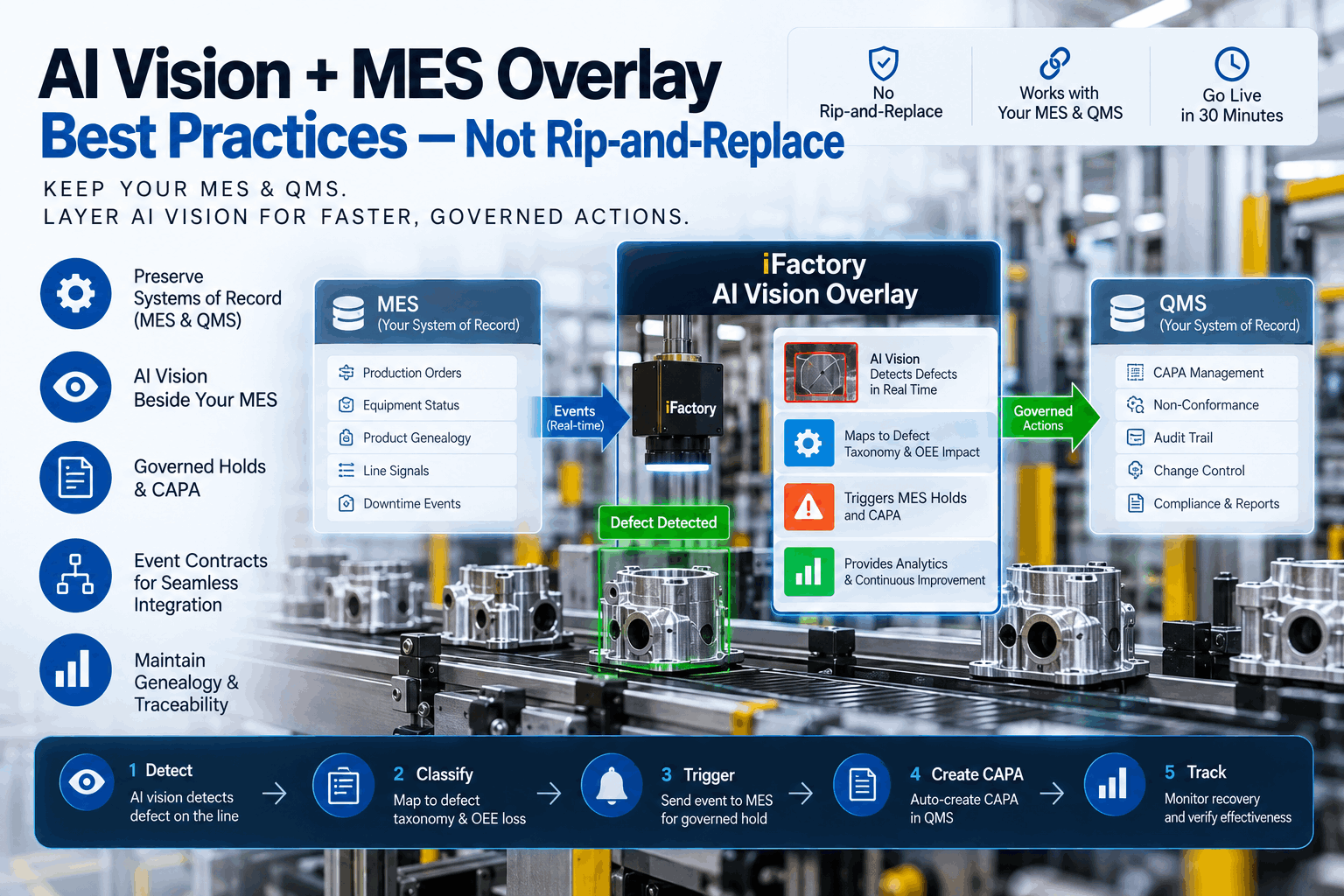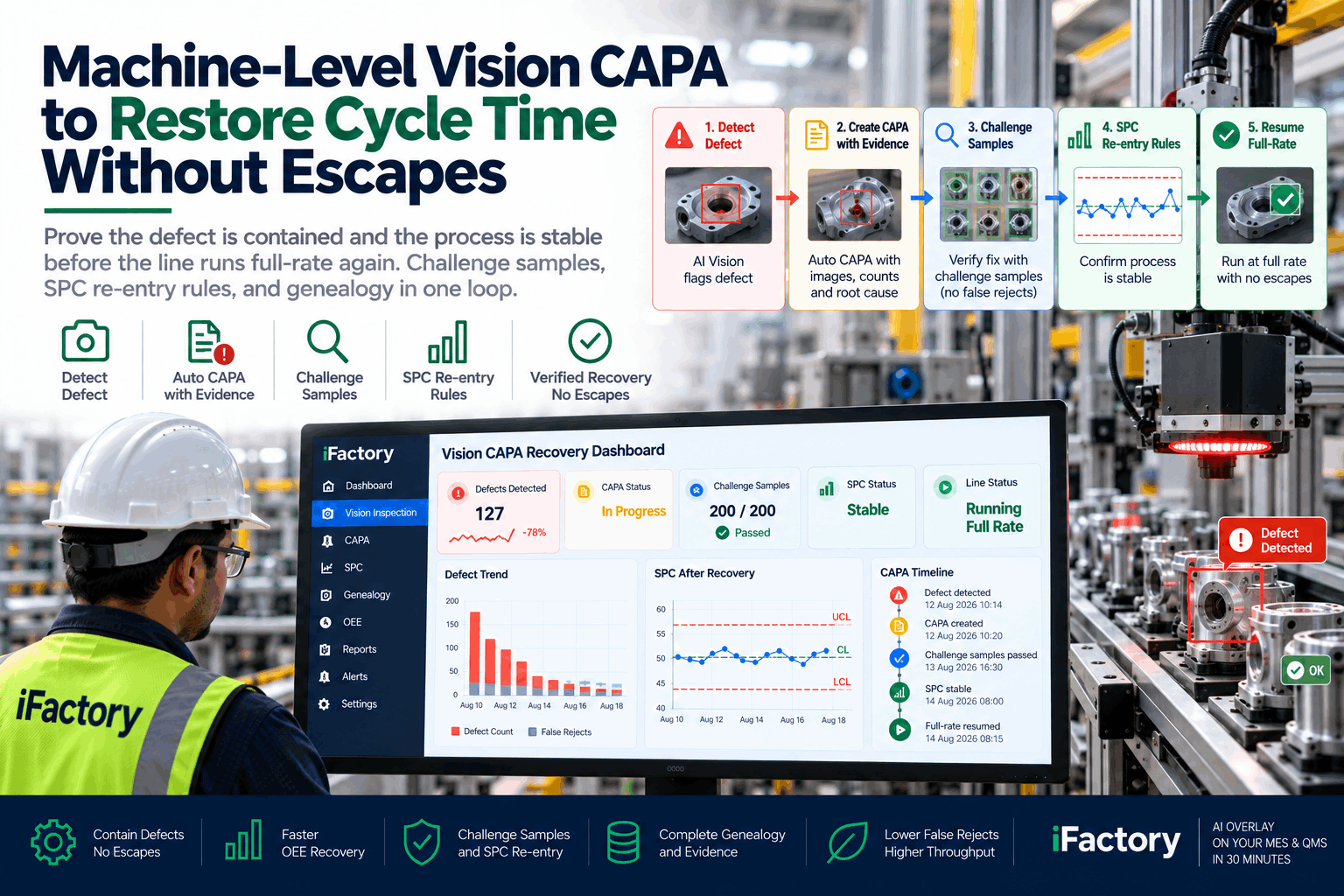
The false-reject storm looked contained until the line slowed again and quarantine started backing up behind the station. That is where machine vision CAPA that restores cycle time becomes the real test — not whether the defect was seen, but whether the process can return to speed without letting an escape slip through re-entry. iFactory AI overlays your existing vision, MES, QMS, and SPC stack with the workflow layer that gates release on challenge samples, SPC re-entry rules, and traceable genealogy — so cycle time recovers only when the evidence supports it. See the full recovery loop in 30 minutes.
A vision CAPA is only done when the line is back at normal cycle time, false rejects are controlled, and escape risk is verified — with human authority on release.
At a Glance
Why Vision CAPA Often Fixes Defects but Not Cycle Time
A lot of teams treat a vision correction like a simple threshold change — tune the model, confirm fewer defects, move on. In practice, that can create a new problem. The inspection station may stop flagging the old defect pattern, but the line still pays for the fix through extra checks, slower takt, re-inspections, manual overrides, or hold queues that never clear.
The common failure mode is easy to recognize: vision flags a defect or marginal condition, the station sends a signal but the signal does not cleanly become a hold event, operators add manual screening to stay safe, quality improves on paper but throughput drops, CAPA closes before the line proves stable at speed, and downstream genealogy still contains gaps so the team cannot prove which units were exposed before containment. In other words, the defect was caught but the process was not fully closed.
The Three Loss Buckets You Have to Watch at Once
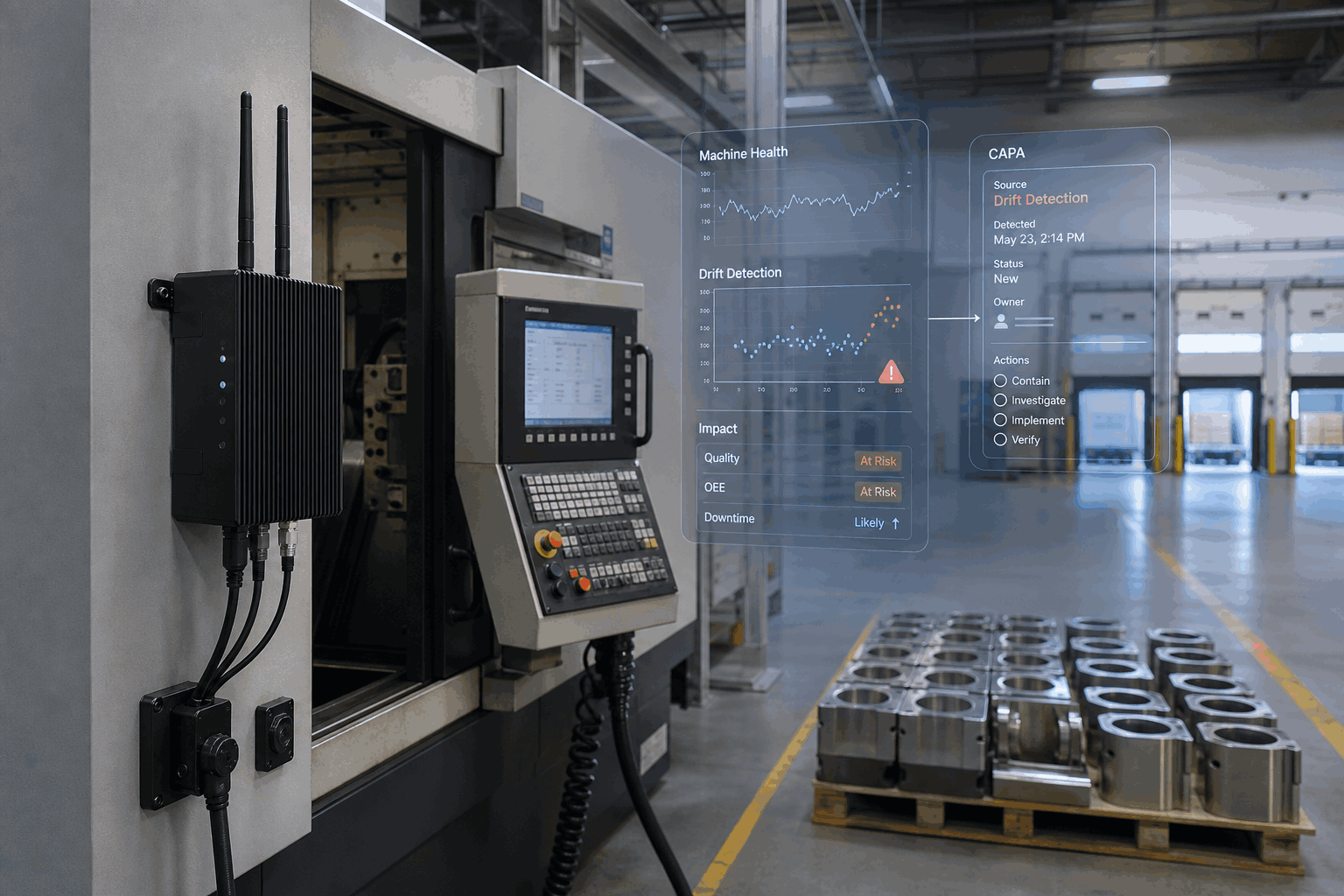
A vision CAPA touches all three OEE buckets even when the project is framed as a quality fix. One bucket can improve while another gets worse — a successful CAPA needs all three to move in the right direction together.
- Hold queues and quarantine steps
- Re-inspection cycles
- Line stoppages
- Human review waiting
- Extra verification steps
- Slower operator response
- More micro-stops
- Cautious workarounds
- Defects, scrap, rework
- False rejects if thresholds too tight
- Escape risk if thresholds too loose
- Recurrence in adjacent families
The Six-Step Recovery Sequence
A machine-level change is not enough by itself. The line needs a closed-loop response that turns a vision event into the correct operational action — and proves the process is truly ready before the line returns to full speed.
That loop is the difference between we changed the vision setting and we restored controlled production.
Challenge Samples — The Fastest Honest Test of Recovery
Challenge samples are one of the most useful tools after a vision CAPA because they test the fix under controlled conditions. They let the team ask: does the station now accept good parts, reject bad parts, and do both consistently?
- Known good parts that should pass
- Known bad parts that should fail
- Mixed-run conditions that resemble real production
- Review of both false rejects and false accepts
- Documentation of the exact model or threshold version used during the test
Defect rate alone does not prove recovery. If the station rejects everything in sight, you may have stopped escapes but also created a throughput problem. If it accepts almost everything, you may have restored speed at the expense of control. Challenge samples expose both failure modes early.
Walk through a hold, a challenge-sample check, SPC re-entry rules, and a governed release — all beside your existing MES.
SPC Re-Entry Rules Should Gate the Return to Full Speed
After a vision CAPA the line should not jump straight back to normal release. It needs SPC re-entry rules so the plant can prove the process is back in control before production volume fully resumes. The specific rules vary by process, but the concept is consistent.
- Confirm the right chart type is in place — attribute-based or variable-based
- Watch for special-cause signals before declaring the process stable
- Require a run of in-control data points before reopening the line
- Check that false rejects are not rising during the recovery period
- Make sure the active vision logic version is documented
A strong re-entry rule set reduces the chance of reopening too early and then discovering the same defect family later in audit, downstream inspection, or customer feedback.
Warning Signs the CAPA Is Not Fully Closed
Even after a successful-looking change, a few warning signs can tell you the CAPA is not fully closed. If any of these conditions exist, the plant may have improved detection without restoring stable production.
- False rejects remain elevated
- Operators keep adding manual inspection
- Quarantine dwell time is still long
- The same defect family appears in a different shift
- Re-entry is based on gut feel instead of data
- Genealogy cannot explain which units were exposed
- SPC re-entry rules were skipped or overridden
- Challenge samples were not documented for the release
Frequently Asked Questions
It is complete only when containment is in place, root cause is corrected, challenge samples pass, SPC re-entry rules are satisfied, and cycle time has returned to a stable normal without escapes.
Use controlled threshold tuning, challenge samples, versioned model logic, and human-reviewed hold release. Validate against known good and known bad parts before reopening fully.
Use the chart type that matches the process, confirm no special-cause signals, and require enough in-control evidence to justify re-entry. Attribute and X-bar or R context both apply when used correctly.
All three buckets — availability through holds and re-inspection, performance through slower cycle time and micro-stops, and quality through defects, scrap, false rejects, and escapes.
Yes. iFactory AI is designed as an overlay that connects to existing MES, QMS, SPC, and vision workflows — signals, holds, CAPA evidence, genealogy, and verification without replacing your current stack.
The real win is not just fewer rejects — it is a controlled return to cycle time with hold logic, genealogy, and re-entry evidence all aligned.