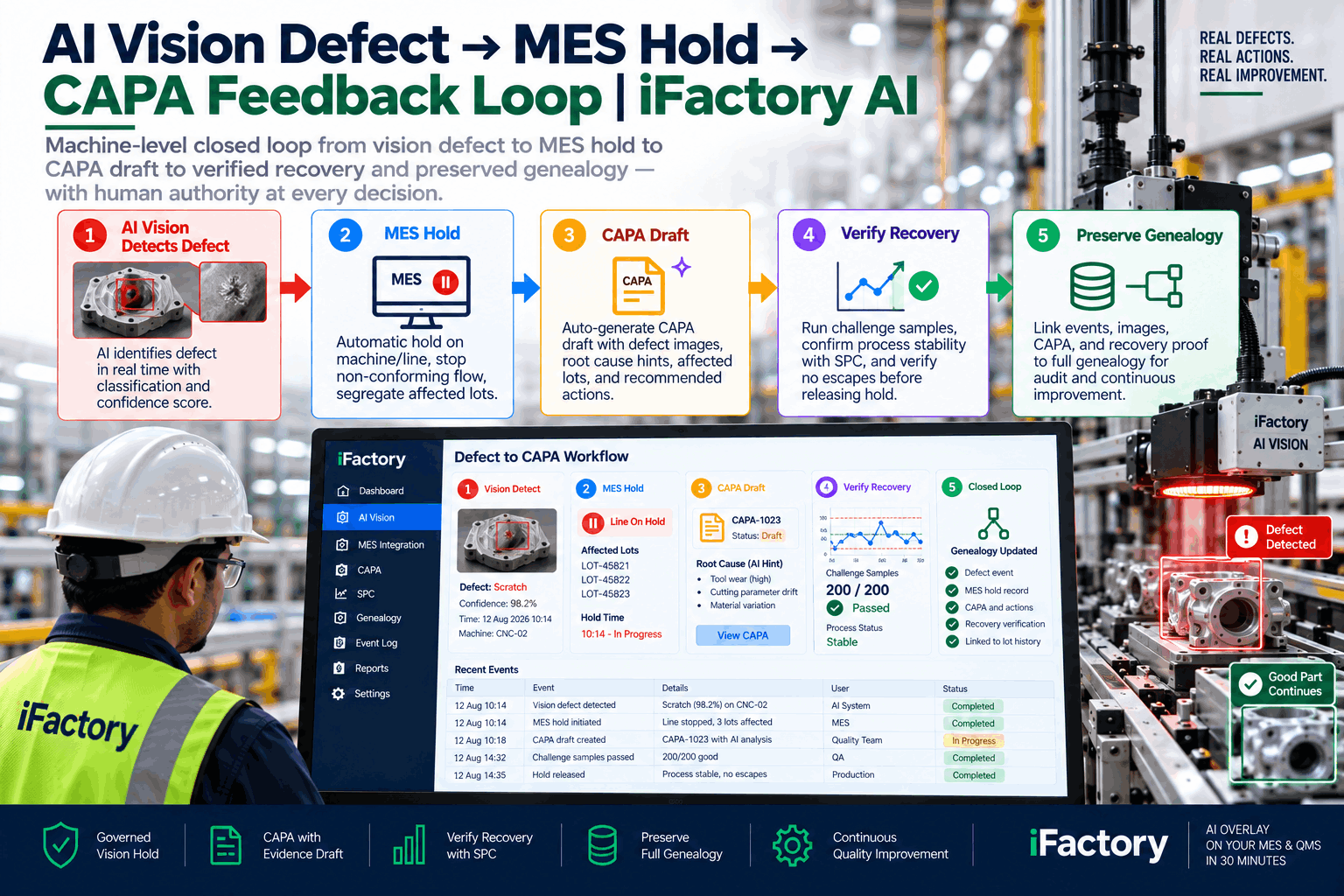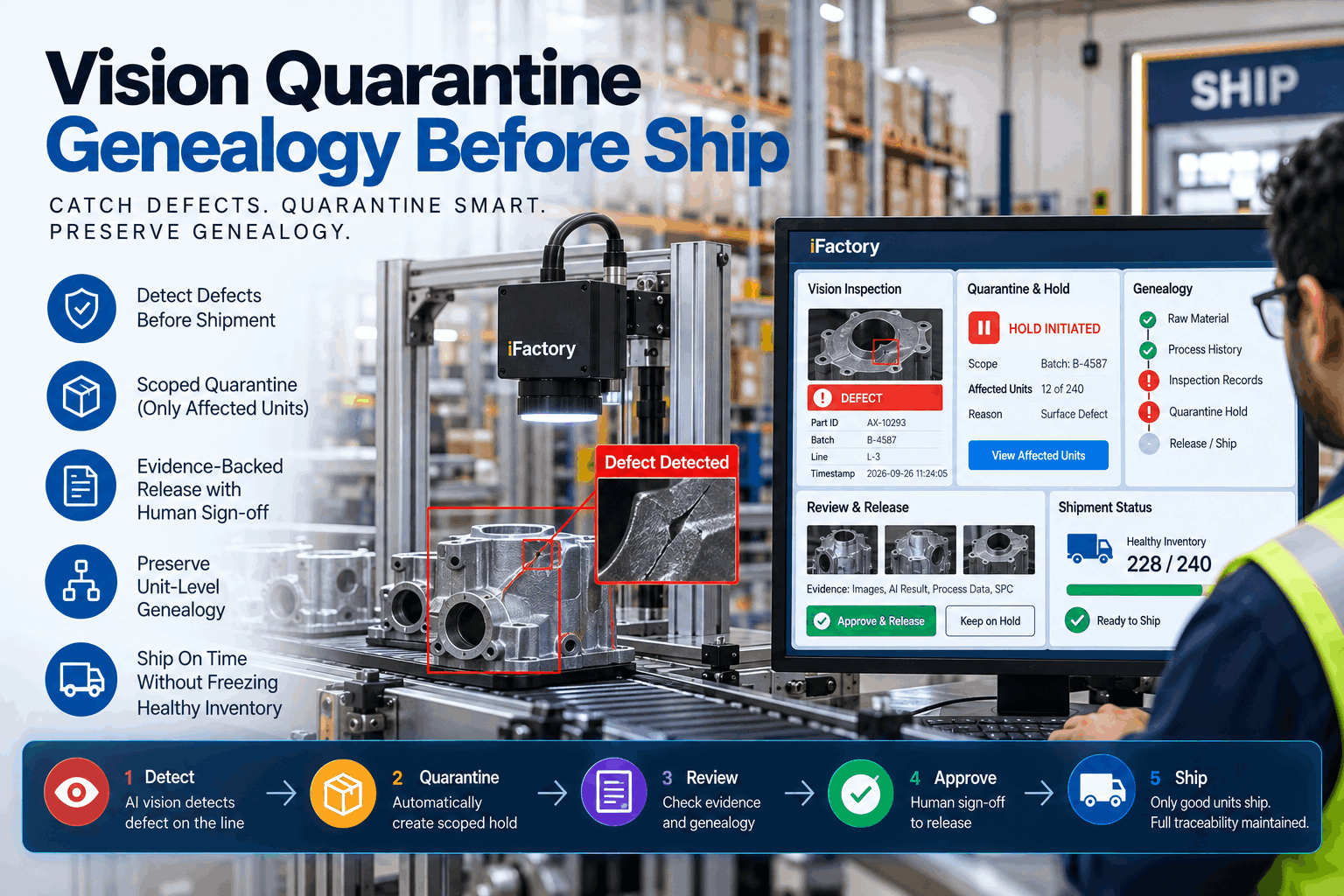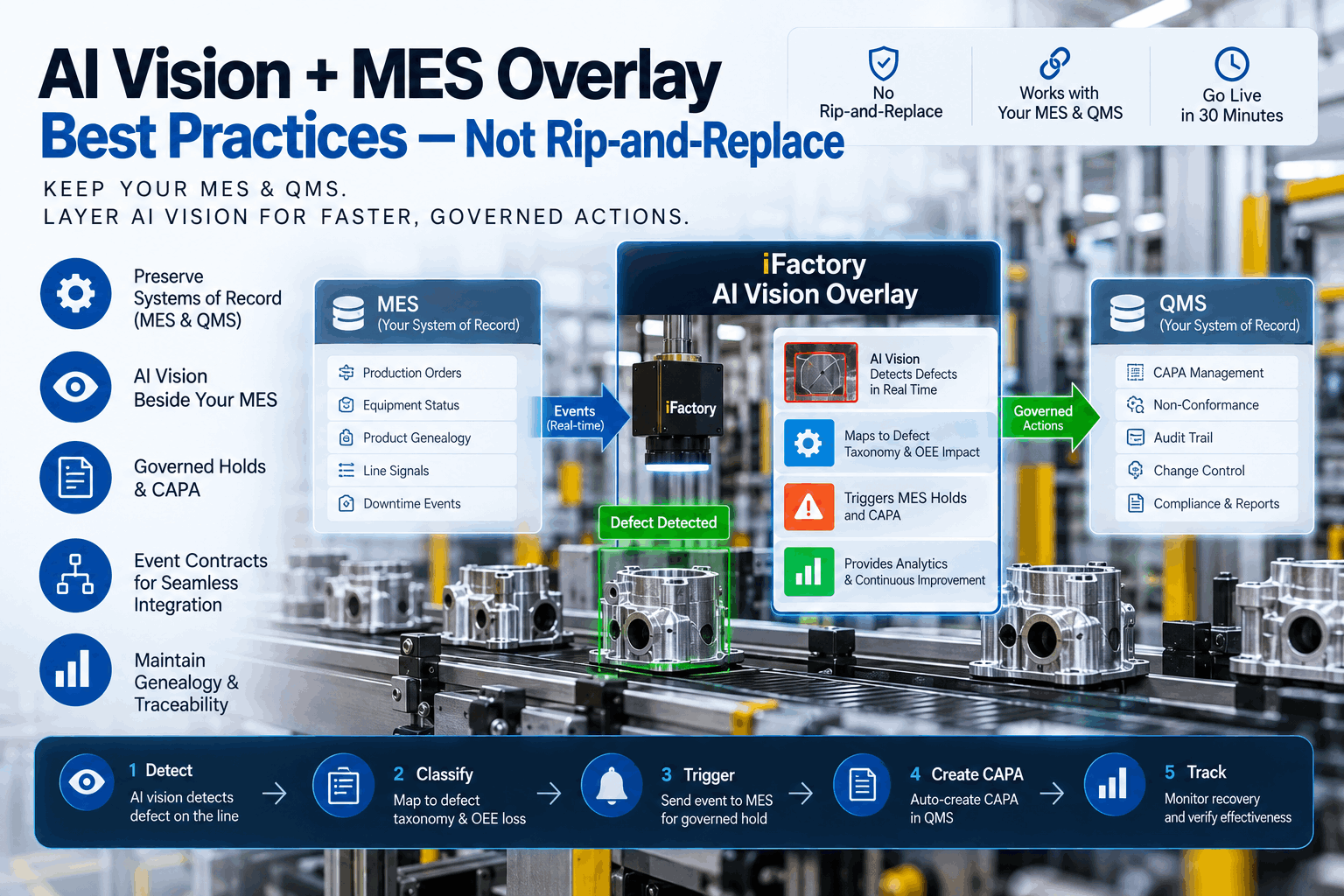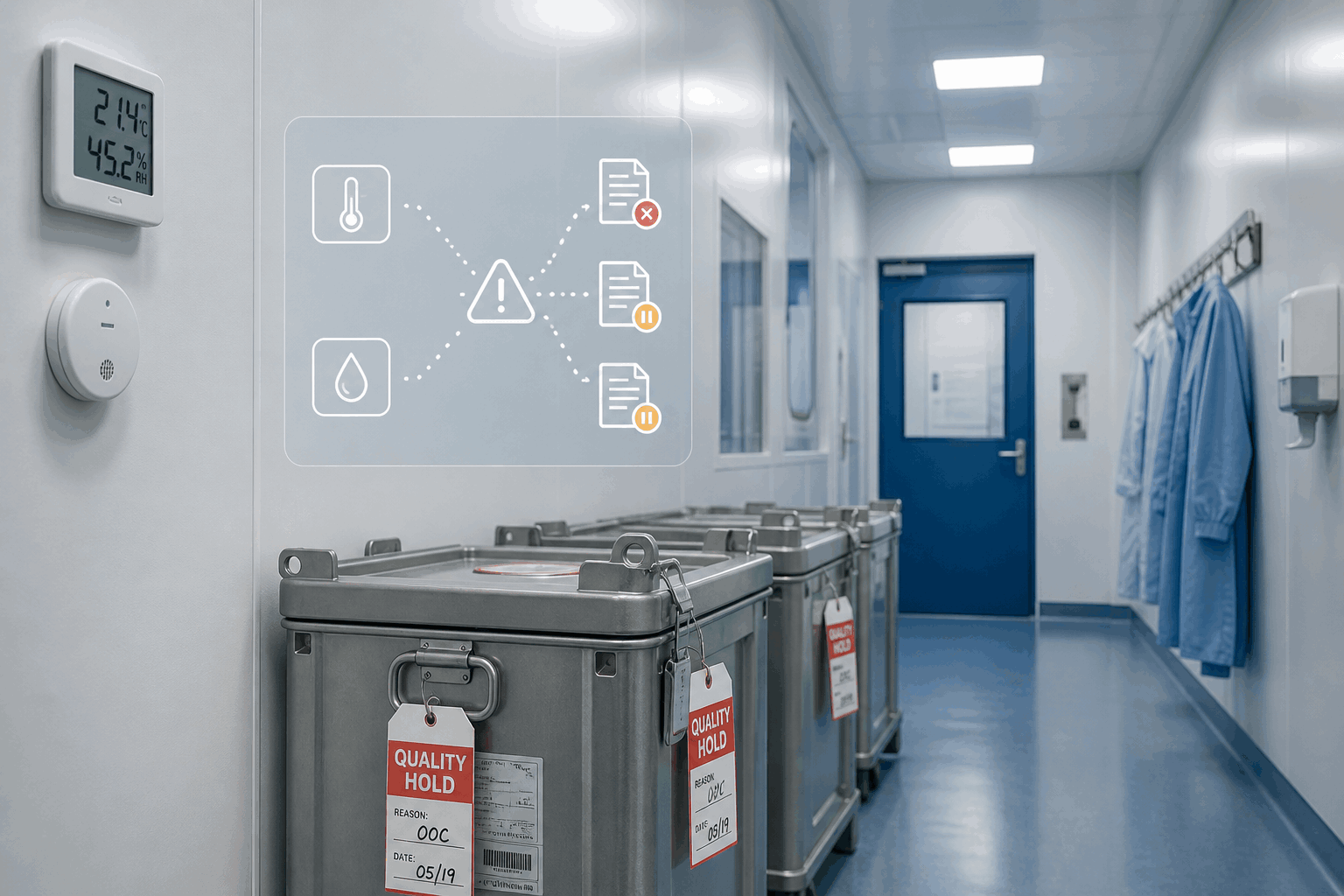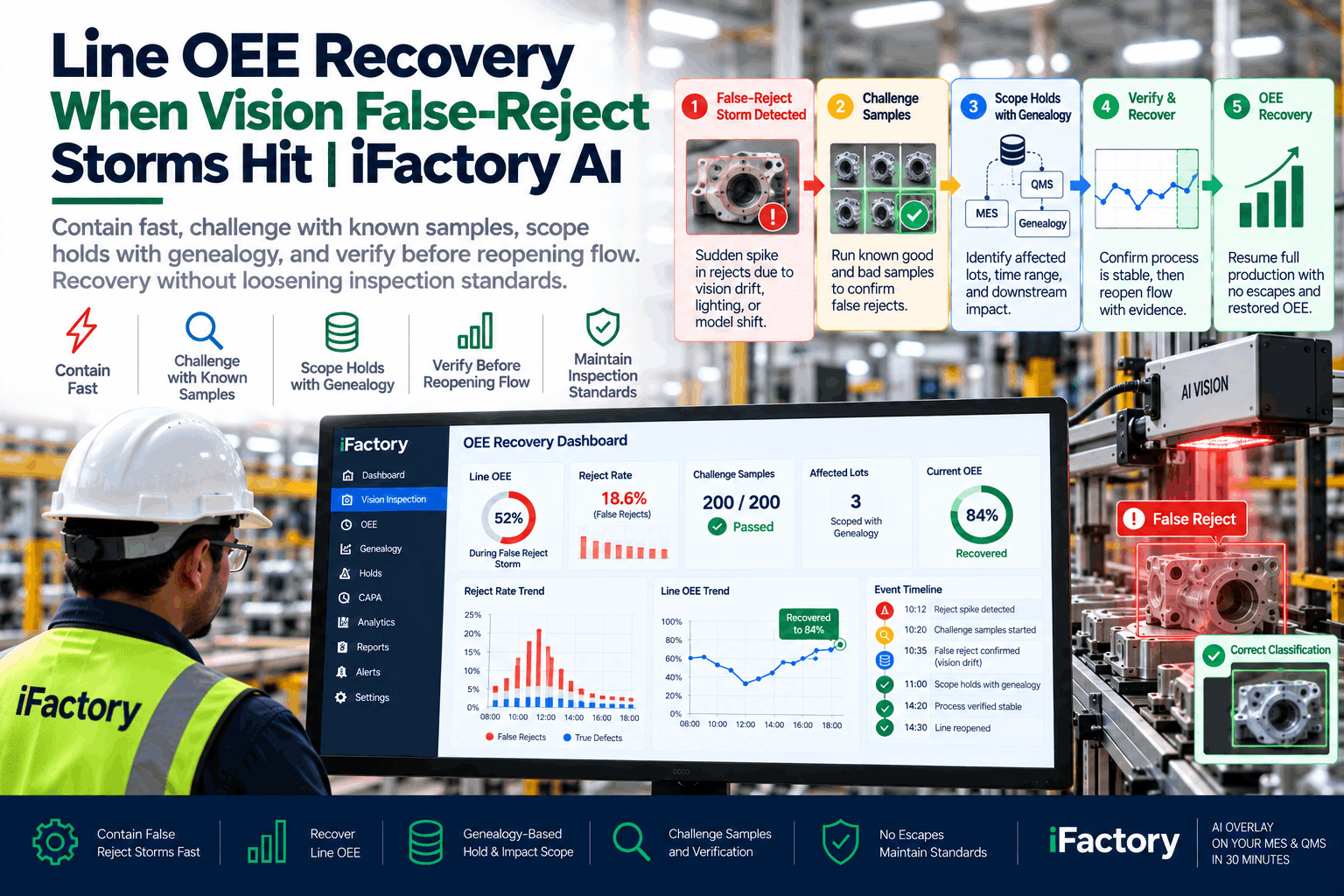
A false-reject storm can crush line OEE faster than a real defect outbreak because every bad call creates a stop, a hold, and a queue before anyone knows whether the product was actually wrong. The fix is not loosening thresholds and hoping for the best — it is rapid containment, challenge-sample proof, and genealogy-linked recovery that restores throughput without letting escapes back onto the floor. iFactory AI overlays your existing MES, QMS, and vision stack with the workflow layer that scopes holds by genealogy, distinguishes vision drift from process drift, and gates release on evidence rather than gut feel. See a false-reject storm recovery in 30 minutes.
A false-reject storm hits availability, performance, and quality at once. Contain fast, challenge the system, verify with genealogy — then restore flow.
At a Glance
Why False-Reject Storms Are an OEE Emergency
When vision starts overcalling defects, the line does not just lose parts. It loses time, flow, and confidence. Availability drops with stop-and-check events, quarantine holds, blocked downstream flow, and re-release delays. Performance sags with slower cycle times, manual inspection loops, operator overrides, and reduced line speed. Quality suffers through scrap, rework, and the risk of creating escapes if teams loosen criteria too fast.
That is why a false-reject storm is more than a quality nuisance. It is an operational event that can drag throughput down while burying the team in triage. The hidden losses are often the worst part — micro-stops, quarantine lag, extra handling, reinspection, and the long tail of product waiting for a decision. In other words, the plant has signals but no closed loop, and it ends up choosing between two bad outcomes: lost throughput or lost containment.
Common Causes of a Vision False-Reject Storm
Most false-reject storms are not mysterious. They are usually the result of one or more of these issues — and knowing which class matters, because the recovery path is different for each.
Contrast or shadowing changes over shifts, cleanings, or ambient light shifts.
Dust or residue on the camera lens creating spurious signals.
Alignment changes from adjacent equipment or fixture movement.
Upstream handling variation changing how parts arrive at the inspection window.
Materials behaving differently under the same recipe, especially after supplier changes.
Settings that were fine for the reference lot but not for real-world variation.
Changeover or product mix update pushing the model outside its trained space.
SKU, station, or shift-level recipe differences colliding at runtime.
The Right Recovery Sequence — Contain First, Then Verify
A false-reject storm needs a disciplined path from signal to restoration. The sequence matters — jumping to threshold changes without containment or verification is how escapes happen.
Look for the pattern, not just the count. Which line changed? Did the spike follow a shift, recipe update, cleaning, or maintenance? Are operators seeing repeated false calls on the same part?
Scope the hold by lot, serial, time window, machine, SKU, or shift. This reduces over-holding while preserving quality control.
Known good, known bad, borderline, and pre-post-event parts. Compare across stations, cameras, and shifts to distinguish inspection drift from process drift.
Symptom summary, first seen time, affected lots, likely causes, challenge findings, inspection settings, environmental changes, and verification steps required before release.
Reject rate normalization, line speed restoration, stop frequency reduction, release decisions by scope, no rise in downstream escapes or rework.
Walk through detect, scope, challenge, draft, and verify — with genealogy linking every step to real inventory.
Using SPC to Tell Signal From Noise
SPC is not just for reporting. In a false-reject storm it is a practical way to separate process drift from inspection drift, and it prevents the team from overreacting to noise or underreacting to true change.
- Rejects spike but process metrics stay stable
- The issue appears only on one machine, camera, or recipe
- Known-good parts start failing after a lighting or calibration change
- Borderline calls dominate the reject pool
- Reject behavior and process measures move together
- Borderline parts fail in ways matching real drift
- Multiple stations show the same pattern
- Upstream signals correlate with the spike
Conceptually this can be tracked with reject-count charts, attribute charts, X-bar and R trends for continuous measures, and rule-based pattern checks for unusual shifts.
Frequently Asked Questions
Look at whether process metrics, genealogy patterns, and SPC signals move with the reject rate or diverge from it. If rejects spike while process behavior stays stable, inspect the vision system first.
Usually no. That can hide a real problem and increase escapes. Use challenge samples, containment, and verification before changing thresholds.
They define the exact scope of affected product, support quarantine decisions, and reduce unnecessary holds while preserving traceability.
Availability is often hit first because of stops and quarantine. Performance follows through manual checks and slower flow. Quality shows up through scrap and rework.
Yes, as a human-reviewed assistant. It can summarize historical patterns, compare similar events, and help teams investigate faster.
A false-reject storm is an OEE emergency. The right response is contain fast, challenge the system, scope with genealogy, and verify recovery before reopening flow.