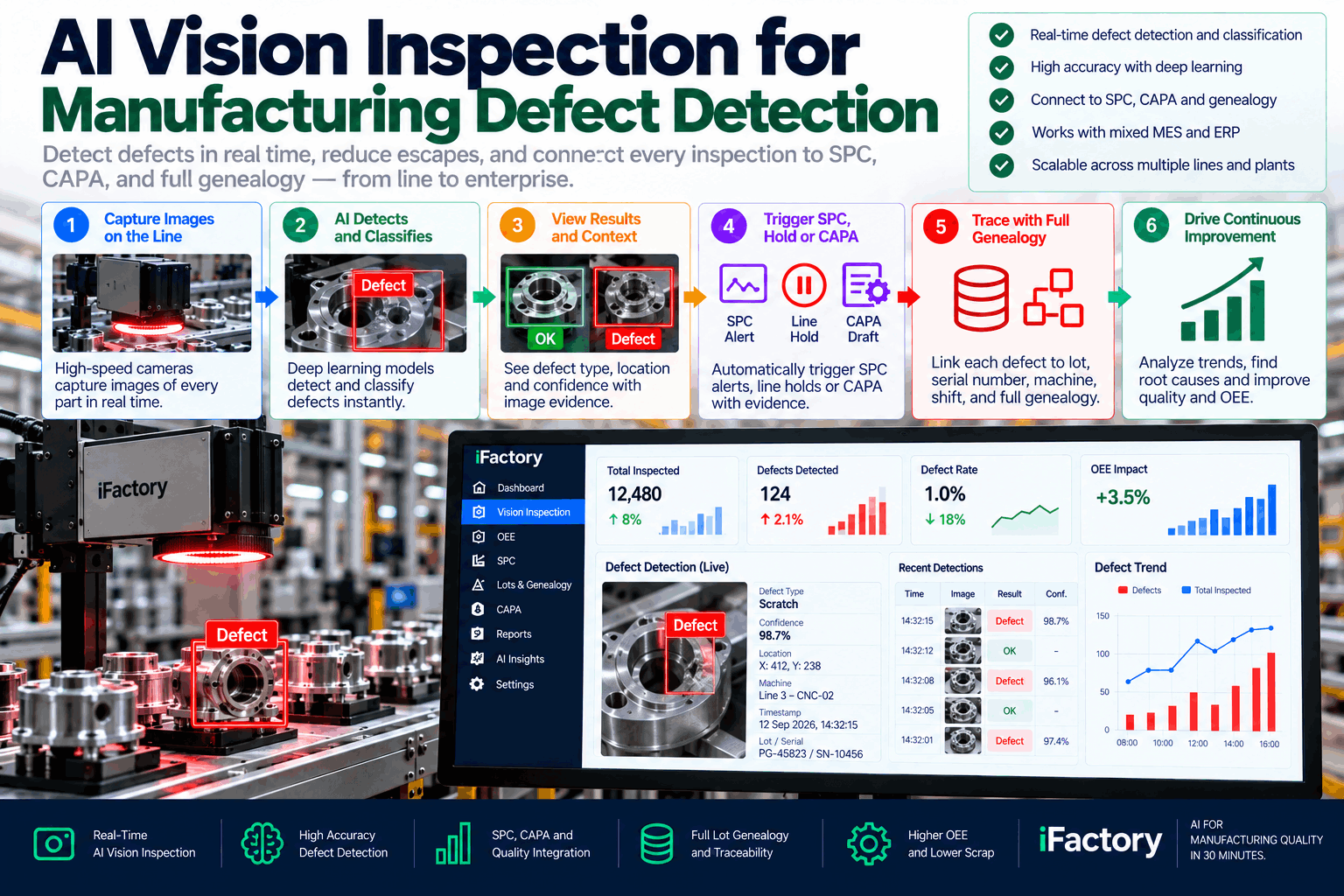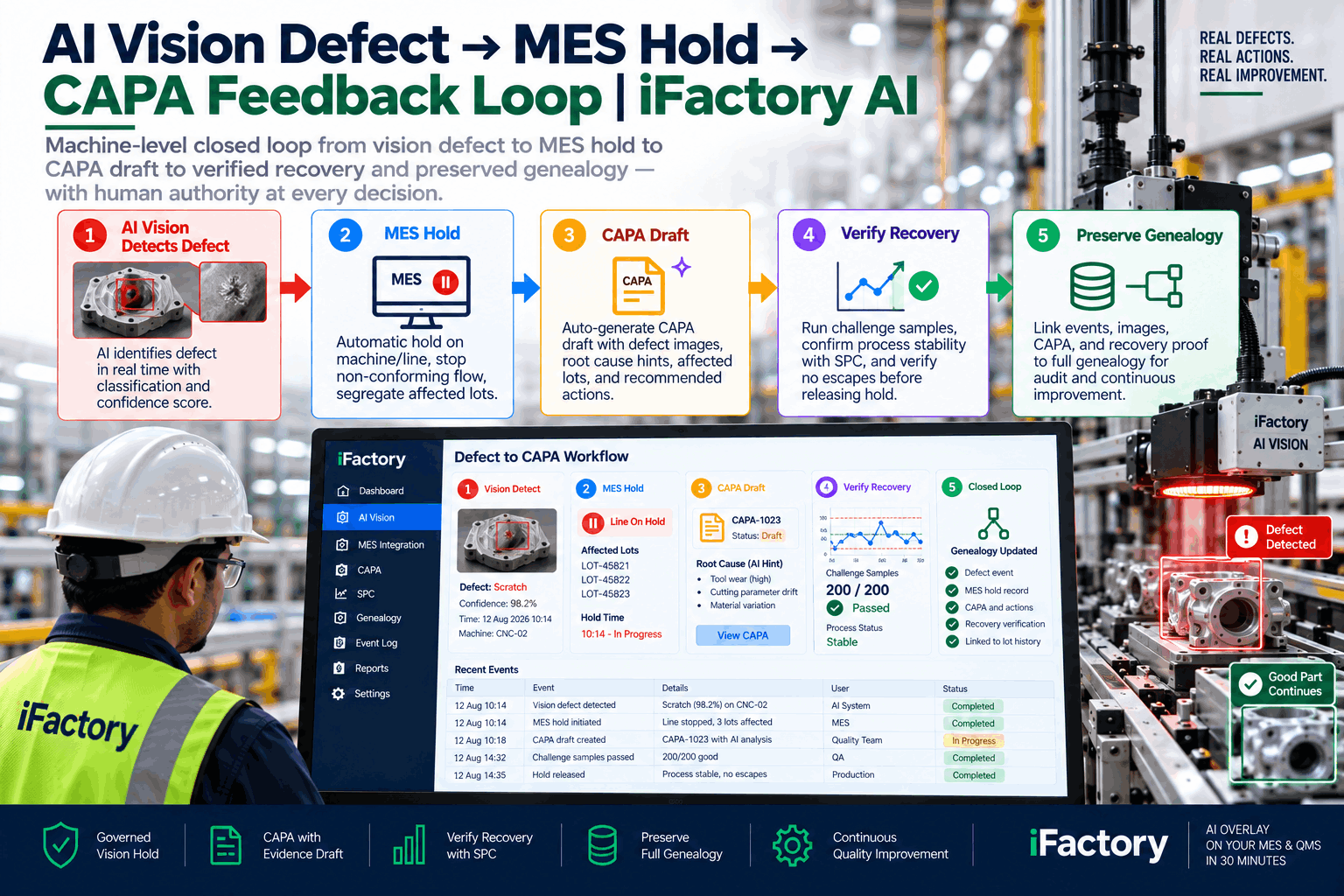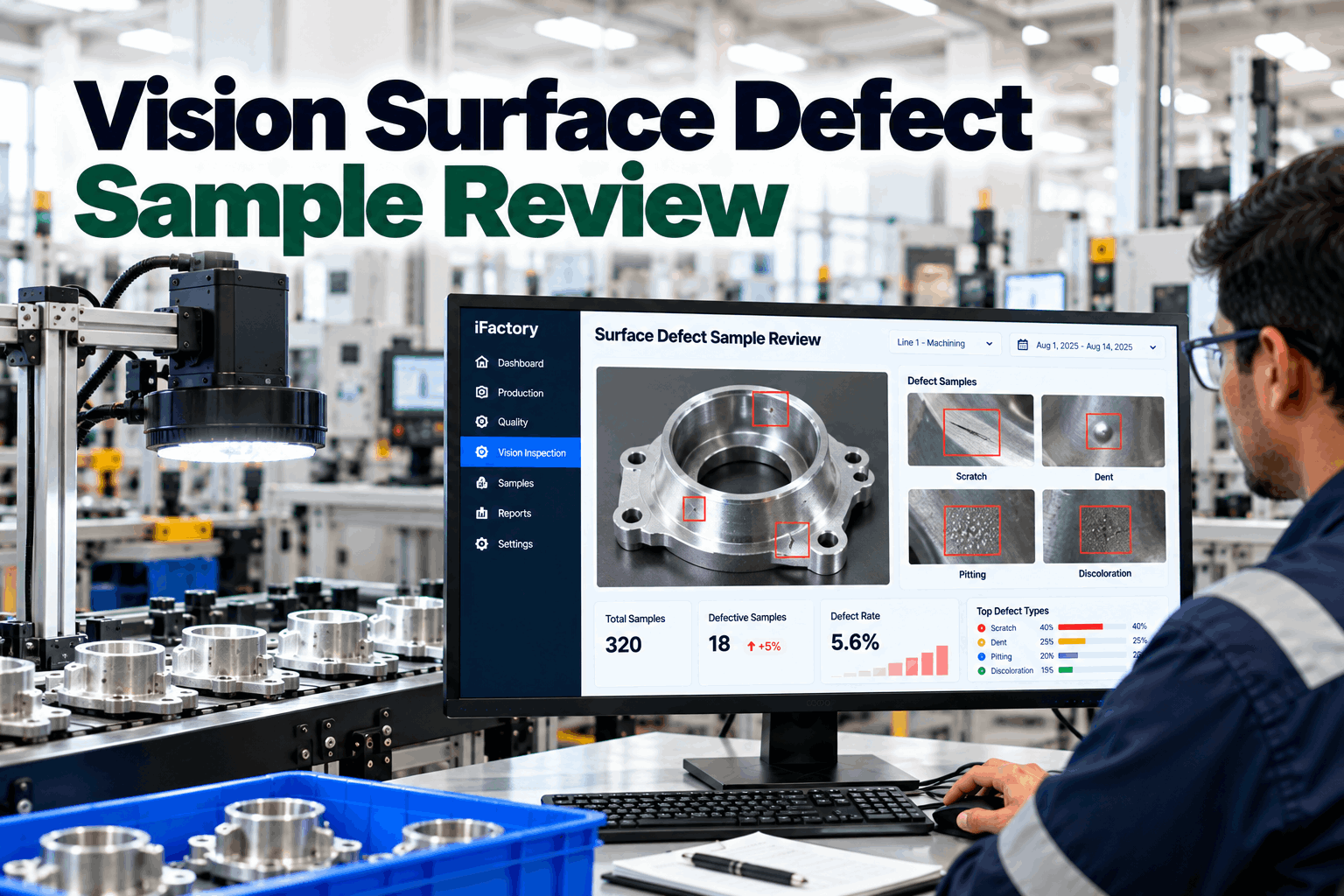
A surface-defect run produces a mix of flags — scratches, pits, cracks, spots — and the quality reviewer wants to know whether the cracks are a real trend or a coincidence in the sample. In that moment, the aggregate defect count is not the answer. The answer lives in a sample-by-sample review with lot, machine, and process context, and a defensible record of what the reviewer decided about each flag. iFactory AI overlays your MES, QMS, historian, and vision stack so surface defect sample reviews assemble the evidence, preserve the sign-off, and support the containment or release decision — reviewed by a person, recorded once, defensible later. Book a 30-minute walkthrough of a surface-defect sample review end to end.
The aggregate count tells you what happened. The sample review tells you what it means — and whose signature is on the containment or release call.
At a Glance
Why Aggregate Counts Miss the Story
A run may show fifty flagged units with a mix of scratches, pits, cracks, and spots. Aggregated, those look like fifty defects. Reviewed sample by sample, they may look like forty routine surface issues within expected variation and ten cracks concentrated on one machine window with the same supplier lot. Those ten are the story. The aggregate count does not tell it, and the containment scope should not be set from the aggregate.
The sample review is where the reviewer separates routine variation from a concentrated pattern, decides whether containment is warranted, and records the reasoning. Without a structured review discipline, the ten cracks may get lost in the fifty aggregate flags, and the containment decision may be under-scoped or over-scoped. Either failure carries downstream cost — an under-scoped containment leaves suspect product in circulation, an over-scoped containment holds product unnecessarily and strains downstream commitments. The middle path, a properly scoped containment based on the sample review, is worth the review discipline it requires.
Context Fields That Sharpen a Sample Review
Which supplier lot or sub-lot each flagged unit came from, so the reviewer can see whether the pattern concentrates.
Which machine, tool, cavity, or chamber produced the flagged unit and whether state alarms overlapped.
Which recipe or setup was active and whether it was recently revised.
Which shift and crew were running, in case the pattern coincides with a handoff or staffing change.
The specific defect type and its position on the surface, which helps distinguish structural cracks from cosmetic scratches.
Whether the flagged units cluster in time and whether that cluster aligns with a process event.
What iFactory Delivers
iFactory puts lot, machine and process context beside every flagged surface so reviewers decide faster and record why.
Each flagged surface with its image result, lot, machine, recipe and shift.
Where defect types cluster by lot, machine window or time.
Accept, extend sampling, contain or escalate, recorded per sample.
Hold lists built from the reviewed samples, not the whole run.
Ask which cracks share a lot and hear the answer while reviewing.
Past reviews available for CAPA verification and audits.
Bring one recent surface-defect run. We walk through sample-by-sample review, containment scoping, and the searchable record — beside your existing MES, QMS, and vision system.
A Sample Review Workflow That Preserves Sign-Off
The strongest workflow presents each flagged sample alongside its context, gives the reviewer a small set of documented outcomes to choose from (accept as routine variation, flag for extended sampling, add to a containment group, escalate to CAPA), and preserves the reviewer identity, timestamp, and rationale on each decision. When the reviewer completes the run, the record shows every sample reviewed, every decision made, every rationale recorded, and any containment or CAPA references opened as a result.
That record is what supports the containment or release decision at the end of the run. It is also what supports a later CAPA verification, a customer investigation, or an audit review. And over time, the archive of sample reviews reveals recurring patterns — a defect signature that keeps appearing on the same machine window, a lot family that keeps producing crack clusters — that feed the CI cadence.
Where Spoken Analytics Fits in Sample Review
Spoken analytics does not classify or accept a sample. It assembles the context for each flag, drafts a summary the reviewer can confirm or override, and preserves the sign-off in the searchable record. The reviewer still owns every decision. The layer speeds the review by putting the context in front of the reviewer, preserves the outcome so the record supports later review, and surfaces recurring patterns across many reviews for CI cadence.
The practical benefit of this workflow is that the reviewer spends more time on interpretation and less time on evidence assembly. When the context is already gathered alongside each flag, the reviewer can focus on the judgment calls that only a person can make — is this a routine surface variation or the leading edge of a real defect trend, is the concentration on one machine window enough to justify containment, does the pattern deserve escalation to CAPA. Those judgments are the value the reviewer adds. Evidence assembly is overhead. Reducing the overhead makes the judgment better and the review more thorough, which is exactly what quality reviewers need in a plant with many parallel inspections.
Frequently Asked Questions
Because the pattern that matters — a concentrated cluster on one lot, machine, or window — is often invisible in the aggregate count.
Lot, machine, recipe, shift, defect signature, and time alignment together give the reviewer the picture needed to interpret the flag.
No. The reviewer makes every decision. The agent organizes the context and preserves the record.
By preserving the reviewer sign-off, the decisions, and the context so a later review can see how the containment or release call was made.
By reviewing the archive across many runs so the recurring lots, machines, and signatures become visible for structural fixes.
A structured sample review preserves the reviewer sign-off, the context, and the reasoning behind every containment or release call. That is what stands up to audit long after the run has ended.