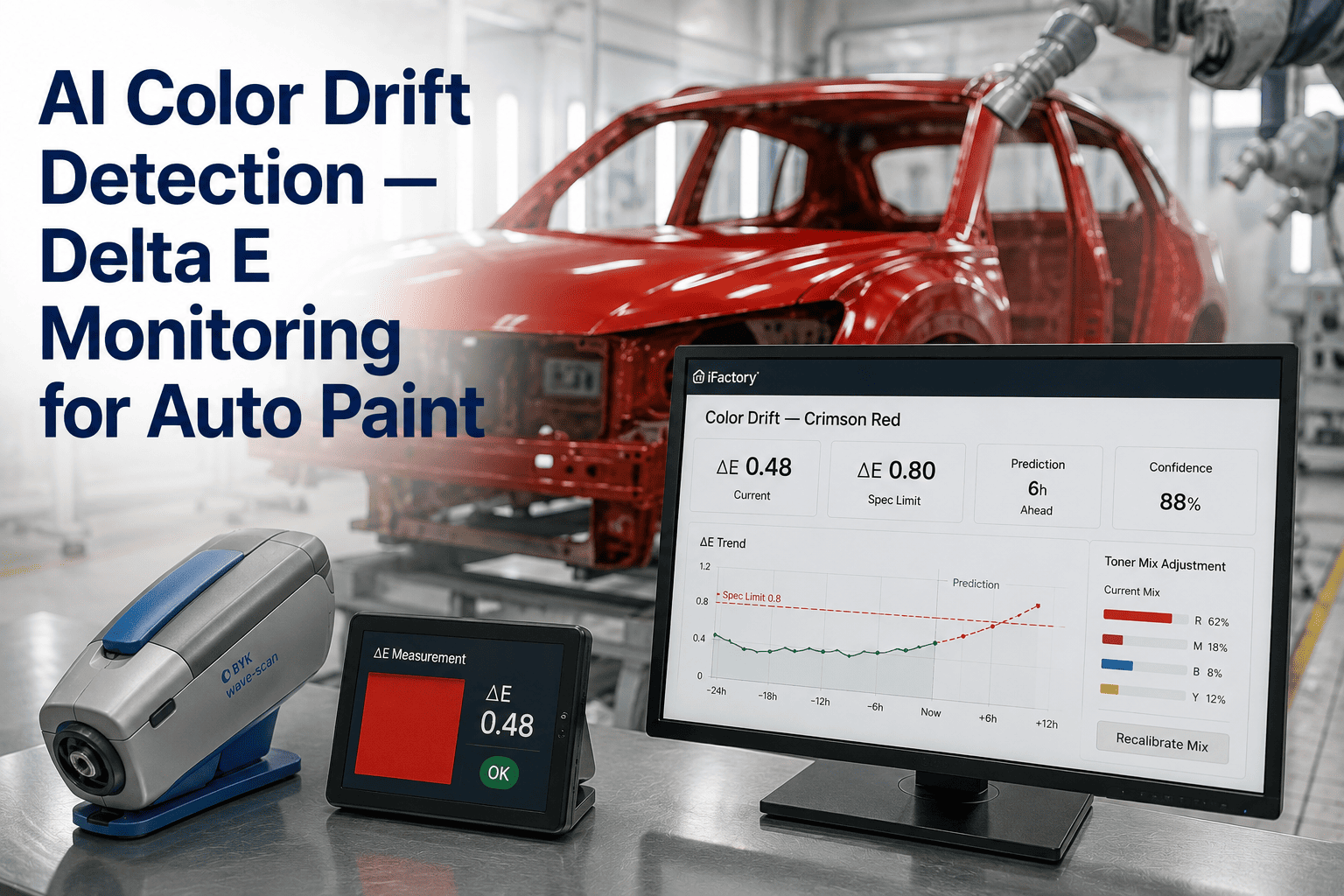
A paint defect that escapes the booth is not the same defect anymore — it's a warranty claim, a dealer touch-up, and a customer who will remember the car by its finish. A human inspector under fixed booth lighting catches around 78 to 84% of surface defects on a fresh shift, and that number drops noticeably by the late hours of a night shift as fatigue sets in. At 60 to 90 vehicles an hour, those missed percentage points become escapes — 5 to 15% of vehicles typically need paint rework, and the further downstream a defect travels before it's caught, the more the rework multiplies, from a booth-exit touch-up to a disassemble-and-repaint job running into thousands per vehicle. iFactory AI vision paint inspection scans 100% of painted surfaces at line speed, catches orange peel, runs, dirt inclusions, and color mismatch invisible under standard lighting, and routes the defect to rework before the panel leaves the booth — on-prem, live in 6 to 12 weeks.
iFactory Vision Defect Detection
AI Vision for Automotive Paint and Surface Finish
Detect orange peel, runs, dirt inclusions, and color mismatch on painted panels at line speed. Cut rework, contain warranty exposure, and inspect 100% of surfaces — running on a single on-prem edge server.
100%
of panels inspected at line speed
0.2mm
defects detected on glossy surfaces
<50ms
inference per frame, edge GPU
6-12wk
to go-live, on-prem
The Four Defects That Cost You the Most
Paint shop defects are not equal — a handful of families account for the bulk of rework and warranty exposure. Each has a distinct visual signature and a distinct root cause. Catching them at the booth exit is a touch-up; catching them at final assembly is a rebuild.
Orange Peel
A textured, bumpy finish that resembles the surface of an orange. Caused by atomization issues, paint viscosity, temperature, or solvent evaporation — droplets fail to flow into a smooth film.
Runs and Sags
Vertical drips, thick lines, or curtain-like flows where wet paint moved before curing. Comes from too much paint, thin paint, or the spray gun held too close to the panel.
Dirt Inclusions
Airborne particles, lint, or booth contamination trapped in wet paint or clearcoat. The single largest defect category in most paint shops, regardless of cleanliness protocols.
Color Mismatch
Panel-to-panel variation between body panels, doors, and bumpers. Detected against L*a*b* color coordinates and delta-E tolerances — the eye catches it, but not consistently.
The 1-10-100 Rule of Paint Defects
The economics of paint rework are brutal and non-linear. A defect caught at the booth exit is a touch-up. The same defect caught at trim line is a repaint. Caught after assembly, it's a disassembly. Caught after delivery, it's a warranty case with brand damage attached.
Booth Exit
1x
A quick touch-up. Cheapest fix, no line disruption, panel continues to trim.
Trim Line
10x
Divert to rework, repaint the panel, catch up with the sequence — a shift's headache.
Final Assembly
100x
Disassembly, repaint, reassembly — thousands of dollars per vehicle in labor and materials.
After Delivery
1000x
Warranty claim, dealer rework, brand exposure — the escape everyone tries to prevent.
The Inspector Fatigue Problem
Trained human inspectors are excellent at the start of a shift. They catch subtle orange peel, spot micro-runs, notice color drift on adjacent panels. Two hours in, accuracy slides. By the end of a night shift, detection is dropping fast — and the paint escapes tend to cluster in exactly the hours no one is watching for them.
Human inspection
Accurate — Until It Isn't
78 to 84% detection on a fresh day shift
Accuracy drops ~25% after two hours of continuous inspection
Fatigue and subjective judgment cluster escapes at shift-end
Sub-millimeter dirt and shallow orange peel routinely missed
iFactory AI vision
Consistent Every Shift
98%+ detection sustained shift after shift, no fatigue curve
100% of painted surface scanned, not a sampled fraction
Defects as small as 0.2mm caught on glossy surfaces
Same result at 8am and 3am — objective and repeatable
Want to see live defect classification on real panel footage from your line? Book a demo and we'll walk through the defects your current process is missing.
Camera, Light, Model — All Three Have to Fit
A paint shop vision system is not a camera. It's a matched system of illumination, optics, and a trained model — because a darkfield rig that catches scratches will not see orange peel, and a general-purpose detector will fail at line speed on curved painted surfaces. iFactory validates each layer against your actual defect library before hardware ships.
01
Zone-Specific Illumination
Raking light for orange peel and micro-texture, darkfield for scratches and inclusions, structured light for craters. The illumination rig is validated against your paint library before install.
02
Multi-Camera Panel Coverage
Area-scan camera arrays capture every painted surface as the body exits the booth — roof, sides, hood, doors — with no manual repositioning at line speeds of 60 to 90 vehicles per hour.
03
Deep Learning Defect Model
Object detection trained on your paint library classifies each defect by type and location. Delta-E color validation runs in parallel against L*a*b* references for panel-to-panel color match.
04
Edge Inference, Sub-50ms
Model runs on an on-prem edge GPU with inference under 50 milliseconds per frame — no cloud dependency, no WAN latency, the line runs during network outages.
Every Defect Routed Automatically
Detection without routing is a monitoring tool, not an inspection system. Every classified defect is scored for severity — critical rejects, major goes to rework, minor is logged and passes — and the conveyor acts on the score without manual sorting. The paint escape rate drops because the routing does not depend on someone catching a flag on a screen.
Critical
Auto-Reject
Major runs, deep craters, adhesion failures — routed to the reject station automatically. No panel with a critical defect advances toward assembly.
Major
Route to Rework
Fixable orange peel, dirt inclusions, minor runs — diverted to the rework bay with the defect map, so the touch-up is targeted and fast.
Minor
Log and Pass
Cosmetic issues within tolerance — documented for process learning, but the panel continues to trim without disrupting the line.
From Detection to Root Cause
The defects themselves are a leading indicator. The pattern across defects is the real value — orange peel spiking on the roof after a booth temperature swing, dirt inclusions clustering on the passenger side after an air handler change, color drift appearing on doors from a specific paint batch. iFactory closes the loop from detected escape to root process cause.
1
Detect and Classify
Every panel scanned at booth exit, every defect classified by type, size, and body location — no sampling, no fatigue curve.
2
Route to Action
Severity scoring drives conveyor routing — critical to reject, major to rework, minor logged and passed. No manual sort step.
3
Correlate to Process
Defect patterns are cross-referenced against booth temperature, humidity, gun parameters, and paint batch — the process cause surfaces, not just the symptom.
4
Feed to MES
Defect data flows to MES and quality systems for work orders, warranty containment, and the digital thread from panel to build record.
What the Cost Curve Looks Like
The reason paint inspection is so high-leverage is the compounding cost. Every stage past booth exit multiplies rework expense, and a single escape to the customer carries brand exposure that dwarfs the sticker cost of the fix.
5-15%
of vehicles
typically require paint rework somewhere in the process
$1000s
per vehicle
for disassembly-and-repaint when defects reach final assembly
60-90
vehicles/hour
line speeds that human inspection can no longer keep up with
-25%
accuracy after 2hr
inspector detection drop from fatigue on a continuous shift
On-Prem AI, Live in 6 to 12 Weeks
Paint defect libraries, booth telemetry, and panel-level defect maps are core operational IP. The iFactory AI vision system runs on a pre-configured edge server on-premise, with all processing inside your firewall and no external egress required to operate. It ships racked and ready with the software and validated illumination rig — and a structured deployment puts it live on your line in a single quarter.
1
Validate the lighting rig
Zone-specific illumination is tuned against your actual paint library and defect samples before hardware ships — no generic rig arrives at the plant.
2
Install cameras and edge GPU
Multi-camera arrays cover every painted surface at booth exit. The edge GPU server slots in on-prem, pre-loaded with the paint inspection model.
3
Line goes live
Detection, classification, routing, and MES integration run on-prem — no defect image, no panel data leaves the plant.
What Live Paint Vision Delivers
Continuous, 100% surface inspection at booth exit converts directly into less rework, contained warranty exposure, and cleaner escapes downstream. These reflect outcomes automotive paint shops report after moving from sampled human inspection to AI vision at line speed.
98%+
detection rate
sustained across shifts, no fatigue curve
84%
rework reduction
defects caught at booth exit, not at trim or final
100%
surface coverage
every panel every vehicle, not a sampled subset
Fewer
warranty claims
paint escapes contained before delivery to the customer
Curious which defect family is driving your rework rate right now? Talk to our vision team and benchmark your paint shop against live AI inspection.
Frequently Asked Questions
What paint defects can AI vision actually catch?
The full common library — orange peel and texture drift, runs and sags, dirt and particle inclusions, craters and fisheyes, solvent pops and pinholes, adhesion failure, and panel-to-panel color mismatch measured against L*a*b* references and delta-E tolerances. Detection down to about 0.2mm on glossy surfaces is achievable with the right illumination rig and a model trained on your actual paint library, not a generic dataset.
Why not just add more human inspectors?
Trained inspectors catch 78 to 84% of defects on a fresh day shift, and accuracy drops around 25% after two hours of continuous inspection. At line speeds of 60 to 90 vehicles per hour, sub-millimeter dirt and shallow orange peel routinely fall below what the human eye can consistently catch under booth lighting. AI vision holds the same accuracy at 8am and 3am, on every panel of every vehicle, without fatigue.
Why does catching defects at booth exit matter so much?
The economics follow a 1-10-100 curve. A defect touched up at booth exit is the cheapest fix. Caught at trim, it becomes a diversion to rework and a repaint. Caught at final assembly, it means disassembly-repaint-reassembly running into thousands of dollars per vehicle. Escaped to the customer, it becomes a warranty claim with brand impact. Every stage the defect travels past detection multiplies the cost of the fix.
Will the system slow down the line?
No — inference runs on an on-prem edge GPU at under 50 milliseconds per frame, which is faster than the panel takes to move past the camera array. Cloud-based inference adds 200 to 500ms of round-trip latency per frame, which is why iFactory deploys edge GPUs at the line side. There's no cloud dependency for real-time decisions, and the line continues to run during WAN outages.
Does our defect data leave the plant, and how long to deploy?
No data leaves. The AI runs on a pre-configured edge server on-premise, with all inference and image storage inside your firewall and no external egress. Illumination rigs are validated against your paint library before hardware ships, and a structured deployment puts the system live in 6 to 12 weeks. The fastest way to see fit is a demo on your own panel footage — book one and bring a sample defect set for us to run through the model.
Catch Every Defect Before It Reaches the Customer.
See AI Vision Classify Your Paint Defects Live
Bring a sample defect set from your paint shop. We'll show live detection of orange peel, runs, dirt inclusions, and color mismatch on real panel footage, with severity-based routing and MES integration — all on an on-prem server, live in 6 to 12 weeks.