A single missing tablet that reaches a patient is not a quality miss — it is a recall, an FDA observation, and a headline. Yet modern pharmaceutical packaging lines run at more than 300 blisters per minute, far faster than any human eye can reliably check pocket by pocket. That speed is exactly why automated inspection has become non-negotiable, and why the market for blister-pack vision systems is climbing from $486 million in 2025 toward $1.38 billion by 2036. The shift underway is from rigid rule-based cameras to deep-learning AI vision inspection that catches missing tablets, broken capsules, empty pockets, and foil defects at line speed — with the audit trails and electronic signatures that keep you 21 CFR Part 11 ready.
iFactory Vision Defect Detection
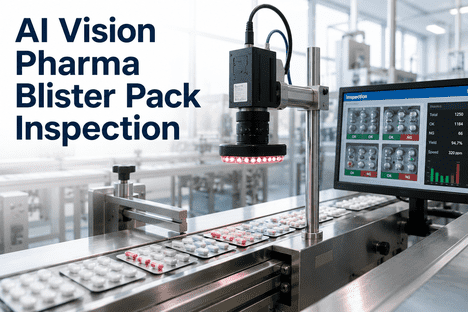
AI Vision Blister Pack Inspection at 300+ Per Minute
Detect missing tablets, broken capsules, empty pockets and foil seal defects in real time with GMP-aligned deep-learning vision — built for FDA 21 CFR Part 11 data integrity from the first pack.
300+
blisters per minute inspected
99.5%
defect detection accuracy
<50ms
edge inference per frame
Part 11
audit trail ready
Every Defect a Blister Can Hide
A blister pack can fail in more ways than a single sensor was ever designed to catch. AI vision inspects every pocket and every seal for the full set of defects at once — the ones that threaten patient safety and the ones that threaten your batch release.
Missing Tablet
Every pocket verified for presence — the defect with the most direct consequence for the patient who opens the pack.
Broken or Chipped Capsule
Cracked, chipped, or split dosage forms caught before they ship, including signs of a cross-contamination event.
Empty Pocket
Empty or partially filled cavities flagged instantly, so an underfilled card never reaches secondary packaging.
Foil & Seal Defects
Incomplete seals, wrinkles, and contamination in the seal zone that would compromise shelf life and tamper evidence.
Wrong Color or Shape
Each unit checked for correct color, shape, and orientation — catching mix-ups and double-product errors.
Print & Code Errors
Lot numbers, expiry dates, and serialization codes verified for presence, legibility, and match to the production order.
Inspect Every Pack, Not Every Tenth
Human inspection is inconsistent, fatiguing, and impossible to sustain at line speed — which is why manual checks devolve into sampling and defects slip through. A camera mounted over the conveyor changes the math: every pack is inspected, every time, at full production rate, with a decision made in milliseconds.
100%
Inspected, not sampled
Inline inspection covers every blister at production speed, replacing statistical sampling with full coverage.
~79 FPS
Real-time throughput
Deep-learning models process frames fast enough to keep up with the conveyor without slowing the line.
<50ms
Edge decision
On-prem edge inference makes the accept-or-reject call locally, fast enough for line-speed rejection.
<45min
To train a product
A new product model can be built from fewer than 200 good images in under an hour, minimizing changeover downtime.
Want to see detection running on your own blister format? Book a demo and we'll inspect a sample card live, defect by defect.
Why Deep Learning Beats Rule-Based Cameras
Traditional rule-based vision works only when every variable is fixed — and pharma rarely is. Tablet sheen, lighting drift, new dosage forms, and subtle foil wrinkles defeat brittle thresholds, producing either escaped defects or a flood of false rejects that scrap good product. Deep learning learns the difference between real defects and acceptable variation.
Rule-based vision
Brittle Thresholds
Breaks when lighting, sheen, or format shifts
High false-reject rate scraps good product
Each new product needs manual re-programming
Subtle defects fall below fixed thresholds
iFactory deep-learning vision
Learns Real vs Acceptable
Tolerates natural variation, holds accuracy
Minimizes false rejects, protects yield
New product trained from a handful of images
Reaches ~99% accuracy vs ~89% for older detectors
GMP-Aligned and 21 CFR Part 11 Ready
In a regulated plant, a detection is only as good as the record behind it. Any system that creates or stores GMP data has to satisfy Part 11 — and FDA increasingly cites data-integrity gaps, found in a large share of GMP warning letters. iFactory is built around ALCOA+ data integrity so every inspection result is attributable, traceable, and inspection-ready.
Full Audit Trail
Every image, decision, and parameter change time-stamped and retained — the trail auditors now treat as a KPI.
Electronic Signatures
Controlled access and e-signatures on model changes and batch records, aligned with 21 CFR Part 11 expectations.
ALCOA+ Data Integrity
Records that are attributable, legible, contemporaneous, original, and accurate, supporting GMP and predicate rules.
Validation Support
A risk-based, GAMP-aligned validation path so the AI model's workflow is documented, versioned, and reproducible.
Live on Your Line in Weeks, On-Prem
Vision inspection ships as a turnkey deliverable, not a multi-year integration. A pre-configured edge AI server arrives racked and ready with the inspection software pre-loaded — rack it, connect power and Ethernet, and inference runs locally, inside your firewall, with no patient or batch data leaving the plant.
1
Rack the edge server
A pre-configured edge AI server slots into your line, shipped pre-validated with the vision software pre-loaded.
2
Train the product model
Capture a small set of good images per format; the model is built and fine-tuned in under an hour.
3
Inspect, inside your firewall
Inference runs on-prem in real time — no external egress, full data residency, every pack checked locally.
What AI Vision Delivers
Automated blister inspection converts directly into fewer escapes, less scrapped good product, and audits you walk into with the record already built. These reflect outcomes pharmaceutical manufacturers report after moving from manual or rule-based inspection to deep-learning vision.
99.5%
Detection accuracy
consistent, high-speed inspection across every defect class
Zero
Defect escapes
100% inline coverage replaces sampling and human fatigue
Lower
False rejects
good product kept instead of scrapped on brittle thresholds
Shorter
Recall exposure
complete records shorten investigations and protect release
Curious how your current escape and false-reject rates compare? Talk to our vision team and benchmark them against deep-learning inspection.
Frequently Asked Questions
What defects can the system actually detect?
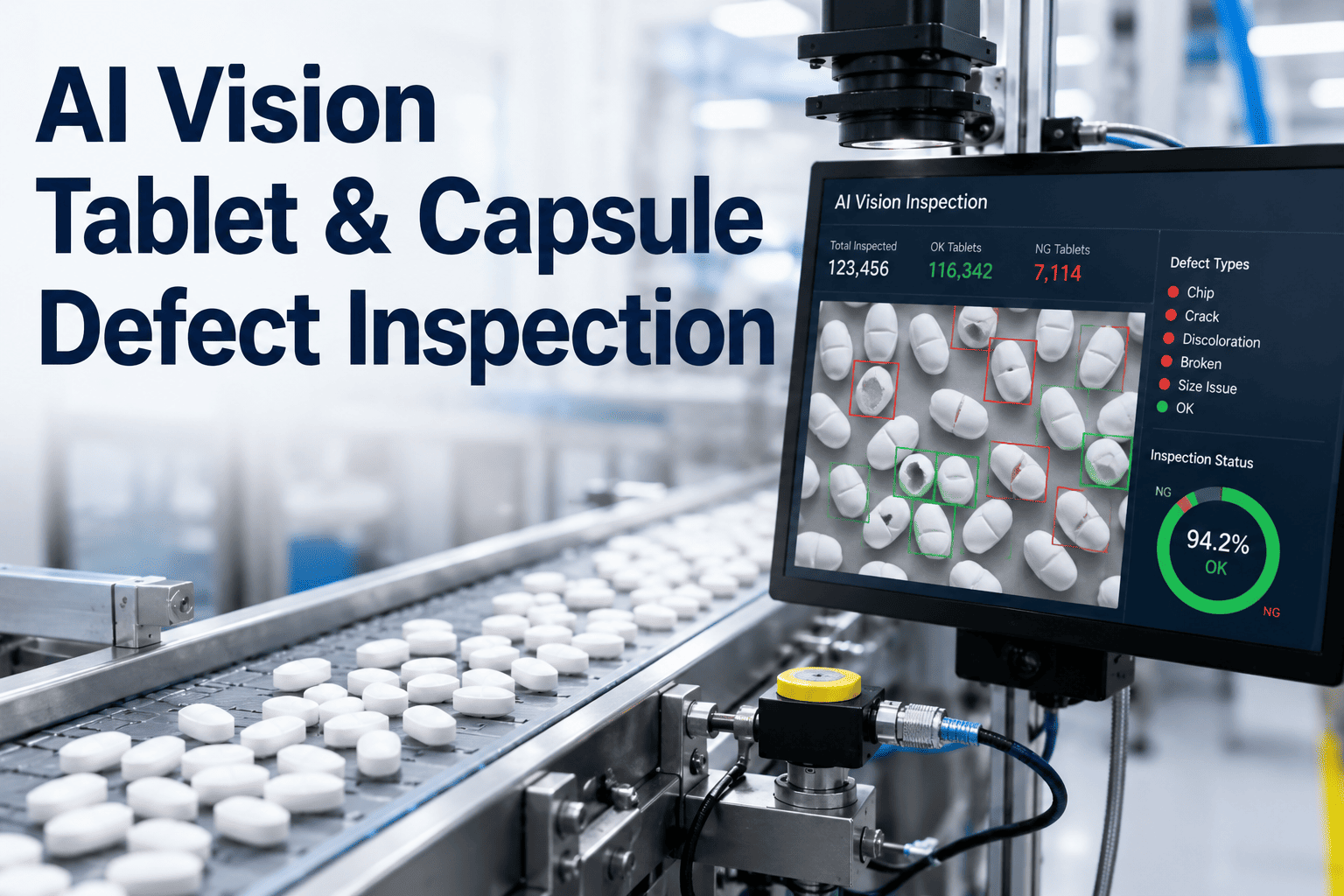
The full critical set: missing tablets, broken or chipped capsules, empty and partially filled pockets, foil and seal defects, wrong color, shape, or orientation, double-product errors, and print or serialization code errors. Every pocket and the seal zone are inspected simultaneously, so a single pass covers both patient-safety defects and batch-release defects.
Can it really keep up with 300+ blisters per minute?
Yes. Modern lines run above 300 blisters per minute, and deep-learning models process frames in milliseconds — around 79 frames per second in published work — with edge inference making the accept-or-reject decision locally in under 50ms. The camera mounts over the conveyor and inspects every pack without slowing production.
How is deep-learning vision better than the rule-based system we have?
Rule-based cameras rely on fixed thresholds that break when lighting, tablet sheen, or format changes, producing escaped defects or excessive false rejects that scrap good product. Deep learning learns the difference between a real defect and acceptable variation, holding roughly 99% accuracy where older detectors sit closer to 89%, and adapts to a new product from a small image set rather than manual re-programming.
Is it FDA 21 CFR Part 11 compliant?
It is built for it. The system maintains full audit trails, supports electronic signatures and controlled access, and follows ALCOA+ data-integrity principles so every inspection record is attributable, traceable, and inspection-ready. Because the AI's output is GMP data, its workflow is validated and versioned along a risk-based, GAMP-aligned path — addressing exactly the data-integrity gaps FDA cites most.
Does our product or batch data leave the plant?
No. Inference runs on a pre-configured edge AI server on-premise, inside your firewall, with no external egress required to operate. Images and inspection records stay local, satisfying data-residency and IT-governance requirements. The fastest way to confirm fit is a demo on your own blister format — book one and bring a sample card.
Catch It on the Line, Not in a Recall.
See AI Vision Inspect Your Blister Format
Bring one product card. We'll show missing-tablet, broken-capsule, empty-pocket and foil-defect detection running at line speed, demonstrate the audit trail and electronic-signature records, and map the on-prem edge deployment to your line — Part 11 ready from the first pack.
On-prem
inside your firewall