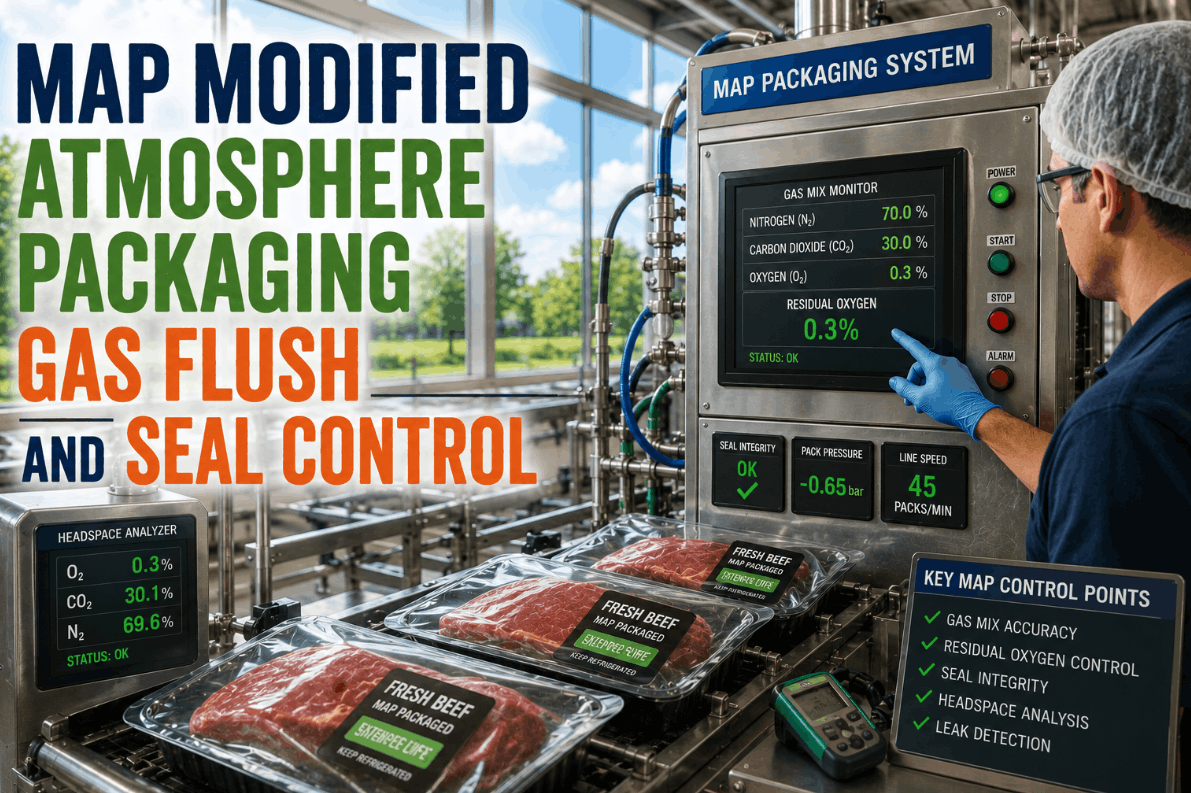
Modified atmosphere packaging works on a simple principle that hides an operationally demanding reality: replace the air inside a sealed food package with a precisely controlled gas mixture, and the biological and chemical processes that drive spoilage slow dramatically. In practice, that simplicity vanishes the moment the gas mixer runs slightly rich on oxygen, the tray sealer's dwell temperature drops half a degree during a long production run, or a micro-leak develops in a film seal that no visual inspection will catch. A MAP line that is not continuously monitored for flush gas ratio, residual oxygen, and seal integrity is not a shelf-life extension system — it is a variable-quality packaging operation that puts retail shelf life claims at risk on every pallet it ships. The difference between a MAP program that reliably delivers the promised shelf life and one that generates retailer returns and quality complaints is data: continuous, actionable, process-level data integrated from the gas mixer through the headspace analyzer to the seal integrity check. This guide covers the full methodology for industrial MAP gas flush and seal control, and how iFactory AI's platform delivers the real-time process intelligence that protects shelf life from machine to market.
Real-Time Gas Flush, Residual O₂, and Seal Integrity Monitoring — One Dashboard
iFactory AI connects your gas mixer, headspace analyzer, tray sealer, and leak detector into a single MAP quality intelligence layer — so your packaging team acts on data, not on 30-minute sampling cycles.
Why MAP Gas Ratio Control Is the Most Consequential Variable on Your Packaging Line
The three gases used in modified atmosphere packaging — oxygen, carbon dioxide, and nitrogen — each serve a specific, product-dependent preservation function. Oxygen maintains the red oxymyoglobin color in fresh red meat but accelerates oxidative rancidity in nuts and snack foods. Carbon dioxide inhibits aerobic bacteria and mold, but at concentrations above 40% it can cause pack collapse in rigid trays if nitrogen is not present to balance the pressure. Nitrogen is inert and prevents oxidation, but it provides no antimicrobial benefit on its own. Getting the ratio wrong — even by a few percentage points — does not just reduce shelf life. It can cause the opposite of the intended preservation effect: too much oxygen in a poultry tray, and aerobic bacteria proliferate at the same rate as in air; too little oxygen in a live-produce package, and anaerobic fermentation begins within hours. Book a Demo to see how iFactory monitors your gas mixer ratio in real time against the specification for every active SKU.
| Product Category | Typical Gas Mix (O₂ / CO₂ / N₂) | Primary Preservation Goal | Residual O₂ Target | Key Failure Risk |
|---|---|---|---|---|
| Fresh Red Meat | 70–80% O₂ / 20–30% CO₂ / 0% N₂ | Maintain oxymyoglobin (bright red color) | 70–80% (high O₂ required) | Metmyoglobin browning if O₂ drops below 60% |
| Poultry & Processed Meat | 0% O₂ / 25–35% CO₂ / 65–75% N₂ | Inhibit aerobic spoilage bacteria | <1% residual O₂ | Aerobic spoilage if O₂ >2%; anaerobic risk if CO₂ too low |
| Fresh-Cut Produce | 3–5% O₂ / 5–10% CO₂ / balance N₂ | Slow respiration; prevent browning and anaerobic fermentation | 3–5% (balance critical) | Fermentation if O₂ <1%; rapid browning if O₂ >8% |
| Ready Meals | 0–2% O₂ / 30–40% CO₂ / balance N₂ | Microbial inhibition; flavor and texture preservation | <1–2% residual O₂ | C. botulinum risk if O₂ eliminated without temperature control |
| Cheese & Dairy | 0% O₂ / 20–40% CO₂ / balance N₂ | Mold inhibition; yeast suppression | <1% residual O₂ | Pack collapse if CO₂ not balanced with N₂ |
| Snacks, Nuts, Coffee | 0% O₂ / 0% CO₂ / 100% N₂ | Prevent oxidative rancidity; maintain texture | <1% residual O₂ | Rancidity and staling if any O₂ present at sealing |
Flush Gas Ratio Drift: How It Starts, Why It Compounds, and How iFactory Catches It
Gas ratio drift in a MAP line rarely starts as a catastrophic failure. It starts as a 1–2% oxygen enrichment in a nitrogen-dominant mix because a proportional valve is wearing. Or a CO₂ supply pressure drops by 0.3 bar during a peak-demand period and the gas mixer compensates inadequately. Or a product changeover reset loads the wrong gas recipe because the operator confirmed the previous SKU's parameters without updating. Each deviation individually is small. Left undetected across a production run of 10,000 trays, the accumulated effect is a batch where actual headspace gas composition is materially outside specification — and the shelf life claim on every label is wrong.
Seal Integrity: The Control Point That MAP Programs Most Commonly Miss
A perfect gas flush is worthless inside a leaking package. Seal failures in MAP are particularly insidious because the most damaging leak modes — micro-leaks through the seal bead, pinholes in the film at the tray corner radius, or channel leaks caused by product contamination on the seal surface — are invisible to visual inspection, produce packages that feel properly pressured immediately after sealing, and only manifest as elevated residual oxygen levels days later when the product is already in distribution. By the time the shelf life failure is confirmed, the product is in the retailer's case. The only defense is continuous seal integrity monitoring integrated into the line, not end-of-shift destructive sample testing.
The tray sealer's seal bar temperature, dwell time, and seal pressure are the three process variables that determine seal quality. iFactory monitors all three continuously, correlating each variable's actual value against the approved sealing specification for the active film-tray combination. Temperature drops of as little as 5°C below the specification minimum can produce structurally incomplete seals that pass a visual check but fail under the mild pressure differentials present in refrigerated distribution.
- Seal bar temperature monitored against film-specific specification — alert on drift >3°C from setpoint
- Dwell time deviation detected from machine cycle data — short dwell correlated with elevated leak rate
- Seal pressure trend tracked across the shift — declining pressure indicates tooling wear before seal failures appear
- Film roll changeover verified against approved specification — wrong film OTR flagged before run begins
- Per-cavity seal performance mapped on multi-cavity tray sealers — identifies single-cavity tooling issues
Multiple leak detection methods are applied at different points in the MAP QC cycle. iFactory integrates data from each method into a unified seal integrity record, linking method results to the specific sealer, cavity, and film lot that produced the package — enabling root cause isolation rather than just defect counting.
- CO₂ trace gas laser detection — non-destructive, detects holes as small as 0.2 mm at 200 packs per minute
- Vacuum decay leak testing — semi-destructive, high-sensitivity method for scheduled QC sampling
- Water bath bubble emission — destructive but definitive; used for sealer setup validation and tooling verification
- High-voltage (HVLD) leak detection — non-destructive option for non-conductive film applications
- Leak event data linked to sealer cycle count, temperature log, and film lot for traceability to root cause
Headspace gas sampling — measuring actual O₂ and CO₂ concentration inside sealed packages — is the definitive confirmation that the MAP process has achieved its intended atmosphere. Most plants sample every 30 minutes or per batch, generating a dataset that reveals trends only in retrospect. iFactory digitizes every headspace reading and plots it as a real-time control chart against the specification limits, enabling statistical process control of residual O₂ as a continuous variable rather than a pass/fail data point.
- Every headspace reading ingested and plotted against SKU-specific O₂ and CO₂ specification limits
- Statistical process control (SPC) chart updated in real time — trend toward limit triggers alert before breach
- Sample frequency automatically increased when O₂ trend approaches upper specification limit
- Results linked to gas mixer ratio log — correlation between supply-side deviation and residual O₂ shift identified automatically
- Shift-level and batch-level residual O₂ summary reports generated for HACCP documentation
iFactory's MAP analytics module connects every data stream in the gas flush and seal control process — from the mixer's mass flow controllers through the headspace analyzer to the leak detector output — into a single, real-time quality intelligence dashboard. The platform correlates these streams automatically, identifying multi-variable combinations that produce seal or atmosphere failures before they propagate through the production run.
- Gas mixer ratio, supply pressure, and headspace O₂ correlated in a single MAP quality model per SKU
- Tray sealer temperature, dwell, and pressure linked to downstream seal integrity results — causal chain identified automatically
- Automated HACCP CCP documentation for MAP gas ratio and residual O₂ critical limits — audit-ready every shift
- Predictive shelf life model updated per batch based on actual residual O₂ achieved — label claim verified against measured result
- Retailer return correlation module links customer complaint data to production run parameters for retrospective root cause analysis
Replace Periodic Headspace Sampling with Continuous MAP Process Intelligence
iFactory AI connects your gas mixer, headspace analyzer, tray sealer, and leak detector into a unified MAP quality platform — catching ratio drift, residual O₂ exceedances, and seal integrity failures in real time, not at the end of the production run.
MAP Quality Is a Process Control Problem, Not a Sampling Problem
The most common failure mode in industrial MAP operations is not bad equipment — it is insufficient process visibility between the sampling points. A gas mixer that is running 3% oxygen-rich for 90 minutes before a headspace check catches it has already filled thousands of packages with a compromised atmosphere. A tray sealer whose seal bar temperature has drifted 6°C below specification over the second half of a shift has produced micro-leak failures that will not manifest as elevated residual oxygen until the product has been in refrigerated distribution for several days. These are process control failures, and they are entirely preventable with the continuous monitoring infrastructure that iFactory makes operationally practical for food packaging operations of any scale.
iFactory AI's MAP analytics platform connects your gas mixer, headspace analyzer, tray sealer, and leak detector into a single, real-time quality intelligence layer that catches drift while it is forming — not after it has shipped. The data that protects your shelf life claim, your retail relationships, and your brand is already being generated on your MAP line. Book a Demo and let iFactory show you exactly what your MAP line's data is already telling you — and what it should be triggering in real time.
Modified Atmosphere Packaging — Frequently Asked Questions
iFactory connects to your gas mixer's mass flow controller outputs, existing headspace analyzer results, and tray sealer parameter logs — no new sensors are required in most installations. Integration with your L2 historian or SCADA is typically completed within one week of commissioning.
Yes — iFactory maintains a separate gas ratio specification, residual O₂ target, and seal integrity parameter set for each SKU, automatically switching the active monitoring profile at every production order changeover and verifying the mixer's loaded recipe against the approved specification before the run begins.
iFactory automatically logs every gas ratio reading, residual O₂ measurement, and corrective action event with timestamps — generating a continuous, audit-ready CCP monitoring record that satisfies HACCP, SQF, BRC, and FSMA Preventive Controls documentation requirements without additional manual data entry.
iFactory integrates with inline CO₂ laser leak detectors, vacuum decay testers, and HVLD systems via standard OPC-UA, Modbus, or 4–20 mA signal outputs — linking every leak detection result to the specific sealer cycle, temperature log, and film lot that produced the package for root cause traceability.
Most MAP operations recover full platform investment within 3 to 6 months — primarily through reduced retailer returns, eliminated MAP gas waste from over-flush, and avoided batch holds — with the fastest payback cases occurring when the platform identifies a recurring drift pattern in the first 30 days of live monitoring.
Build a Continuous MAP Quality Intelligence Program with iFactory AI
iFactory connects every data stream on your MAP line — gas mixer ratio, headspace analyzer, tray sealer parameters, and leak detector output — into a single real-time quality dashboard that protects shelf life from machine to market. Trusted by food manufacturers across 38 countries.