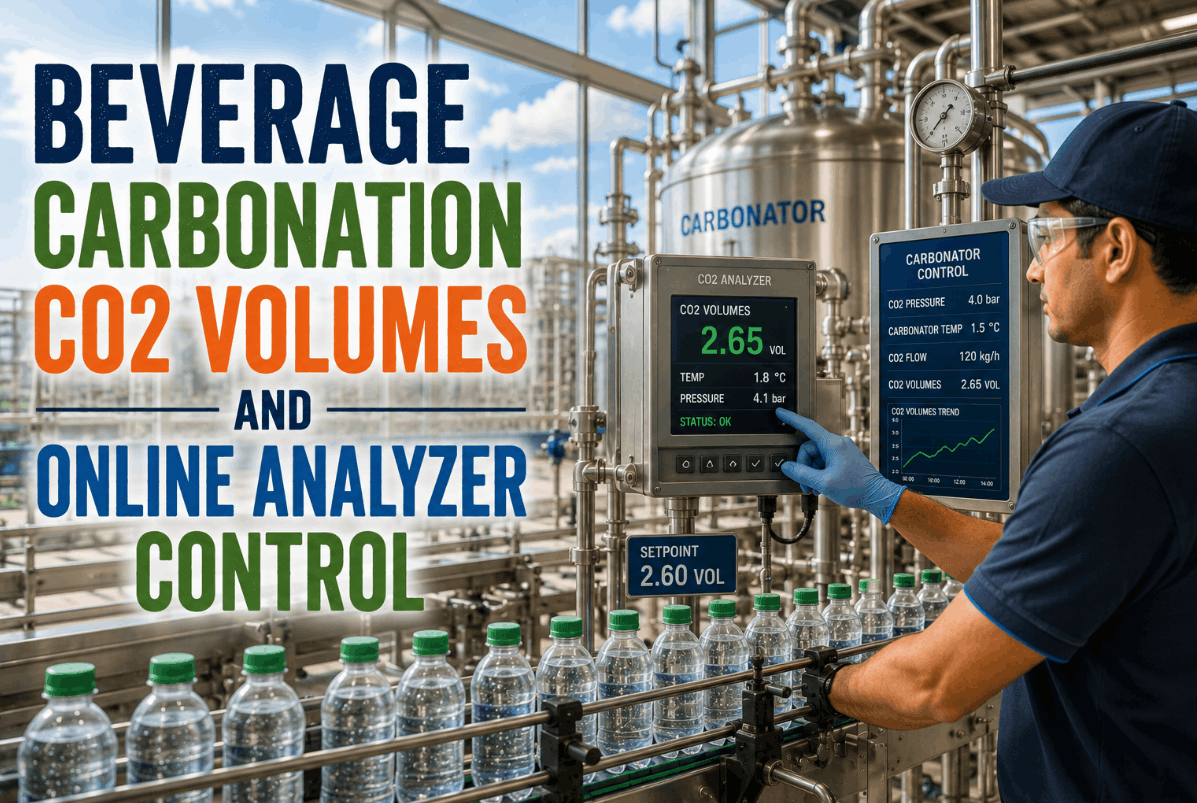
Carbonation is one of the most precisely specified quality attributes in beverage manufacturing — and one of the most operationally difficult to hold stable across a full production run. The physics are straightforward: CO2 solubility in liquid increases with pressure and decreases with temperature, governed by Henry's Law. The process reality is more complex. Carbonator temperature drifts by fractions of a degree. Storage tank pressure fluctuates between blending and the filler. Inline CO2 injection ratios shift with product flow rate changes. Each variable moves independently, and their combined effect on dissolved CO2 volumes at the filler head is the difference between a beverage that tastes exactly on-specification and one that reaches a consumer flat, over-foamed, or inconsistent with the last purchase. Managing carbonation drift in a high-speed beverage line requires more than a well-calibrated carbonator — it requires a continuous, integrated monitoring and control strategy that links online CO2 measurement directly to carbonator setpoint management, storage tank pressure regulation, and filler counter-pressure control. This guide covers the full methodology for industrial beverage carbonation control and how iFactory AI's platform delivers the real-time process intelligence that closes the loop from analyzer reading to corrective action.
Why Carbonation Drift Happens — and Why It Is Harder to Catch Than It Looks
Carbonation drift is rarely a single-point failure. A carbonation deviation that shows up at the online analyzer post-filler is almost always the accumulated result of two or three small process disturbances occurring simultaneously upstream — a 0.3°C temperature rise in the carbonator chiller, a 0.5 bar pressure drop in the storage tank during a product changeover hold, and a slight increase in product flow rate that the CO2 injection system did not compensate fully. Each deviation individually would be within tolerance. Combined, they produce a batch running 0.2 to 0.3 volumes below specification — enough to generate flat-texture complaints on sensitive SKUs like sparkling water or light lager, where the carbonation specification window is tight and consumer perception of under-carbonation is immediate.
The challenge is that most beverage lines monitor these variables independently. The carbonator temperature controller operates in its own loop. The storage tank pressure gauge is read manually during rounds. The online CO2 analyzer reading is checked periodically but not connected to a feedback path that adjusts the carbonator setpoint automatically. The result is a control architecture that responds to carbonation deviations after they have developed — not while they are forming. Book a Demo to see how iFactory integrates these isolated control loops into a unified carbonation management system.
- CO2 volumes verified by periodic grab sample — deviations identified after batch production complete
- Carbonator temperature and storage tank pressure managed in separate, disconnected control loops
- Flat or over-foamed product identified at QC check — not at the carbonator where correction is possible
- CO2 injection ratio adjusted manually in response to operator observation, not real-time flow data
- Carbonation drift root cause analysis delayed — multiple process variables examined after the fact
- SKU changeovers require extended stabilization periods before carbonation levels are confirmed in-spec
- Online CO2 analyzer readings fed to iFactory in real time — drift trend identified within minutes of onset
- Carbonator temperature, tank pressure, and CO2 injection ratio correlated in a single control model
- Carbonation deviation flagged at the carbonator stage — correction applied before product reaches the filler
- CO2 injection setpoint automatically adjusted against flow rate changes — ratio held constant under variable throughput
- Root cause of drift identified in real time — temperature, pressure, or flow variable isolated automatically
- SKU changeover carbonation stabilization time reduced — target CO2 volumes confirmed faster with trend monitoring
CO2 Volume Targets by Beverage Category — and Why the Specification Window Matters
Different beverage categories carry substantially different carbonation targets, measured in volumes of CO2 (one volume = one liter of CO2 dissolved per liter of liquid at standard conditions). The specification window — the acceptable tolerance band around the nominal target — varies significantly by product type, and the consequence of drifting outside that window ranges from a mild sensory deviation to a consumer-visible defect. Understanding the target and the tolerance for each SKU in production is the prerequisite for setting meaningful control limits on the carbonation monitoring system.
| Beverage Category | Typical CO2 Target (Volumes) | Specification Window | Under-Carbonation Symptom | Over-Carbonation Symptom |
|---|---|---|---|---|
| Cola / Dark CSD | 3.5 – 3.8 vol | ± 0.15 vol | Flat taste, reduced bite, perceived sweetness increase | Harsh mouthfeel, excessive gassing at fill, fobbing |
| Lemon-Lime / Clear CSD | 3.2 – 3.7 vol | ± 0.15 vol | Loss of refreshing character, reduced effervescence | Sharp or acidic perception, over-foaming at open |
| Sparkling Water | 3.8 – 5.0 vol | ± 0.10 vol | Flat texture immediately detectable — consumer-visible defect | Violent gassing on open, container overpressure risk |
| Lager / Light Beer | 2.5 – 2.8 vol | ± 0.10 vol | Thin mouthfeel, reduced head retention, stale perception | Excess head, pour loss, bitterness amplification |
| Energy Drink | 3.0 – 3.5 vol | ± 0.20 vol | Reduced tingle, brand differentiation loss | Aggressive carbonation interfering with flavor balance |
| Tonic Water | 4.0 – 5.0 vol | ± 0.15 vol | Loss of quinine sharpness, flat mouthfeel | Over-foaming, mixer application problems |
The specification windows above are tighter than most plants' manual monitoring frequency can reliably protect. A carbonation check every 30 minutes on a line filling 600 containers per minute means that a drift event developing over 15 minutes has already produced thousands of off-spec units before the next check catches it. Continuous online monitoring with iFactory's closed-loop alert model is the only approach that protects the full specification window at production speed. Book a Demo to review how the alert thresholds map to your specific SKU portfolio.
The Four Process Variables That Control CO2 Volumes — and How iFactory Monitors Each
Industrial beverage carbonation is controlled by four process variables that interact continuously: carbonator temperature, system pressure, CO2 injection ratio, and product flow rate. A change in any one of these without a compensating adjustment in the others produces a CO2 volume deviation at the filler. iFactory's carbonation analytics module monitors all four simultaneously — calculating the expected CO2 volume at current conditions and comparing it against the measured value from the online analyzer to identify which variable is responsible when a deviation occurs.
Carbonation Control Across the Line: From Carbonator to Sealed Container
Achieving a CO2 volume specification at the sealed container is not a single-point control problem — it is a cascade of pressure and temperature management events that begins at the carbonator and ends at the filler valve seal. Each stage in the sequence is an opportunity for CO2 loss if the conditions are not maintained. iFactory's line-level carbonation model tracks the CO2 volume state at each stage, building a transfer loss picture that identifies where the gap between measured carbonator-outlet CO2 and final sealed-container CO2 is occurring.
Expert Perspective: What Closed-Loop Carbonation Monitoring Changed on a High-Speed CSD Line
We were running 1,200 cans per minute across two filling lines and managing carbonation with a 20-minute manual analyzer check. We knew the system well enough that our operators had developed a good feel for when things were drifting — but a good feel on a line running that fast still means thousands of cans between when a drift starts and when someone acts on it. When we deployed iFactory and connected it to our inline CO2 analyzers, the first thing we discovered was that our carbonation variance was concentrated almost entirely in the first 40 minutes of each production run and during any throughput speed change. Those two windows represented maybe 15% of our total production time but accounted for over 70% of our out-of-spec product. The AI identified that the drift during startup was a carbonator chiller recovery lag — the setpoint was held but the actual chiller outlet temperature was 0.8°C above target for the first 35 minutes after a cold start. We adjusted the pre-chill protocol and startup drift dropped immediately. That single finding justified the platform cost in the first month.
Frequently Asked Questions: Beverage Carbonation CO2 Volumes and Online Analyzer Control
iFactory connects to any online CO2 analyzer that outputs a standard 4–20 mA, OPC-UA, or Modbus signal — including infrared, dielectric constant, and pressure-temperature measurement systems from major beverage instrumentation suppliers. Integration is typically completed within a few days of site commissioning without process interruption.
Yes — iFactory maintains a separate CO2 target profile and alert threshold set for each SKU in your product portfolio, switching automatically when the active production order changes, so carbonation monitoring remains calibrated to the correct specification throughout every product changeover without manual reconfiguration.
iFactory's carbonation model applies Henry's Law in real time using simultaneous temperature and pressure readings — isolating which variable's deviation accounts for the observed CO2 volume shift and directing the corrective recommendation to the specific control point responsible, rather than flagging a generic carbonation alarm.
Yes — iFactory's carbonation analytics model adapts to both inline and tank saturator configurations, with the tank-based model additionally monitoring thermal stratification risk from multi-point temperature data and flagging hold-period pressure decay events that are specific to saturator-based operations.
Most beverage line deployments reach full operational status within 2 to 4 weeks — covering historian integration, SKU target configuration, and alert threshold calibration — with the first actionable carbonation drift findings typically surfacing within the first week of live monitoring.
Conclusion: Close the Loop Between Your CO2 Analyzer and Your Carbonation Control System
The online CO2 analyzer is the most important quality instrument on a carbonated beverage line — and in most plants, it operates as a standalone readout rather than the feedback signal for a closed-loop control system. The reading changes. The operator sees it, evaluates it, and decides whether to adjust a setpoint. That evaluation and adjustment cycle takes minutes on a well-run line. On a line filling hundreds of containers per second, minutes of carbonation drift translate directly into thousands of containers outside specification.
iFactory AI closes the loop between the analyzer and the control system — building the real-time, multi-variable carbonation intelligence layer that converts your existing process data into proactive control actions rather than reactive adjustments. The technology is already in your plant. The physics are already understood. The only gap is the data integration and analytics layer that connects them into a system that catches drift while it is forming — not after it has already filled your production run. Book a Demo and let iFactory show you where your carbonation control gaps are, on your line, with your data.