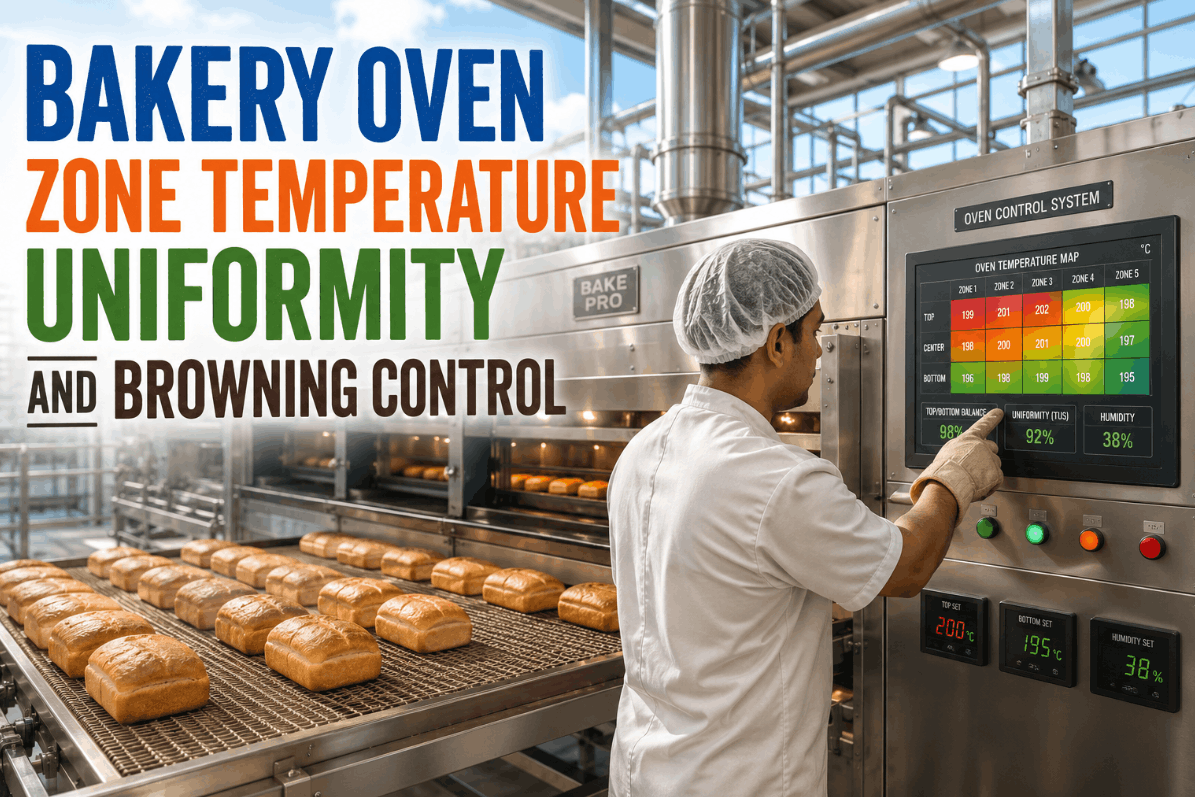
In commercial bakery operations, oven zone temperature uniformity is not a quality preference — it is the primary process variable that determines whether every loaf, roll, or snack leaving the tunnel oven meets spec or becomes yield loss. A cold zone at the entry end of a conveyor oven produces under-baked crumb structure that fails compression testing. A hot spot at Zone 4 burns the bottom crust before the interior reaches target moisture. And a top-to-bottom heat imbalance that drifts by just 8°F across a shift can move your product from premium to reject without a single alarm firing. Most bakery operations manage these risks through manual temperature surveys, periodic thermocouple checks, and trial-and-error damper adjustments — a workflow that resolves yesterday's problem while tomorrow's deviation is already building. iFactory's industrial AI platform brings real-time oven zone intelligence to commercial and industrial bakery production, giving process engineers and quality managers the continuous heat mapping, browning correlation, and predictive alert capability needed to lock in consistent crumb, color, and yield across every production run. Bakeries beginning this shift typically start by booking a platform demo to see how live zone monitoring maps to their specific oven configuration and product portfolio.
The "Drift Gap" Hiding Inside Your Tunnel Oven Zone Profile
Why Point-in-Time Temperature Checks Miss the Real Variability
Commercial tunnel and conveyor ovens are not static thermal environments. They are dynamic systems where burner output, airflow velocity, conveyor belt loading, steam injection rate, and ambient plant temperature interact continuously to produce the actual heat exposure your product receives at every point along the bake path. The problem with manual zone surveys — thermocouples inserted at shift start, damper positions checked at changeover — is that they capture a single moment in what is, in practice, a continuously shifting thermal landscape. A Zone 3 top burner that read 385°F at 6 AM may be delivering 372°F by 10 AM as a nozzle progressively clogs. By the time the quality technician pulls a product sample and measures internal temperature, two hours of production have passed through a mis-balanced oven. iFactory closes this gap by monitoring every zone sensor continuously and correlating thermal data against product browning outcomes, giving process engineers a live view of both cause and effect. Quality leads who Book a Demo consistently identify zone temperature drift as the largest single contributor to their batch-to-batch color and texture variation.
5 Root Causes of Oven Zone Uniformity Failure
Diagnosing the Thermal Blind Spots Before the Next Yield Loss Event
Mapping Zone Uniformity: What a Comprehensive Oven Intelligence Platform Must Monitor
The Parameter Matrix That Determines Browning, Crumb, and Yield
Effective oven zone management requires simultaneous monitoring of thermal, humidity, mechanical, and product response parameters — not individual spot checks. iFactory's sensor integration layer captures the full oven data picture and translates it into actionable process intelligence for every zone across the bake path. Process engineers who Book a Demo consistently identify that the parameter correlations iFactory provides are what finally allow them to stop chasing quality problems and start preventing them.
| Monitored Parameter | Zone Location | Product Impact | iFactory Capability |
|---|---|---|---|
| Top-deck zone temperature | All zones, continuous | Top crust color and Maillard reaction rate | Per-zone trend with browning correlation index |
| Bottom-deck zone temperature | All zones, continuous | Bottom crust char, bottom moisture release | Top/bottom differential alert per product spec |
| Steam injection pressure and flow | Zones 1–2 (entry) | Oven spring, surface gelatinization, crust gloss | Continuous steam profile vs. recipe setpoint |
| Oven humidity / dewpoint | Mid-oven and exhaust | Crumb moisture, surface drying curve | Live humidity trend with moisture target deviation alert |
| Exhaust damper position | Each zone damper | Zone pressure balance, humidity accumulation | Position feedback vs. setpoint with drift detection |
| Conveyor belt speed | Full oven length | Total bake time and heat exposure accumulation | Speed deviation alert with predicted bake time impact |
| Gas burner pressure per zone | Individual burner headers | Zone output consistency, nozzle fouling detection | Burner pressure trend with nozzle degradation flag |
The Browning Curve: Connecting Zone Temperature Data to Product Color Outcomes
How iFactory Correlates Thermal Profile with Maillard Reaction and Crust Development
Surface color development in baked goods — driven primarily by the Maillard reaction between reducing sugars and amino acids — is an exponential function of temperature and time exposure. This means that small, sustained deviations in mid-oven zone temperature produce disproportionately large shifts in final product color. A Zone 4 temperature that runs 10°F low for two hours does not produce product that is 10°F worth of lighter — it produces product that may fall outside the L* value range required for retail specification. iFactory's browning intelligence module correlates the cumulative thermal exposure received across all zones with the expected colorimetric outcome, alerting process engineers when the integrated heat curve is trending toward a color deviation before the product reaches the discharge end. This is the difference between catching a problem at Zone 4 and catching it at the packing line.
Measurable Outcomes from AI-Driven Oven Zone Intelligence
What Production Bakeries Gain from Continuous Thermal Monitoring
The operational case for continuous oven zone monitoring resolves into three parallel value streams: quality consistency, yield recovery, and energy efficiency. The following outcomes reflect results achieved by food and beverage manufacturers using iFactory's process monitoring platform in continuous oven production environments.
Frequently Asked Questions
How does iFactory monitor oven zone temperatures without replacing existing oven instrumentation?
iFactory integrates with existing zone thermocouples and RTDs via OPC-UA, Modbus, and 4–20mA inputs, overlaying its AI monitoring layer on current instrumentation without requiring new sensors or oven control system replacement.
Can iFactory detect a burner nozzle fouling event in real time?
Yes — iFactory tracks the temperature differential between adjacent zone sensors and flags asymmetric heat distribution patterns consistent with nozzle fouling, typically detecting the issue 60–90 minutes before it produces visible product color deviation.
How does iFactory support HACCP compliance for baking critical control points?
The platform archives every production run's complete zone thermal record with lot ID, recipe reference, and deviation log, providing a fully traceable, timestamped baking record that satisfies HACCP CCP documentation requirements without manual chart transcription.
Does iFactory manage recipe-specific zone profiles for multi-product tunnel ovens?
Yes — each approved recipe has its own baseline zone profile stored in iFactory; at changeover, the system automatically activates the new profile and monitors the oven's transition to confirm thermal targets are met before production begins.
How quickly does a production bakery typically see ROI from oven zone monitoring?
Most production bakeries achieve measurable ROI within 60–90 days through yield recovery from reduced color rejects and gas savings from zone balancing, with full platform payback typically completed within one baking season.
Conclusion: The Oven That Sees Itself Bakes Consistent Product Every Run
Commercial tunnel and conveyor oven operations are complex enough that no shift team — however experienced — can manually detect and compensate for every zone thermal deviation as it happens. Burner nozzles foul gradually. Dampers drift. Steam headers lose pressure. Belt speed controllers drift at the edges of their calibration range. Each event individually may be small; in combination, they produce the batch-to-batch color and texture variation that drives reject rates, customer complaints, and the quiet yield losses that accumulate invisibly in the cost of goods. iFactory gives production bakeries the continuous zone intelligence needed to see these interactions as they develop — not after the product has already been affected. Whether your facility runs two tunnel ovens or twelve, the value equation is the same: consistent zone profiles produce consistent product, and consistent product protects both yield and brand reputation. To see how iFactory applies to your specific oven configuration, product portfolio, and quality targets, Book a Demo with our food and beverage process engineering team.