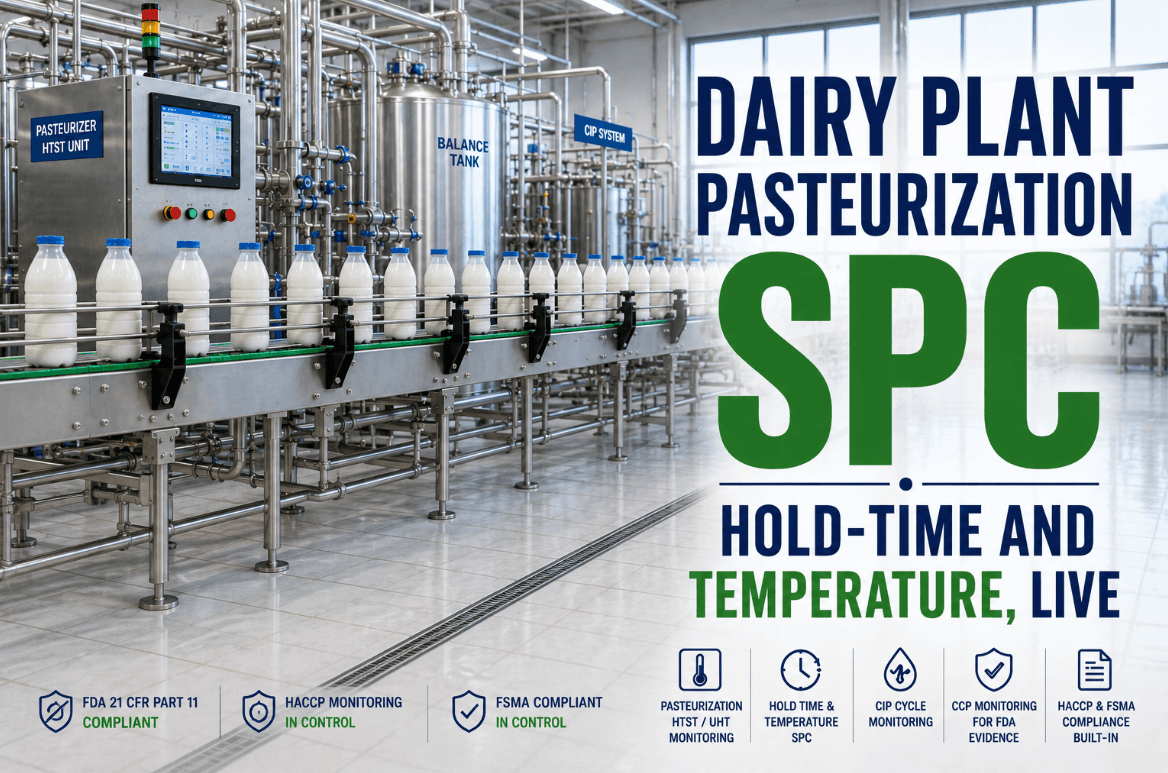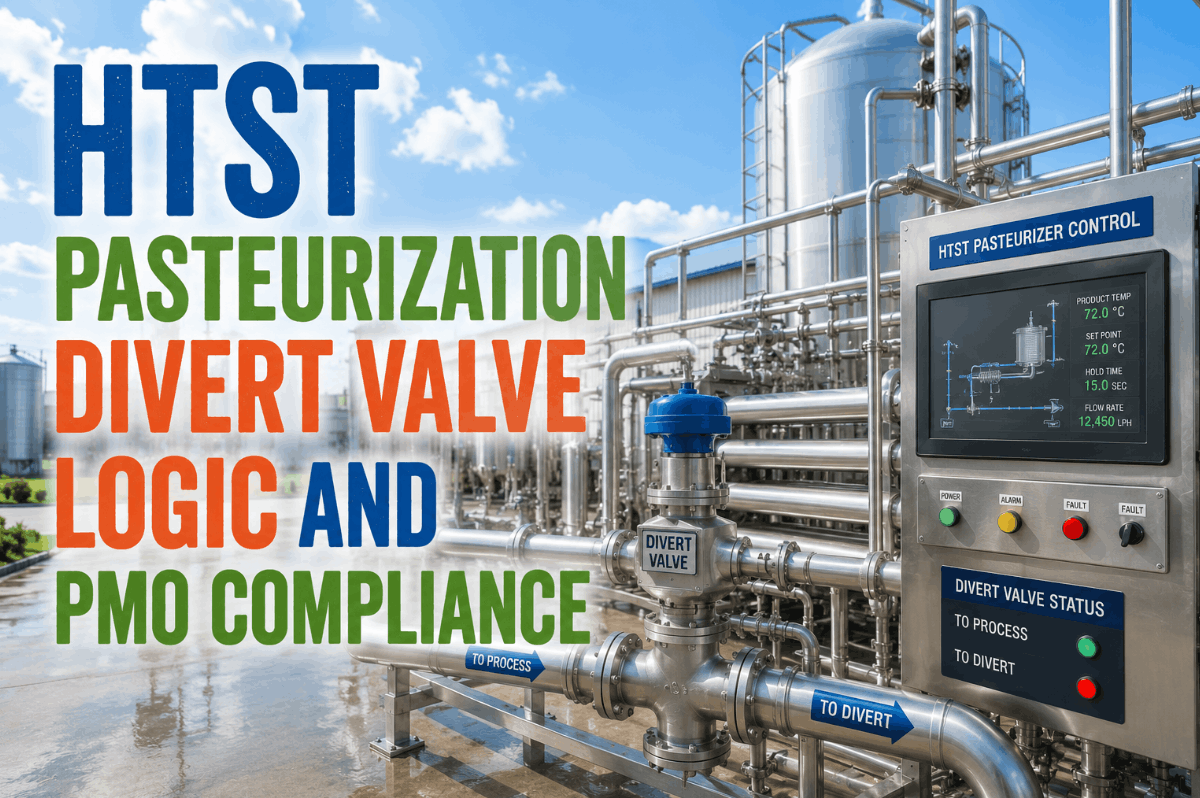
In Grade A dairy operations, the High Temperature Short Time (HTST) pasteurization system is not simply a piece of process equipment — it is the primary regulatory control point that separates safe, market-ready product from a potential public health event. At the center of that system sits the Flow Diversion Valve (FDV): a single mechanical component whose response logic, timing, and verification record determine whether a plant remains in PMO compliance or faces immediate regulatory action. Yet across U.S. dairy facilities, the most common source of audit findings and product holds is not equipment failure — it is inadequate visibility into FDV performance, hold tube temperature continuity, and recording chart integrity during high-volume production runs. iFactory's industrial AI platform brings real-time HTST intelligence to dairy operations, giving quality managers and plant engineers the continuous monitoring, automated compliance logging, and predictive alert capability they need to protect both product safety and Grade A status. Dairy operations beginning this transition typically start by booking a platform demo to see how live HTST monitoring maps to their specific pasteurizer configuration and IMS audit requirements.
Real-Time FDV Logic Monitoring and PMO Compliance for Grade A Dairy
iFactory's AI platform delivers continuous divert valve logic verification, hold tube temperature analytics, and automated IMS recording chart compliance — purpose-built for the regulatory demands of modern dairy pasteurization.
Why FDV Logic and PMO Documentation Define Grade A Risk
The Pasteurized Milk Ordinance (PMO), administered through the FDA's Milk Safety Branch and enforced by state regulatory agencies under the Interstate Milk Shippers (IMS) program, establishes precise, non-negotiable requirements for every HTST system operating in U.S. Grade A dairy plants. The Flow Diversion Valve must divert product to the raw side whenever the temperature at the end of the hold tube falls below the legal minimum — 161°F (71.7°C) for 15 seconds in standard HTST — and this divert event must be automatically initiated, verifiably logged, and included in continuous temperature recording charts reviewed at every regulatory inspection. The gap most facilities face is not regulatory awareness: it is the inability to demonstrate, in real time and through documentary evidence, that their FDV is performing exactly as the IMS requires. Quality managers who Book a Demo with iFactory consistently identify that their most significant compliance risk lies not in the pasteurizer itself, but in the data layer surrounding it.
FDV Response Lag
A divert valve that takes longer than its rated actuation time to reach full divert position can allow sub-legal temperature product to pass forward — a direct PMO violation regardless of downstream product disposition.
Chart Gap Findings
Continuous temperature recording charts with unexplained gaps, missing divert event annotations, or time-stamp discontinuities are the leading cause of Grade A audit findings and product hold orders.
Hold Tube Thermal Drift
Hold tube temperature drop during startup, product changeover, or CIP-to-production transition is rarely captured by manual checks — yet it represents the highest-frequency window for sub-pasteurization flow events.
Interlock Logic Gaps
Aging PLC-based divert interlock logic that lacks redundant safety relay verification can pass individual sensor checks while containing latent logic faults not detectable through standard IMS testing protocols.
HTST Critical Control Parameters: What PMO Requires and iFactory Monitors
The PMO's HTST requirements are technically precise and operationally demanding. Meeting them on paper is not the same as demonstrating continuous compliance during production. iFactory's sensor integration layer captures every critical parameter the IMS evaluates — in real time, continuously, and with a tamper-evident audit record that survives any inspection.
| PMO / IMS Requirement | Regulatory Basis | Traditional Monitoring Gap | iFactory Capability |
|---|---|---|---|
| 161°F minimum at hold tube exit for ≥15 seconds | PMO Item 16p, 21 CFR 1240.61 | Manual temperature checks at shift start; no continuous sub-second tracking | Continuous hold tube temperature with 1-second resolution and automatic sub-legal alert |
| FDV automatic divert on temperature failure | PMO Item 16p, Appendix H | Annual or semi-annual FDV function test; no runtime actuation time logging | Every divert event logged with timestamp, trigger temperature, and actuation duration |
| Continuous temperature recording chart | PMO Item 16p-3, IMS 3-A Standard | Paper chart rolls; manual annotation of divert events; no gap detection | Digital recording chart with automated gap detection, divert overlay, and export for IMS review |
| Milk-to-raw pressure differential (>1 psi) | PMO Item 16p, Appendix H Section 6 | Pressure gauge visual read; no continuous differential tracking across regenerator | Live differential pressure monitoring with alarm on reversal and trend logging |
| FDV forward-flow interlock verification | PMO Appendix H, IMS Rating Form | Push-button test at startup; no real-time logic state monitoring | Continuous interlock state monitoring with deviation alert and test result archiving |
| Timing pump seal and speed verification | PMO Item 16p-2 | Tachometer check at startup; no drift detection during production | Continuous pump speed monitoring with drift alert and runtime deviation flagging |
How iFactory Monitors and Documents Every Divert Valve Event
Every divert is a compliance event. Under PMO requirements, when the FDV actuates to divert position, the event must be captured in the continuous recording record, the cause must be traceable, and the return to forward flow must be authorized only after the system has re-established legal temperature. iFactory treats each FDV divert cycle as a structured data event — not simply a control signal — ensuring that every occurrence produces the documentation the IMS expects to see. Dairy plant quality managers and process engineers who Book a Demo regularly identify that iFactory's divert event logging module resolves the single most common root cause of their recurring audit findings.
Temperature Trigger Detection
iFactory captures the exact sensor reading and timestamp at which the hold tube exit temperature fell below the legal setpoint, creating an immutable trigger record that links the divert event to its cause.
Trigger CaptureFDV Actuation Time Logging
The elapsed time from trigger signal to confirmed divert position is logged for every event and compared against the valve's rated actuation specification, flagging any response degradation before it becomes a regulatory concern.
Actuation VerificationDivert Duration and Cause Classification
iFactory records the full divert duration, classifies the probable cause (startup transient, product changeover, pump speed drift, or unplanned temperature drop), and appends this to the event record for root cause analysis and audit documentation.
Root Cause ClassificationForward Flow Re-Authorization and Chart Overlay
Return to forward flow is logged with the re-establishment temperature, time of authorization, and operator ID. The entire divert cycle is automatically overlaid on the continuous digital recording chart, producing the annotated IMS-ready documentation without manual entry.
Compliance DocumentationReplacing Paper Charts with Digital IMS-Ready Recording Intelligence
The continuous temperature recording chart is the central documentary artifact of every PMO compliance inspection. IMS auditors review chart rolls not just for temperature continuity, but for proper divert event annotation, timing pump seal mark presence, and evidence that the chart drive speed was correct throughout the production run. Paper-based recording systems introduce risk at every point in this chain — chart jams, pen failures, illegible annotation, and storage degradation. iFactory replaces this entire workflow with a tamper-evident digital recording system that meets or exceeds all IMS documentation requirements. Plant quality leads who Book a Demo typically find that iFactory's digital chart module alone resolves the majority of their recurring documentation findings within the first inspection cycle.
Tamper-Evident Digital Chart
Every temperature data point is written to an immutable time-series record with cryptographic integrity verification, preventing retroactive modification and providing a clear chain of custody from sensor to audit file.
Automated Divert Annotation
Divert events, forward-flow returns, and startup transients are automatically annotated on the digital chart with cause classification, eliminating the manual annotation step and the errors it introduces.
Gap Detection and Alert
Any recording interruption — sensor dropout, communication loss, or data acquisition fault — triggers an immediate alert and is logged as a gap event, giving QA teams time to investigate and document before the next inspection.
IMS Export and Audit Package
Digital chart files, divert event logs, and pressure differential records can be exported in IMS-review-compatible formats, allowing quality managers to prepare a complete audit package in minutes rather than hours of chart roll retrieval.
Compliance and Operational Results from AI-Driven HTST Monitoring
The business case for continuous HTST intelligence is built on two parallel value streams: regulatory risk elimination and operational efficiency recovery. The following outcomes reflect results achieved by food and beverage operations using iFactory's process monitoring platform in pasteurization-intensive production environments.
"We were running two HTST lines producing 400,000 pounds per day on paper chart recorders and manual FDV test logs. Our IMS auditor found three chart gap findings in one visit. After implementing iFactory's digital recording and divert event logging, we went through two full inspection cycles with zero recording findings. The biggest surprise was how much time our QA team got back — audit prep went from a two-day exercise to an hour."
HTST Pasteurization Divert Valve Logic — Frequently Asked Questions
Does iFactory's digital recording chart meet PMO continuous recording requirements for IMS audits?
Yes — iFactory's digital recording system captures hold tube temperature at 1-second resolution with tamper-evident logging, meeting and exceeding the PMO's continuous recording requirements and producing IMS-exportable files for audit review.
Can iFactory detect FDV actuation time degradation before it becomes a compliance failure?
Yes — the platform logs the elapsed time from temperature trigger to confirmed divert position for every divert event and alerts QA teams when actuation time trends toward the valve's rated limit, enabling preventive maintenance before a regulatory failure occurs.
How does iFactory monitor the PMO-required milk-side pressure differential across the regenerator?
iFactory integrates with differential pressure transmitters on the regenerator to provide continuous monitoring, logging, and alert-on-reversal capability, replacing manual gauge reads with a permanent, auditable pressure differential record.
Can the platform integrate with existing HTST PLC control systems without replacing installed hardware?
Yes — iFactory connects to existing PLCs via OPC-UA, Modbus, and 4–20mA inputs, overlaying its AI monitoring layer on current HTST control infrastructure without requiring replacement of installed instrumentation or control logic.
How does iFactory handle HTST startup and CIP-to-production transition monitoring?
iFactory classifies startup and transition divert events separately from production diversions in the recording log, providing IMS-aligned documentation that distinguishes regulatory divert events from expected system stabilization periods.
Grade A Compliance Starts with a Data Layer the IMS Can Trust
HTST pasteurization is one of the most regulated unit operations in the U.S. food system — and for good reason. The PMO and IMS framework exists because under-pasteurized milk reaching consumers is a public health failure, not simply a quality event. Maintaining Grade A status in this environment requires more than equipment that functions correctly; it requires a continuous, verifiable, and inspectable data record that demonstrates compliance at every moment of production. iFactory provides that data layer — not as a replacement for regulatory expertise, but as the digital infrastructure that makes compliance continuous rather than periodic. Whether your facility operates two HTST lines or twenty, the value is the same: every divert event documented, every temperature deviation acted on, and every IMS inspection prepared for before the auditor walks in the door. To see how iFactory applies to your specific pasteurizer configuration and regulatory situation, Book a Demo with our food safety and process monitoring team.
Every Divert Documented. Every Inspection Ready. Every Batch Safe.
iFactory's AI platform delivers the continuous HTST monitoring, automated FDV event logging, and digital IMS recording intelligence that Grade A dairy operations need to maintain compliance at production scale.