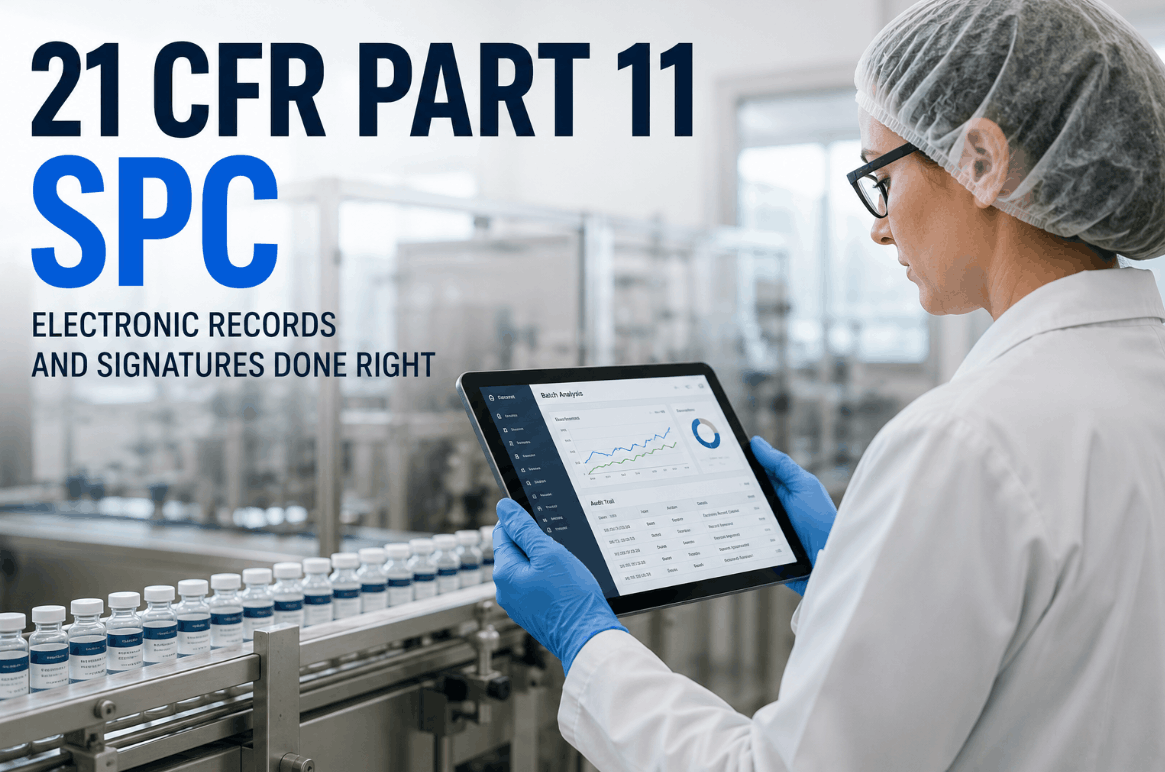
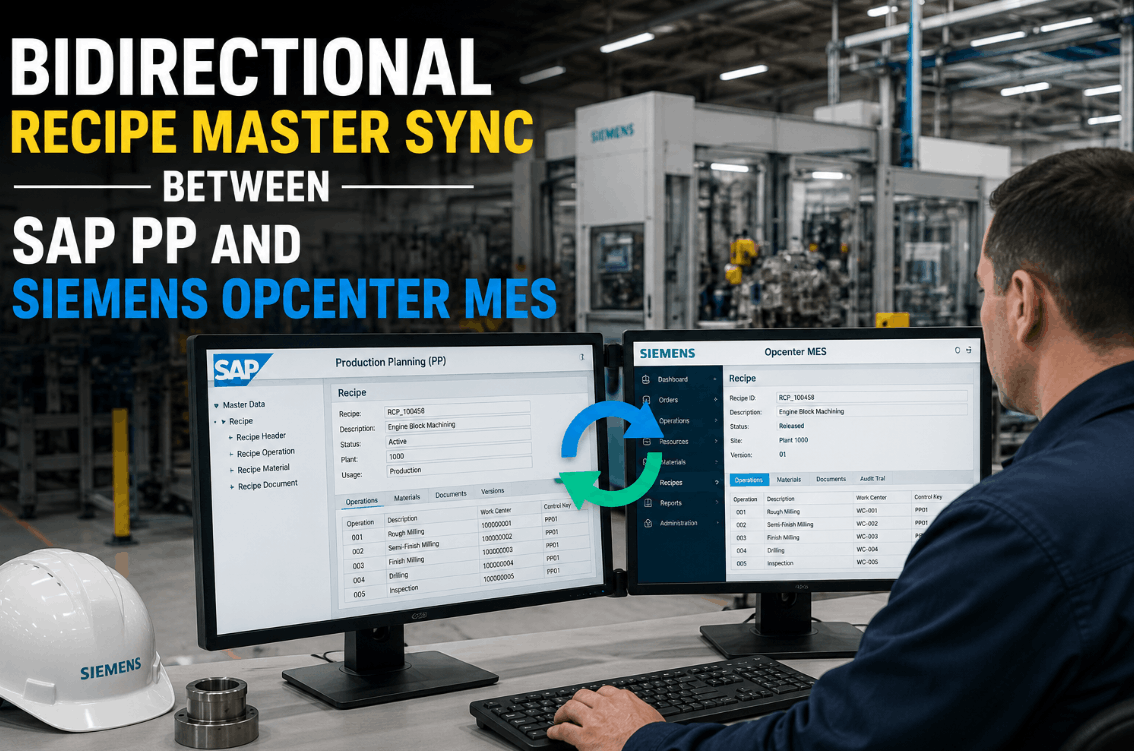
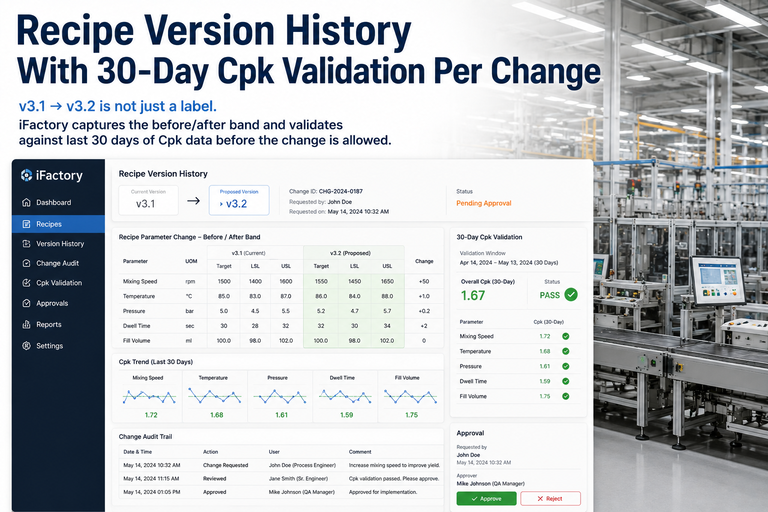
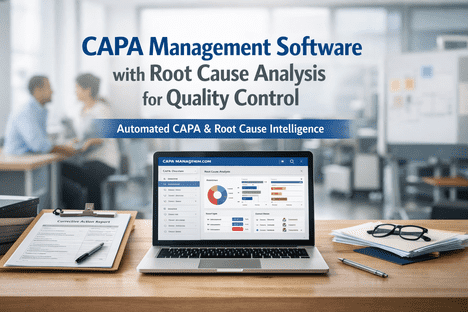
For Quality Compliance Directors managing recipe governance across pharmaceutical, automotive, food, and discrete manufacturing operations, the risk is rarely in the recipe itself — it is in the gap between a recipe change being made and that change being properly authorized, documented, and synchronized across your SAP PP system and PLC floor controllers. A single unreviewed recipe edit that reaches the production line can trigger a customer audit finding, a 21 CFR Part 11 observation, or an IATF 16949 nonconformance that takes months to close. iFactory AI's two-person recipe approval workflow closes that gap entirely: every parameter change is formally requested by a quality engineer, reviewed and electronically signed by a qualified approver, bidirectionally synchronized with SAP PP, and pushed to the PLC only on the next authorized production order. Book a Demo to see how iFactory AI's recipe change control platform operates in a live manufacturing environment.
RECIPE CHANGE CONTROL · ELECTRONIC SIGNATURE · AUDIT TRAIL
Is Every Recipe Change on Your Floor Authorized, Signed, and Traceable?
iFactory AI enforces two-person recipe approval with electronic signatures — every edit requested, approved, SAP-synced, and PLC-pushed with a complete, immutable audit trail built for 21 CFR Part 11, IATF 16949, and FDA inspection readiness.
100%
Electronic signature coverage on every recipe parameter change
Zero
Unauthorized PLC recipe pushes — changes locked until approver signs
21 CFR 11
Part 11-compliant audit trail with timestamped, role-bound signatures
Bi-Dir
SAP PP and PLC synchronized on every approved recipe version
The Recipe Governance Gap That Creates Audit Exposure
Why a Shared Password Is Not a Change Control System
In most manufacturing operations, recipe modification follows an informal path: a process engineer makes a parameter adjustment at the HMI, notifies a supervisor verbally, and the change goes into production. A paper log may be updated hours later — or not at all. This is not a change control system; it is an exposure point. Under 21 CFR Part 11, every modification to a computerized record that affects product quality requires a unique electronic signature from an authorized individual at the time of the action. Under IATF 16949, recipe changes must be subject to documented approval before use in production, with records retained for the life of the product. iFactory AI replaces informal processes with an enforced digital workflow: no recipe change reaches the PLC without a formal two-person approval sequence — requester signs to initiate, approver signs to authorize, and the version-controlled record is immediately synchronized to SAP PP and stored in a tamper-evident audit trail.
How the Two-Person Recipe Approval Workflow Operates
Request, Review, Sign, Sync — in That Order, Every Time
Step 01
Quality Engineer Submits a Recipe Change Request
The requesting engineer opens the affected recipe in iFactory AI, modifies the target parameter — setpoint, tolerance band, dwell time, speed, temperature, or any controlled variable — and submits the change with a mandatory reason code and supporting reference document link. The change is immediately locked in a pending state: it cannot be pushed to the PLC or applied to any active work order until the approval chain is complete.
Step 02
System Routes Request to Designated Approver Role
iFactory AI's role-based routing engine identifies the qualified approver for the affected product family, process area, or equipment class based on your configured approval matrix. The designated Quality Leader — or backup approver if the primary is unavailable — receives an in-platform notification and email alert with the full change detail, redline comparison, and the requester's justification. Approval delegation follows your escalation policy automatically.
Step 03
Approver Reviews and Applies Electronic Signature
The approver reviews the parameter delta, the requester's rationale, and any linked risk assessment or SPC data. Approval requires re-authentication with the approver's unique credentials — enforcing the meaning-of-signature requirement under 21 CFR Part 11. The approver may approve, reject, or return for revision with documented comments. Every action is time-stamped and identity-bound. The system prevents the requester from also serving as the approver for the same change, enforcing the two-person integrity rule.
Step 04
Approved Recipe Synchronizes Bidirectionally with SAP PP
Upon approval, iFactory AI immediately pushes the new recipe version to SAP PP via certified REST API and IDoc interfaces — updating the relevant master recipe, routing, and production order specifications in your ERP system. The SAP record and the iFactory AI recipe record are version-matched and time-stamped together, creating a single source of truth that survives plant floor changes, system upgrades, and audit requests.
Step 05
Approved Parameters Pushed to PLC on Next Authorized Order
The approved recipe version is queued for PLC download and is pushed to the relevant controller only when the next authorized production order for the affected part number is released from SAP. The PLC receives the exact approved parameter set — no manual entry, no clipboard transcription error, no version mismatch. The download event is logged with order number, timestamp, and operator acknowledgment, completing the chain of custody from request to execution.
Regulatory Frameworks That Require Two-Person Recipe Control
21 CFR Part 11, IATF 16949, and EU GMP Annex 11 Compared
Recipe change control requirements appear across multiple regulatory and quality management frameworks, each with distinct documentation and authorization requirements. iFactory AI's approval workflow is designed to satisfy all three simultaneously, giving multi-sector manufacturers a single platform that works across pharmaceutical, automotive, and food production environments. Book a Demo to review how iFactory AI maps your specific compliance framework to the recipe approval workflow configuration.
| Requirement Area |
21 CFR Part 11 (FDA) |
IATF 16949 (Automotive) |
EU GMP Annex 11 |
iFactory AI Coverage |
| Electronic Signature |
Mandatory — unique, identity-bound |
Required for approved records |
Mandatory — role-authenticated |
Re-auth e-signature on every change |
| Two-Person Authorization |
Requester + Approver separation |
Change must be approved before use |
Independent review required |
Enforced role separation — no self-approval |
| Audit Trail |
Tamper-evident, time-stamped |
Retained for product life |
Complete history of modifications |
Immutable log — exportable on demand |
| ERP / MES Synchronization |
Records must reflect actual process |
Master recipe in ERP must match floor |
System reconciliation required |
Bidirectional SAP PP sync on approval |
| PLC / Equipment Enforcement |
Approved parameters must be in use |
No unauthorized parameter deviation |
System must prevent unauthorized changes |
PLC push only on next authorized order |
What the Audit Trail Captures — and Why Every Field Matters
The Anatomy of a Compliant Recipe Change Record
When an FDA investigator, a Tier 1 automotive customer, or an internal quality auditor requests evidence of recipe change control, the record they need goes well beyond a timestamp and a signature. iFactory AI's audit trail captures the complete chain of custody for every recipe modification — not as a static report, but as a live, queryable record that can be filtered by product, parameter, date range, approver, or production order.
01
Parameter Delta Record
The exact previous value and the proposed new value for every modified parameter — setpoint, tolerance, sequence step, timing, or controlled variable — captured at the moment of request submission with a mandatory change reason code.
02
Requester Identity and Credentials
The authenticated identity of the engineer who submitted the request, their role, their organizational unit, and the date and time of submission — with a system-verified signature that cannot be delegated or shared.
03
Approver Decision and Electronic Signature
The approver's authenticated identity, decision (approved, rejected, or returned), any reviewer comments, and the exact timestamp of the approval action — with re-authentication enforced at the moment of signing per 21 CFR Part 11 meaning-of-signature requirements.
04
SAP PP Synchronization Record
Confirmation of the bidirectional SAP PP update — the specific master recipe, routing, and production order records updated, the SAP transaction timestamp, and the version number applied in both the ERP system and the iFactory AI platform.
05
PLC Download and Production Order Linkage
The exact production order that triggered the approved parameter download to the PLC, the controller address and version confirmation, the operator acknowledgment timestamp, and the first unit produced under the new recipe — completing the traceability chain from approval to execution.
Expert Review: What Quality Compliance Directors Must Demand from Recipe Control in 2026
An Assessment for Pharmaceutical, Automotive, and Regulated Discrete Manufacturers
Reviewed by quality systems engineers and compliance specialists with experience deploying electronic batch record, recipe management, and 21 CFR Part 11 validation programs across FDA-regulated pharmaceutical manufacturers, IATF-certified automotive tier suppliers, and ISO 13485-compliant medical device facilities. The following reflects current best practice and regulatory expectation across U.S. manufacturing compliance environments.
The most common recipe governance failure observed in FDA warning letters and IATF customer audit findings is not deliberate falsification — it is procedural erosion. A two-person approval requirement documented in a quality manual that is routinely bypassed on the floor due to a cumbersome paper process is, in regulatory terms, equivalent to having no control. The gap between the written procedure and the actual practice is precisely what investigators look for. iFactory AI eliminates procedural erosion by making the correct path the only possible path: the system does not allow a recipe parameter to reach the PLC without a completed two-person approval sequence, period. Book a Demo to see how iFactory AI enforces the approval sequence without slowing legitimate recipe development cycles.
The second critical requirement for Quality Compliance Directors in 2026 is ERP-floor synchronization. The audit exposure created when a recipe change is approved in SAP but the floor PLC is still running the previous version — or vice versa — is significant. This version mismatch is one of the leading causes of process deviation reports and customer 8D requests in automotive supply chains. iFactory AI's bidirectional SAP PP integration ensures that the master recipe in your ERP system and the active parameters in your PLC are always at the same approved version, with a reconciliation log that can be produced instantly during an audit.
FDA 21 CFR Part 11 Readiness
Every electronic signature on a recipe change record satisfies Part 11 requirements for uniqueness, identity binding, re-authentication at time of signing, and tamper-evident storage — audit-ready at any time without manual compilation.
IATF 16949 Customer Audit Defense
iFactory AI provides a complete, filtered export of all recipe changes for any part number or date range — with approver identities, timestamps, and SAP linkage — satisfying Tier 1 customer PPAP and process audit requests in minutes rather than days.
SAP PP Version Integrity
Bidirectional synchronization means the master recipe in SAP and the active PLC parameters are always on the same approved version — eliminating the version mismatch findings that drive the majority of process deviation and customer complaint records in automotive supply chains.
Role Separation Enforcement
The platform enforces true two-person integrity — the requester cannot approve their own change, and the approval routing matrix ensures only qualified personnel in designated roles can authorize changes for specific product families or process areas.
Conclusion: Recipe Change Control Is a System, Not a Signature
For Quality Compliance Directors responsible for 21 CFR Part 11, IATF 16949, or EU GMP Annex 11 compliance, recipe change control is not a documentation exercise — it is a product integrity control. The value of a two-person approval requirement is only realized when the system enforces it without exception, synchronizes the approved change to every connected system automatically, and retains an audit trail that can survive regulatory scrutiny years after the change was made.
iFactory AI's recipe parameter change audit platform delivers all three: enforced two-person approval with electronic signatures, bidirectional SAP PP synchronization on approval, PLC parameter push only on the next authorized production order, and an immutable audit trail exportable on demand. Whether your facility operates under FDA pharmaceutical guidance, automotive customer requirements, or internal ISO quality system mandates, iFactory AI provides the recipe governance infrastructure that makes compliance auditable and bypass impossible.
Frequently Asked Questions
Does iFactory AI's electronic signature satisfy 21 CFR Part 11 requirements?
Yes — every signature requires unique credential re-authentication at the moment of signing, is time-stamped and identity-bound, and is stored in a tamper-evident audit trail that meets all Part 11 electronic signature and audit trail requirements.
Can the system prevent a requester from approving their own recipe change?
Yes — the platform enforces role separation by design; the requester role and the approver role are mutually exclusive for the same change, and the routing matrix ensures only qualified personnel in the designated approver role can authorize a specific request.
How does iFactory AI synchronize approved recipes with SAP PP?
Upon approval, iFactory AI pushes the new recipe version to SAP PP via certified REST API and IDoc interfaces, updating the relevant master recipe and production order records bidirectionally with a version-matched timestamp in both systems.
What prevents an approved recipe from being applied before the next authorized production order?
Approved recipe parameters are queued in iFactory AI and released to the PLC only when the next authorized production order for the affected part number is released from SAP — preventing out-of-sequence parameter application and creating a complete order-to-download traceability link.
Can the audit trail be exported for FDA inspections or customer PPAP audits?
Yes — the complete audit trail for any recipe, part number, parameter, or date range is exportable on demand in structured formats, including all requester and approver identities, timestamps, parameter deltas, SAP synchronization records, and PLC download confirmations.
ENFORCE RECIPE COMPLIANCE — NO EXCEPTIONS
Two-Person Approval. Electronic Signatures. SAP Synced. PLC Controlled.
iFactory AI is already supporting recipe change control programs at regulated manufacturers across pharmaceutical, automotive, and discrete production environments. Schedule a live walkthrough and see how the approval workflow, audit trail, and SAP integration map to your specific compliance requirements.