Most smart factory discussions happen in slide decks. Plant Foxtrot is different — it is a live reference plant streaming real production data right now, with SAP S/4HANA handling enterprise transactions at the top of the stack, Siemens Opcenter MES managing shop-floor execution in the middle, an MSMQ message bus carrying inter-system events, an Allen-Bradley PLC fleet on the floor, AI-driven Statistical Process Control running in real time, and an on-premises Copilot providing contextual operator intelligence without sending data to the cloud. For smart factory program leads evaluating what a fully integrated architecture actually looks like in operation — not in a whitepaper — this walkthrough maps every layer of Plant Foxtrot and explains how each integration point works, what data flows across it, and what breaks when it is absent. Book a Demo to tour the live Plant Foxtrot reference environment with iFactory's integration team.
See the Full Stack Running Live — SAP, MES, MSMQ, PLC, AI SPC
iFactory's Plant Foxtrot reference environment streams real manufacturing data across SAP S/4HANA, Opcenter MES, Allen-Bradley PLCs, and on-prem AI SPC — so you can evaluate the integration before committing to the architecture.
Why a Live Reference Plant Matters for Smart Factory Program Leads
The difference between a smart factory architecture diagram and a live reference plant is the difference between a blueprint and a building. Architecture diagrams show what should happen between SAP, MES, and the PLC floor. A live reference plant shows what actually happens — the latency on the MSMQ bus during a shift change, the way the AI SPC model responds to a process drift at station three, the moment Opcenter MES closes a work order and the confirmation lands in SAP S/4HANA. Plant Foxtrot was built precisely to close this demonstration gap for smart factory program leads who need to evaluate integration depth, not just integration intention.
The architecture is not simplified for demonstration purposes. Every system running in Plant Foxtrot is production-grade: SAP S/4HANA on a certified cloud instance, Siemens Opcenter MES on its standard deployment model, MSMQ as the message transport layer, a real Allen-Bradley ControlLogix fleet generating live PLC telemetry, iFactory's AI SPC engine processing that telemetry in real time, and an on-premises Copilot that provides operator guidance without data leaving the plant boundary. Book a Demo to walk through each layer with iFactory's architecture team.
SAP S/4HANA
Enterprise layer handling production orders, BOM management, goods movements, and quality notifications. Bidirectional integration with Opcenter MES via certified APIs delivers real-time production confirmation back to ERP without manual entry.
Opcenter MES
Manufacturing Execution System managing work order dispatch, operator instructions, electronic batch records, and genealogy tracking. Receives production orders from SAP and sends confirmations back through the MSMQ integration bus.
MSMQ Message Bus
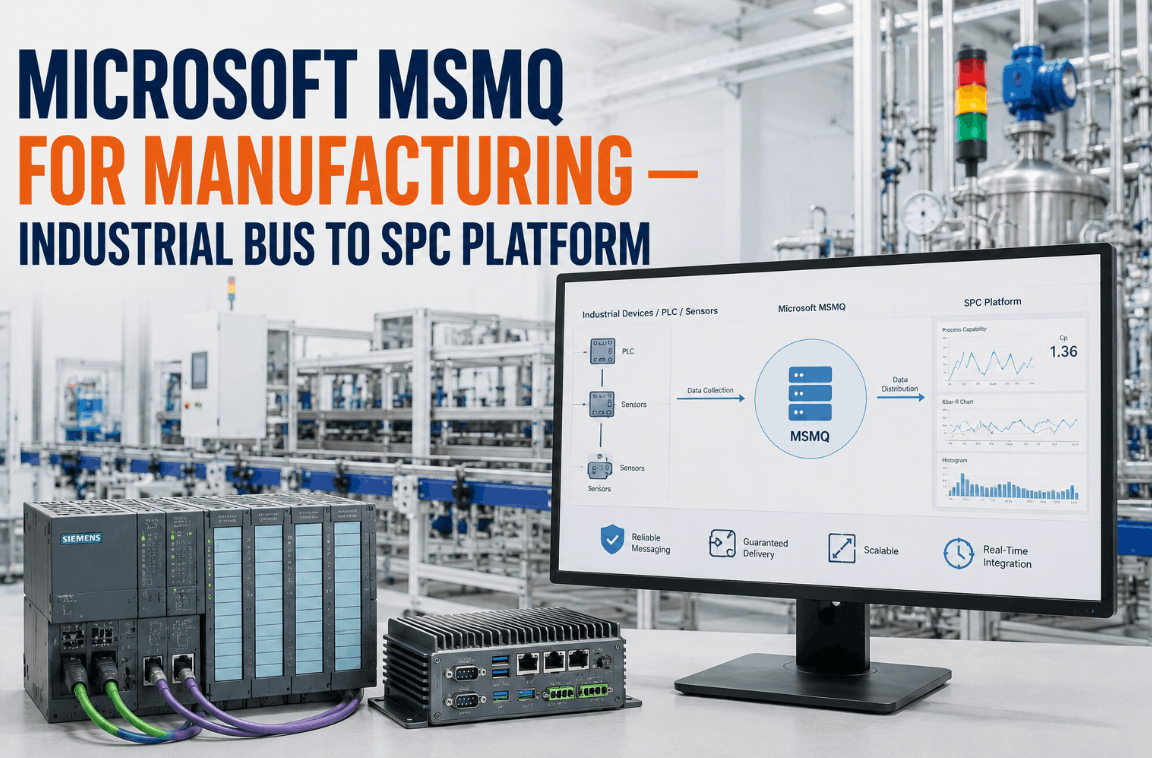
Microsoft Message Queuing provides the reliable, store-and-forward transport layer between SAP, Opcenter, and the plant floor systems. Guarantees message delivery during network interruptions and manages event sequencing across the integration stack.
Allen-Bradley PLC Fleet
ControlLogix PLCs on the plant floor generate real-time process telemetry — cycle times, temperatures, pressures, motor currents — via EtherNet/IP. iFactory's OPC UA gateway collects this telemetry and routes it to the AI SPC engine and Opcenter simultaneously.
AI SPC Engine
iFactory's statistical process control layer processes live PLC telemetry to calculate Cpk, detect Western Electric rule violations, and issue real-time process alerts — without requiring an operator to run a report or a quality engineer to check a spreadsheet.
On-Prem Copilot
iFactory's on-premises AI Copilot provides operators and engineers with natural language process guidance, anomaly explanation, and corrective action recommendations — running entirely within the plant boundary, with no production data transmitted externally.
How Data Moves Through Plant Foxtrot — Layer by Layer
Understanding the Plant Foxtrot architecture requires following a production event from initiation to closure. The sequence below maps the exact data path for a single work order — from release in SAP S/4HANA to physical execution on the Allen-Bradley floor, through AI SPC monitoring and back to ERP confirmation — showing every integration point and the protocol handling it.
Production Order Released in SAP S/4HANA
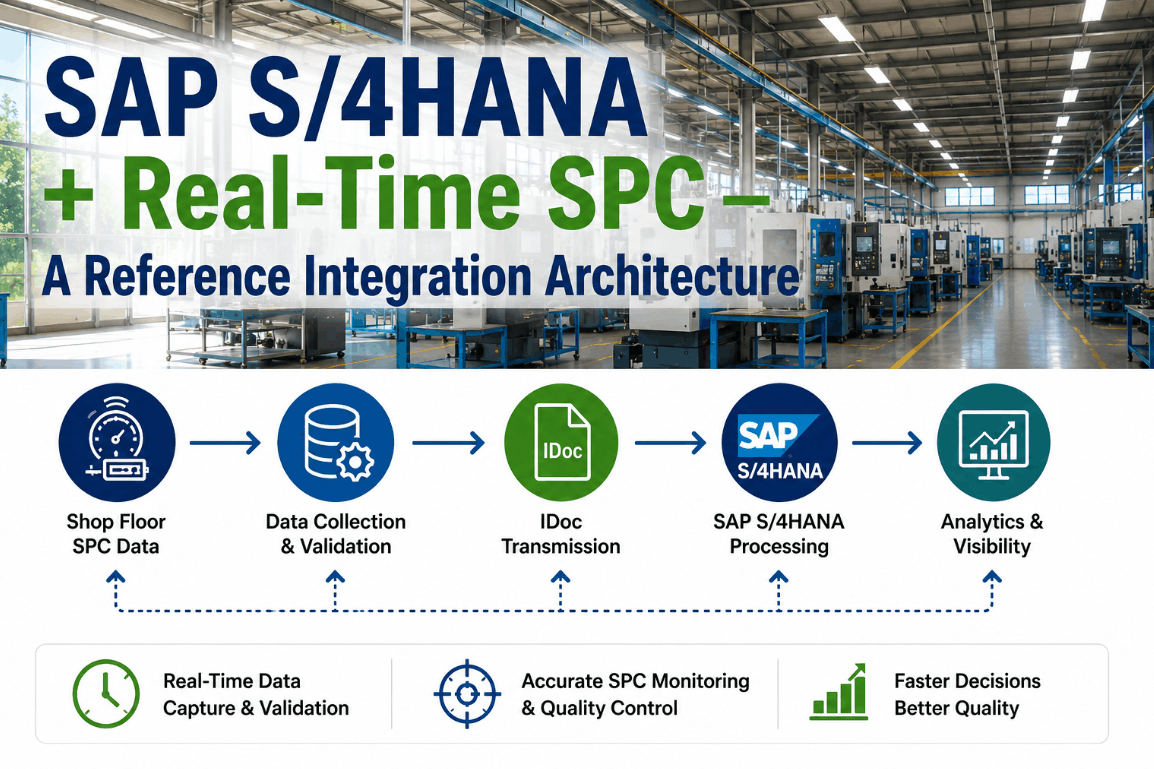
A planned order converts to a production order in SAP S/4HANA. The order — including BOM components, routing operations, target quantities, and quality plan reference — is published to the MSMQ integration bus as a structured message for downstream consumption by Opcenter MES.
Opcenter MES Receives and Dispatches the Work Order
Opcenter MES subscribes to the MSMQ channel, receives the production order, creates the corresponding work order, and dispatches it to the relevant work center. Operator terminals at each station display the work instructions, sequence, and quality checkpoints for the active order.
Allen-Bradley PLC Fleet Executes and Streams Telemetry
As physical production begins, Allen-Bradley ControlLogix PLCs generate continuous telemetry across all monitored process parameters. iFactory's OPC UA gateway polls each PLC via EtherNet/IP and routes the normalized tag data simultaneously to the AI SPC engine and to Opcenter's Automation Gateway for work order context binding.
AI SPC Engine Monitors Quality in Real Time
iFactory's AI SPC engine processes the live PLC telemetry stream, calculates Cpk per quality characteristic, evaluates control chart rules, and triggers process alerts when statistical signals indicate drift. Alerts surface on the on-prem Copilot with context — which station, which parameter, which work order — without cloud transmission.
Work Order Closes and Confirmation Returns to SAP
When production completes, Opcenter MES closes the work order with actual quantities, yield, and quality results. The confirmation is published back to the MSMQ bus and consumed by SAP S/4HANA, which updates inventory, posts goods movements, and triggers any quality notifications — closing the loop without manual ERP entry.
Plant Foxtrot vs. Typical Smart Factory Implementations
Most smart factory program leads evaluating integration platforms encounter two problems: vendor demonstrations that use pre-recorded data, and architecture proposals that skip the hard integration questions about message reliability, on-premises AI, and protocol-level PLC connectivity. The table below maps what Plant Foxtrot demonstrates live versus what is typically deferred or simplified in standard vendor proofs of concept.
| Capability | Typical Vendor POC | Plant Foxtrot (iFactory) |
|---|---|---|
| SAP S/4HANA Integration | Simulated with static data files | Live bidirectional — production orders and confirmations in real time |
| MES Work Order Execution | Demo environment, no live floor data | Opcenter MES dispatching and closing real work orders |
| Message Bus Reliability | Direct API calls — no queue, no retry logic | MSMQ with store-and-forward — messages survive network interruption |
| PLC Connectivity | OPC UA simulation or SCADA replay | Live Allen-Bradley ControlLogix fleet via EtherNet/IP + OPC UA gateway |
| SPC / Quality Monitoring | Post-run report or end-of-batch CSV | AI SPC running live on PLC telemetry — Cpk and control chart in real time |
| AI / Copilot | Cloud-dependent — data leaves plant boundary | On-premises Copilot — zero external data transmission |
| Data Sovereignty | Mixed — some telemetry sent to vendor cloud | Full on-prem deployment option — all data stays within plant perimeter |
What a Smart Factory Program Lead Observes During the Plant Foxtrot Walkthrough
The Plant Foxtrot walkthrough is structured as a 90-minute live session covering each integration layer in sequence. The following describes what program leads observe at each stage — and what technical questions each stage is designed to answer. Book a Demo to schedule your Plant Foxtrot session with iFactory's integration architects.
Expert Review: What Smart Factory Program Leads Miss in Standard Vendor Demonstrations
Reviewed by industrial systems architects and smart factory program leads with deployment experience across automotive, discrete manufacturing, and process industry environments running SAP, Siemens Opcenter, Rockwell Automation, and on-premises AI platforms. The following reflects the most common evaluation gaps seen when program leads assess smart factory integration platforms without a live reference plant.
The first gap is message reliability. Almost every smart factory architecture uses an integration bus of some form — MSMQ, MuleSoft, Azure Service Bus, or a custom middleware layer. In demonstration environments, the bus is rarely stress-tested. Evaluators see clean end-to-end flows in optimal network conditions. What they do not see is what happens when Opcenter is briefly unavailable, when the PLC subnet drops for 45 seconds, or when a burst of end-of-shift work order confirmations hits the SAP integration adapter simultaneously. MSMQ's store-and-forward model handles all three of these scenarios reliably. Most REST-only integration architectures do not. Plant Foxtrot demonstrates this explicitly because it is the failure mode most likely to cause a production outage six months after go-live.
The second gap is on-premises AI. The majority of smart factory AI demonstrations rely on cloud inference — the plant floor data is sent to a vendor cloud, a model runs remotely, and a result is returned. For manufacturing environments with data sovereignty requirements, ITAR-controlled production, or network-constrained plant floors, this architecture is non-deployable regardless of the AI capability it demonstrates. iFactory's on-premises Copilot is not a cloud product with a firewall exception — it runs entirely within the plant boundary on standard server hardware. Book a Demo to review the on-prem Copilot deployment model in the Plant Foxtrot environment.
The third gap is SPC latency. Standard quality management implementations produce Cpk reports at the end of a batch or shift. The value of real-time AI SPC is that it moves quality control from a post-production audit function to an in-process correction capability. That shift only delivers ROI if the SPC engine is processing live PLC telemetry — not buffered historian data or manually entered measurement records. Plant Foxtrot runs AI SPC on raw Allen-Bradley tag streams precisely to demonstrate this distinction.
Plant Foxtrot Reference Plant — Frequently Asked Questions
Is Plant Foxtrot streaming live data during the demo or using pre-recorded data?
Plant Foxtrot streams live data throughout the walkthrough — real PLC telemetry from the Allen-Bradley fleet, real work orders moving through Opcenter MES, and real confirmations posting to SAP S/4HANA. No pre-recorded playback is used.
Can the Plant Foxtrot architecture be replicated in our plant with our existing SAP and PLC environment?
Yes. The Plant Foxtrot stack — SAP S/4HANA, Opcenter MES, MSMQ, Allen-Bradley PLCs, AI SPC, and on-prem Copilot — is designed as a deployable reference architecture, not a custom demonstration build. iFactory's team maps each component to your existing system versions during the post-walkthrough assessment.
Why does Plant Foxtrot use MSMQ rather than a cloud integration bus?
MSMQ provides store-and-forward message reliability that keeps SAP and Opcenter synchronized during network interruptions — a failure scenario that cloud buses handle inconsistently in plant environments with unreliable OT network connectivity.
Does the on-premises Copilot in Plant Foxtrot require any external cloud connection to function?
No. iFactory's on-prem Copilot runs inference entirely on local server hardware within the plant boundary. No production data, process parameters, or operator queries are transmitted externally — making it deployable in data-sovereign and air-gapped environments.
How long does the Plant Foxtrot walkthrough take and who should attend from our team?
The standard walkthrough runs 90 minutes and is designed for smart factory program leads, IT-OT architects, and plant operations leadership — the session covers both the technical integration depth and the operational decision framework each layer supports.
Conclusion: Evaluate the Architecture Before You Commit to It
Smart factory program leads face a fundamental evaluation problem: the architectures being proposed to them are complex, the vendor demonstrations are simplified, and the integration questions that determine whether a deployment succeeds — message reliability, on-premises AI, live SPC on PLC telemetry — are rarely answered in a standard sales process. Plant Foxtrot exists to close that gap. Every layer of the reference plant — SAP S/4HANA, Opcenter MES, MSMQ, Allen-Bradley PLCs, AI SPC, and on-prem Copilot — runs in production mode so that program leads can evaluate integration depth, not integration intention.
The integration decisions made at the architecture stage determine the operational performance of a smart factory for years after go-live. Evaluating those decisions against a live reference environment, rather than a vendor diagram, is the most efficient path to a deployment that performs as specified on day one — and scales without architectural rework as the program matures.
Tour the Live Plant. Evaluate the Architecture. Deploy with Confidence.
iFactory's Plant Foxtrot reference plant streams SAP S/4HANA, Opcenter MES, MSMQ, Allen-Bradley PLCs, AI SPC, and on-prem Copilot live — so your smart factory program team can evaluate the full integration stack before committing to the architecture.