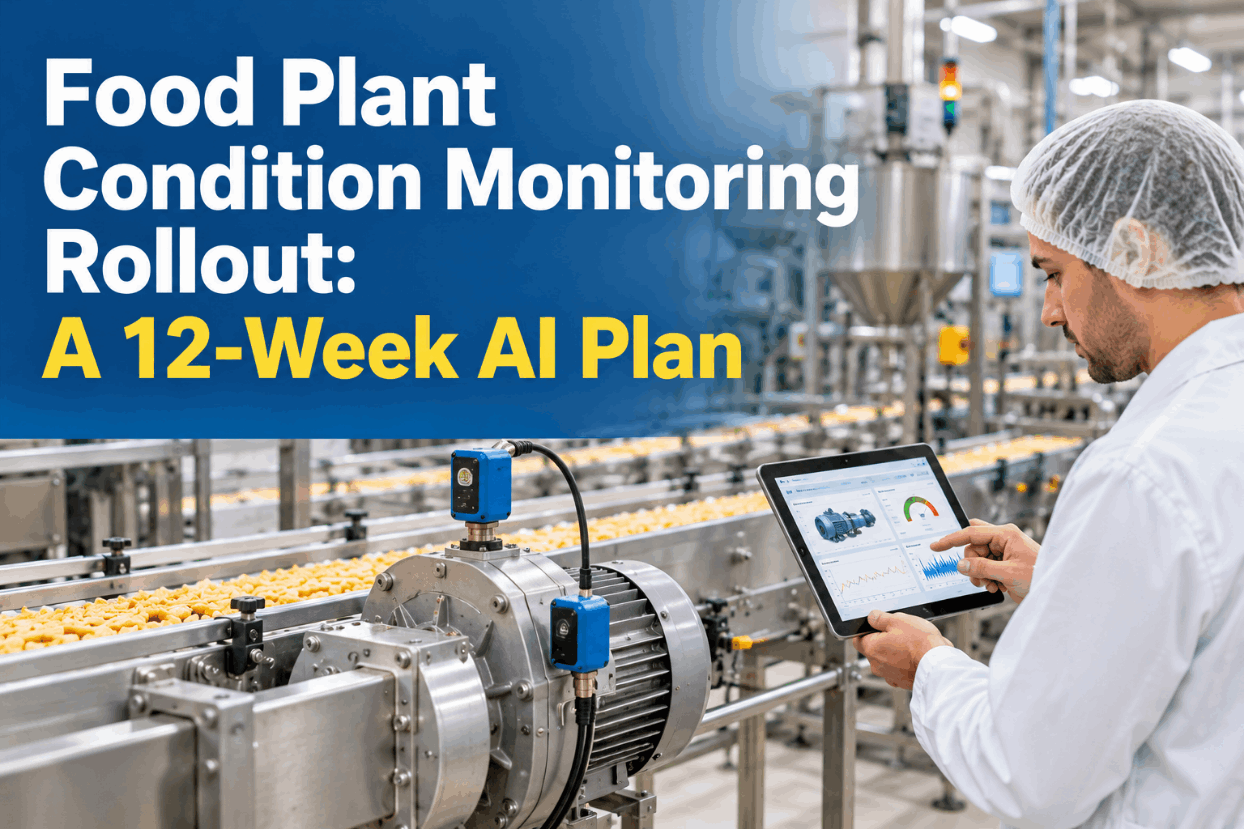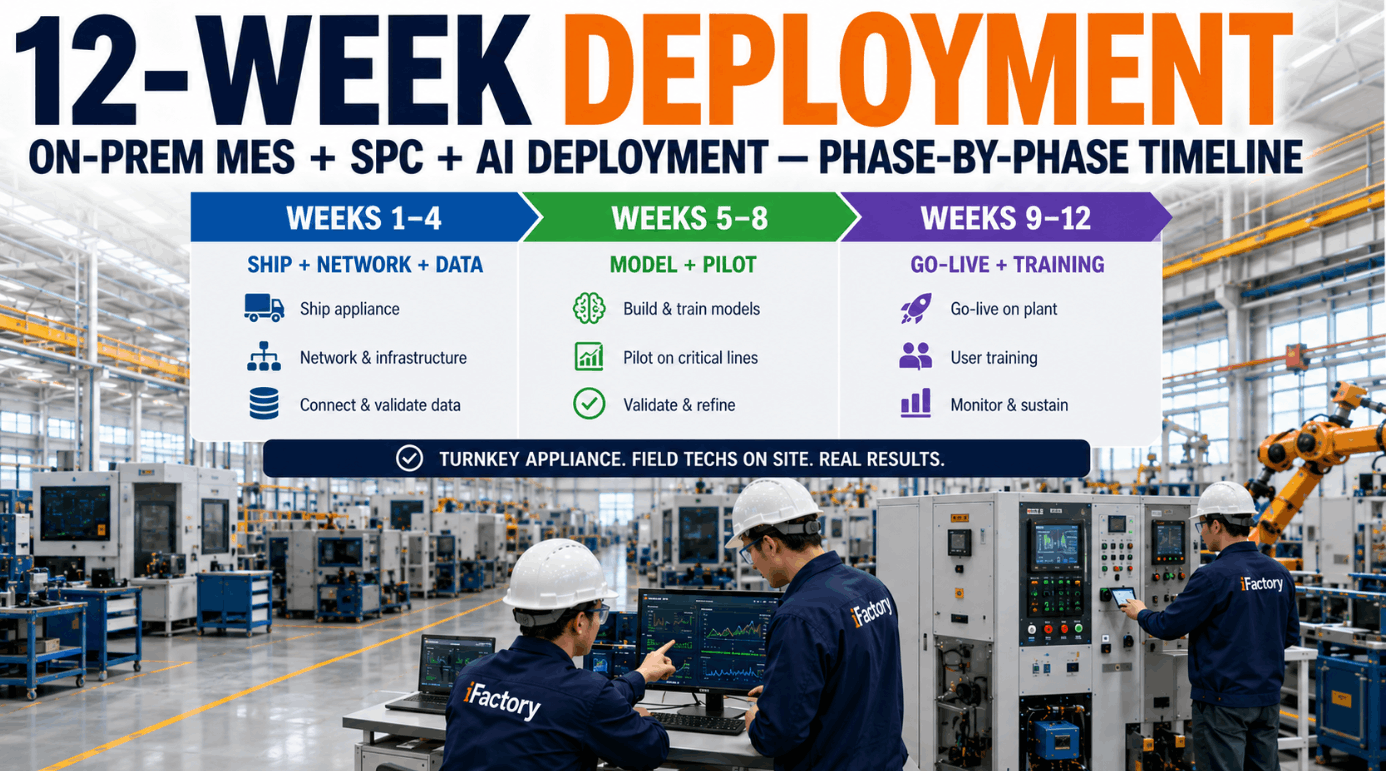
Most manufacturing AI deployments fail not because the technology is wrong but because the deployment plan is borrowed from an IT software rollout that has no relationship to the realities of an operating plant — network topology that was never designed for analytics traffic, historians storing years of data in formats no SaaS connector can reach, and a production floor that cannot accept any downtime for a technology experiment. The iFactory 12-week deployment is built from real plant deployments, with field technicians on site, a turnkey NVIDIA AI appliance that ships pre-configured, and a three-phase roadmap that delivers live SPC and MES capability at week 12 without disrupting a single production shift. This is not a vendor's optimistic timeline — it is the sequence, the dependencies, and the decision gates that determine whether a manufacturing AI deployment crosses the finish line or stalls in a six-month integration limbo. Book a Demo to review the week-by-week plan against your plant's specific infrastructure.
On-Prem MES + SPC + AI. Live in 12 Weeks. Field Techs On Site. No Cloud Dependency.
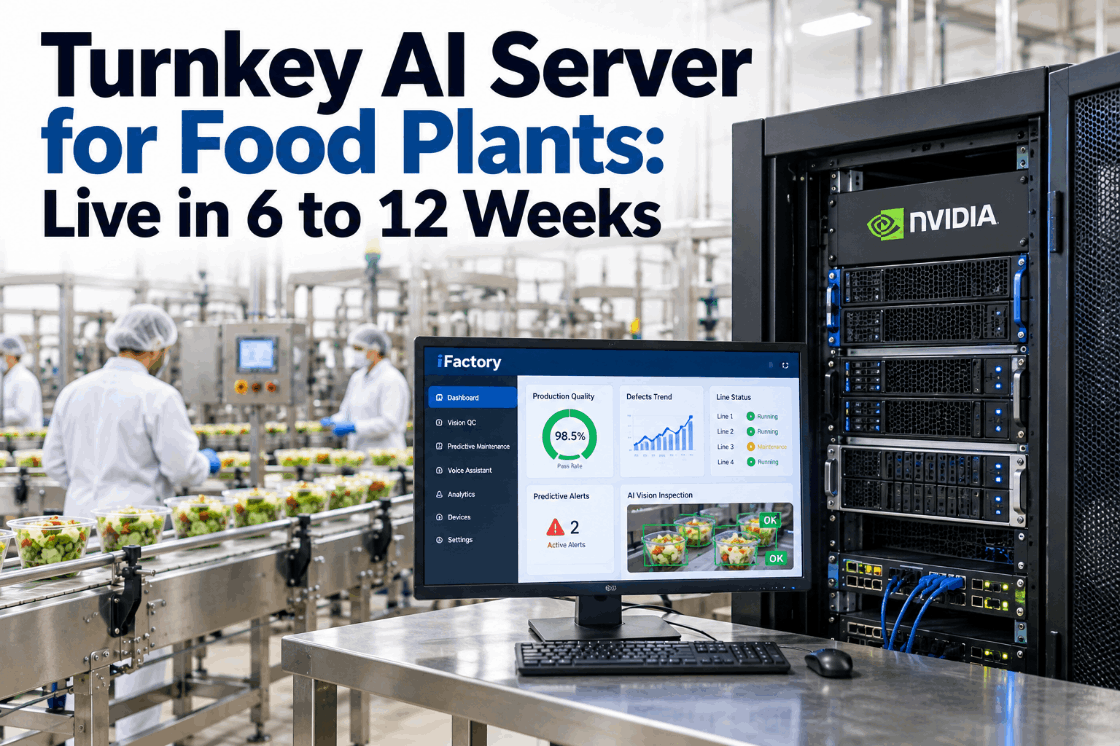
iFactory ships a pre-configured NVIDIA AI appliance, connects to your existing SCADA and historian, trains SPC baselines on your real production history, and hands off a fully operational platform with trained operators at week 12.
What Makes a 12-Week Plant AI Deployment Achievable — and What Makes Most Miss It
The 12-week window is achievable for on-premise MES and SPC deployments because iFactory's turnkey appliance model eliminates the two phases that consume the most time in traditional industrial software rollouts: infrastructure procurement and custom integration development. The NVIDIA AI server ships with the iFactory platform pre-installed, pre-configured for OPC-UA and MSMQ historian connectivity, and pre-loaded with SPC model templates for the most common manufacturing process classes. When the appliance arrives at the plant, the field technician's first task is network integration — not software installation, not license activation against a remote server, not waiting for a cloud environment to be provisioned.
What most deployments miss is sequencing. Data connection before model training. Model training before pilot operation. Pilot validation before full go-live. When these phases overlap without a validated gate between them, the result is a go-live event that launches an untrained model onto a production floor where operators have no confidence in the alerts they are receiving. iFactory's three-phase gate structure — Ship + Network + Data, then Model + Pilot, then Go-Live + Training — enforces this sequencing at every plant regardless of stakeholder pressure to accelerate. Book a Demo to walk through the gate criteria with our deployment engineering team.
Phase 1: Ship, Network, and Data — Establishing the Analytics Foundation
Phase 1 has one job: get clean, validated data flowing from the plant's SCADA, PLC network, and process historian into the iFactory analytics layer. Nothing in Phase 2 is possible without this. The appliance ships in Week 1. Field technicians arrive on site in Week 2. The network integration, historian connector configuration, tag mapping, and data quality validation that constitute Phase 1 are completed by the end of Week 4. The Phase 1 gate review confirms that every data stream required for the planned SPC models is present, validated, and recording at the correct sample rate before Phase 2 work begins.
NVIDIA AI server ships pre-loaded with iFactory platform, OPC-UA drivers, MSMQ connector, and SPC model templates. Network interface configuration completed for customer's OT network segment before shipping. Hardware asset documentation packaged for facility IT security review.
Field technician on site for physical installation, rack mounting, and network switch configuration. Appliance placed in OT DMZ per ISA/IEC 62443 network segmentation. Read-only MSMQ bridge to existing historian configured — no PLC program modification, no production impact, no historian reconfiguration required.
200–2,000 historian tags mapped to iFactory asset register. OPC-UA connections to SCADA validated for each process unit. Historical data pull initiated for SPC baseline training — minimum 12 months of historian archive required, 24–36 months optimal for highest model accuracy.
Every data stream validated for completeness, sample rate integrity, and unit-of-measure accuracy. Data gaps, sensor outages, and historian compression artifacts identified and documented. Phase 1 gate review with plant engineering confirms all required streams are valid before Phase 2 model training begins.
Phase 2: Model Training and Controlled Pilot — Building Operator Confidence Before Go-Live
Phase 2 is where the AI becomes specific to the plant. The iFactory SPC engine ingests the historical process data validated in Phase 1 and trains control limits, process capability indices (Cpk, Ppk), and normal operating envelopes that reflect actual plant performance — not textbook specification limits that trigger false alerts every shift. The pilot operation in Weeks 7–8 runs the live system in parallel with the plant's existing quality monitoring without replacing it — allowing the shift team to compare iFactory alerts against their current process, build confidence in the model accuracy, and identify any alert threshold calibration required before full go-live. Book a Demo to see a live SPC model trained on real plant historian data.
iFactory SPC engine processes historical data to establish asset-specific control limits for each monitored parameter. Western Electric Rules applied. Cpk and Ppk calculated against actual process distribution — not specification limits alone. Predictive spec breach detection models initialized on process trend data.
Production order tracking, work order management, quality hold workflows, and shift reporting configured against plant's specific production structure. Integration with existing ERP (SAP, Oracle) validated for production order and quality record synchronization. Role-specific dashboards configured for operators, quality engineers, and plant managers.
iFactory SPC alerts run live on production data in parallel with existing quality monitoring — no operator action required on iFactory alerts during shadow mode. Alert accuracy logged against actual process events. Threshold calibration adjustments made based on first week of live data. False positive rate target: below 15% before Phase 2 gate.
Pilot performance reviewed with plant quality team: alert accuracy, false positive rate, coverage of priority process parameters. SPC model adjustments finalized. Operator feedback on dashboard usability incorporated before go-live. Phase 2 gate sign-off by plant quality manager required before Phase 3 begins.
Phase 3: Go-Live and Training — Full Production Operation with a Trained Team
Phase 3 converts the validated pilot into the plant's primary quality monitoring and production tracking system. The go-live transition in Week 9 retires shadow mode — iFactory SPC alerts and MES workflows become the operational standard. Field technicians remain on site through Week 10 to support the shift team during the first week of full operation. Operator and supervisor training is structured across Weeks 10–12 in role-specific sessions that build the competency required for autonomous platform operation after the field engagement ends. At Week 12, the deployment is complete: the plant has a live, trained, fully operational MES + SPC + AI system running on-premise with no cloud dependency and a trained team operating it independently.
Shadow mode retired. iFactory SPC and MES become the live operational system for the plant. All process parameter alerts now require acknowledgment and action per configured escalation workflows. Production order tracking and quality hold workflows active across all configured process units.
Field technician remains on site for the first full operational week to support shift teams during peak demand periods, resolve alert calibration issues in real time, and document any process events that require model adjustment. All hypercare findings logged and resolved before field disengagement.
Structured training delivered in role-specific sessions: operator training covers alert response, quality hold initiation, and production reporting; supervisor training covers dashboard interpretation, shift summary reports, and SPC trend analysis; quality engineer training covers model management, threshold adjustment, and compliance documentation.
Final deployment documentation package delivered: system architecture diagram, tag mapping register, SPC model configuration record, trained operator competency sign-offs, and 90-day performance baseline established. Platform operating fully independently under plant team ownership. Remote support SLA active from Week 12 forward.
The Complete Platform Delivered at Week 12 — Capability by Module
At the conclusion of a 12-week deployment, iFactory delivers a fully operational on-premise industrial AI platform across five capability modules — all running on the installed NVIDIA appliance, all connected to the plant's existing SCADA and historian, all operating without any cloud dependency. The table below documents exactly what is live and operational at Week 12 and the key performance indicator each module is tracked against in the 90-day post-deployment performance baseline. Quality managers who Book a Demo regularly find that their current monitoring coverage has significant gaps against this capability standard.
| Platform Module | What Is Live at Week 12 | Primary KPI Tracked | Deployment Phase | Status |
|---|---|---|---|---|
| Real-Time SPC | Western Electric Rules monitoring, live Cpk/Ppk per parameter, control chart dashboards | Out-of-control event detection rate vs. manual sampling | Phase 2 (Weeks 5–8) | Live |
| MES — Production Tracking | Production order execution, work-in-process visibility, shift reporting automated | Production order cycle time accuracy vs. planned | Phase 2 (Week 6) | Live |
| Quality Hold Workflows | Automated quality hold on SPC breach, escalation routing, hold release authorization | Time from SPC alert to quality hold action | Phase 2 (Week 6) | Live |
| Predictive Spec Breach | Trend-based early warning for approaching spec limit before breach occurs | Preventive interventions vs. reactive corrections ratio | Phase 2 (Week 5) | Live |
| Plant Copilot (RAG) | On-prem LLM over SOPs, maintenance records, and process documentation | Operator query response accuracy vs. manual document search | Phase 3 (Week 9) | Live |
| Compliance Reporting | Automated quality records, SPC compliance reports, audit-ready documentation | Documentation completeness rate vs. manual records | Phase 3 (Week 10) | Live |
The Six Deployment Risks That Delay Manufacturing AI Rollouts — and How iFactory Addresses Each
Every manufacturing AI deployment that misses its go-live date misses it for the same reasons. Understanding these risks before the project starts — and having a deployment architecture designed to neutralize them — is the difference between a 12-week delivery and a 12-month integration project. iFactory's deployment model directly addresses all six of the failure patterns documented in brownfield plant rollouts across U.S. manufacturing.
iFactory's read-only MSMQ connector requires only historian access — no SCADA reconfiguration, no PLC program modification, no OT network redesign. Field technician validates connectivity in Week 2 before any model work begins.
Phase 1 data quality validation in Week 3–4 explicitly surfaces compression artifacts, sensor outages, and tag mapping errors before they corrupt SPC model training. No model training starts on unvalidated data.
iFactory trains control limits on your plant's actual production history — not textbook specification limits. Phase 2 pilot shadow mode validates false positive rate below 15% before go-live, building operator trust before full activation.
Role-specific training in Weeks 11–12 with field technician hypercare in Week 10 ensures every operator, supervisor, and quality engineer is trained on their specific dashboard before the engagement ends. No go-live without competency sign-off.
The turnkey NVIDIA appliance ships pre-configured in Week 1 — no separate procurement of servers, operating systems, databases, or middleware. The deployment clock starts when the appliance ships, not when IT finishes a procurement process.
ERP integration (SAP, Oracle) is validated in Week 6 during MES configuration — not at go-live. If integration issues surface, they are resolved in Phase 2 without blocking the Phase 3 go-live timeline for the SPC and AI capability stack.
I have overseen fourteen manufacturing technology deployments across eight plants in the past decade. The ones that took 12 months instead of 12 weeks all failed at the same two points: the data connection phase, where nobody had mapped the historian tags against the analytics requirements before the consultants showed up, and the go-live event, where a model that had never been validated on live production data was pushed onto a floor where operators had every reason not to trust it. The iFactory deployment approach addresses both problems structurally. The data validation gate in Phase 1 is not optional — you cannot start model training until the data quality review is signed off. The pilot shadow mode in Phase 2 is not a demo — it is a calibration run that gets the false positive rate below a defined threshold before the model touches a real quality decision. I have watched these gates get pushed by stakeholders who want to see the platform live before the deployment is ready. The plants that held the gates went live in 12 weeks with operator teams that trusted the system from day one. The plants that skipped the gates went live in 10 weeks and spent six months correcting alert configurations on a production floor that had already lost confidence in the platform. Hold the gates.
12 Weeks Is Achievable — If the Deployment Is Built for a Plant, Not for a Slide Deck
The 12-week timeline for on-premise MES, SPC, and AI deployment is not a marketing claim. It is a sequenced engineering plan built from the actual dependencies of brownfield plant deployments: appliance pre-configuration that eliminates infrastructure procurement delays, read-only historian connectivity that requires zero production impact, asset-specific SPC model training that builds operator trust before go-live, and role-based training that ensures autonomous platform operation from Week 12 forward.
What distinguishes deployments that hit the 12-week target from those that stall is not budget or plant complexity — it is gate discipline. Phase 1 data validation before Phase 2 model training. Phase 2 pilot validation before Phase 3 go-live. These gates exist because the failure mode of skipping them is documented and costly. iFactory's field deployment team enforces this sequence at every site because the 12-week outcome — a trained team operating a validated, fully capable on-premise manufacturing AI platform with no cloud dependency — is only achievable if the work is done in the right order.
12-Week MES + SPC + AI Deployment — Common Questions Answered
What happens if the plant's historian data quality is poor — does that extend the 12-week timeline?
Phase 1 data quality validation in Weeks 3–4 is specifically designed to surface historian issues before they affect model training; most data quality problems are resolved within the Phase 1 window, and the phase gate ensures model training only starts on validated data — keeping the overall 12-week timeline intact.
Does the deployment require any changes to existing PLC programs or SCADA configurations?
No — iFactory's read-only MSMQ bridge connects to the existing historian without any PLC program modification, SCADA reconfiguration, or production process change; the entire deployment is non-invasive to the operating plant.
How many SPC parameters can iFactory monitor from a single plant deployment?
The iFactory platform monitors 200 or more process parameters simultaneously on a standard deployment, with tag mapping completed in Weeks 3–4 across the historian's available data streams — all running on the installed on-premise NVIDIA appliance with no cloud processing required.
What does iFactory's SPC model training use — our specifications, or our actual production history?
SPC control limits are trained on the plant's actual production history from the connected historian — 12 months minimum, 24–36 months optimal — producing asset-specific baselines that reflect real process behavior rather than textbook specification limits that generate excessive false positives.
What support is available after Week 12 when the field technician disengages?
A remote support SLA activates from Week 12, covering model performance monitoring, threshold calibration support, and platform updates delivered via the standard support channel — with field re-engagement available for any plant-side configuration changes that require on-site presence.
Ready to Put a Deployment Timeline on the Calendar?
iFactory's deployment team reviews your plant's historian infrastructure, confirms data readiness, and produces a week-by-week delivery plan specific to your facility — before you commit to any contract.