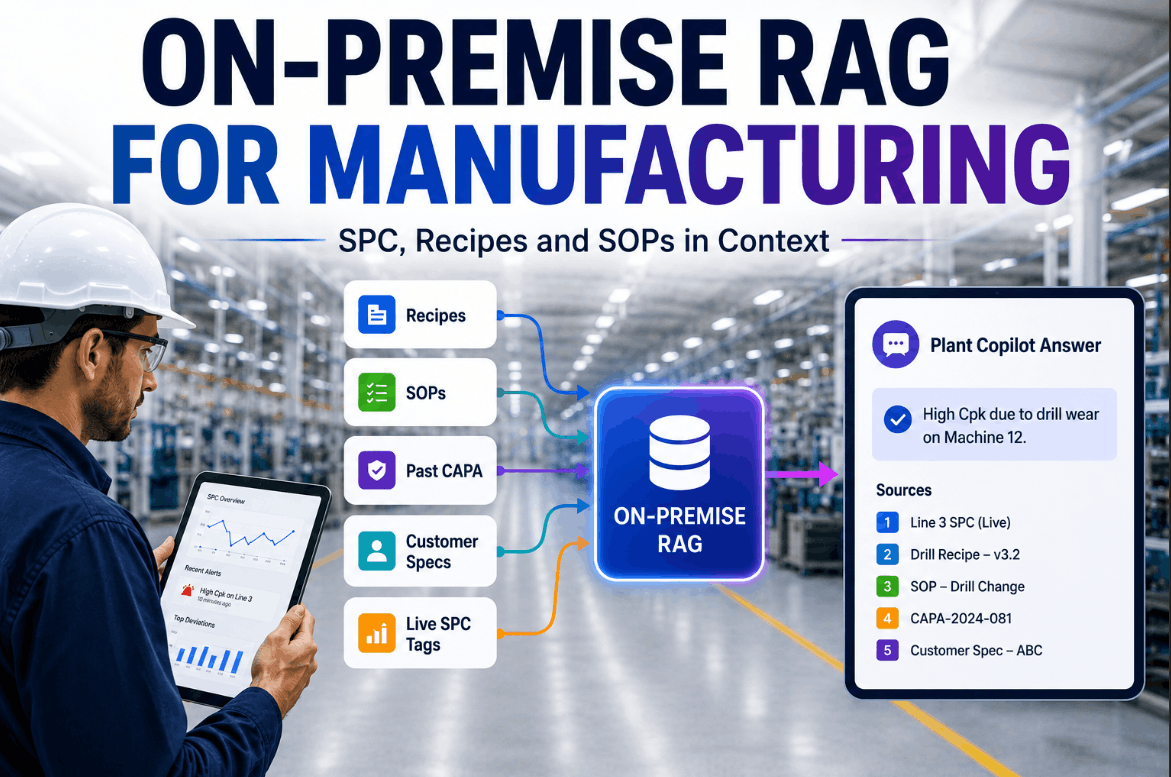
As CFOs in U.S. manufacturing face mounting pressure to justify every technology investment, AI-powered platforms are no longer a future promise—they are a present-day financial lever. iFactory's integrated SPC, AI Vision, and Copilot suite is engineered to deliver a measurable, documented return within 12 weeks of deployment. Three metrics define the payback: scrap saved, downtime saved, and quality-engineer hours recovered. From day one, every data point feeds a live ROI tracker that speaks the language your board understands. Book a Demo to see real plant numbers in action.
Why CFOs Are Demanding AI ROI Proof Before Deployment
The era of "pilot and hope" AI projects is over. Finance leaders at mid-size and enterprise manufacturers are now requiring a structured business case—one that maps AI capabilities directly to P&L line items before a single dollar of CapEx is approved. The challenge is that most AI vendors offer theoretical value, not tracked actuals. iFactory solves this by embedding a live ROI dashboard into its 12-week deployment pilot. Every SPC alert that prevents a scrap event, every vision-detected jam that averts downtime, and every automated report that frees a quality engineer—each is logged, timestamped, and converted into a dollar figure. The result is an audit-ready payback model that CFOs can present to the board with confidence.
The Three ROI Streams: Scrap, Downtime, and QE Hours
iFactory's 12-week ROI model is built on three quantifiable value streams, each tied to a specific module and a specific line item on the plant's operating budget. Understanding each stream is essential for building a defensible business case. Book a Demo to see how these streams map to your plant's cost structure.
Statistical Process Control alerts operators the moment a process drifts outside control limits—before a non-conforming part is produced. iFactory's SPC module logs every intervention, calculating the scrap cost avoided at your actual material and labor rates. For a plant scrapping 2–4% of output, a 30% reduction in SPC-driven scrap events translates directly to six-figure annual savings.
AI Vision cameras deployed at critical bottleneck stations detect anomalies—jams, misfeeds, tool wear signals—faster than any operator can. Each early detection is logged as a downtime event prevented, valued at your plant's documented cost-per-hour of unplanned stoppage. For high-throughput lines, preventing even two unplanned stoppages per week often covers the entire platform cost within the pilot window.
Quality engineers spend a disproportionate amount of time compiling shift reports, manually reviewing control charts, and answering routine compliance questions. iFactory's AI Copilot automates report generation and surfaces SPC insights on demand. The platform tracks the hours recaptured per QE per week, converting them to a labor-cost saving based on fully loaded headcount rates.
The 12-Week Pilot Deployment Timeline
iFactory's structured 12-week pilot is designed to eliminate deployment risk and accelerate time-to-value. Each phase builds on the last, ensuring that ROI accumulates progressively rather than waiting until full implementation is complete.
Data Baseline & Integration
iFactory connects to your existing PLCs, MES data feeds, and ERP. A baseline scrap rate, downtime frequency, and QE labor utilization are established. These become the denominator in every ROI calculation for the next 10 weeks.
Live SPC Control Charts & Alerts
SPC control limits are configured for your highest-value processes. Operators begin receiving real-time drift alerts. The ROI tracker logs the first scrap avoidance events and begins accumulating documented savings.
AI Vision Cameras Online
NVIDIA Edge nodes are installed at two to three critical inspection or bottleneck points. Vision models are trained and validated against your specific defect types. Downtime prevention events begin populating the ROI dashboard automatically.
AI Copilot for Quality Teams
Quality engineers begin using the Copilot for automated shift summaries, SPC trend interpretation, and compliance query response. Time-tracking within the platform captures hours recaptured and applies the loaded labor rate.
Board-Ready ROI Package
iFactory generates a consolidated ROI report: total scrap savings, total downtime savings, total QE labor recovered, and projected annual run-rate value. The report is formatted for executive and board-level presentation, including payback period and NPV at current run rates.
ROI Module Comparison: SPC vs. AI Vision vs. Copilot
Each iFactory module targets a distinct cost center. The table below maps each capability to its primary financial impact, the plant role that benefits most, and the typical payback contribution within the 12-week pilot period.
| Module | Primary Cost Targeted | Financial Metric Tracked | Typical 12-Wk Saving | Key Beneficiary |
|---|---|---|---|---|
| SPC (Statistical Process Control) | Scrap & rework material cost | Scrap events prevented × unit material cost | 15–35% scrap reduction | Quality Director, CFO |
| AI Vision (Edge) | Unplanned downtime & manual inspection labor | Downtime hours prevented × hourly loss rate | 2–4 stoppages/week prevented | Plant Manager, Operations VP |
| AI Copilot | Quality engineer administrative labor | QE hours recovered × fully loaded labor rate | 6–10 hrs/week per QE recovered | Quality Engineers, EHS |
| Live ROI Tracker | Board reporting and audit preparation time | Combined savings vs. platform cost | Positive ROI documented by Week 12 | CFO, Finance Team |
Building the Internal Business Case: What Finance Needs to See
Winning budget approval for AI in manufacturing requires translating operational improvements into financial language. iFactory's ROI framework is structured specifically to produce the artifacts that finance and executive teams require, without relying on vendor-supplied estimates.
A complete business case for AI manufacturing investment must address five questions: What is the current cost baseline for scrap, downtime, and QE labor? What is the projected reduction in each category, expressed as a percentage and a dollar value? What is the total platform cost, including integration and ongoing fees? What is the payback period and projected Year 1 and Year 3 NPV? And who owns the ongoing ROI measurement? iFactory's 12-week pilot is designed to answer all five with system-generated data, not estimates. Book a Demo to walk through the business case framework with our financial team.
Baseline Documentation
iFactory automatically captures your pre-deployment scrap rate, downtime frequency, and QE labor hours, establishing a verifiable cost baseline that cannot be disputed.
Progressive Savings Tracking
Every SPC intervention, vision alert, and Copilot automation is logged with a dollar value in real time, building an auditable savings ledger week by week throughout the pilot.
Export-Ready Board Report
At week 12, iFactory generates a formatted executive summary with payback period, ROI percentage, and projected annual run-rate value, ready for board or investment committee review.
No Vendor Estimates
All figures are generated from your own production data using your own cost rates. iFactory's ROI tracker produces actuals, not projections—eliminating the credibility risk of vendor-modeled numbers.
"We needed to justify a seven-figure AI investment to our board, and theoretical ROI models from vendors weren't going to cut it. iFactory's 12-week pilot gave us a live savings tracker that showed $340,000 in documented scrap and downtime savings before we ever signed a full contract. That data closed the investment committee in one meeting." — VP of Finance & Operations, Tier-2 Automotive Components Manufacturer
Frequently Asked Questions: AI Manufacturing ROI
How does iFactory calculate the dollar value of scrap saved?
The platform logs each SPC-triggered intervention that prevents a nonconforming part, then multiplies prevented events by your configured material and labor cost per unit—using your own cost rates, not industry averages.
Can the 12-week pilot run alongside our existing quality systems?
Yes. iFactory integrates with your current MES, ERP, and QMS without requiring a system replacement, running in parallel to validate ROI before any legacy system is retired.
What happens to the ROI tracker data after the pilot ends?
All pilot data is retained and becomes the baseline for full-deployment performance tracking; it is your data and is fully exportable at any time.
How many quality engineers are needed to manage iFactory day-to-day?
No dedicated administrator is required; the Copilot handles routine reporting, and the platform is designed so existing QEs manage it as part of their normal workflow with reduced time burden.
Is the AI Vision hardware a capital expense?
iFactory structures the NVIDIA Edge nodes and cameras as part of a scalable OpEx subscription model, avoiding large CapEx approval hurdles and allowing deployment to begin immediately.
Conclusion: The 12-Week Mandate for Manufacturing AI
For CFOs navigating the pressure to modernize while protecting EBITDA, iFactory's 12-week pilot ROI model offers a third path beyond "spend and hope" and "wait and see." By tracking scrap saved, downtime prevented, and QE hours recovered from day one—using your own production data and your own cost rates—iFactory turns AI deployment into a documented financial event rather than a speculative bet. The business case builds itself, week by week, in the same dashboard your board will review at quarter-end. If your plant is producing scrap, experiencing unplanned downtime, or paying quality engineers to compile reports manually, the cost of inaction is already measurable. The question is whether that cost is being tracked. Book a Demo to start your 12-week ROI pilot and bring real numbers to your next investment review.