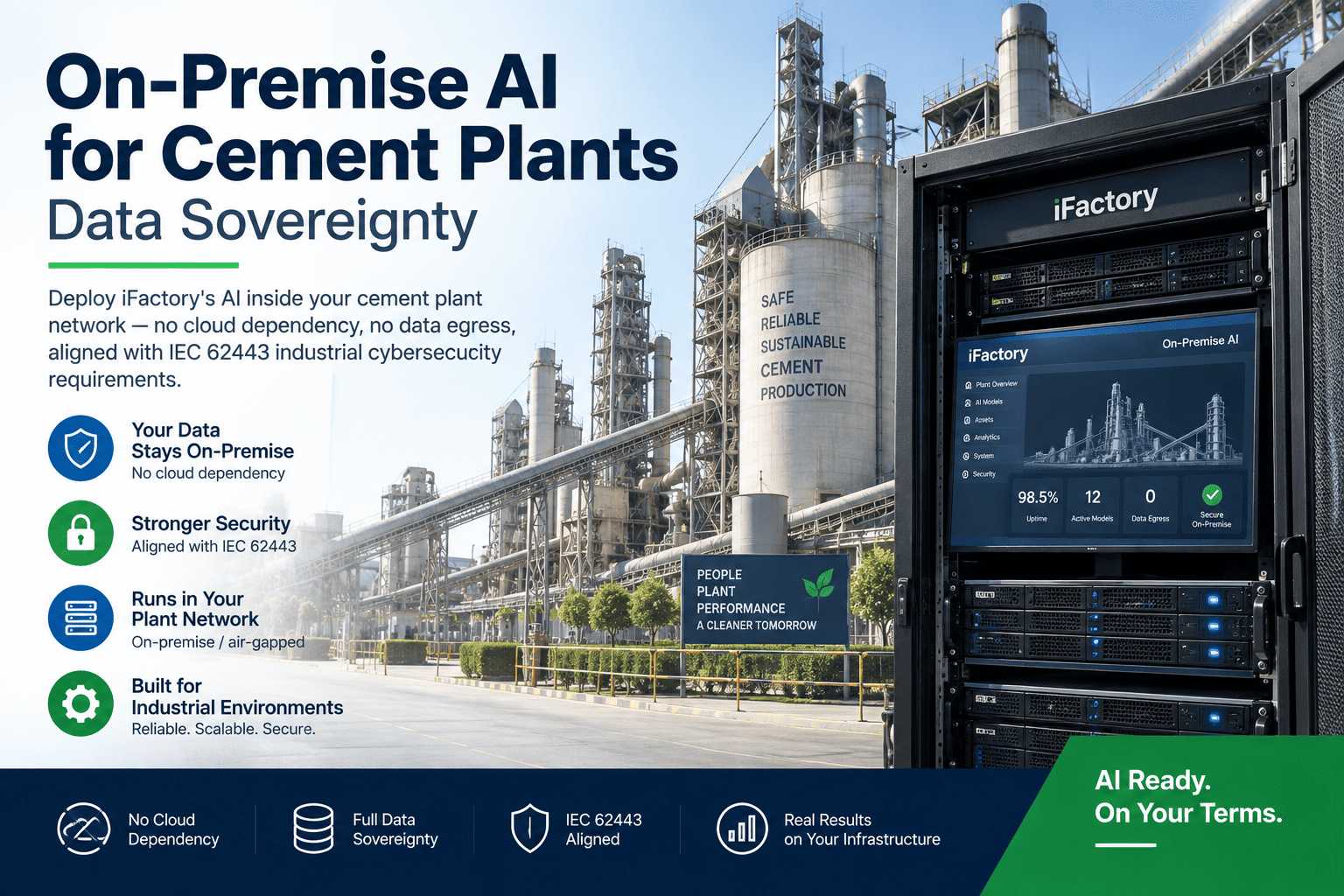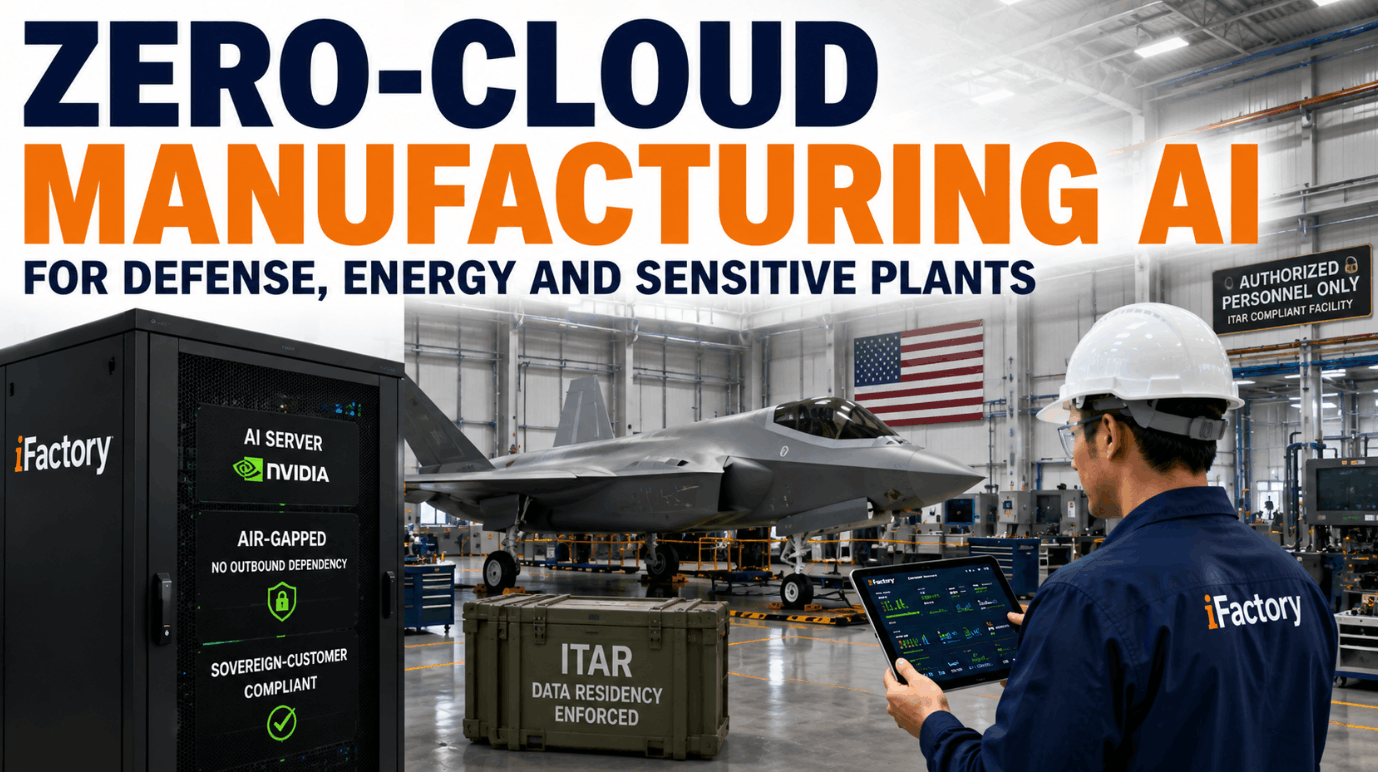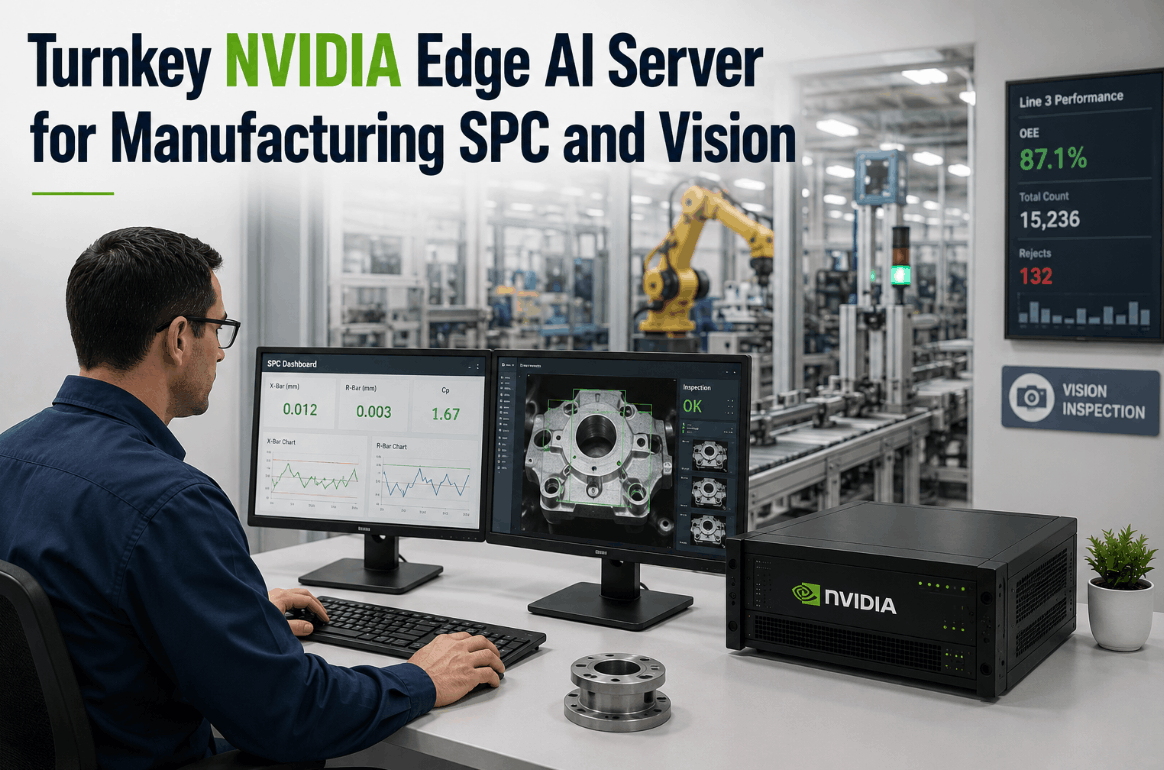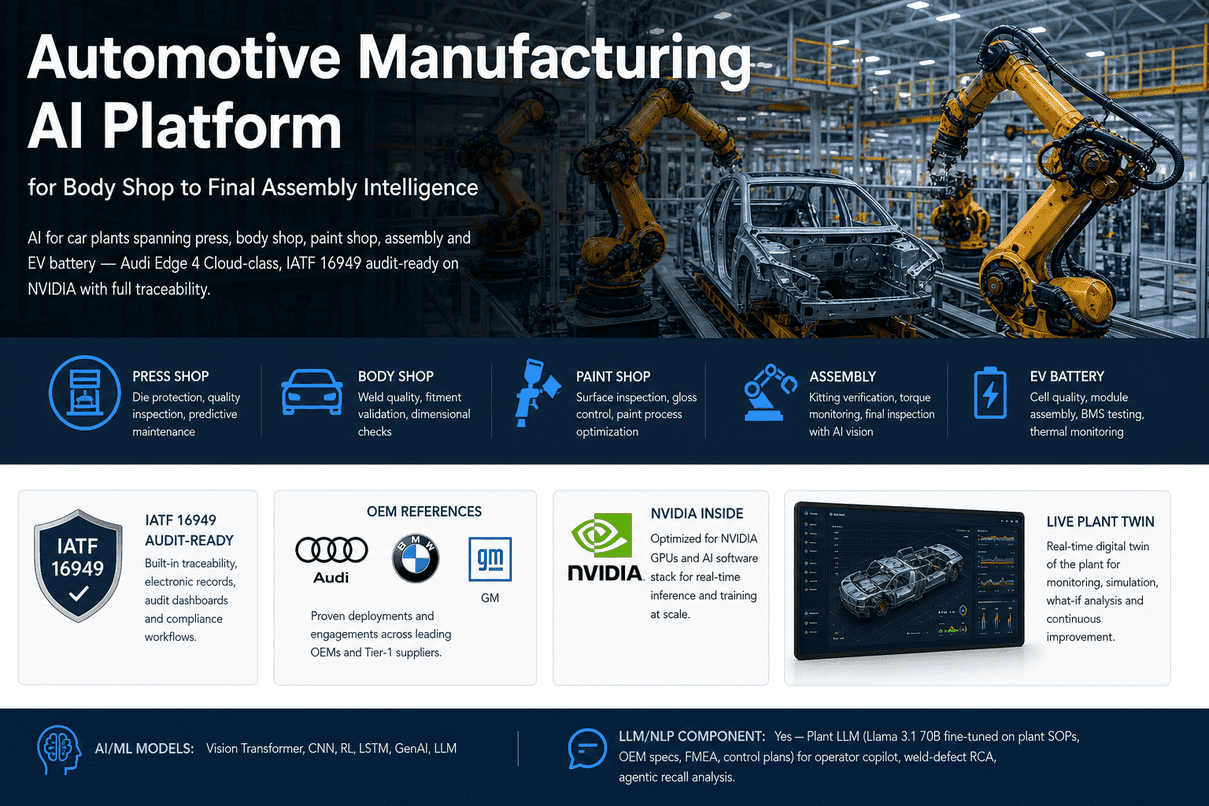
For Manufacturing IT Security teams in U.S. industrial facilities, the conversation about deploying AI on the plant floor has a predictable collision point: the OT team refuses any system that transmits operational data outside the facility perimeter, and the IT team refuses to maintain legacy infrastructure that cannot be secured or audited. Cloud-hosted AI platforms resolve neither objection. They add a third-party data dependency to a network that was explicitly designed to have none, and they create a compliance exposure that no combination of contractual assurances fully eliminates. iFactory's AI platform resolves this collision at the architecture level — a turnkey NVIDIA AI server shipped pre-loaded with iFactory software, installed behind your plant firewall, operating with zero outbound network dependency under any condition. OT teams get a fully isolated system. IT teams get a manageable, auditable appliance. And the plant gets production AI without accepting cloud risk. Facilities evaluating this architecture should Book a Demo to see the deployment model and security posture in detail.
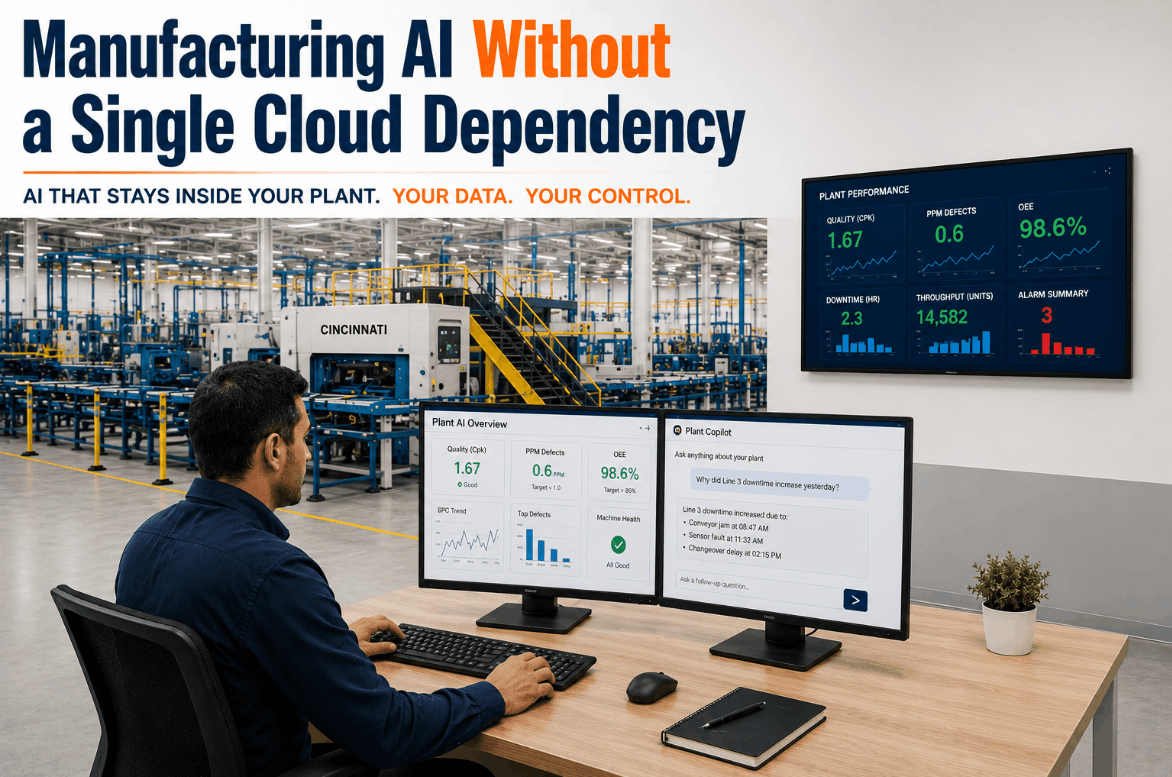
Manufacturing AI That Runs Entirely Behind Your Plant Firewall — No Outbound Dependency. Ever.
iFactory ships a pre-loaded NVIDIA AI server to your facility. It connects to your OT network, runs all inference locally, and never requires an internet connection for operation, licensing, or updates. Zero cloud. Full AI.
Why Cloud-Hosted AI Is Architecturally Incompatible with OT Network Security
The operational technology network of a U.S. manufacturing facility is not a general-purpose IT network with stronger access controls. It is a purpose-built communications environment designed around three non-negotiable requirements: deterministic response times for process control, physical isolation from external networks, and protection of process intellectual property from competitive exposure. Cloud AI platforms violate all three requirements simultaneously. They introduce latency variability from internet connectivity into environments where millisecond-level process decisions determine product quality. They require persistent outbound connections from a network architecture that was specifically designed to have none. And they transmit process recipes, SPC data, PLC configurations, and production records to third-party servers that have no contractual obligation to maintain the same security posture as your facility.
iFactory's architecture starts from the OT security requirement and builds up, rather than starting from a cloud product and trying to retrofit compliance. The AI server is a physical appliance that ships to your facility pre-configured with iFactory software. It connects to your OT and IT networks through standard industrial protocols — OPC-UA, Modbus TCP, MQTT — entirely within your network perimeter. There is no cloud licensing call, no telemetry heartbeat, no update dependency, and no data egress path of any kind. Book a Demo to review the network architecture diagram with your IT security team.
Data Egress Exposure
Cloud AI platforms receive your process parameters, recipes, and production data as query inputs — creating undisclosed data transmission that violates OT network isolation policies and may breach customer confidentiality agreements, ITAR controls, and CMMC requirements.
Internet Dependency in OT
Any cloud AI function creates a persistent internet dependency in a network that was architecturally designed to have none. This dependency introduces an attack surface — and a single-point-of-failure — that OT security standards explicitly prohibit in Level 2 and Level 3 network zones.
Regulatory Incompatibility
CMMC Level 2, ITAR, DoD contractor requirements, and sector-specific data handling regulations in defense, aerospace, and critical infrastructure manufacturing prohibit transmission of controlled technical data to commercial cloud platforms without explicit authorization that most cloud AI vendors cannot provide.
Context-Free Responses
Cloud AI models have no knowledge of your plant's specific equipment, recipes, process parameters, or operational vocabulary. Their responses are drawn from general manufacturing knowledge — which is not the same as knowing your process. On-premises deployment enables plant-specific model contextualization that cloud platforms structurally cannot provide.
The iFactory Turnkey AI Appliance: What Ships, What It Does, and How It Integrates
iFactory's zero-cloud architecture centers on a physical deployment model: a certified NVIDIA GPU server ships to your facility pre-loaded with iFactory software, pre-configured for your target data sources, and ready for OT network integration. The deployment model eliminates the multi-month cloud onboarding cycle and the ongoing cloud security review burden — the appliance is a known, auditable hardware and software configuration that your IT security team can evaluate once and approve permanently.
Deployment Architecture — From Shipment to Production AI
IT Security Architecture: How iFactory Satisfies Every OT and IT Requirement Simultaneously
Manufacturing IT Security teams evaluating AI deployment face a dual requirement that most platforms cannot satisfy: OT network isolation requirements that prohibit external data transmission, and IT governance requirements that demand auditable, manageable systems with defined security boundaries. iFactory's architecture satisfies both through a layered security design that gives IT security teams a concrete, verifiable posture rather than a vendor's contractual promise. Book a Demo to review the full security architecture documentation with your security team.
| Security Requirement | Traditional Cloud AI | iFactory On-Premises | Compliance Outcome |
|---|---|---|---|
| OT Network Isolation (ISA/IEC 62443) | Requires outbound internet — violates isolation | Zero outbound connectivity — full isolation maintained | Level 2/3 zone compliance |
| CMMC Level 2 / ITAR Data Handling | CUI transmitted to commercial cloud — prohibited | All data remains on-premises — no transmission | CMMC & ITAR compliant |
| Process Recipe Confidentiality | Recipes transmitted as query input to vendor servers | Recipes indexed locally — never leave facility | IP protection maintained |
| Software Update Security | Automatic cloud push — uncontrolled update surface | Offline package delivery — IT-controlled update cycle | Change management compliant |
| Availability Without Internet | Complete failure on internet outage | Full functionality — internet irrelevant to operation | 99.9% availability target met |
| Audit Trail & Access Logging | Vendor-controlled logs — limited facility access | Local immutable logs — full facility control | SOC 2 / ISO 27001 ready |
| Role-Based Access Control | Vendor IAM — separate identity silo | Active Directory / LDAP integration — single identity | Zero identity sprawl |
Compliance Frameworks That On-Premises AI Satisfies by Default
The compliance case for on-premises AI is not about avoiding risk through contractual language — it is about architectural alignment with the control requirements that regulatory frameworks were built to enforce. iFactory's air-gapped deployment model satisfies the core data handling, network isolation, and access control requirements of every major manufacturing security and compliance framework without requiring special authorization, exception requests, or vendor attestation.
Cybersecurity Maturity Model
Defense Supply Chain Manufacturers
- CUI never transmitted to external systems
- Access control mapped to NIST 800-171 AC controls
- Audit logging satisfies AU domain requirements
- Configuration management via offline update model
Industrial Automation & Control Security
All Industrial Facility OT Networks
- Zone-and-conduit model fully respected
- No Level 2/3 boundary violations
- Appliance deployed in IT/OT DMZ or Level 3.5
- No PLC or SCADA direct write access
Export Administration & Arms Regulations
Aerospace, Defense, Dual-Use Manufacturing
- Technical data never transmitted outside facility
- No foreign national data access risk
- Process parameters and designs stay on-site
- No third-country cloud server exposure
Manufacturing AI Without Cloud Dependency Is Not a Compromise — It Is the Correct Architecture
The premise that manufacturing AI requires cloud infrastructure is a product of the enterprise software industry's distribution model, not a technical requirement. AI inference, model contextualization, and plant-specific intelligence all run efficiently on on-premises hardware at the scale relevant to a manufacturing facility. The only thing cloud deployment adds to manufacturing AI is a data transmission dependency that OT security policy, regulatory compliance, and competitive IP protection all require you to eliminate. iFactory's turnkey NVIDIA AI server architecture delivers production-grade AI without accepting any of those dependencies — and it does so in a deployment model that Manufacturing IT Security teams can evaluate, approve, and manage within their existing security governance frameworks. The OT team gets a fully isolated system. The IT team gets an auditable appliance with defined security boundaries. The plant gets AI that actually knows its process. Book a Demo to review the architecture with your security and IT teams together.
Manufacturing AI Without Cloud — Frequently Asked Questions
Deploy Manufacturing AI That Never Leaves Your Fence — and Never Needs To.
iFactory ships a pre-loaded NVIDIA AI server to your facility. It connects to your OT network, indexes your plant data locally, and runs all AI inference on-premises — with zero cloud dependency, zero data egress, and full air-gap compatibility from day one.