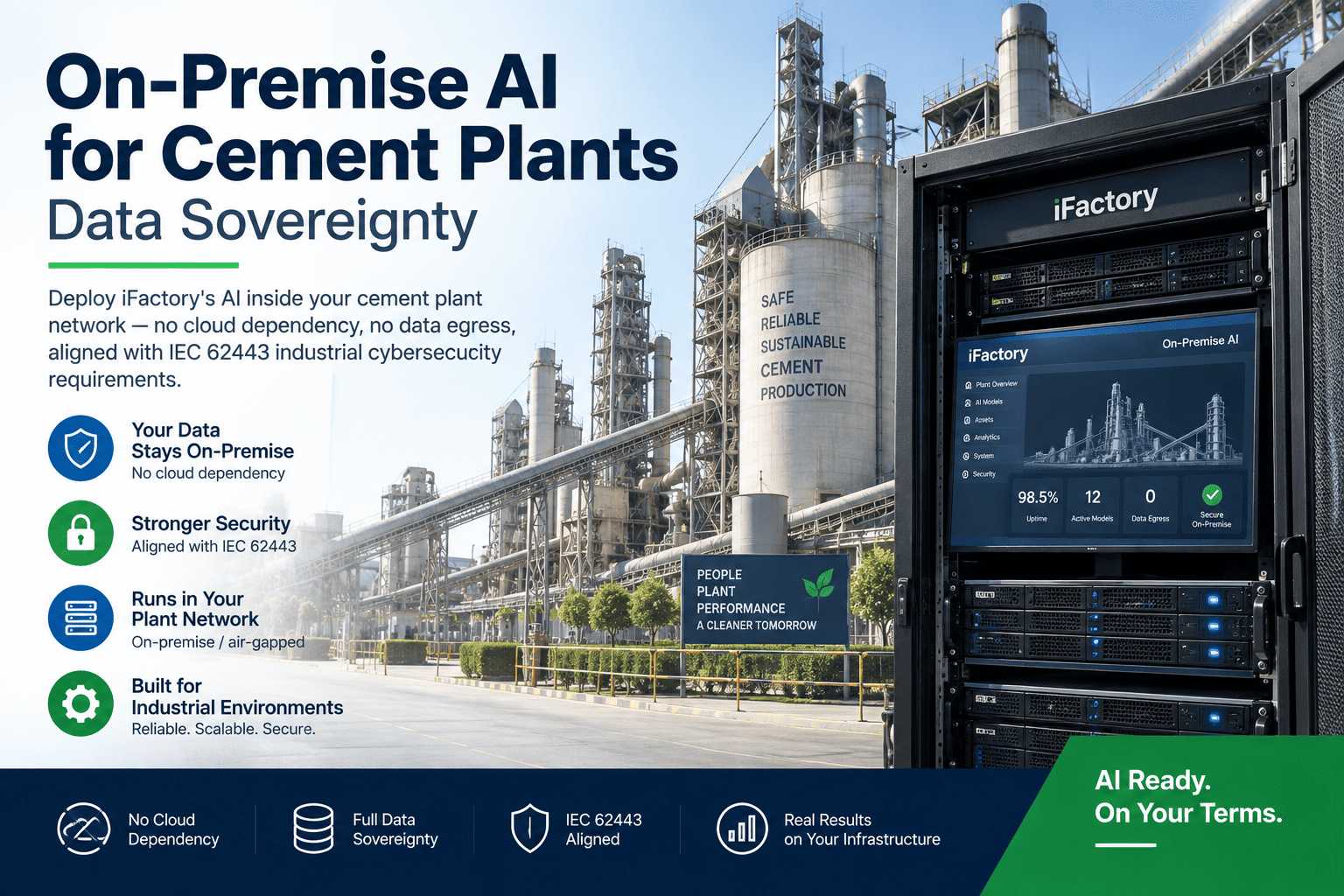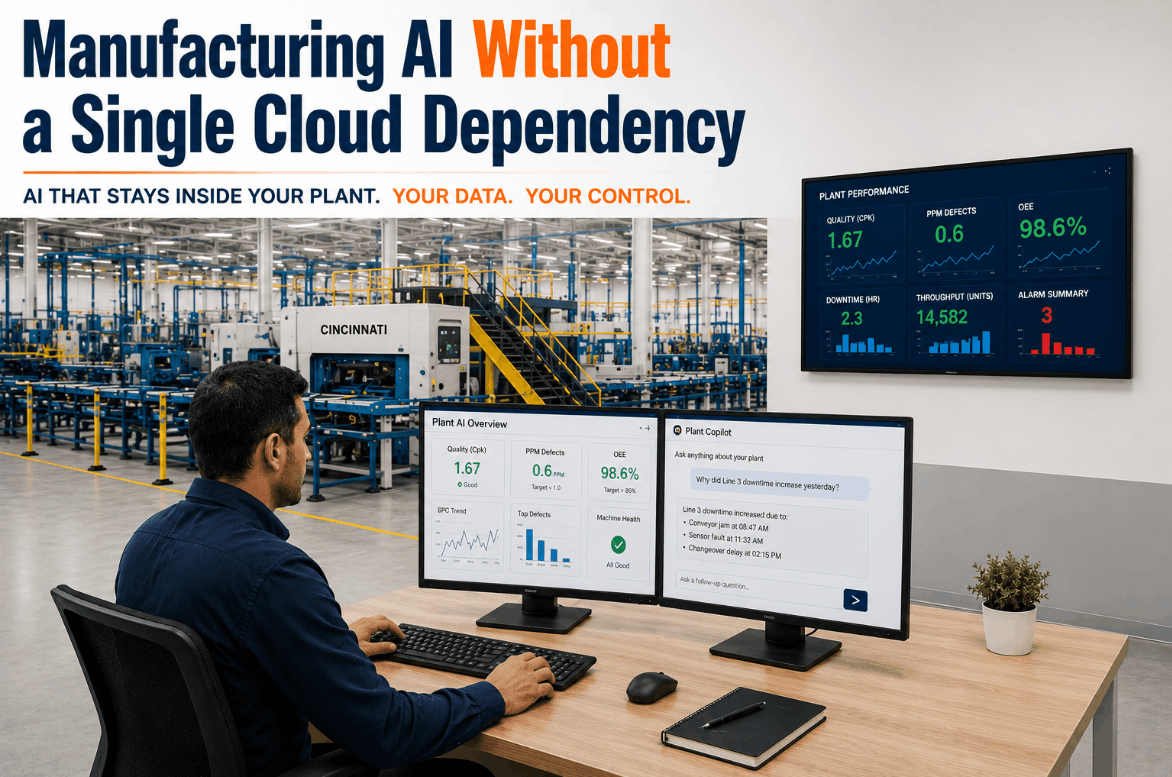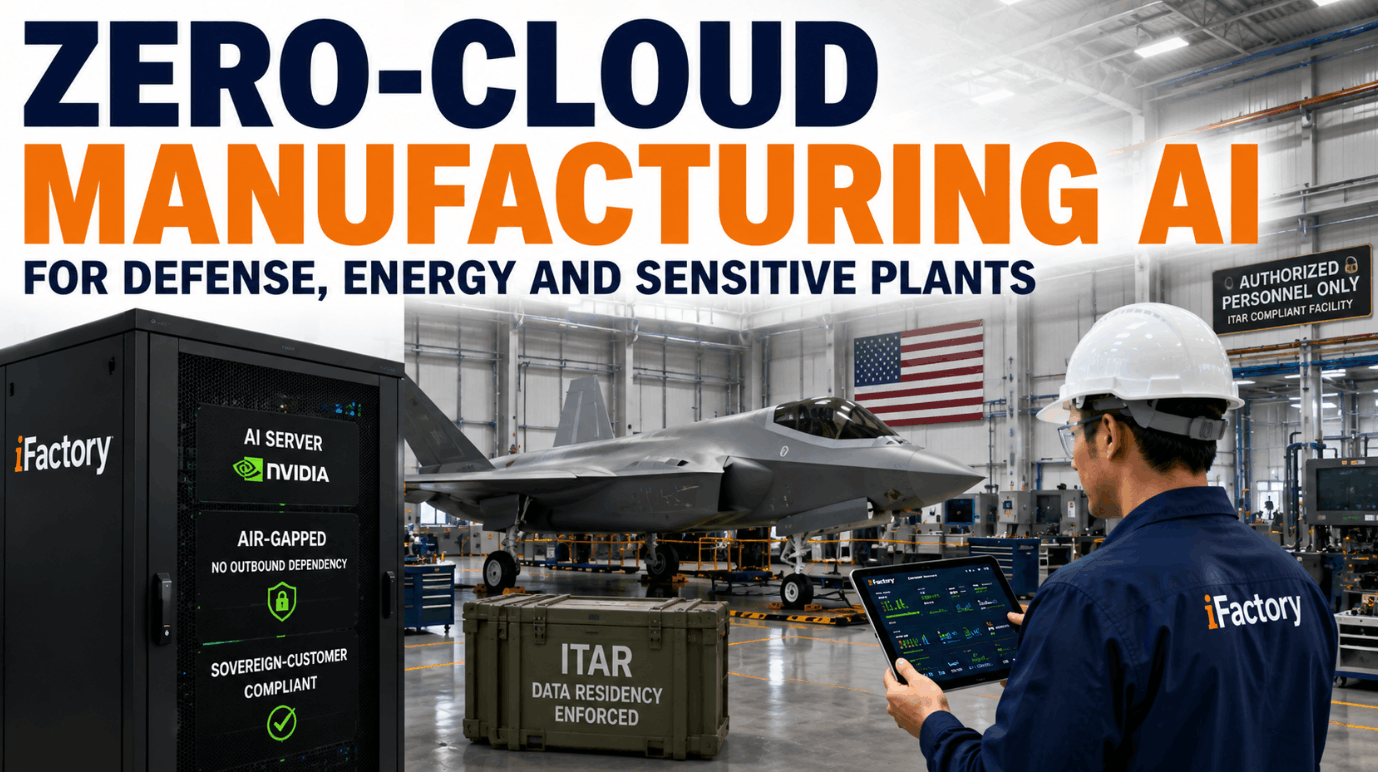
For defense primes, nuclear operators, sensitive-chemical facilities, and sovereign-customer manufacturers, the question of whether to use cloud AI has already been answered — by ITAR, by CMMC 2.0, by IEC 62443, by classified program security plans, and by the fundamental architecture of every air-gapped OT network on which their production runs. The answer is no. Not "no, with compensating controls." Not "no, unless you use a private endpoint." No. A manufacturing AI platform that initiates any outbound connection to a hyperscaler, that phones home for model updates, that streams telemetry to a SaaS vendor's cloud tenant — regardless of encryption, regardless of compliance certifications — has already failed the only test that matters in these environments: data never leaves the network. iFactory's zero-cloud deployment is built from the ground up for exactly this constraint. The entire AI capability stack — predictive maintenance, vision inspection, plant copilot, agentic workflows, SPC analytics — runs on a sovereign NVIDIA AI server inside your network boundary, with no outbound dependency of any kind. Book a Demo to see how zero-cloud AI deploys inside your facility's security perimeter.
Why Cloud AI Is Not an Option for Defense, Nuclear, and Sovereign-Customer Plants
The compliance frameworks governing the most sensitive manufacturing environments in the United States do not leave room for interpretation on data residency. ITAR prohibits the transfer of defense-related technical data to foreign nationals — a prohibition that cloud AI vendors cannot satisfy when their infrastructure spans multiple sovereign jurisdictions and their engineering teams include non-U.S. persons. CMMC 2.0 Level 2 and Level 3 requirements for Controlled Unclassified Information mandate that CUI never traverse unapproved external networks. IEC 62443 Security Level 3, the baseline for critical infrastructure OT environments, requires architectural isolation that no shared-tenancy cloud service can provide. Nuclear facility cybersecurity programs under 10 CFR 73.54 require demonstrated protection of critical digital assets that precludes any external connectivity pathway.
These are not preferences. They are legal obligations with criminal exposure, program termination risk, and facility license consequences for non-compliance. Every cloud AI vendor in the market today — regardless of their government cloud tier, their FedRAMP authorization, their data processing addenda — operates on the same fundamental architecture: your data leaves your facility to be processed somewhere else. That architecture is incompatible with these environments. Book a Demo to review iFactory's zero-cloud architecture against your specific compliance requirements.
The Four Manufacturing Environments Where Zero-Cloud Is the Only Compliant Architecture
Zero-cloud AI is not a niche requirement. It is the mandatory architecture for a defined set of manufacturing environments whose regulatory, contractual, and national-security obligations make outbound data transmission architecturally prohibited — not merely discouraged. iFactory's sovereign deployment model is purpose-built for these four environments, each with its own compliance driver, data classification standard, and audit requirement.
Defense primes and tier-one suppliers processing technical data packages, manufacturing process instructions, or quality records related to ITAR-controlled articles cannot transmit that data to any external system — including cloud AI APIs. SIPRNet and JWICS production networks are physically isolated by design. AI must operate inside the same enclave as the data it processes.
Nuclear facility cybersecurity programs require demonstrated protection of critical digital assets with documented isolation from external networks. NERC CIP standards for electric grid facilities and CISA guidance for pipeline operators mandate OT network isolation that categorically excludes cloud AI connectivity pathways.
Chemical facilities subject to CFATS Top-Screen requirements and OSHA PSM programs have specific restrictions on transmission of process safety information that governs toxic release scenarios, explosion hazard data, and facility vulnerability assessments. AI systems processing this data must operate within the facility's security perimeter.
Foreign military sales contracts and sovereign-customer manufacturing programs increasingly contain explicit data residency provisions requiring that all production data, AI model outputs, and quality records remain within the host nation's territory under host-nation control. Hyperscaler cloud tenants cannot satisfy contractual data residency clauses that require physical, not logical, data containment.
What Zero-Cloud Means in Practice: iFactory's Sovereign AI Architecture
Zero-cloud is not a marketing position. It is an architecture specification with measurable, auditable properties. The distinction between a cloud AI vendor's "private deployment" or "on-premise option" and a genuinely air-gapped zero-cloud system is not a matter of degree — it is a matter of network topology. If the system initiates any outbound connection for any purpose — model inference, license validation, telemetry, update check — it is not air-gapped, regardless of what the vendor documentation says. The table below documents exactly how iFactory's zero-cloud architecture differs from cloud AI and hybrid on-premise deployments across every dimension that OT security auditors and compliance programs evaluate.
| Architecture Dimension | Cloud AI (SaaS) | Hybrid / Private Endpoint | iFactory Zero-Cloud | Compliance Verdict |
|---|---|---|---|---|
| AI Inference Location | Vendor cloud — data leaves facility | Vendor cloud via private link — data leaves facility | On-premise NVIDIA server — data never leaves | Only iFactory passes ITAR / CMMC |
| Outbound Network Dependency | Continuous — API calls for every query | Continuous via private circuit | Zero — no outbound connection of any type | Zero outbound required for air-gap |
| Model Update Mechanism | Automatic over internet | Automatic via private circuit | Physical media delivery — offline update protocol | Physical delivery only for classified networks |
| Vendor Telemetry | Continuous — usage, performance, errors | Continuous via private circuit | None — no telemetry architecture in deployment | No telemetry required by CMMC / IEC 62443 |
| License Validation | Online — phone home required | Online via private circuit | Hardware-locked — no activation server | Hardware lock required for air-gap |
| Data Residency Guarantee | Contractual only — not architectural | Contractual only — not architectural | Architectural — physically impossible to exfiltrate | Architecture is the only valid guarantee |
| Audit Trail for Regulators | Vendor-provided logs — chain of custody gap | Partial — vendor retains some records | Complete local audit log — no external records | Local audit trail required for NRC / CMMC |
Full AI Capability Inside the Air-Gap: What iFactory Delivers on Sovereign Hardware
The operational concern most frequently raised in zero-cloud AI discussions is capability parity: whether an air-gapped deployment delivers the same AI capability as a cloud-connected system, or whether the isolation required for compliance forces a capability compromise. For iFactory's zero-cloud deployment, the answer is unambiguous. The complete industrial AI capability stack runs on the on-premise NVIDIA AI server with no functional reduction relative to the cloud-connected version. Book a Demo to see the full air-gapped capability demonstration in your security environment.
Deployment Architecture: How iFactory Installs, Updates, and Audits a Zero-Cloud AI System
Operating a production AI system without any internet connectivity requires a disciplined operational model for installation, model updates, retraining, and audit — every function that cloud AI handles automatically through internet connectivity must be replicated through a physically controlled, documented process. iFactory's zero-cloud deployment playbook covers each of these operational requirements with a defined protocol that satisfies security auditors, ISSOs, and facility security officers in classified environments. Book a Demo to walk through the deployment architecture with our OT security team.
NVIDIA AI server delivered and baseline-configured in a secure staging environment before entry into the classified or restricted network. OS hardening, unnecessary service removal, and network interface configuration completed prior to installation. Hardware asset recorded in facility's equipment register with serial number and configuration baseline documented for auditor review.
OPC-UA connections to existing SCADA, PLC, and historian infrastructure configured entirely within the facility network. No external connector or cloud relay involved. Data flows validated against the facility's approved data flow diagrams. Network segmentation maintained per ICS security zone architecture — iFactory server placed in the appropriate DMZ or process control zone per the facility's approved security plan.
Foundation models and industry-specific pre-trained weights delivered via encrypted physical media. Asset criticality register built from facility equipment data. Predictive maintenance models initialized on historical sensor data residing in the on-premise historian. Vision inspection models trained on labeled image sets from local production data — all training compute executed on the installed server, no external GPU dependency.
Full system security documentation package produced for facility ISSO: system security plan, data flow diagrams confirming zero outbound connections, port and protocol list, audit log configuration, and user access control register. Penetration testing and network traffic validation confirming no unexpected outbound connections performed as final validation step before production authorization.
Model updates and platform patches delivered on a scheduled cadence via encrypted physical media — USB, optical, or removable hard drive depending on facility media control policy. Each update package cryptographically signed and verified before installation. Update records maintained in the local audit log. Model retraining on new production data executed entirely on the installed server with no external data transmission.
Expert Review: The Architectural Distinction That Cloud AI Vendors Cannot Resolve
I have reviewed AI platform proposals for classified manufacturing programs at three different defense contractors over the past four years. Every cloud AI vendor we evaluated made the same argument: their private endpoint, their VPC isolation, their FedRAMP authorization — these were presented as equivalent to the data residency our program required. They are not equivalent. A private endpoint does not change where inference computation happens. Data still crosses the facility boundary to be processed on vendor infrastructure. That transmission — regardless of encryption, regardless of contractual assurance — fails the security architecture our program security plan requires, and it fails the ITAR analysis our export control counsel applied. The only platform proposal that passed both our ISSO's technical review and our export control counsel's analysis was one where the entire AI inference stack ran inside our network boundary on hardware we controlled, with a documented zero-outbound architecture we could independently verify with a network traffic capture. OT security directors in classified environments need to understand: a contractual data residency guarantee is not an architectural one. The question is not whether the vendor promises your data is protected. The question is whether the architecture makes it physically impossible for your data to leave. Those are different questions, and only one of them has an answer that satisfies a rigorous compliance audit."
Conclusion: The Architecture Is the Compliance Posture
For defense, nuclear, sensitive-chemical, and sovereign-customer manufacturing programs, the compliance question around AI is not a matter of vendor selection or contract negotiation. It is a matter of network architecture. A system that initiates outbound connections — for any reason, at any frequency, to any destination — cannot satisfy ITAR, CMMC 2.0 Level 2, IEC 62443 SL-3, or nuclear cybersecurity program requirements, regardless of what the vendor's compliance documentation states. The architectural requirement is absolute: AI must run inside the facility network boundary on hardware the facility controls, with no outbound dependency of any kind.
iFactory's zero-cloud deployment delivers exactly that architecture — the complete industrial AI capability stack running on a sovereign NVIDIA server inside your network boundary, with a documented zero-outbound design, hardware-locked licensing, and an offline update protocol that keeps the system current without ever touching the open internet. The deployment timeline is 8–12 weeks. The security documentation package is ready for ISSO review. And the capability delivered — predictive maintenance, vision inspection, plant copilot, SPC analytics, digital twin — is identical to the cloud-connected version, because the AI runs on hardware that does not need a cloud to be powerful. The compliance posture your program requires and the AI capability your operations need are not in tension. They are the same deployment.