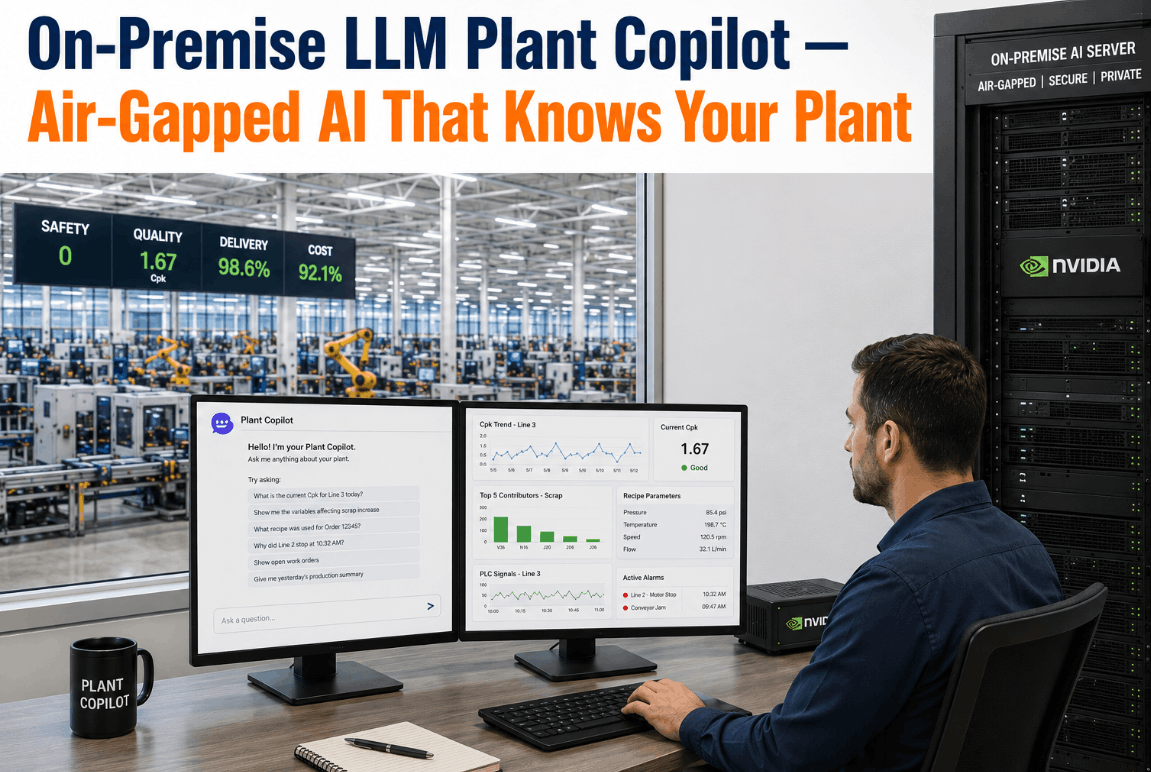
Manufacturing plants are drowning in unstructured knowledge — process recipes locked in PDFs, SOPs written across five revisions with no clear active version, CAPA records buried in CMMS ticket archives, customer specifications scattered across email folders, and live SPC data running in real time on the historian. The engineers and process architects who need that information to make a correct, defensible decision have no reliable path to retrieve it in context at the moment they need it. Retrieval-Augmented Generation applied to on-premise plant data solves exactly that problem: the model retrieves from your documents, your SPC tags, your CAPA history, and your customer specs — all grounded, all cited, all inside your firewall. Book a Demo to see how iFactory's on-prem RAG engine surfaces the right answer from the right document at the right moment without sending a single byte to an external server.
Why Manufacturing Knowledge Retrieval Fails Without RAG — and What the Failure Costs
The core failure mode in manufacturing knowledge management is not a shortage of documentation. U.S. manufacturers collectively maintain enormous volumes of process records — engineering change orders, first-article inspection reports, customer-specific control plans, statistical process control history, corrective action files going back years. The failure is retrieval: getting the right piece of that knowledge in front of the right person in the time frame that a decision actually requires. An AI Solutions Architect deploying a cloud-based LLM against public training data gets a generic answer. A process engineer querying iFactory's on-prem RAG gets an answer grounded in your actual recipe version 4.2, your actual CAPA from 2022 on the same failure mode, and your actual SPC Cpk reading from this shift — with citations showing exactly which document each sentence came from.
The financial consequence of this retrieval gap is measurable. When a shift supervisor cannot locate the correct SOP version in time, the wrong procedure executes. When an engineer responding to a customer complaint cannot pull the relevant CAPA history, the response is weak and the root cause is misidentified. When a process deviation alert fires and no one can immediately access the recipe tolerance band for that parameter, the plant escalates to a hold that costs hours of production. iFactory eliminates every one of these failure modes through structured retrieval across five document types that collectively represent the operational knowledge base of any precision manufacturing facility.
The Five Knowledge Sources iFactory RAG Retrieves From — and Why Each One Matters
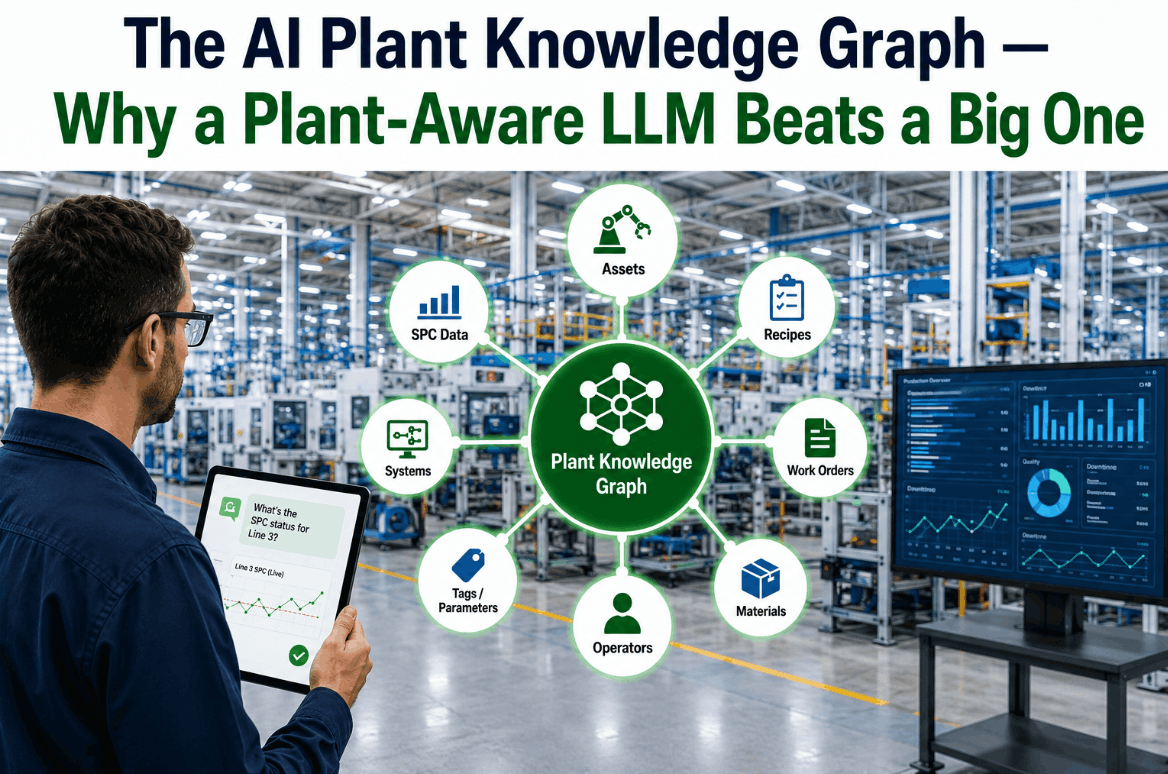
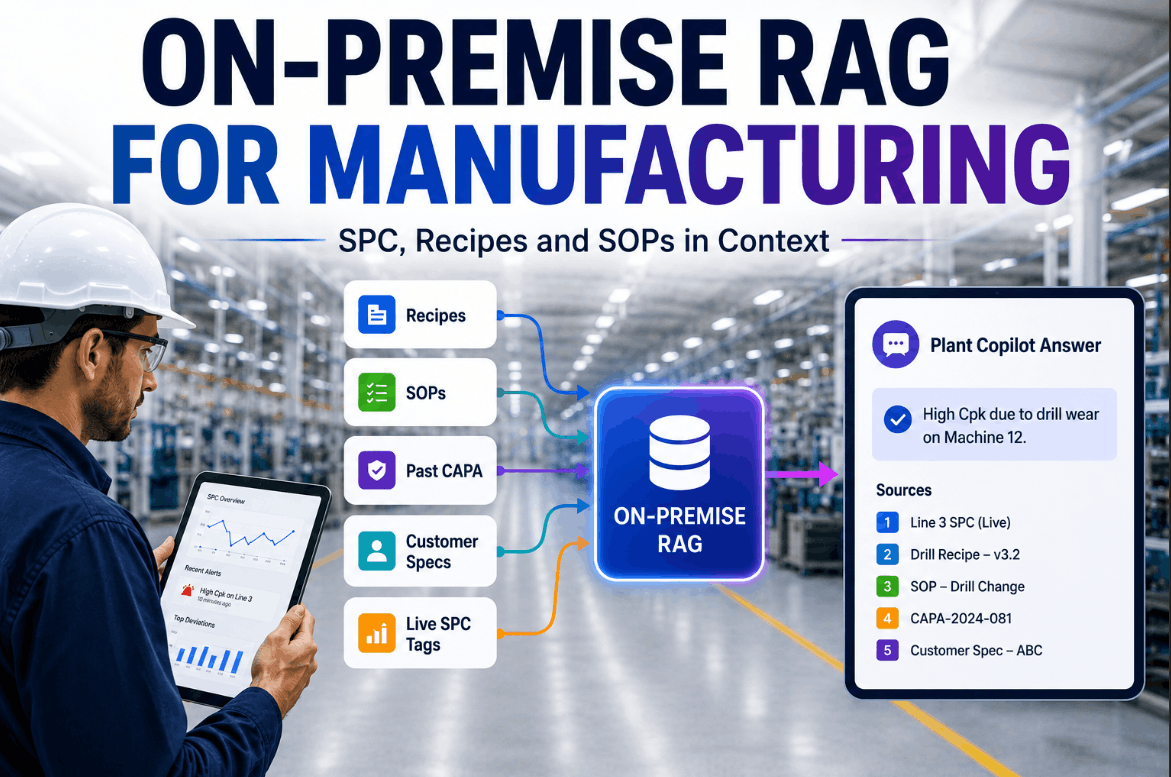
Most enterprise RAG implementations index a single document type — typically a SharePoint corpus or a maintenance manual library. That narrow scope misses the compounded value that manufacturing knowledge retrieval delivers when multiple authoritative sources are queried simultaneously in context. iFactory's on-prem RAG architecture indexes five distinct knowledge categories, each with its own ingestion pipeline, chunking strategy, and citation format, so every answer the system returns can show exactly which recipe version, which SOP revision, which CAPA record, or which SPC tag window the information came from.
Process Recipe Retrieval — Version-Aware, Parameter-Specific
Recipe documents define the exact process parameters — temperatures, pressures, dwell times, feed rates, material ratios — that determine whether a production run meets specification. The retrieval challenge is version control: a facility running 200 product families may have 4–8 revisions of each recipe in the document management system, and the relevant revision depends on the current production order, the customer, and the material lot. iFactory's recipe ingestion pipeline parses each recipe document, extracts parameter tables with their tolerance ranges, and stores version metadata at the chunk level — so a query about a specific parameter returns the answer from the active revision for that SKU, not a generic result from an older version that may have been superseded.
SOP Retrieval — Revision-Controlled, Step-Level Precision
Standard Operating Procedures are the most frequently queried document type in a plant environment — and the most frequently out of date in most document management systems. iFactory's SOP indexing pipeline ingests every SOP in the facility's document library, parses step-level structure, and stores document revision, effective date, and process area at the chunk level. When a query references an SOP, the system returns the relevant steps from the current active revision — not from a draft or a superseded version — with the step number and revision citation visible in the response. The practical effect is that a technician asking "What is the lockout procedure for Line 4 press #7?" gets the exact current steps with the correct SOP number and revision, not a generic answer.
CAPA History Retrieval — Root Cause Pattern Recognition Across Years of Records
Corrective and Preventive Action records represent the institutional memory of every quality failure your plant has investigated and resolved. That memory is routinely inaccessible: CAPA records in most plants exist as closed tickets in a CMMS or QMS, searchable only by date, part number, or operator — not by symptom, failure mode, or root cause pattern. iFactory's CAPA ingestion pipeline extracts problem description, root cause, corrective action taken, and verification outcome from each closed CAPA record and indexes them into the vector store with part family and failure mode metadata. When an engineer opens a new nonconformance with a familiar symptom profile, a query against the CAPA index surfaces every historically similar case with its verified root cause and the corrective action that resolved it.
Customer Specification Retrieval — Drawing-Level Requirements on Demand
Customer specifications — dimensional tolerances, material certifications, surface finish requirements, inspection protocols, packaging and labeling requirements — arrive in different formats from every customer and are often distributed across engineering, quality, and procurement without a unified retrieval path. When a nonconformance occurs against a customer spec, the relevant section needs to be accessible within minutes. iFactory's spec ingestion pipeline processes customer-supplied PDFs, drawing notes, and quality clauses into the vector index with customer name, part number, and specification section as metadata, enabling a query like "What is the maximum acceptable hardness variation for this Ford PPAP submission?" to return the exact tolerance from the applicable section of that customer's active spec, cited with document name and section number.
Live SPC Tag Retrieval — Real-Time Process Context in Every Answer
The five knowledge sources in iFactory's RAG architecture include one that no document management system can provide: live SPC tag data from the historian. When a process question has a temporal component — "Is Line 2's coating weight Cpk currently within spec?" or "When did the hardness process last go out of control?" — a purely document-based RAG returns a generic answer based on recipe tolerances but cannot tell you what the data is saying right now. iFactory bridges this gap by connecting the RAG query layer to live SPC tag streams from the historian, allowing the LLM to ground its response in both the documented tolerance (from the recipe) and the actual current process performance — with the SPC tag name, current Cpk, and control status cited alongside the document sources.
How iFactory's On-Premise RAG Architecture Works — From Document Ingest to Cited Answer
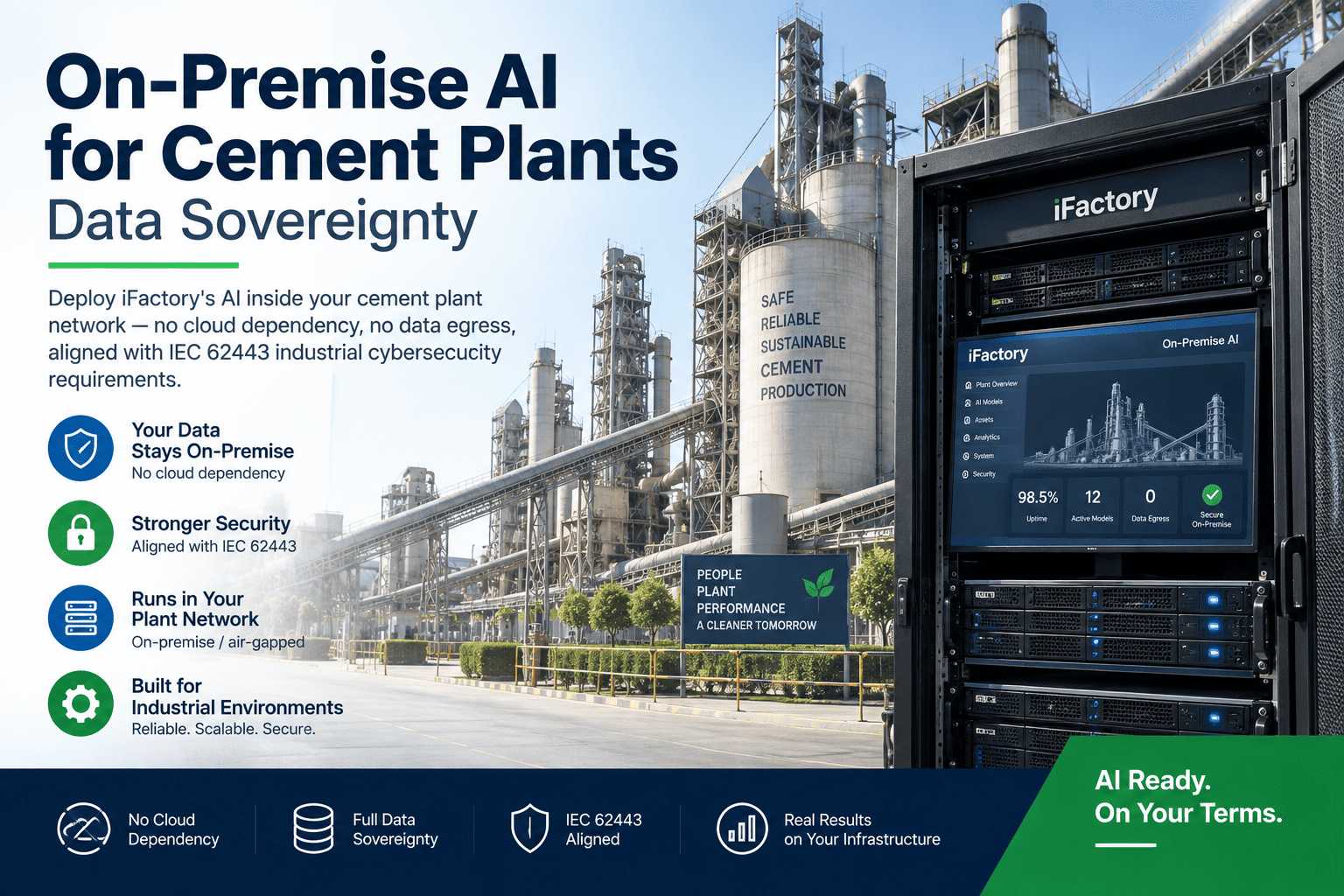
The architectural requirement that separates industrial RAG from generic enterprise AI deployments is on-premise containment: the embedding model, the vector store, and the LLM inference engine must all run within the plant network, with no query data, no retrieved content, and no generated answer leaving the firewall. For AI Solutions Architects building or evaluating this stack, the following pipeline describes how iFactory delivers grounded, cited answers across all five knowledge source types — entirely on infrastructure you control.
On-Prem RAG vs. Cloud AI vs. Document Search: Decision Framework for AI Solutions Architects
AI Solutions Architects evaluating retrieval architectures for manufacturing environments face a three-way decision that most vendor comparisons misrepresent. The choice is not "AI vs. no AI" — it is between cloud LLM with external data exposure, enterprise search without generation, and on-prem RAG with full data containment and grounded answers. The table below documents how each approach performs against the criteria that matter most in a precision manufacturing or regulated production environment.
| Evaluation Criterion | Cloud LLM (GPT / Gemini) | Enterprise Document Search | iFactory On-Prem RAG |
|---|---|---|---|
| Data Leaves the Plant | Yes — query and retrieved content sent to external API | No — but no generation capability | No — LLM, embeddings, and vector store run on-prem |
| Answer Grounding | Training data + retrieved docs; hallucination risk on plant-specific parameters | Returns documents; no synthesized answer | Answer generated only from retrieved plant documents and live SPC context |
| Source Citations | Variable; citations often missing or unverifiable | Document links returned; no inline citation in generated text | Every answer cites recipe version, SOP revision, CAPA ID, spec section, or SPC tag |
| Live SPC Integration | Not available without custom integration; data export required | Not applicable | Native historian connection; SPC tag values fused into context at query time |
| Recipe Version Awareness | Generic; cannot distinguish active from superseded revision without explicit tagging | Returns all versions; user must identify correct one | Active revision flagged at ingest; superseded versions labeled in retrieval results |
| ITAR / IP Compliance | High risk; process parameters and customer specs transmitted externally | Compliant but limited functionality | Full compliance; no controlled data leaves the plant network |
| CAPA Pattern Retrieval | Requires manual upload of CAPA records; not auto-synced from CMMS | Keyword search only; no semantic similarity on failure mode patterns | CMMS auto-sync; semantic retrieval on problem description and failure mode vocabulary |
The decision for a manufacturing facility handling proprietary process recipes, ITAR-controlled specifications, or customer-specific quality requirements is not a close call. On-prem RAG is the only architecture that delivers the generation capability of a large language model with the data containment that plant operations, legal, and customer quality agreements require. Book a Demo to walk through an architecture review for your specific data environment.
What iFactory On-Prem RAG Looks Like in Practice: Three Query Scenarios
Abstract architectural descriptions of RAG systems rarely communicate the operational value as clearly as the actual query-and-response behavior. The following three scenarios represent the most common high-value use cases that process engineers, quality managers, and shift supervisors surface in the first 90 days of iFactory RAG deployment — each one demonstrating the multi-source retrieval capability that distinguishes iFactory's platform from single-index document search.
- Recipe Active recipe Rev 5 — quench temp UCL: 182°C, confirmed parameter
- CAPA 3 matching records (2019, 2021, 2023) — all root-caused to heat exchanger fouling
- SOP SOP-TH-017 Rev 4 — Step 7: initiate exchanger flush sequence; escalate at 2hr sustained exceedance
- SPC Current Cpk 0.61 — process running out of control since 06:14 this shift
- Customer Spec Section 4.3 — Hardness range 58–62 HRC; no individual reading to exceed ±2 HRC from nominal
- SPC 30-day Cpk: 0.88 — two Western Electric Rule 2 violations on Days 14 and 22
- CAPA Prior CAPA CAPA-2022-0441 — identical complaint, root cause: furnace atmosphere controller drift
- Recipe Recipe Rev 3 active — atmosphere setpoint confirmed correct for Part #C8812
- SPC 2 parameters near alert: coolant flow (Cpk 1.03) and spindle speed variation (Cpk 1.09)
- CAPA 1 open CAPA (CAPA-2025-0187) on coolant system — verification overdue by 3 days
- SOP SOP-MT-009 Rev 2 — coolant monitoring checklist due at shift start per Step 3
- Recipe No recipe deviations logged for Cell 4 in past 8 hours
Expert Review: What AI Solutions Architects Get Wrong About Manufacturing RAG Deployments
The mistake I see most often when architects scope manufacturing RAG projects is treating it as a generic enterprise document retrieval problem — same stack as a legal knowledge base or an HR policy bot, just with different PDFs. That framing misses the three characteristics that make manufacturing knowledge retrieval fundamentally different. First, the documents have versions that matter operationally: the wrong recipe revision retrieved during a deviation response is not a minor inconvenience — it is a quality incident. Second, manufacturing knowledge is not static — live process data from the historian needs to be part of the retrieval context, not just the document corpus. And third, the data cannot leave the plant network, full stop. When you start from those three requirements — version-aware retrieval, live SPC fusion, and on-prem containment — the architectural choices become much clearer, and most of the generic cloud RAG platforms fall out of the running immediately. The organizations that get this right are the ones that index five source types simultaneously, tag every chunk with its document metadata, connect directly to the historian, and run the LLM on-prem. That is not a complex architecture. It is a disciplined one — and it is the only one that delivers the citation quality that manufacturing quality and compliance teams require.
Conclusion: The Knowledge Retrieval Gap Is Solvable — If the Architecture Is Right
The information your plant needs to prevent process deviations, respond to customer complaints, identify CAPA patterns, and enforce SOP compliance already exists. It is in your recipe management system, your document control platform, your CMMS, your customer spec folder, and your historian. The gap is not data generation — it is retrieval: getting the right piece of the right version of the right document into the hands of the right person, in context, at the moment a decision requires it.
iFactory's on-prem RAG platform closes that gap across five knowledge source types simultaneously, with every answer grounded in your actual documents, cited to the specific version or record it came from, and generated by an LLM that never receives data outside the boundaries your plant network defines. For AI Solutions Architects tasked with deploying responsible, auditable AI in a manufacturing environment, on-prem RAG with live SPC fusion is not a future-state ambition — it is a deployable architecture available today. Book a Demo to see iFactory's retrieval engine working against a representative sample of your own plant documentation.
Frequently Asked Questions
On-premise RAG means the embedding model, vector store, and LLM inference all run within your plant network — no process parameters, recipe data, SPC readings, or customer specifications leave your firewall, which is a non-negotiable requirement for ITAR-controlled production, proprietary process IP, and customer quality agreement compliance.
Every document chunk is tagged at ingest with its revision status (active, superseded, draft); retrieval filters prioritize active revisions by default, and superseded versions are labeled explicitly in citations so engineers can distinguish current from historical parameters without ambiguity.
Yes — iFactory connects directly to the process historian via OPC-UA or MQTT, pulling live SPC tag values and fusing them into the retrieval context window alongside document chunks so the LLM's answer reflects both the documented tolerance and the actual current process performance in a single cited response.
iFactory ingests CAPA records from CMMS closed ticket exports, QMS CAPA module APIs, and 8D report archives; new CAPA records are auto-synced on closure so the vector index always reflects the current institutional memory without manual export or upload workflows.
A full five-source deployment — recipes, SOPs, CAPA, customer specs, and live SPC tags — typically reaches production operation in 8–14 weeks, with the first retrieval index live within 3 weeks of kickoff on a facility with existing document management and historian connectivity. Book a Demo for a scoping call specific to your infrastructure.