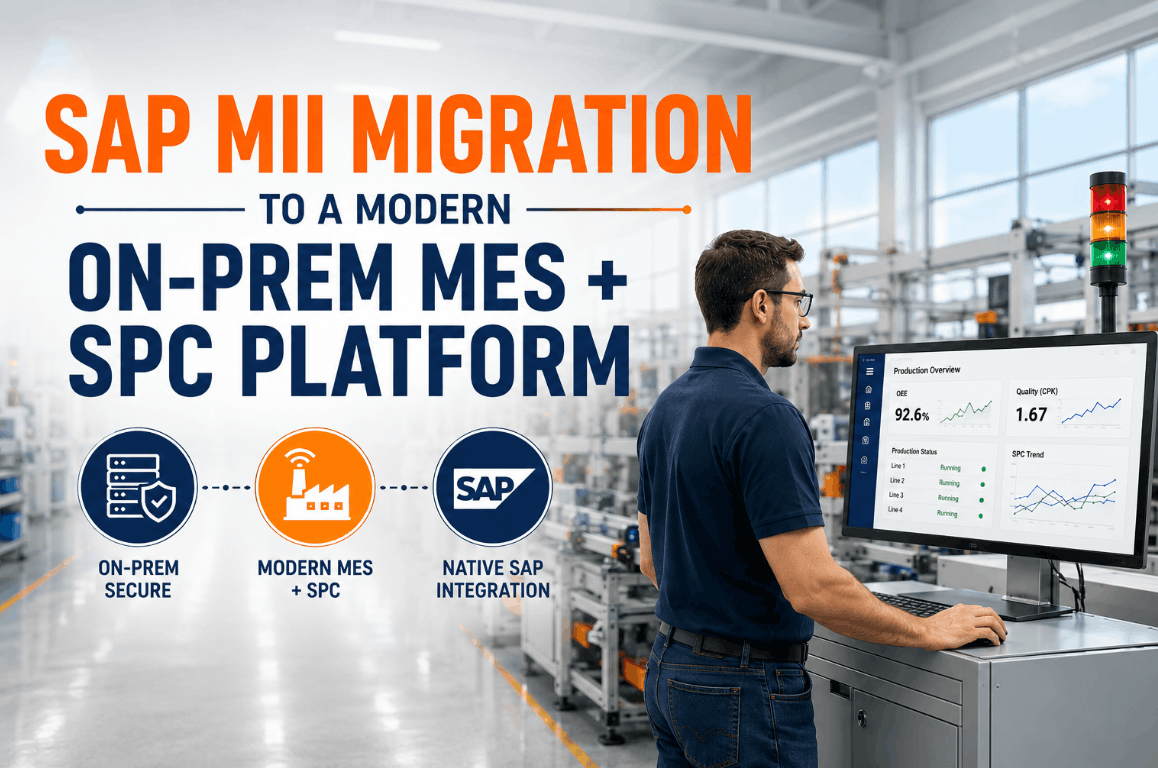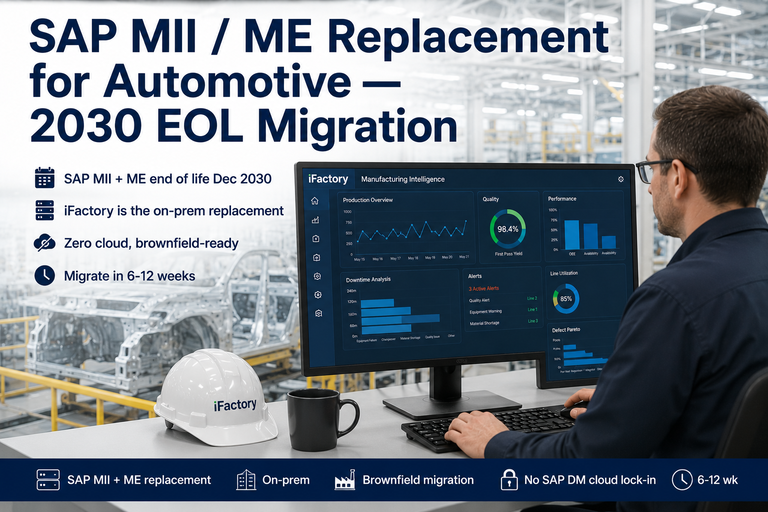
Most manufacturing plants running a legacy MES today didn't plan to be in this position. The system was deployed a decade or more ago, it worked well enough at the time, and the rip-and-replace math never penciled out cleanly enough to force a decision. Now the vendor support is thin or gone, the system runs on an unsupported .NET framework or VB6 codebase, operators have developed workarounds that bypass it entirely, and the IT team spends more time maintaining brittle integrations than delivering new capability. The problem is not that the old MES stopped working — it is that the plant stopped relying on it. iFactory's legacy MES replacement path addresses this directly: a MSMQ-based brownfield connector reads from the legacy system while iFactory takes over the write path — no rip-and-replace, no production disruption, and AI-driven SPC added natively from the first day of deployment. For manufacturing IT directors evaluating a replacement path without a multi-year re-implementation project, Book a Demo to see how iFactory connects to your current environment.
Replace Your Legacy MES Without a Rip-and-Replace Project
iFactory's MSMQ brownfield connector reads from your legacy MES while iFactory takes over the write path — on-prem AI SPC included from day one, no production disruption, no multi-year reimplementation.
Why Your Legacy MES Is Failing Silently — and Why Operators Stopped Trusting It
The standard narrative around legacy MES replacement focuses on technology risk — unsupported platforms, unpatched vulnerabilities, brittle ERP integrations. These are real problems. But the deeper operational failure is quieter and more corrosive: operators and process engineers have stopped using the system as the source of truth. They work around it. Shift supervisors keep their own spreadsheets. Quality engineers export raw CSV files and run their own analysis. Maintenance schedulers track work orders in a separate tool because the MES can't be trusted to reflect actual equipment state. This is the actual cost of a legacy MES — not just the IT maintenance burden, but the organizational detachment from a system that is supposed to be the shop floor's operational backbone. Replacing a legacy MES is not primarily a technology project. It is an operator trust project. The replacement platform has to be fast enough, clear enough, and accurate enough that operators choose to use it over their workarounds. iFactory's replacement path is designed around this reality — with modern operator interfaces, real-time data from existing PLC and historian connections, and AI-driven SPC that surfaces actionable signals rather than static control charts that nobody reads. Book a Demo to see the operator interface against your current MES screens.
- Batch-based data with 5–30 minute lag — quality decisions made on stale information
- Static SPC control charts with limits set at commissioning, never updated for grade or tooling changes
- Operator UI designed for desktop-only, 15 years ago — workarounds more common than intended workflow
- ERP integration maintained by one person, breaks on every adjacent system upgrade
- Vendor support reduced to quarterly email responses and no roadmap for new features
- Real-time data from existing PLC/SCADA connections via MSMQ bridge — no new sensors required
- AI-driven adaptive SPC recalibrates control limits per grade, tooling state, and shift condition
- Modern responsive operator UI — role-based screens built around actual workflow, not legacy architecture
- Native ERP integration via IDoc, RFC, OData — no custom ABAP, survives adjacent upgrades
- Active product roadmap with AI Copilot — features driven by process engineering requirements
How iFactory Reads the Legacy MES Without Disrupting Production
The technical risk that stops most legacy MES replacements is not the new platform — it is the transition period. If the replacement system goes live and the old system goes dark on the same day, any gap in functionality causes a production event. iFactory eliminates this risk with a MSMQ-based brownfield connector that establishes a read path from the legacy MES to iFactory before any production traffic is switched. The legacy system continues to operate as normal. iFactory receives the same data stream, builds context, and runs AI SPC in parallel. Once the parallel-run validation period confirms that iFactory's outputs match and exceed the legacy system's, the write path is switched over — production order confirmations, quality records, and SFC data flow through iFactory, and the legacy system transitions to a read-only archive. The cutover is a planned, low-risk maintenance window, not a day-zero gamble.
Legacy MES vs. Cloud MES vs. iFactory On-Prem — The Migration Choice That Actually Matters
Manufacturing IT directors evaluating legacy MES replacement typically face three paths: keep patching the legacy system, migrate to a cloud-native MES (which solves the technology debt problem but introduces data sovereignty and latency risks for shop-floor operations), or deploy a modern on-premises platform that preserves data control while delivering AI-native process intelligence. The table below maps the real-world tradeoffs across each path for brownfield manufacturing environments.
| Capability | Legacy MES (Keep Patching) | Cloud-Native MES | iFactory On-Prem |
|---|---|---|---|
| Data Latency | 5–30 min batch delays | Near-real-time (cloud round-trip) | Real-time (<1 sec, on-prem) |
| Data Sovereignty | On-prem (full control) | Cloud (limited control) | On-prem (full control) |
| SPC Capability | Static / rules-based | Static to limited adaptive | AI-driven adaptive SPC (native) |
| Brownfield Migration Path | No change needed (but no improvement) | Full rip-and-replace required | MSMQ bridge parallel-run — no disruption |
| ERP Integration | Custom, breaks on upgrades | Cloud API (new integration required) | IDoc, RFC, OData — no ABAP |
| Vendor Support Trajectory | Declining / EOL | Active (cloud-native roadmap) | Active (AI-native roadmap) |
| Deployment Timeline | N/A | 12–36 months | 6–12 weeks to first live output |
| AI Copilot | None | Roadmap / limited | Native (included) |
Why a Legacy MES Replacement Is the Right Moment to Add AI SPC
A legacy MES replacement is typically scoped as a like-for-like functional replacement — preserve production order execution, work instruction delivery, SFC tracking, and quality recording, then modernize the interface. This framing misses the highest-value capability that a modern platform can deliver and a legacy system never could: native AI-driven statistical process control that operates on the same data stream as execution, not as a bolt-on analytics layer requiring separate integration and maintenance. iFactory's AI SPC engine recalibrates control limits dynamically based on product grade, tooling condition, and process state — and it runs natively within the same platform handling ERP integration and operator execution. For manufacturing IT directors, this eliminates a second integration project and a second vendor relationship, while giving process engineers the adaptive process intelligence that static legacy SPC configurations were never designed to provide. Book a Demo to see how AI SPC maps to your current quality monitoring process.
How Much Is Your Legacy MES Costing You Per Year?
iFactory's manufacturing IT team will map your legacy MES integration points, identify the brownfield connector configuration for your environment, and model the total cost of continued legacy operation versus the iFactory replacement path — including AI SPC ROI projections from your current quality data. Book a Demo to begin.
The Legacy MES Replacement Decision Is a Data Architecture Decision
The plants that successfully replace their legacy MES are not the ones that find a way to justify a rip-and-replace project to the CFO. They are the ones that find a replacement path where the new platform can be proven against the existing system before production traffic is switched — and where the new capability is demonstrably better, not just technologically newer. A 14-year-old MES running on a dying codebase is a problem. But the larger problem is that process engineers and operators have already decided the system is not worth trusting. Recovering that trust requires a platform that delivers faster, more accurate, and more actionable intelligence than the workarounds they have built around the legacy system. iFactory's brownfield replacement path — MSMQ connector, parallel-run validation, AI SPC from day one — is designed around this operational reality. The technology transition is the easy part. The adoption transition is what the 12-week framework is built to solve.
Legacy MES Replacement — Frequently Asked Questions
iFactory's MSMQ brownfield connector installs in the plant network and taps the legacy MES data stream — production orders, SFC events, quality records — without modifying the legacy system's write path. The legacy system keeps running while iFactory builds context in parallel.
Yes. iFactory connects via OPC UA, Modbus, and native historian APIs (AVEVA PI, GE Proficy, Wonderware InSQL, Yokogawa Exaquantum) — all existing infrastructure. New sensors are not required for the brownfield deployment path.
Typically 4–8 weeks, depending on plant complexity and product mix. Cutover requires five consecutive production days with clean parallel-run data before the write path is switched on a planned maintenance window.
The legacy MES transitions to read-only archive mode. Historical quality records, production orders, and SFC data remain accessible for audit and regulatory purposes — nothing is deleted at cutover.
No. iFactory's operator UI is configurable to match existing workflow sequences without custom code. ERP integration uses standard IDoc, RFC, and OData — no ABAP development required on the ERP side.
Replace Your Legacy MES Without a Rip-and-Replace Project
iFactory's brownfield replacement path connects to your legacy system on day one, runs in parallel until operators and process engineers have adopted the new platform, and completes cutover on your schedule — with AI-driven SPC active from the first week.