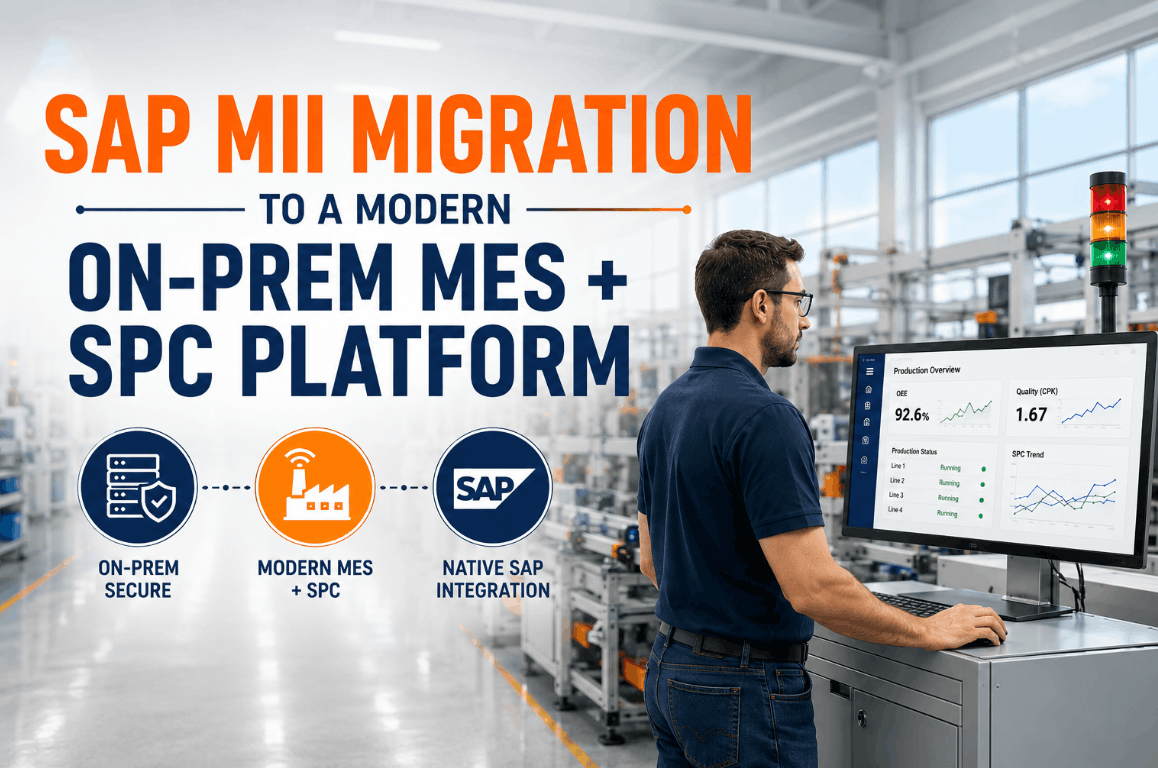
SAP MII Migration to a Modern On-Prem MES + SPC Platform
By Henry Green on June 10, 2026
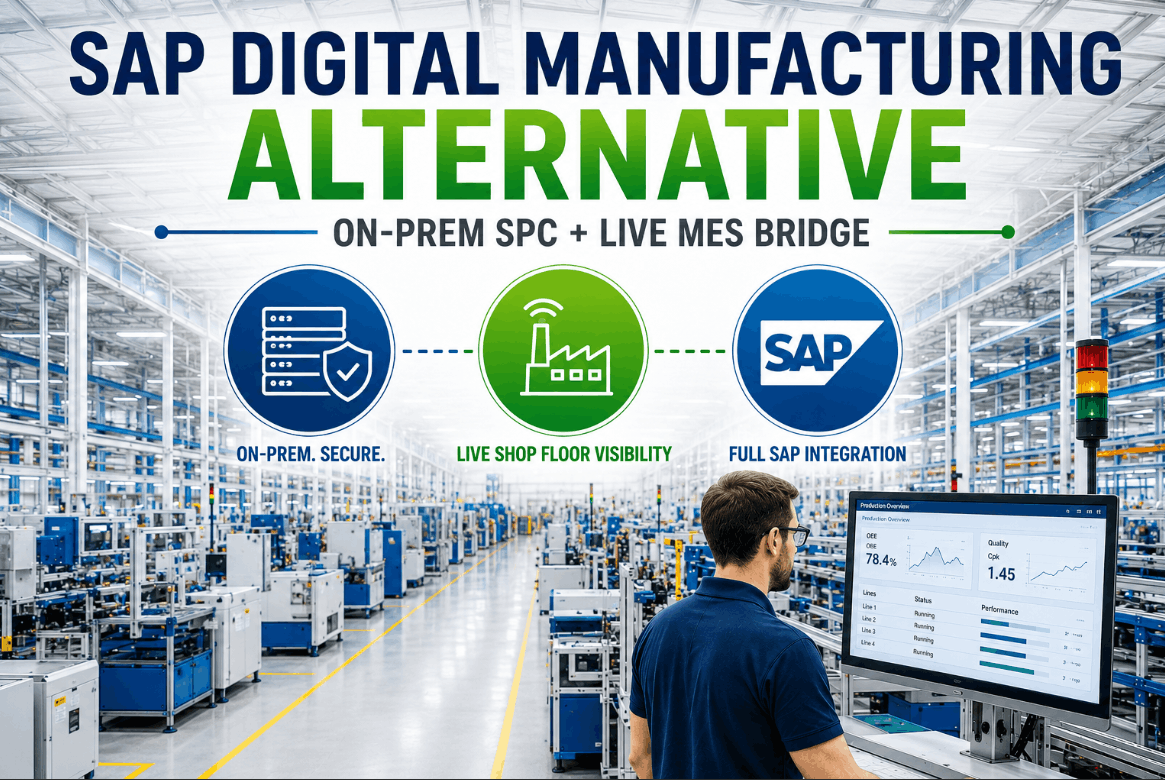
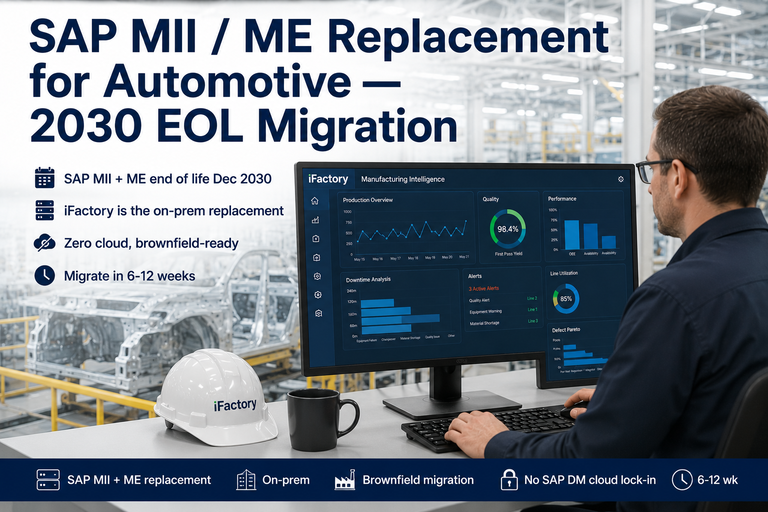
SAP MII's mainstream support ends December 31, 2027—with extended support running only through 2030 at a premium. For U.S. manufacturing plants running MII as the backbone of shop-floor ERP integration, this isn't a future problem. Migration programs take 12–36 months, which means the planning window is now. Most teams evaluating their path are choosing between SAP Digital Manufacturing Cloud (a cloud-first platform that carries new infrastructure debt) and a modern on-premises MES with native S/4HANA integration. iFactory's MII-to-iFactory migration path delivers a REST + IDoc + MSMQ bridge that mirrors the MII integration bus, with AI-driven SPC added natively—so you replace MII without re-architecting your entire ERP layer. To understand how iFactory maps to your current MII transaction inventory, Book a Demo with our integration engineering team.
SAP MII END OF LIFE
MII Support Is Ending. Your Migration Path Starts Here.
iFactory's on-prem MES + SPC platform mirrors the MII integration bus via REST, IDoc, and MSMQ—with S/4HANA-native connectivity and AI Copilot built in from day one.
2027Mainstream SAP MII support cutoff — migration programs run 12–36 months
61%of SAP ECC customers still face migration pressure — specialist rates rising 30–50% by 2027
4–12 wksTypical live use case delivery with iFactory vs. 12–24 months for full SAP DM rollouts
Zero ABAPiFactory integrates with S/4HANA and ECC via OData, RFC, and IDoc — no custom ABAP required
Why SAP MII Migration Is More Than a Technical Upgrade
The Risk Accumulating in Every Month of Delayed Planning
SAP MII became central to manufacturing operations over two decades precisely because it sat between the shop floor and the ERP. It handled production order downloads, OEE aggregation, SCADA integration, and operator-facing dashboards—often with substantial custom transaction logic built over years. When SAP announced end-of-life, the challenge became clear: this is not an upgrade. It is a platform replacement. The risk of delaying isn't just paying premium extended maintenance through 2030. It is entering a compressed migration window in 2028 or 2029 when integration specialists are overbooked, consulting rates are 30–50% higher, and your internal team has less runway to stabilize before the deadline. Plants that begin assessment in 2025–2026 complete migrations with time to harden. Plants that wait do not. If your MII transaction inventory hasn't been cataloged yet, Book a Demo to begin a structured readiness assessment with iFactory's migration engineers.
The 6 Hidden Risks in Every SAP MII Migration
What the Program Plan Needs to Account for Before Cutover
01
Undocumented Custom Transactions
Most MII environments have 40–120 custom transactions built over years with no formal documentation. These are the leading cause of migration delays—they surface mid-project when re-mapping is most disruptive.
02
IDoc and BAPI Interface Gaps
SAP ECC and S/4HANA integration via IDoc, BAPI, and RFC must be fully re-mapped on the new platform. Missed interfaces translate directly to broken production order confirmation or quality notification flows.
03
Change-Control Collision with S/4HANA Programs
Many plants are running concurrent S/4HANA upgrades. MII migration timelines that overlap with S/4 change freezes create compounded risk—integration dependencies need to be sequenced carefully across both programs.
04
Data Residency and On-Prem Constraints
Cloud-only replacement platforms like SAP DM create a structural problem for plants with regulatory data-residency requirements or OEM customer audit obligations that mandate on-premises data control.
05
Static SPC in a Dynamic Process Environment
MII's built-in SPC was rules-based and static. A modern replacement needs adaptive, AI-driven SPC that adjusts control limits dynamically based on product mix, tooling state, and shift conditions—not just replicate what MII had.
06
Historian and PLC Re-Integration Scope
Every PLC brand, SCADA system, and process historian connected to MII must be re-inventoried with firmware versions confirmed. Undocumented edge connections are the second-largest source of post-cutover failures.
How iFactory Mirrors the MII Integration Bus
The REST + IDoc + MSMQ Bridge Architecture That Eliminates Rework
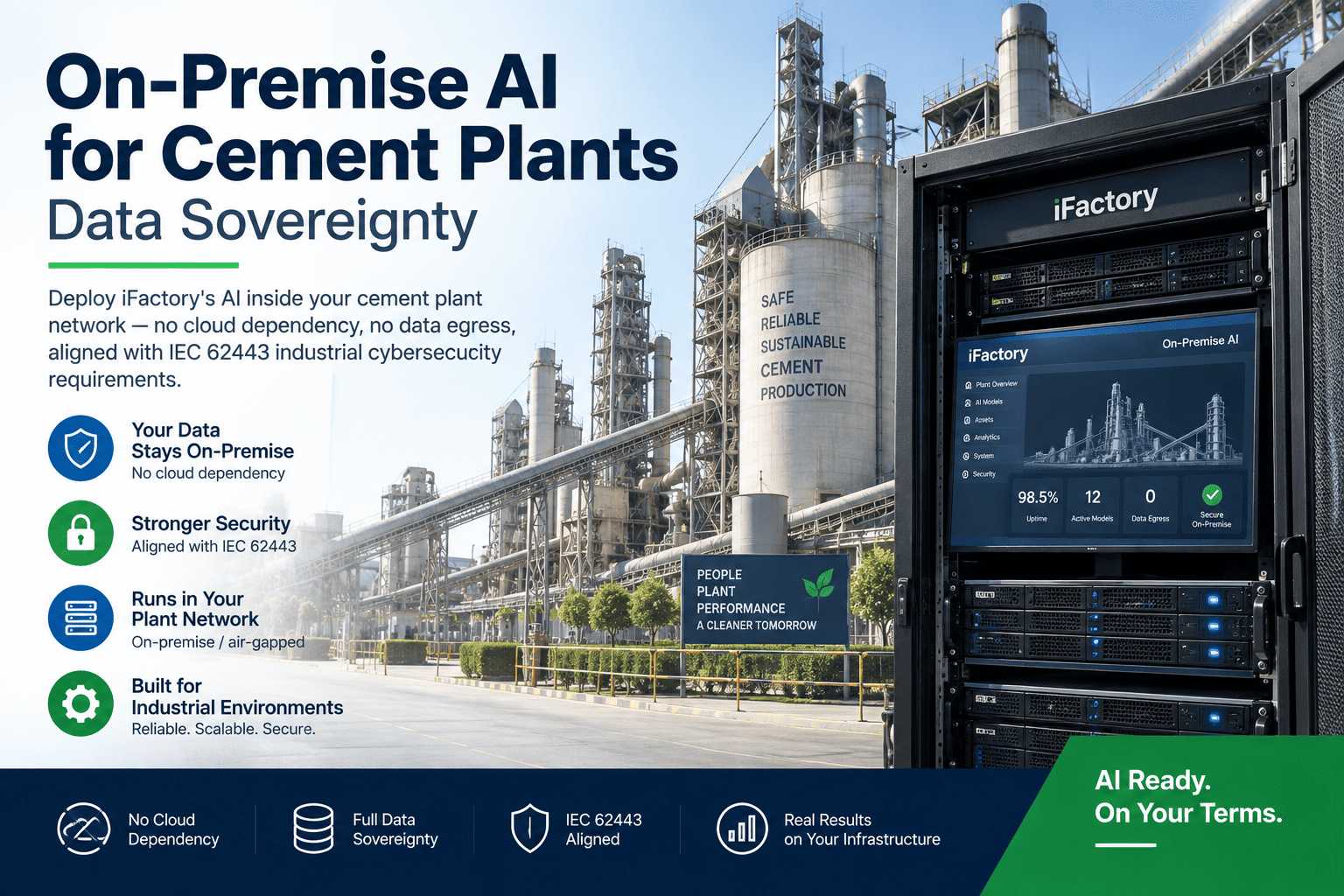
The core technical challenge in replacing MII is preserving the integration bus that connects shop-floor events to SAP ERP transactions. iFactory's migration path is built around a three-protocol bridge—REST for modern API-based integration, IDoc for SAP-native document exchange, and MSMQ for reliable message queuing in air-gapped or bandwidth-constrained plant environments. This mirrors how MII's integration layer operated, which means existing SAP transaction mappings can be preserved and re-pointed rather than rebuilt from scratch. S/4HANA connectivity uses OData and RFC without requiring custom ABAP, and iFactory runs on-premises on NVIDIA hardware behind your plant firewall—preserving full data sovereignty.
SAP MII (Legacy)
SAP DM Cloud
iFactory On-Prem
Deployment Model
On-premises (NetWeaver)
Cloud-only (BTP)
On-prem (NVIDIA hardware)
S/4HANA Integration
IDoc + BAPI (custom ABAP)
Native SAP-to-SAP
OData + RFC + IDoc (no ABAP)
SPC Capability
Static, rules-based
Static SPC paradigm
AI-driven adaptive SPC (native)
Data Residency
On-premises (full control)
Cloud (limited sovereignty)
On-premises (full sovereignty)
MII Bus Compatibility
Native
Requires full re-architecture
REST + IDoc + MSMQ bridge
Time to First Live Use Case
N/A
12–24 months
4–12 weeks
AI Copilot
None
Limited / roadmap
Native (baked in)
The iFactory MII Migration Roadmap
A Structured 5-Phase Path from MII Assessment to Full Cutover
Phase 1
MII Transaction & Integration Inventory (Weeks 1–4)
Catalog every custom transaction, IDoc/BAPI interface, PLC connection, and historian integration. Identify undocumented data flows. Establish the complete scope before architecture decisions are locked. Most missed integrations surface here—not during cutover.
Phase 2
Integration Bridge Configuration (Weeks 5–10)
Deploy iFactory's REST + IDoc + MSMQ bridge alongside the live MII environment. Re-point ERP interfaces to iFactory without disrupting active production. Validate S/4HANA OData and RFC connections in parallel with existing MII transactions.
Phase 3
Operator UI and Dashboard Migration (Weeks 8–16)
Rebuild MII operator dashboards and supervisor views in iFactory's modern UI layer. Migrate role-based screen configurations. Validate against existing MII dashboard logic to confirm functional parity before user acceptance testing.
Phase 4
AI SPC Activation and Baseline Calibration (Weeks 12–18)
Activate iFactory's AI-driven SPC on critical process lines. Establish adaptive control limit baselines using historical MII process data. Configure SPC by product grade, tooling state, and shift profile—replacing MII's static rules-based approach with dynamic intelligence. Book a Demo to see AI SPC in action on your process.
Phase 5
Parallel Run, UAT, and Final MII Decommission (Weeks 16–24+)
Run iFactory and MII in parallel on a defined set of production lines. Execute user acceptance testing against the MII baseline. Confirm all ERP confirmations, quality records, and OEE reporting match expected outputs before completing the final decommission of MII.
Migration Cost and Risk Profile by Plant Type
How Complexity, Integration Depth, and Data Residency Requirements Drive the Business Case
Plant Profile
MII Complexity
Primary Migration Risk
Recommended Path
Est. Timeline
Single-site, ECC-integrated
Moderate
Undocumented custom transactions
iFactory on-prem, direct ECC IDoc bridge
4–8 months
Multi-site, S/4HANA rollout in progress
High
Change-control collision with S/4HANA program
Hybrid: S/4HANA-native ERP, iFactory for analytics and SPC
10–18 months
Regulated mfg. (pharma, defense, food)
High
Data residency + audit trail continuity
iFactory on-prem (full data sovereignty, behind firewall)
8–14 months
Greenfield / post-acquisition plant
Low
No existing MII logic to preserve
iFactory direct deployment, S/4HANA OData integration
4–12 weeks
Enterprise multi-site with deep MII customization
Very High
100+ custom transactions, multiple historians
Phased site-by-site migration with iFactory MII bridge layer
18–36 months
Why AI SPC Must Be Native, Not Bolted On
The Limitation of Migrating to a Platform That Still Uses Static Control Charts
MII's SPC capability was functional for its era—static Shewhart control charts with fixed control limits set at commissioning and updated manually during annual reviews. In a modern manufacturing environment with variable product mixes, frequent grade changes, and multi-variable process interactions, static SPC generates excessive false alarms on tight products and misses genuine drift on stable ones. The migration from MII is the correct moment to close this gap—not to replicate it on a newer platform. iFactory's AI SPC engine recalibrates control limits dynamically based on current process state, product grade, tooling age, and shift pattern. It operates natively within the same platform handling ERP integration and shop-floor execution—not as a separate analytics layer requiring additional integration. This eliminates the data latency and interface maintenance burden that comes with bolt-on SPC solutions.
Adaptive Control Limits
Control limits recalibrate in real time based on product grade, tooling condition, and process state—eliminating the false alarms and missed drift that plague static MII-era SPC configurations.
Real-Time Cpk Monitoring
Process capability indices update continuously across every critical dimension—not in the hourly or shift-level batches that MII's reporting architecture supported.
Drift Prediction and Early Warning
AI Copilot identifies multivariate drift patterns 4–8 process cycles before a conventional control chart would flag a violation—enabling correction before scrap is produced.
Grade-Based SPC Recipes
SPC configurations load automatically at grade changeover from S/4HANA production order data—no manual limit adjustments by operators between product families.
"We had over 90 custom MII transactions, many of them completely undocumented. The iFactory migration team cataloged every one in the first four weeks, then rebuilt the integration layer with the REST and IDoc bridge running in parallel to MII. We ran both systems simultaneously for six weeks with zero production disruption, then cut over. The AI SPC alone has reduced our false alarm rate by 60% compared to the static control charts we had in MII."
MES & Integration LeadTier-1 Automotive Supplier, Midwest USA
Frequently Asked Questions
When does SAP MII actually lose support?
Mainstream maintenance ends December 31, 2027. Extended (premium-cost) support runs through approximately December 2030, after which the platform is fully unsupported with no security fixes or functional updates delivered.
Does iFactory replace the MII integration bus or require re-architecture?
iFactory mirrors the MII integration bus via a REST + IDoc + MSMQ bridge—existing SAP transaction mappings are preserved and re-pointed, not rebuilt. Native OData and RFC integration with S/4HANA requires no custom ABAP.
Can iFactory run on-premises for plants with data residency requirements?
Yes. iFactory runs on NVIDIA on-premises hardware behind your plant firewall with no public internet connectivity required—fully preserving data sovereignty for regulated environments including pharma, defense, and food manufacturing.
How long does an MII-to-iFactory migration take?
Scope drives timeline: single-site with moderate MII complexity typically runs 4–8 months; large multi-site enterprises with deep customization run 18–36 months. iFactory delivers first live use cases in 4–12 weeks regardless of total program length.
What makes iFactory's SPC better than what MII had?
MII used static Shewhart control charts with manually updated limits. iFactory's AI SPC recalibrates limits dynamically by product grade, tooling state, and process condition—reducing false alarms and catching genuine drift earlier.
START YOUR MII MIGRATION ASSESSMENT
Get a Structured MII Migration Readiness Review
Our integration engineering team will catalog your MII transaction inventory, map your IDoc and BAPI interfaces to iFactory's bridge architecture, and deliver a structured migration timeline with ROI analysis—before you commit to a platform decision.