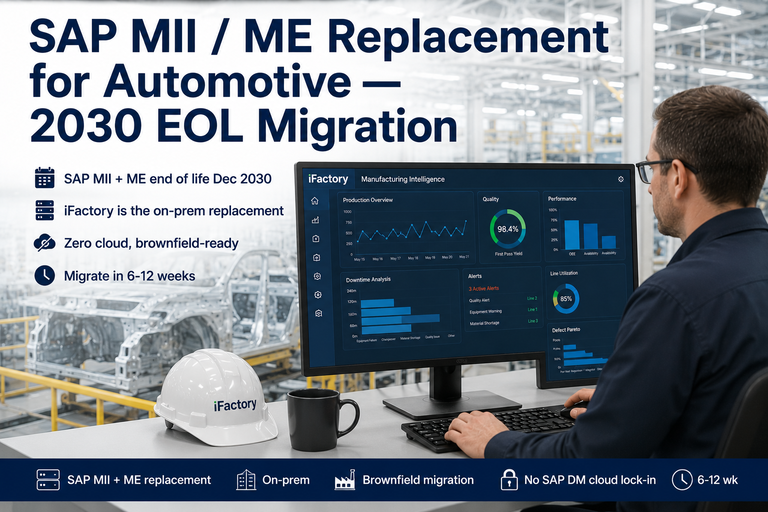
SAP MII / ME Replacement for Automotive — 2030 EOL Migration | iFactoryAi
By Larry Eilson on May 26, 2026
Inside the paint shop of a Tier 1 automotive supplier feeding three OEM assembly lines, the production supervisor watches the humidity and temperature readings scroll across the booth control panel — 22.0 °C, 55% RH. The numbers look stable. The paint robot applies coat after coat with mechanical precision. But what the supervisor cannot see from the control panel is the micro-drift in booth humidity that started 14 hours ago — 0.3% per hour, invisible to the operator, invisible to the hourly SPC check, expensive enough to cost this plant roughly $12,000 per shift in rework and scrap when the defect finally appears at the end-of-line inspection. Multiply that across a 6-plant network serving three different OEM platforms, across a year, across all the small drifts that the existing SAP MII reporting layer was never designed to catch in real time, and the number becomes a boardroom problem. For the manufacturing executive running operations across an Automotive portfolio, 2026 is the year that "uncomfortable" turns into "decision required" — because the SAP MII platform that has been the production reporting backbone for two decades is being sunset, and the replacement choices in front of you are not equal. This page is a head-to-head read of where iFactory fits against SAP MII and SAP DM for Automotive — written for the executive who has to make the call.
Automotive · SAP MII Alternative · 2026
The AI-Native Successor to SAP MII for Automotive.
SAP MII is sunsetting. The replacement question isn't binary. For Automotive executives running multi-plant paint, body, assembly, and powertrain operations — here's how iFactory's on-premise AI-native intelligence layer compares to SAP MII, SAP DM, and the do-nothing path. With the ROI math, side-by-side capability map, and decision framework.
First-pass yield target for automotive production lines
6–12 wk
iFactory turnkey on-prem deployment per plant
The Executive Decision Window Is Closing
SAP MII reaches end of mainstream maintenance on December 31, 2027. Premium extended support runs through roughly December 2030 — at premium pricing, with no new features and a shrinking pool of qualified MII engineers. For an Automotive executive, three options are on the table. Each has a different cost, timeline, and operational ceiling. The least-decided option — keep running MII and revisit later — is the one that gets more expensive every quarter from here.
Option A
Migrate to SAP Digital Manufacturing
SAP-recommended path. Cloud-first, BTP-hosted, ProdCon at the edge.
Best when SAP-centric IT mandate, S/4HANA migration in flight, cloud-first corporate strategy
Strength Native SAP integration, ERP alignment, cloud-managed configuration
Gap AI-native vision, predictive SPC, paint defect detection, condition monitoring not deeply native
On-premise NVIDIA appliance or managed cloud. Reads from existing MII / DCS / PLCs / vision systems.
Best when AI-native capability is the priority, on-prem data sovereignty matters, fast time-to-value is needed
Strength Predictive SPC, paint defect detection, condition monitoring, vision inspection — natively in the platform
Gap Not a replacement for ERP-side workflows — works alongside, not instead
Timeline 6–12 weeks per plant
Cost Hardware + license + managed service — typically pays back in months
Option C
Stay on SAP MII / Extended Support
Continue running MII through extended maintenance to ~2030.
Best when No internal capacity for migration, MII handles only basic reporting
Strength No migration cost in current budget cycle
Gap Premium pricing, no new features, technical debt accumulates, shrinking engineering pool
Timeline 4-year deferral
Cost Premium extended support fees + growing operational risk
Most Automotive executives we work with end up running Option A and Option B in parallel — SAP DM for ERP-side workflows, iFactory for AI-native operations intelligence. Walk an executive briefing with our team and we'll map your specific plant, current MII footprint, and 24-month roadmap.
The Capability Map — iFactory vs SAP MII, Head to Head
SAP MII was designed in the early 2000s as an integration-and-intelligence layer that bridged SAP business processes to plant-floor data. It does that job well. What it was not designed to do is real-time predictive SPC, AI vision inspection, paint defect detection, condition-based monitoring, or operator AI guidance — capabilities that today's Automotive operations require to hit first-pass yield and OEE targets. Below is the head-to-head, by capability.
Capability
SAP MII
SAP Digital Manufacturing
iFactory AI
Predictive SPC with adaptive limits
Basic control charts
Configurable, manual tuning
Native · LSTM forecasting · 24-hr lookahead
Paint defect detection & classification
Not supported
Not deeply native
Native · NVIDIA-accelerated · real-time AI vision
Vibration / condition monitoring
Not native — integration only
Not native — integration only
Native · 1-sec sampling · anomaly scoring
AI vision inspection
Not supported
Not deeply native
Native · NVIDIA-accelerated · on-prem
Operator AI assistant
None
None
Native · suggested-action overlays
Multi-plant rollup
Manual configuration
Cloud-native
Hybrid · on-prem nodes + corporate dashboard
PLC / robot controller integration
OLE DB / OPC
OPC UA via ProdCon
Native · plus 12 other industrial protocol adapters
Edge AI processing
No
Cloud-only by design
NVIDIA on-prem appliance · sub-second decisions
Time to value
3–6 months reporting
12–24 months fleet-wide
6–12 weeks per plant
Data sovereignty (on-premise)
On-prem available
Cloud-first architecture
On-prem standard · cloud optional
IATF 16949 / VDA 6.3 alignment
Customer-implemented
Customer-implemented
On-prem + documented controls
Roadmap status
EOL Dec 2027 / ~2030
Active
Active · AI-native roadmap
Where the Money Actually Is — The Automotive Loss Math
The capability map is one way to look at the decision. The other is to look at where money actually leaks out of an automotive plant today — and which of those losses the existing SAP MII reporting layer can catch in time to act. The answer, for most plants, is: not enough of them. Below is the loss-cost stack that executives actually see in board reports, mapped against what the data layer needs to do to surface each one.
Where the Lost Revenue Sits in a Typical Automotive Plant
Paint Rework & Scrap
Paint defects — dirt, runs, sags, orange peel, blisters — account for 40–60% of all rework costs in automotive assembly. Each percentage point of first-pass yield improvement in the paint shop is worth $2–5M annually at a typical 300,000-vehicle-per-year plant.
$2–5M / 1 pt
Welding & Joining Defects
Weld porosity, incomplete fusion, and spatter on body-in-white lines drive rework loops, structural repair, and line stoppages. A 1% reduction in weld defect rate on a high-volume line saves roughly $1.5–3M annually in repair labor and material.
$1.5–3M / 1%
Line Stoppages & OEE Loss
Unplanned downtime on a 60-JPH assembly line costs $20K–$50K per hour in lost production. Condition monitoring with predictive SPC typically reduces unplanned stoppage time by 20–40% on critical transfer lines and robot cells.
$20K–$50K / hr
Powertrain Machining Scrap
Cylinder head, block, and transmission case machining — tool wear, spindle drift, coolant temperature excursions — generate scrap rates of 2–5% on typical lines. Predictive SPC on spindle load and vibration catches tool wear 2–4 hours before a crash.
$1–3M / 1% scrap
Warranty Returns
Post-shipment defects caught at final inspection or in-field cost 10–100x more than those caught in-process. A 10% reduction in warranty-returned assemblies through in-line AI vision and process SPC saves $5–15M annually for a Tier 1 supplier.
$5–15M
Maintenance Inefficiency
Calendar-based preventive maintenance on robot cells, conveyor systems, and paint booths wastes 30–40% of maintenance spend on parts replaced before end-of-useful-life. Condition-based maintenance driven by live SPC moves the budget toward the assets that actually need it.
30–40% recoverable
The MII Migration Is Real. The AI-Native Upgrade Is Optional. Choose Both.
SAP MII is leaving. SAP DM handles the ERP-side workflows well. iFactory delivers the AI-native production intelligence that neither was designed to deliver — predictive SPC, paint defect detection, condition monitoring, vision inspection. On-prem NVIDIA appliance, 6 to 12 weeks per plant, pays back inside the budget cycle.
What Predictive SPC Looks Like on an Automotive Paint Booth
The single biggest capability gap between MII and an AI-native platform is what happens on the SPC chart. MII shows you a Shewhart chart after the parameter has already breached its control limit. Predictive SPC catches the same parameter 24 hours earlier — by forecasting the trajectory, applying Western Electric rule patterns, and zoning the chart into Safe, Warning, and Critical regions before the breach. The math is the same. The intelligence layer on top is what changes.
What MII shows: The current point. If it's inside the control limits, no alarm. If it breaches, an alarm — but you're already in the excursion.
What iFactory adds: A 24-hour forward forecast with confidence bands. SPC zoning (Safe / Warning / Critical). Western Electric rule pattern detection (1-of-1, 2-of-3, 4-of-5, 8-in-a-row). Cross-parameter correlation that catches the upstream cause before the downstream defect appears.
What the operator sees: The chart above, with a suggested action — "Booth humidity trending up over last 6 hours · HVAC dehumidifier valve response delayed · check valve actuator before next shift change." Andon overlay. One-tap acknowledge. Maintenance work order auto-generated if not actioned in 30 minutes.
The Six Automotive Use Cases iFactory Solves Day One
01
Paint Defect Prediction & Prevention
Live SPC on booth temperature, humidity, airflow velocity, and paint viscosity. Predictive model flags drift toward defect zones 12–24 hours before first-pass yield drops. Cross-parameter correlation catches upstream cause — HVAC, supply air, or paint mix.
02
Body-in-White Weld Quality Monitoring
Weld current, voltage, wire feed speed, and gas flow continuously SPC-charted with adaptive limits. Predictive alarms 2–4 hours before weld porosity or incomplete fusion appears in ultrasonic inspection. Robot cell condition monitoring included.
03
Powertrain Machining & Tool Wear
Spindle load, vibration, coolant temperature, and feed rate on CNC lines. SPC catches tool wear trajectory 2–4 hours before a crash or surface-finish deviation. Tool life optimized to actual condition, not calendar schedule.
04
Assembly Line OEE & Stoppage Prediction
Cycle time, conveyor speed, pick-and-place robot position, torque tool data on every station. SPC detects micro-stoppages and cycle-time drift before they compound into line-wide downtime. Operator AI guidance for root cause resolution.
05
In-Line AI Vision Inspection
NVIDIA-accelerated vision models inspect every part at line speed — paint defects, weld quality, surface finish, dimensional accuracy. Defects classified and flagged to upstream SPC model for root cause traceability. No separate inspection station required.
06
Supplier Quality & Incoming Parts Monitoring
Incoming part dimensions, hardness, surface condition continuously SPC-charted against supplier specifications. Drift flagged before it hits the assembly line. Supplier corrective action triggered automatically with data evidence package.
The 30-60-90 Executive Timeline
For an Automotive executive evaluating where iFactory fits in the next budget cycle, the realistic timeline runs 30-60-90 days from first conversation to first plant live. Below is what each window looks like in practice.
Days 1–30
Executive Briefing & Scope
Architecture walkthrough with operations and IT leadership. Current SAP MII footprint inventory. Pilot line selection — typically paint shop or body-in-white. Tag library review against existing PLC, robot controller, and vision system data sources. Commercial proposal with capex, opex, and ROI model tied to your specific plant baseline.
Days 31–60
Pilot Line Deployment
NVIDIA on-prem appliance shipped pre-loaded. Field techs connect to plant network, integrate with PLCs, robot controllers, vision systems, MII as parallel data sources. SPC models trained on 90 days of historical data. Paint defect baseline established. Andon screens deployed at line-side.
Days 61–90
Pilot Validation & Fleet Rollout Plan
Pilot line goes live with predictive SPC on critical loops, condition monitoring on robot cells and conveyors, AI vision on paint inspection. First 30-day post-go-live review with quantified first-pass yield, OEE, and defect reduction gains. Fleet rollout schedule locked — typically 2–3 plants per quarter.
Where the ROI Comes From — Built for Automotive Economics
Paint first-pass yield
$2–5M
Per plant, per year, from 1–2 percentage point improvement through live SPC and AI vision on paint booth parameters
Weld defect reduction
$1.5–3M
Per body-in-white line, per year, from 1% reduction in weld defects through predictive SPC on weld parameters
Line stoppage reduction
$2–5M
Per assembly line, per year, from 20–40% reduction in unplanned downtime through condition-based monitoring
Machining scrap reduction
$1–3M
Per powertrain line, per year, from 1% scrap reduction through tool wear prediction and spindle condition monitoring
Warranty cost reduction
$5–15M
Per Tier 1 supplier, per year, from 10% reduction in warranty returns through in-line AI vision and process SPC
Time to value
6–12 wk
Per plant from order to live floor — payback typically inside the first 12 months of operation
Why Manufacturing Executives Choose iFactory Over SAP MII
A
Built AI-native, not retrofitted
SAP MII was designed as an integration layer in the early 2000s. SAP DM adds cloud modernization. Neither was built ground-up for predictive SPC, AI vision inspection, paint defect detection, condition monitoring, or operator AI guidance. iFactory was.
B
On-premise NVIDIA edge — your data stays on plant
Critical for IATF 16949 and VDA 6.3 alignment, data sovereignty, IP-sensitive operations, and air-gap-capable environments. All AI processing happens on-site. No cloud round-trip. No data egress.
C
Layers above your existing stack
Reads from PLCs, robot controllers, vision systems, SAP MII, DCS, plant historians as parallel data sources. No rip-and-replace. No conflict with your existing automation vendors. The migration path stays under your control.
D
6 to 12 weeks per plant — not 18 months
Turnkey hardware-plus-software appliance ships pre-loaded. Field integration handled by our team. Pilot in 30 days, plant live in 90. Fleet rollout at 2–3 plants per quarter after first pilot stabilizes.
E
Operator-first UI, not engineer-first
Line-side operators see the loop, the loss, the suggested action — in two taps. Continuous-improvement engineers get the full analytical layer. Both layers built from the same data spine.
F
24×7 managed service included
Remote monitoring, monthly model retraining, quarterly performance review with your plant manager, 99.9% uptime SLA. We handle cabling, network setup, PLC tap-in, training. Your team runs production.
Frequently Asked Questions
Is iFactory a replacement for SAP MII or a complement to it?
It's a complement, not a replacement. SAP MII (and its successor SAP DM) handles the ERP-side workflows — work orders, batch records, production declaration, integration with SAP S/4HANA, ERP-linked dashboards. iFactory handles the AI-native production intelligence layer — predictive SPC, paint defect detection, condition monitoring, AI vision inspection, operator AI guidance — that neither MII nor DM was designed to deliver natively. Most Automotive customers run them side by side, with iFactory reading from MII/DM as a parallel data source and adding the analytical layer on top. As MII sunsets through 2027–2030, customers either migrate the ERP-side workflows to SAP DM or move them elsewhere, while iFactory stays in place as the operations intelligence layer.
Does iFactory work with our existing PLCs, robot controllers, and vision systems?
Yes. We connect natively to Siemens S7, Allen-Bradley ControlLogix, Mitsubishi, Beckhoff, and most major PLC families via OPC UA, OPC DA, and vendor-specific protocols. Robot controller integration covers Fanuc, KUKA, ABB, Yaskawa, and Kawasaki — reading weld parameters, position data, and diagnostic codes. Vision system integration