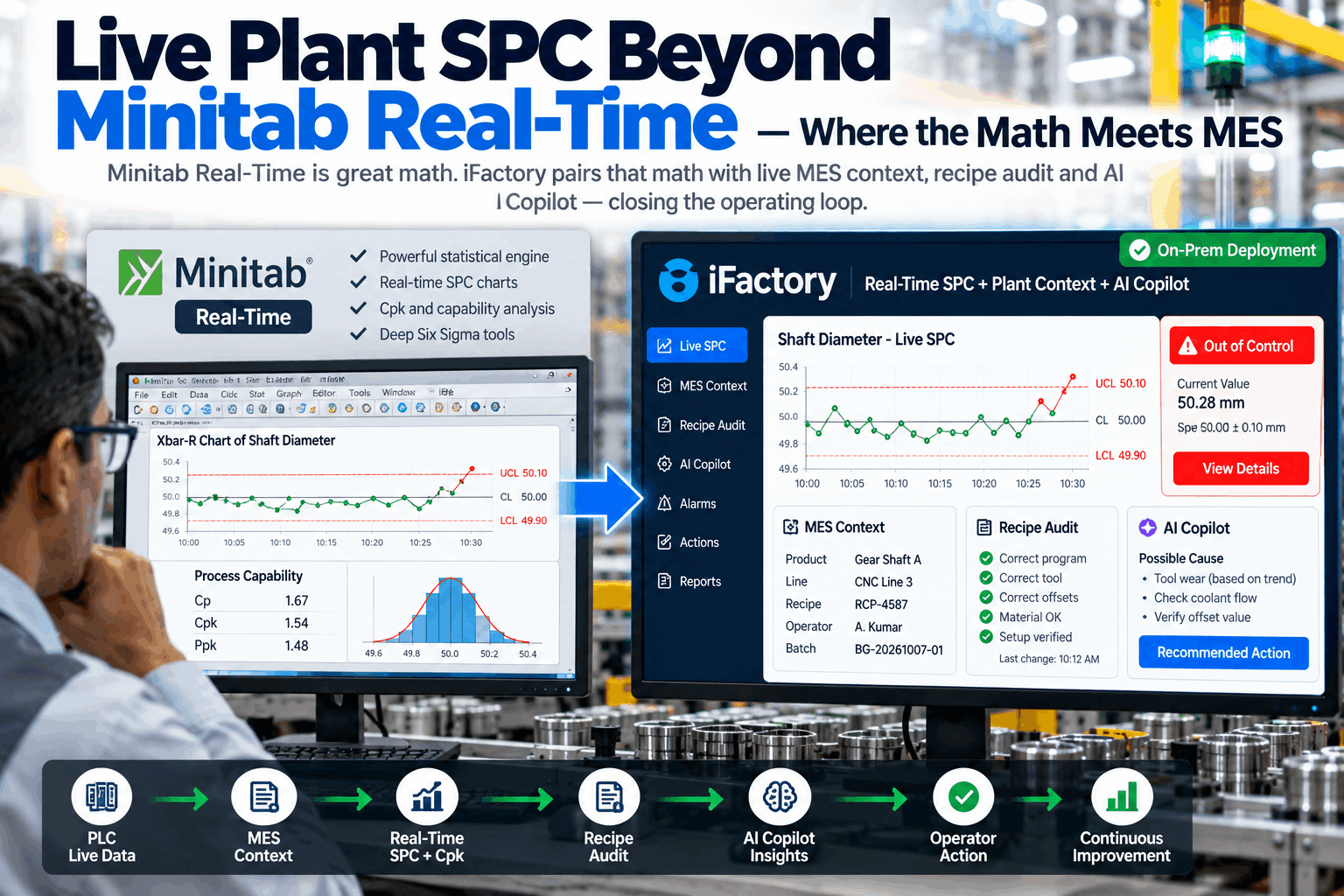
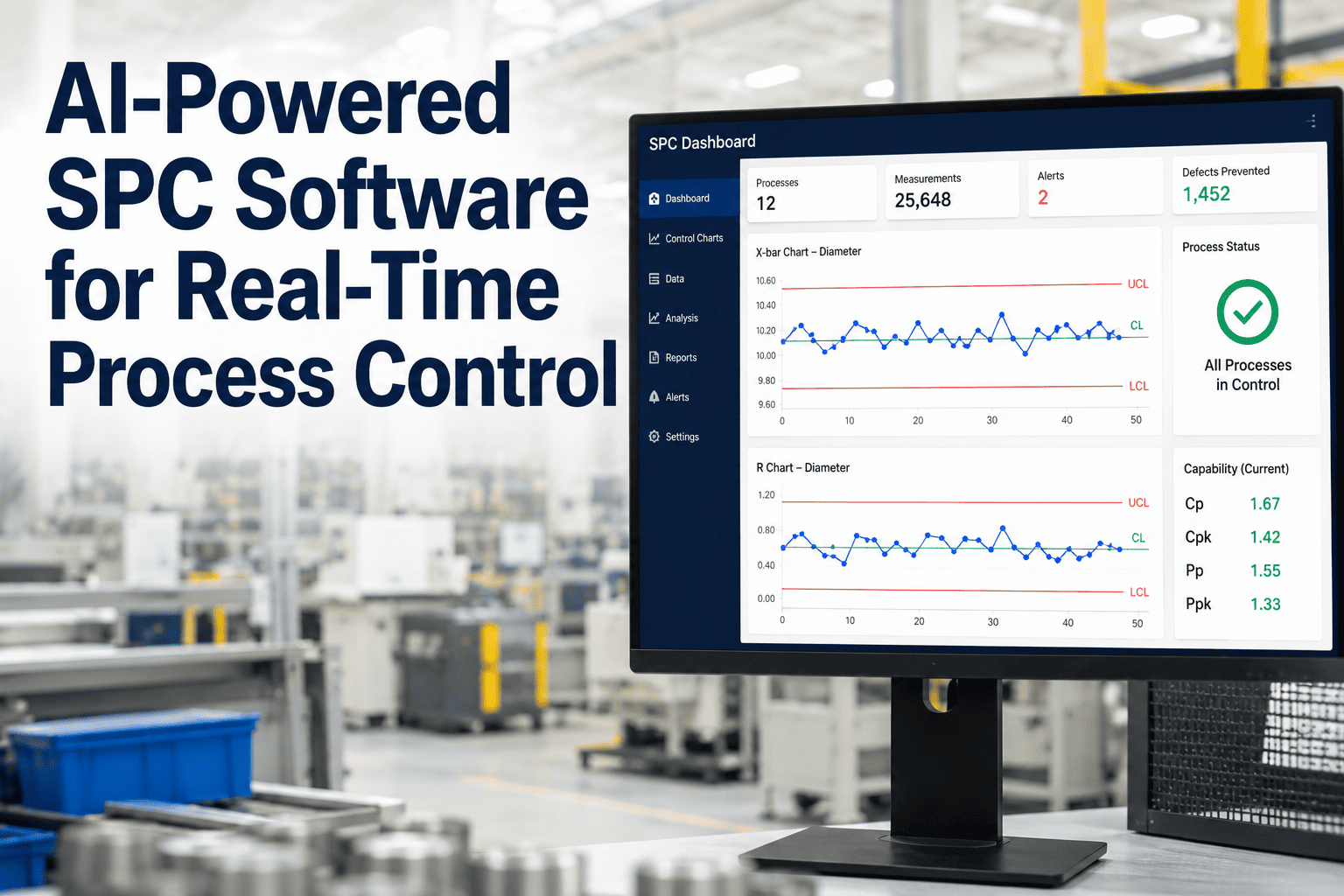
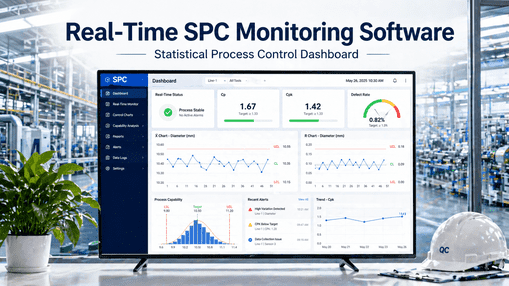
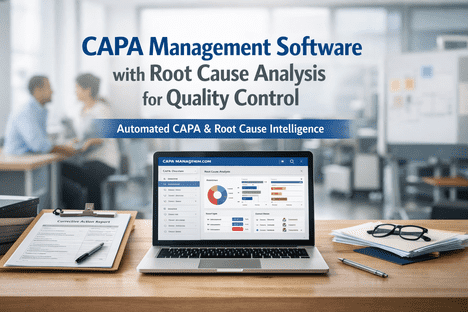
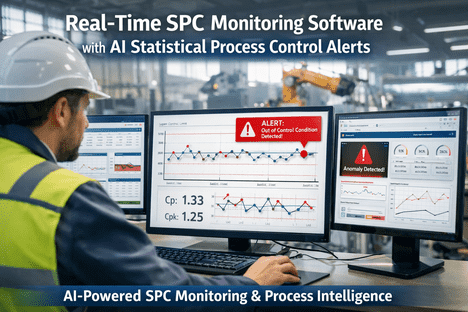
Classic SPC platforms — InfinityQS, WinSPC, and Wonderware QI Analyst — were engineered to do one thing exceptionally well: generate control charts and surface process variation. In isolated quality lab environments, they delivered real value. But U.S. manufacturing floors in 2026 are not isolated environments. They run SAP for production orders, MES systems for work-in-process tracking, PLCs for machine data, and increasingly, AI-driven analytics for predictive quality decisions. When your SPC platform cannot talk to any of those systems in real time, the control chart becomes a historical document rather than a live intervention tool — and the variation it finally surfaces has already cost you scrap, rework, and customer escapes. iFactory's modern SPC platform delivers the full statistical toolkit your quality engineers rely on — Xbar-R, Xbar-S, I-MR, P, NP, C, U charts, Cpk, Ppk, Western Electric rules — natively integrated with your MES, SAP, and PLC stack, with an AI Copilot that converts raw SPC signals into prioritized corrective actions. Quality platform owners evaluating a Book a Demo for iFactory consistently report the same finding: the charts are comparable to legacy tools on day one, and the integration stack and AI layer deliver capabilities their current platform cannot replicate at any configuration level.
Why Quality Platform Owners Are Moving Away from Legacy SPC Tools in 2026
The case for switching from InfinityQS, WinSPC, or Wonderware QI Analyst is rarely about the charts themselves. Those platforms chart well. The case is about what happens after the chart fires an out-of-control signal — and whether your SPC platform can do anything with it beyond logging it in a database that nobody queries until the customer complaint arrives. In U.S. manufacturing, the quality management function has shifted from passive monitoring to active intervention. That shift requires SPC software capable of pulling live production context from your MES, correlating OOC signals with SAP work orders and BOM revisions, reading PLC parameter data at the moment of variation, and recommending corrective action with enough specificity that a line operator can act on it without escalating to engineering. Legacy SPC tools were not architected for that workflow. Their data models are chart-centric, not process-centric. Their integration layers were built for periodic file imports, not live system handshakes. And their analytical logic stops at the control limit — it does not continue to root cause, work order, or action queue.
The result is a capability gap that compounds as manufacturing complexity increases. For a quality platform owner managing multiple product families, multiple production lines, and a SAP S/4HANA environment pushing material and production order data in real time, a standalone SPC tool creates a disconnected quality silo — one that produces accurate charts and accurate Cpk values while remaining invisible to every other system making production decisions. iFactory was built to close that gap. The platform delivers full-spectrum SPC analytics in a native integration architecture that connects directly to the systems your floor already runs.
InfinityQS vs. WinSPC vs. Wonderware QI vs. iFactory: Where the Gaps Are
The comparison below is not about which platform draws a better Xbar-R chart. At the SPC chart level, the leading legacy tools are functionally equivalent and competent. The comparison is about what the platform does with quality data once it is collected — and whether it can participate as a live actor in a connected manufacturing IT architecture.
| Capability | InfinityQS | WinSPC | Wonderware QI | iFactory |
|---|---|---|---|---|
| Control Charts (Xbar-R, I-MR, P, NP, C, U) | ✓ Full | ✓ Full | ✓ Full | ✓ Full |
| Cpk / Ppk / Process Capability Indices | ✓ Full | ✓ Full | ✓ Full | ✓ Full |
| Western Electric Run Rules (All 8) | ✓ Full | ✓ Full | Partial | ✓ Full |
| Live MES Integration (real-time, bidirectional) | Limited / middleware required | Limited / custom build | AVEVA ecosystem only | ✓ Native connector |
| SAP S/4HANA Live Integration | File-based / periodic sync | File-based / batch | Not supported | ✓ Native SAP connector |
| PLC / OPC-UA Data Ingestion | Via middleware | Via middleware | AVEVA stack only | ✓ Direct OPC-UA |
| AI Copilot — OOC to Corrective Action | Not available | Not available | Not available | ✓ Built-in |
| On-Premises Deployment (air-gapped) | ProFicient (on-prem) | ✓ On-prem | ✓ On-prem | ✓ On-prem + cloud |
| Multi-Plant Rollup Dashboards | Cloud tier only | Limited | Limited | ✓ All tiers |
| Mobile Operator Interface | Limited | Web interface | Limited | ✓ Responsive / native mobile |
The Four Capabilities Legacy SPC Tools Cannot Deliver — and iFactory Does
The limitations of InfinityQS, WinSPC, and Wonderware QI are structural, not configurational. They are not missing features that a consulting engagement or a custom integration project can fully close. They reflect architectural decisions made when these platforms were originally designed — before MES systems became the operational backbone of the floor, before SAP moved to real-time production order management, and before AI-based root cause analysis became a viable quality engineering tool. The four capability gaps below are the ones quality platform owners consistently identify as the primary drivers of their evaluation.
Live MES, SAP, and PLC Integration Without Middleware
InfinityQS and WinSPC both advertise integration capabilities, but in practice, those integrations are batch-based file transfers or require a custom middleware layer that must be maintained separately from the SPC platform itself. When a production order changes in SAP, the SPC system does not know until the next scheduled sync. When a PLC parameter shifts outside its target window, the SPC system does not see it unless a separate OPC bridge was custom-built and is still functioning. iFactory's integration architecture is different by design. Native connectors for SAP S/4HANA, common MES platforms, and OPC-UA-compliant PLCs deliver bidirectional, real-time data flow — so when a SAP production order revision changes material spec, the SPC control limits for that part update automatically. When a PLC reports a process parameter deviation, iFactory correlates it to the active SPC chart within the same 30-second data cycle. The result is a quality platform that participates in real-time production decisions rather than auditing them after the fact.
AI Copilot: From OOC Signal to Prioritized Corrective Action
When InfinityQS, WinSPC, or Wonderware QI generates an out-of-control signal, the platform's job ends at the alert. What happens next — root cause investigation, corrective action assignment, containment decision — is entirely manual, entirely separate from the SPC tool, and entirely dependent on whether the right person sees the alert at the right time. iFactory's AI Copilot changes the workflow after the OOC signal. The Copilot cross-references the triggered control chart against historical OOC events for that part and process, correlates PLC process parameter data from the same production window, checks for concurrent MES events (tool change, operator change, material lot change) that statistically correlate with the variation pattern, and generates a ranked list of probable root causes with associated corrective action recommendations. Quality engineers receive a prioritized action queue rather than a raw alert log. The difference in response time and containment effectiveness is measurable: iFactory customers report corrective action closure rates 3 to 5 times higher per week than on their prior legacy SPC platform.
Multi-Plant Quality Rollup Across All Deployment Tiers
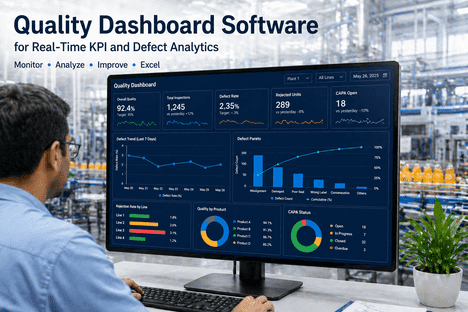
Multi-site quality visibility in InfinityQS requires the Enact cloud platform — the on-premises ProFicient product does not support enterprise-level rollup dashboards at the same capability level. For manufacturers with a mix of on-prem and cloud-connected facilities, or facilities in environments with restricted internet access, this architecture creates a visibility gap at exactly the level where quality leadership needs it most. iFactory delivers multi-plant quality rollup dashboards regardless of whether individual plants are running on-premises, cloud-connected, or in a hybrid configuration. Quality directors can view Cpk trending by part family across all plants, compare OOC rates by production line and shift, and drill into individual control charts from a single unified interface — without requiring every plant to move to a cloud deployment to participate in the enterprise view.
On-Premises Deployment With Full Platform Capability
A consistent pain point for quality platform owners evaluating InfinityQS is the capability split between ProFicient (on-prem) and Enact (cloud) — where the more advanced analytics and enterprise features are cloud-only, effectively penalizing manufacturers who must run on-premises due to cybersecurity policy, customer data handling requirements, or network environment constraints. WinSPC and Wonderware QI are functionally on-prem platforms, but their cloud migration paths are limited, and their AI and analytics roadmaps are constrained by the legacy architecture. iFactory is a full-parity platform in both on-premises and cloud configurations. Every SPC chart type, every AI Copilot feature, every integration connector, and every enterprise dashboard is available regardless of deployment model. Quality teams in air-gapped automotive Tier 1 facilities get the same analytical capability as teams running fully cloud-connected operations.
How the Migration Works: From InfinityQS, WinSPC, or Wonderware QI to iFactory
The primary concern quality platform owners raise about switching SPC platforms is not capability — it is continuity. Historical SPC data, part configurations, control limit definitions, and established chart templates represent years of quality engineering investment. A migration that discards that institutional knowledge is a migration that will not get past the business case stage. iFactory's migration methodology is built around zero-loss chart continuity and phased go-live that keeps legacy systems operational until the new platform is fully validated.
Quality teams that have completed the migration report 14-week average timelines from kickoff to full cutover, with no loss of historical SPC data and full chart parity confirmed before legacy system decommission. To understand what the migration timeline and investment looks like for your specific platform and facility configuration, Book a Demo with iFactory's migration team.
iFactory's SPC Capability Stack: Everything Your Legacy Platform Has, Plus the Integration Layer It Doesn't
The table below documents iFactory's full SPC analytical capability alongside the integration and AI features that legacy platforms do not provide. For quality platform owners conducting a formal evaluation, this represents the complete feature comparison baseline.
- Xbar-R, Xbar-S, I-MR, Moving Average charts
- Attribute charts: P, NP, C, U — all standard configurations
- CUSUM and EWMA charts for small shift detection
- Multi-vari charts, box plots, histograms with normality testing
- All 8 Western Electric detection rules, configurable by chart
- Cp, Cpk, Pp, Ppk — real-time and historical trending
- Capability by part, by line, by shift, by plant — any slice
- Gauge R&R study templates: crossed, nested, expanded
- MSA reports with discrimination ratio and %tolerance
- Automated capability report generation for customer PPAP/APQP
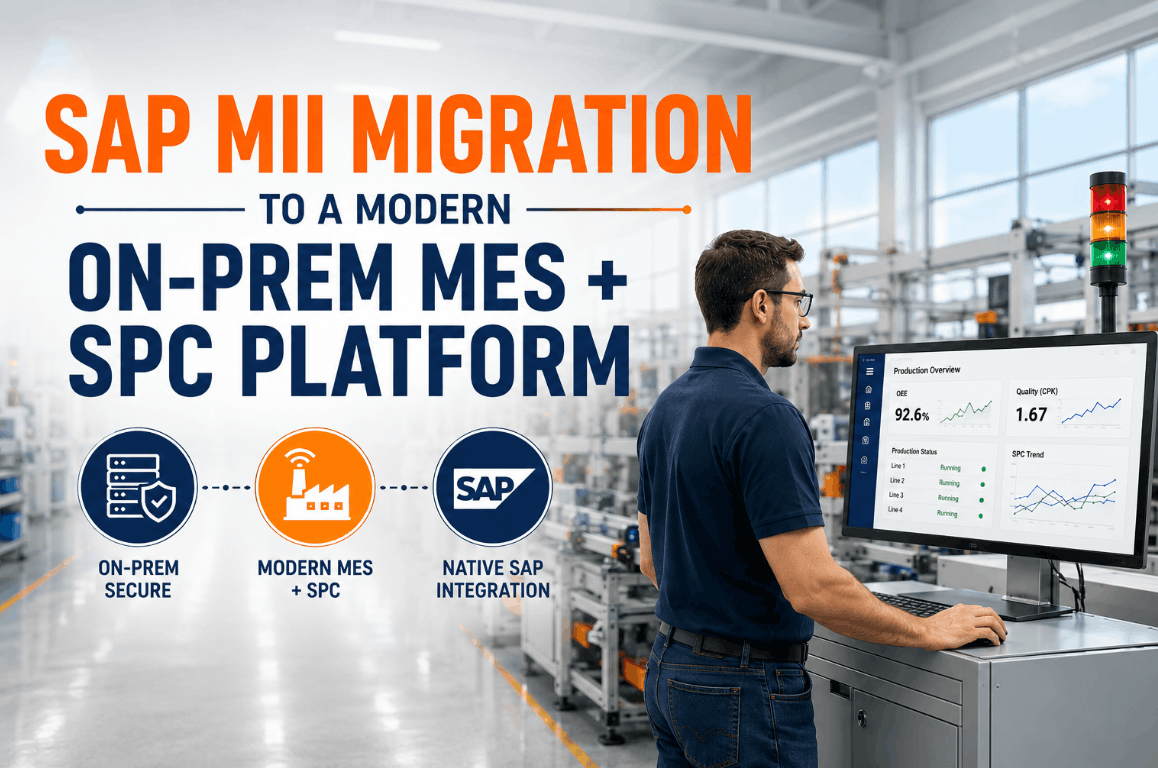
- SAP S/4HANA: native bidirectional connector, real-time production order sync
- MES: live work-in-process, job routing, and operator assignment data
- PLC/OPC-UA: direct process parameter ingestion, 30-second polling cycle
- LIMS: lab result correlation with in-process SPC charts
- CMM: automated measurement data import without manual bridging
- OOC-to-corrective-action workflow: root cause ranking in under 60 seconds
- Correlation analysis: links process parameter deviations to quality signals
- Predictive Cpk trending: flags capability degradation before spec breach
- Natural language query: quality engineers ask questions in plain text
- Automated CAPA initiation linked to OOC event records
Expert Review: What the SPC Platform Evaluation Process Gets Wrong
In 22 years of quality systems work across automotive, aerospace, and industrial manufacturing, I have been through seven SPC platform evaluations — three as the buyer and four as an independent advisor. The same mistake appears in nearly every one of them: the evaluation team spends 80% of its time comparing chart types and control limit calculation methods between platforms that are functionally identical at that layer, and almost no time evaluating what the platform does with an out-of-control signal after it fires. InfinityQS, WinSPC, and Wonderware QI all draw accurate charts. That was never the problem. The problem is what happens at 2:00 AM when an Xbar-R chart on Line 3 goes OOC, nobody sees the alert until morning shift, and the customer finds the escape three days later. The question that actually differentiates a modern SPC platform from a legacy one is not whether it can generate a P chart. It is whether it can correlate that OOC signal to a PLC parameter anomaly, link it to the material lot from the SAP production order, and put a prioritized corrective action in front of the right person within ten minutes — automatically, without human routing. That is the evaluation criterion that tells you whether you are buying a charting tool or a quality management platform. The difference in business outcome over a three-year period is not marginal. It is transformational.
Conclusion: The SPC Platform Evaluation Has One Question That Matters Most
If your current InfinityQS, WinSPC, or Wonderware QI platform were generating accurate OOC signals and nobody with authority to stop production was seeing them within 15 minutes — would you know? In most manufacturing environments running legacy SPC tools, the honest answer is no. The charts are accurate. The alert logic is sound. But the signal path from chart to corrective action runs through manual alert review, manual escalation, and a corrective action process that lives in a completely separate system. Every handoff in that path is a point where the signal can die before it becomes action.
iFactory closes that signal path. The SPC analytics are at parity with every legacy tool in the market. The integration stack connects quality signals to the MES, SAP, and PLC data that provides production context. The AI Copilot converts OOC signals to prioritized corrective actions without manual intervention. And the platform deploys on-premises, in the cloud, or in a hybrid configuration — without creating a capability split between deployment tiers. The migration from your current platform preserves every chart configuration, every historical data point, and every control limit definition your quality team has built. What changes is what happens after the next OOC signal fires. To see that difference in a live environment built around your production configuration, Book a Demo with iFactory today.
Frequently Asked Questions
Yes — iFactory includes the full SPC chart library: Xbar-R, Xbar-S, I-MR, P, NP, C, U, CUSUM, EWMA, all 8 Western Electric run rules, and full process capability indices (Cp, Cpk, Pp, Ppk) with configurable subgroup and sample logic identical to InfinityQS and WinSPC.
Yes — iFactory ships a native SAP S/4HANA connector that delivers real-time, bidirectional data exchange with no custom middleware required; production orders, material specs, and BOM revisions update SPC configurations automatically as they change in SAP.
Full historical data migration is a standard component of iFactory's migration methodology — all part configurations, control limit history, chart data, and OOC event records are migrated and accessible in iFactory before the legacy system is decommissioned.
iFactory is a full-parity platform in both on-premises and cloud configurations — every SPC chart type, AI Copilot feature, and integration connector is available on-prem, with no capability penalty for facilities that cannot run cloud-connected deployments.
Where InfinityQS stops at generating an alert, iFactory's AI Copilot automatically cross-references the OOC event against PLC process parameters, MES production context, and historical patterns to deliver a ranked root cause list and corrective action recommendation within 60 seconds of the signal.