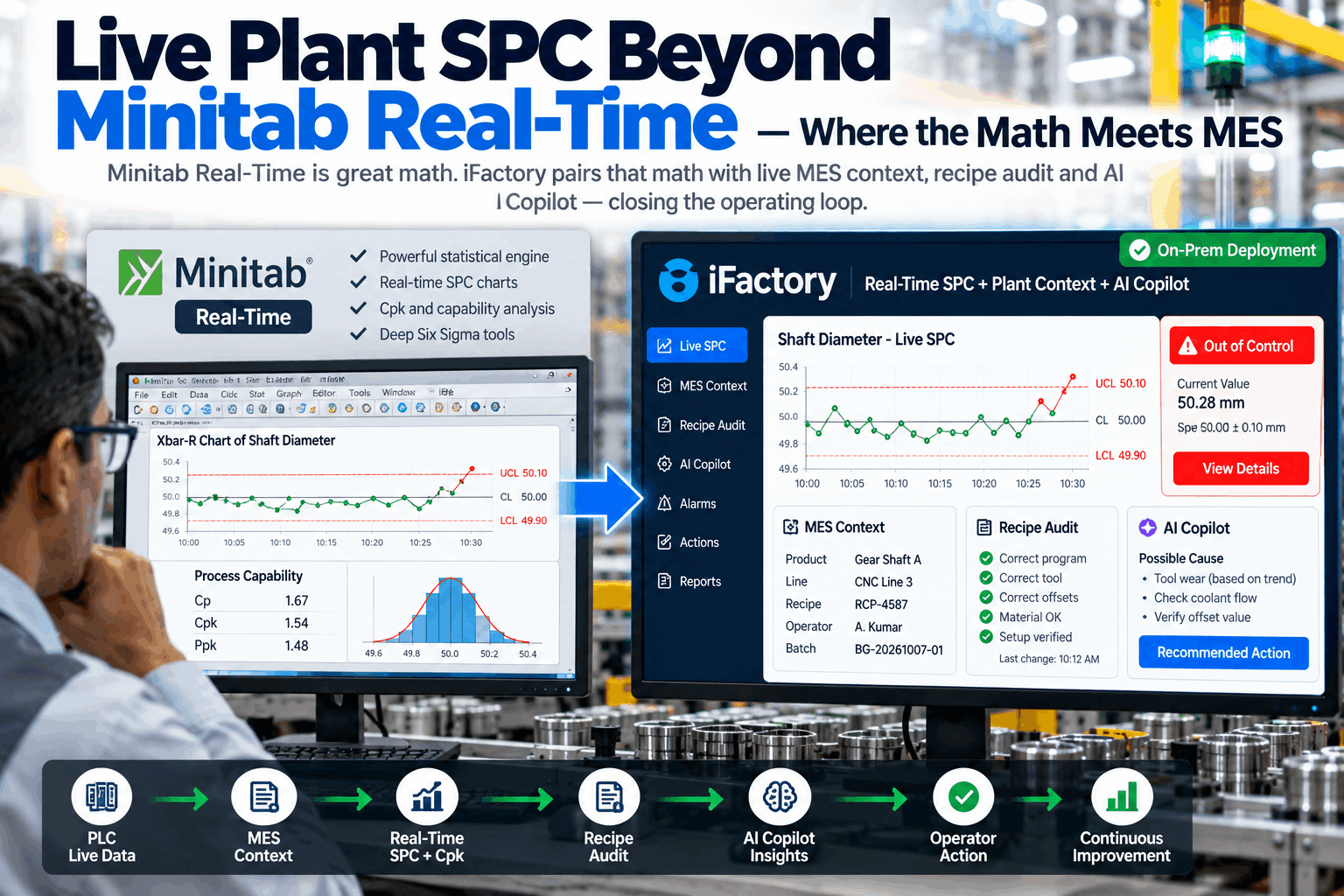
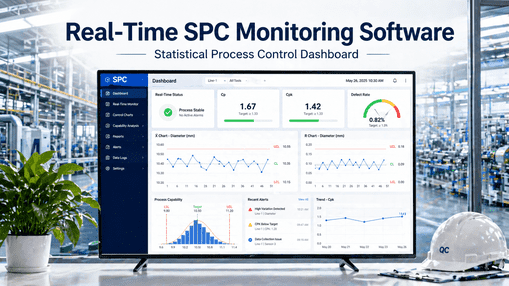
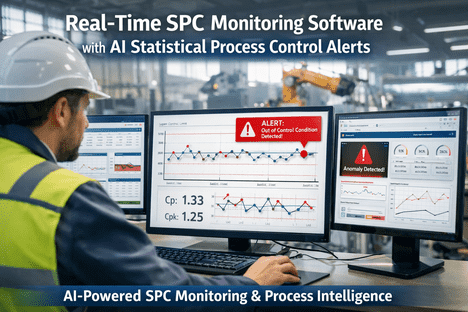
Minitab has been the trusted engine behind Six Sigma programs for more than five decades. The statistical rigor it delivers — Xbar-R, EWMA, I-MR, Cpk, Ppk, hypothesis testing, capability analysis — is genuinely best-in-class, and no serious quality professional disputes that. Where Minitab Real-Time runs into structural limitations is not in the math. It is in what happens after the math fires a signal. On a live production floor in 2026, an out-of-control event on a control chart is only the starting point of a quality intervention. To close the operating loop, your SPC platform needs to know what recipe was running at the moment of the signal, what the MES says about the active work order, which PLC parameters drifted in the same time window, and what corrective action to generate automatically — without routing the alert through three systems and two email threads before anyone acts on it. iFactory delivers the full Minitab-grade statistical engine your Six Sigma program is built on, paired with live MES context, recipe audit, PLC data correlation, AI Copilot–driven root cause analysis, and on-premises deployment for facilities that cannot run cloud-dependent quality infrastructure. If your current Minitab Real-Time deployment produces accurate charts that nobody acts on fast enough, Book a Demo to see what a plant-aware SPC platform actually looks like in operation.
Why Six Sigma Master Black Belts Are Evaluating Beyond Minitab Real-Time
The limitation Master Black Belts consistently identify with Minitab Real-Time is not statistical — it is contextual. Minitab's cloud-based SPC product generates accurate control charts and sends alerts. What it does not do natively is answer the question every quality engineer asks in the first 90 seconds after an OOC alert: what changed? Answering that question requires live access to MES production order data, recipe version history, PLC process parameter logs, and the prior OOC pattern for that specific part and line. Minitab Real-Time's architecture keeps those data streams separate. iFactory integrates them. The result is not a different chart — it is a different response time, a different corrective action hit rate, and a different customer escape rate at the end of the quarter. Quality platform owners who Book a Demo with iFactory regularly describe the same experience: the charts look identical to Minitab on day one, and the gap becomes visible the first time an OOC signal fires and the system tells you exactly why it happened rather than simply that it happened.
Where Minitab Real-Time Is Strong — and Where It Stops
The comparison below is not a criticism of Minitab's statistical engine. It is an accurate description of what a cloud-first SPC charting tool is architecturally capable of versus what a plant-integrated quality platform delivers. For Six Sigma programs that need to close the operating loop — not just document variation — the distinction matters.
| Capability | Minitab Real-Time SPC | iFactory SPC Platform |
|---|---|---|
| Xbar-R, I-MR, EWMA, CUSUM Control Charts | ✓ Full | ✓ Full |
| Cpk, Ppk, Process Capability Analysis | ✓ Full | ✓ Full |
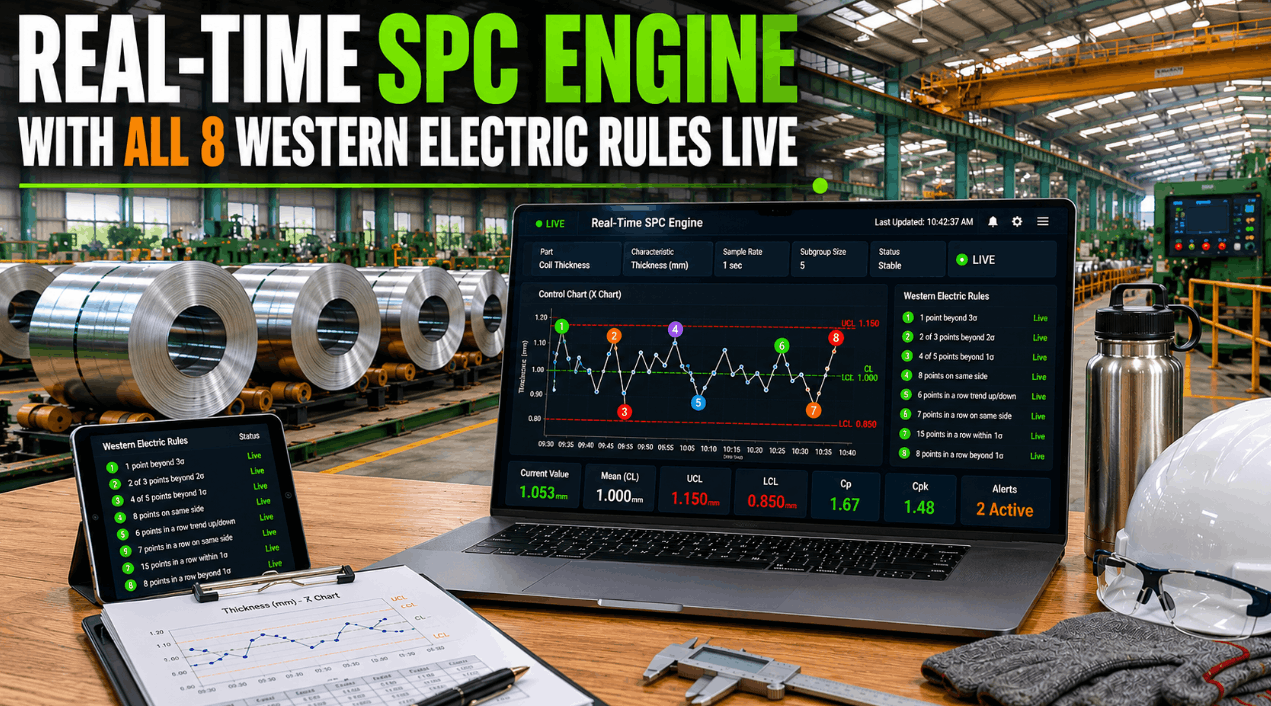
| Western Electric Detection Rules (All 8) | ✓ Full | ✓ Full |
| Hypothesis Testing, Regression, DOE | Via Minitab Statistical Software | ✓ Built-in analytics suite |
| Live MES Integration (bidirectional, real-time) | SAP DMC partnership only / limited | ✓ Native connector, all major MES |
| Recipe Audit Trail at OOC Event | Not available natively | ✓ Recipe version linked to every event |
| PLC / OPC-UA Live Process Parameter Correlation | Not available | ✓ 30-second OPC-UA polling cycle |
| AI Copilot — OOC to Root Cause in <90 sec | Not available | ✓ Built-in |
| On-Premises Deployment (air-gapped) | Cloud-only product | ✓ Full parity on-prem |
| Automated CAPA Initiation from OOC | Manual / external system | ✓ Auto-initiated, linked to event record |
The Four Capabilities That Close the Operating Loop Minitab Leaves Open
Each capability below addresses a specific failure point in the OOC-to-corrective-action workflow that Minitab Real-Time's architecture does not cover. For a Six Sigma Master Black Belt designing a quality management system — not just a charting deployment — these are the capabilities that separate a statistical tool from a quality operating platform.
Live MES Context at Every Signal
When iFactory fires an OOC alert, the alert includes the active MES production order, work-in-process status, operator assignment, and material lot at the exact moment of the signal. No manual lookup. No cross-referencing separate systems. The production context is embedded in the alert itself, so the person responding knows immediately what was running, who was running it, and what material was being processed.
Recipe Audit Trail Linked to OOC Events
Recipe changes are one of the highest-frequency root causes in process industry OOC events — and Minitab Real-Time has no native mechanism to link a control chart violation to a recipe version change that occurred in the same production window. iFactory maintains a continuous recipe audit log and automatically flags any recipe revision in the 24-hour window preceding an OOC event as a potential contributing factor, surfacing it in the root cause ranking without requiring a separate LIMS or recipe management investigation.
PLC Process Parameter Correlation
A product quality deviation visible on an Xbar-R chart almost always has a process parameter cause visible in PLC data — a temperature setpoint drift, a pressure variation, a feed rate anomaly. Minitab Real-Time monitors the quality dimension but does not ingest PLC process parameter data. iFactory reads OPC-UA–compliant PLC data on a 30-second cycle and correlates process parameter deviations to quality signals automatically, giving the quality engineer a ranked list of process causes rather than a chart signal with no context.
AI Copilot: Statistical Signal to Corrective Action
iFactory's AI Copilot converts an OOC signal into a prioritized corrective action recommendation within 90 seconds. The Copilot cross-references the triggered chart against historical OOC events for that part and process, correlates PLC and MES context from the same production window, identifies statistically significant correlations between the current pattern and prior confirmed root causes, and generates a ranked corrective action queue — eliminating the gap between signal detection and organized response that costs quality programs their most recoverable defect events.
Statistical Capability Benchmark: iFactory vs. Minitab Real-Time
For Six Sigma program leads evaluating platform parity, the chart below maps iFactory's statistical engine against Minitab Real-Time SPC across the dimensions that matter most for a manufacturing quality deployment. Book a Demo to run iFactory against your active part families and confirm parity before any migration decision.
How iFactory Fits Into an Active Six Sigma Program Without Disrupting It
The concern most Six Sigma Master Black Belts raise about platform transitions is institutional continuity — DMAIC project data, historical Cpk baselines, control plan templates, and gauge R&R study records represent years of quality program investment. iFactory's implementation methodology is designed around a zero-disruption parallel deployment model that preserves that investment while adding the integration and AI layer that Minitab Real-Time does not provide.
I have run Six Sigma programs at three manufacturing sites over 19 years, and every one of them ran on Minitab. The statistical engine is outstanding — I have no objection to it. The objection I have is what happens at 11:30 PM when an Xbar-R chart flags a 2-sigma shift on a critical dimension and the operator cannot tell whether the process actually drifted, the tool was just changed, the recipe was revised yesterday, or the measurement system needs recalibration. With Minitab Real-Time, that investigation requires pulling data from three separate systems in the morning. By then, 200 parts have been produced that may need quarantine. With iFactory, the system already correlated the OOC event to the tool change record in the MES and the recipe revision log before the shift supervisor finished reading the alert. The corrective action was initiated automatically. That is the difference between a statistical tool and a quality operating system. Minitab gives you the best charts in the industry. iFactory gives you a closed operating loop. Once you have both in the same platform, you cannot go back to separating them.
Conclusion: The Math Is Solved. The Operating Loop Is What's Missing.
Minitab Real-Time SPC solved a real problem: making the statistical rigor of Minitab's analytical engine available in a live monitoring environment rather than a post-production analysis tool. That was meaningful progress. The problem it did not solve is what comes after the chart fires. On a plant floor where every OOC event has a process cause visible in PLC data, a production context available in the MES, and a recipe history stored in a separate system, a charting platform that stops at the alert boundary leaves the most actionable part of the quality management workflow to manual effort. iFactory closes that gap without asking your Six Sigma program to replace its statistical foundation. The chart types are the same. The capability indices are calculated identically. The Western Electric rules fire on the same pattern logic. What changes is that every signal now carries context — MES production state, recipe version, PLC parameters — and every signal now has an AI Copilot that converts it into a ranked corrective action queue before the operator finishes reading the notification. If your program is generating accurate OOC signals and losing corrective action time in the gap between detection and investigation, Book a Demo with iFactory and see what the closed loop looks like in a live environment built around your process.