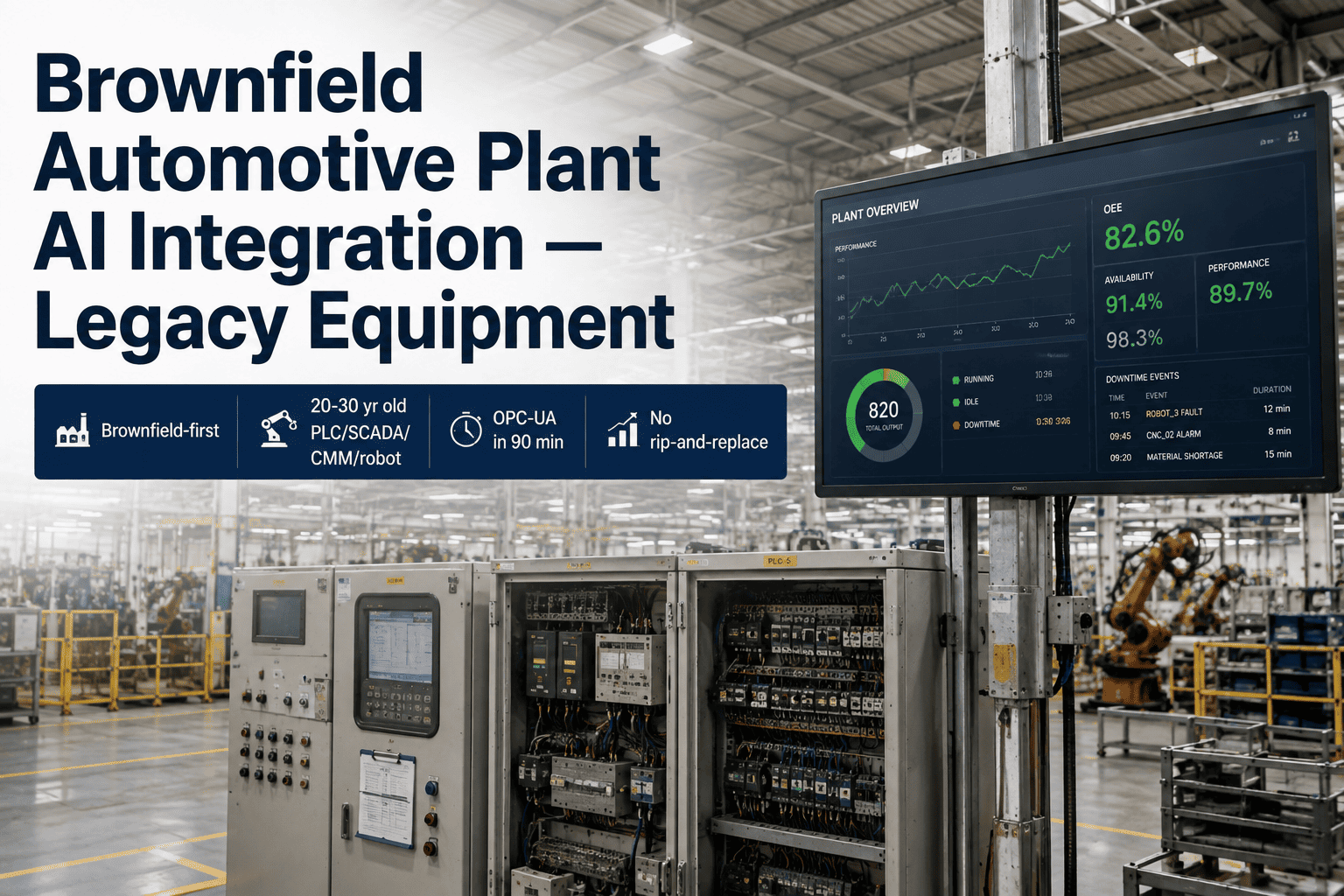
Walk any Tier 1 automotive plant in the US and you'll find the same picture: a stamping press from 2003 running on a Siemens S5, a robotic weld cell commissioned in 2011 on Allen-Bradley SLC 500, a paint booth SCADA still on Modbus RTU, a CMM from the late 90s pushing measurements to a serial printer, and — somewhere in the newer building — a couple of shiny Rockwell CompactLogix cells that were installed last year. This is brownfield. And it's most of automotive manufacturing. The pitch every AI vendor makes is beautiful: connect your data, unlock predictive maintenance, drive OEE from 64% to 82%. The pitch every plant manager has heard before: rip out the legacy control layer, replace with a modern PLC, add cloud connectivity, deal with the six months of production risk, watch the $8M capital request die in the CFO's inbox. iFactory doesn't require any of that. On-prem NVIDIA AI plugs into your existing PLC, SCADA, CMM, and robot fleet through OPC-UA gateways that go live in 90 minutes per asset. No rip-and-replace. No production stop. No cloud dependency. 6–12 weeks from PO to full plant coverage. iFactory Brownfield AI Integration is built for the plant you have — not the one a greenfield vendor wishes you had.
iFactory Brownfield-First AI Integration
Legacy Equipment Stays. AI Goes Live in 90 Minutes Per Asset.
Connect 20–30+ year old PLCs, SCADA, CMM, and robots without rip-and-replace. OPC-UA gateways, MQTT Sparkplug B, and native historian connectors. On-prem NVIDIA AI. IEC 62443-secured. IATF 16949-aligned.
$22K
automotive downtime/min
The Legacy Asset Inventory — What's Actually on Your Floor
Every brownfield plant is a museum of automation eras. iFactory's integration library covers all of them because we built it that way — knowing the plant you're integrating today has PLCs, controls, and instrumentation from every decade since the 1990s coexisting on the same shop floor.
Vintage
Typical Assets
Native Protocol
iFactory Bridge
1990s
Allen-Bradley SLC 500, Siemens S5, Modicon 984, older CMMs
DH+, PROFIBUS, RS-232
Protocol gateway to OPC-UA
2000s
Rockwell ControlLogix early gen, Siemens S7-300, Modbus RTU I/O
Modbus RTU/TCP, EtherNet/IP
Softing edgeConnector or Kepware server
2010s
CompactLogix, S7-1200/1500, Mitsubishi Q-series, Fanuc R-30iA robots
EtherNet/IP, Profinet, FOCAS
Native OPC-UA or vendor adapter
2020s
Modern PLCs with OPC-UA server, MQTT edge gateways, IIoT devices
OPC-UA, MQTT Sparkplug B
Direct connection, no gateway needed
SCADA
Wonderware, iFIX, WinCC, FactoryTalk View, historian (PI, InSQL)
Native historian API
Direct historian connector + OPC-UA
The 90-Minute OPC-UA Promise — What Actually Happens
90 minutes per asset. That's the target and the reality for standard integrations. Not because the AI is trivial — because we built the integration library to handle 30 years of automotive automation on day one. Here's what the 90 minutes actually looks like on a legacy weld cell.
0-15 min
Asset discovery
PLC model, firmware, and protocol identified. Existing tag list retrieved from PLC or SCADA. Network path validated against IEC 62443 segmentation rules.
15-45 min
Gateway install
Protocol gateway (Softing, Kepware, or vendor adapter) deployed at the cabinet. No PLC firmware change. No production stop. OPC-UA server exposed on the secured segment.
45-70 min
Tag mapping
Cycle time, part count, alarm state, motor current, and quality signals mapped to iFactory's equipment model. Companion specifications applied where available (umati for CNC, etc.).
70-90 min
Live data flow
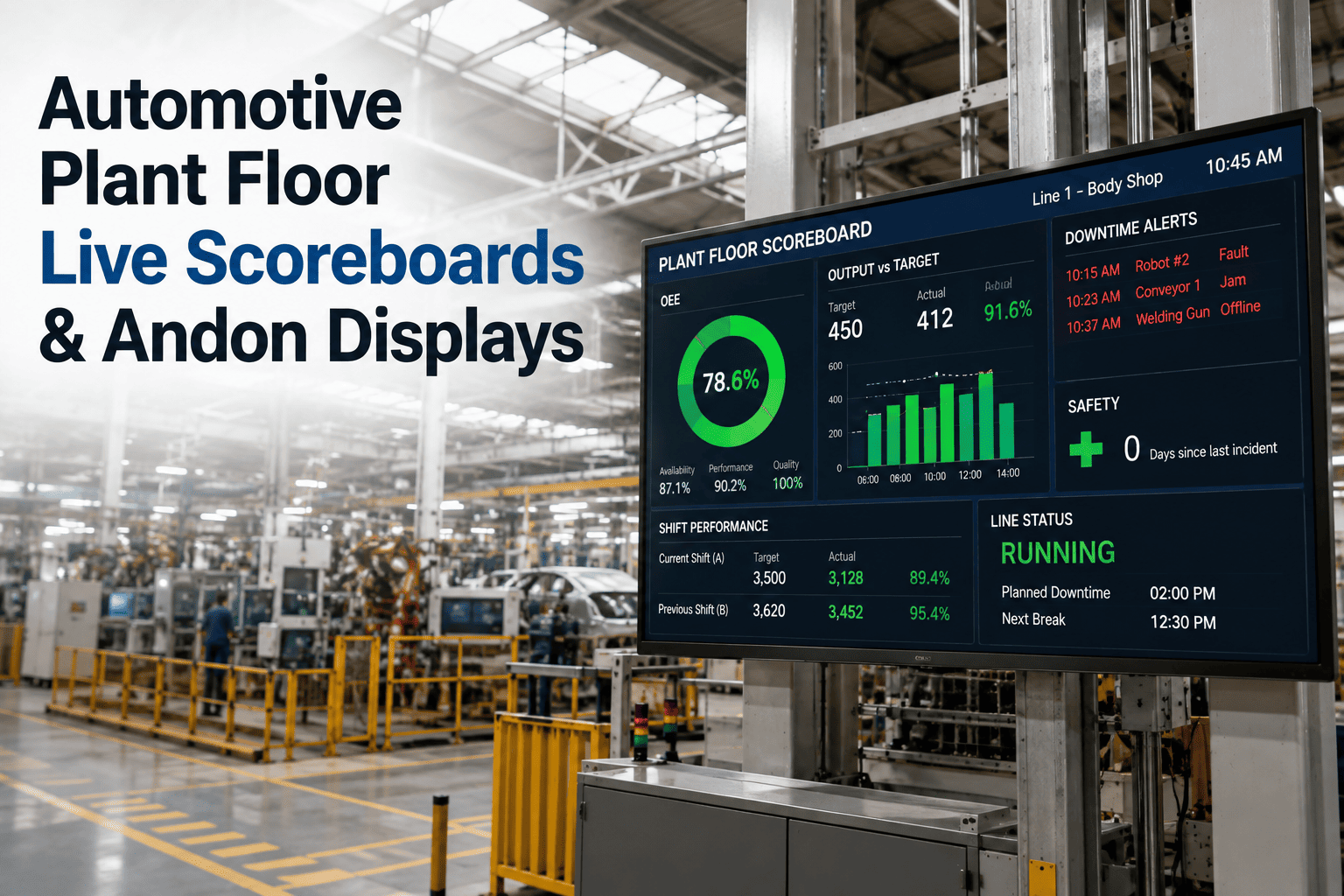
Data flowing to iFactory on-prem AI. Baseline capture begins. Cell appears on plant scoreboard and predictive maintenance dashboard. Zero disruption to running production.
Traditional Modernization vs Brownfield-First Integration
The classic modernization playbook is a decade old and it hasn't gotten cheaper. iFactory's brownfield-first path takes a fundamentally different approach — one that respects the plant, the capital budget, and the production schedule.
Traditional modernization
Rip-and-replace, then integrate
$5-15M capital request per plant
12-24 month deployment timeline
Production stops for cutover
Institutional ladder-logic knowledge lost
Payback horizon: 5-8 years
OEM audit pressure not addressed for 2+ years
iFactory brownfield-first
Integrate now, migrate on your timeline
Turnkey AI stack, no PLC replacement
6-12 weeks to full plant coverage
Zero production interruption
Legacy expertise stays operational
Payback: 6-12 months typical
OEM scorecard evidence in the first quarter
Curious how iFactory would connect to your specific mix of legacy assets? Book a demo — send us your PLC and SCADA inventory and we'll map it before the call.
The Six-Stage Brownfield Methodology
Every brownfield integration follows the same six-stage methodology. Each stage has a defined gate review before the next begins. Your existing control systems never stop operating.
01
Asset inventory
Every PLC model, protocol version, SCADA platform, historian type, and network topology mapped. Output: structured tag-to-asset registry.
02
Network & security review
OT network segmentation per IEC 62443. OPC-UA certificate authority setup. MQTT broker hardening. Zero exposure to plant IT network without explicit routing.
03
Gateway deployment
Protocol bridges installed at cabinet level. Modbus, DH+, Profibus, EtherNet/IP, Sparkplug B — all mapped to standardized OPC-UA server.
04
AI baseline capture
On-prem NVIDIA server learns line signatures — cycle times, motor patterns, alarm distributions. Baseline period 2-4 weeks per asset class.
05
Analytics activation
Predictive maintenance, live OEE, andon, and quality analytics activated line by line. Team leads and supervisors trained on dashboards.
06
OEM audit package
Full audit trail generated to IATF 16949 + Ford, GM, Stellantis, Toyota NA, Honda scorecard requirements. Live dashboards replace monthly Excel.
Why Legacy PLCs Aren't the Problem — Data Silos Are
Every brownfield plant has the same silent margin killer. Manufacturing plants lose 12–27% of production capacity annually to undetected equipment degradation hidden inside SCADA — not catastrophic failures, but gradual performance drift across PLCs and sensors that no manual dashboard catches in time.
Cycle time drift
Robot cycle drifts 3-4 seconds over 6 months. PLC still runs. SCADA never alarms. OEE quietly falls from 82% to 68%.
AI reads drift in the first shift. Root cause flagged before it compounds.
Micro-stops below alarm
2-4 minute stops throughout the shift. Individually invisible. Aggregated: 40+ minutes of lost run time.
Every stop captured with duration, cause, and shift context.
Motor current signature drift
Servo current climbs 8% over 3 months. Within factory limits, not alarmed. Bearing failure imminent.
AI catches the trend at week 2, work order raised for planned changeover.
Unrecorded quality rejects
Rejects reworked at station without being logged. Actual reject rate 2x reported. PPM to OEM misleading.
Live counter captures every reject. True PPM restored for OEM scorecard.
The On-Prem AI Stack — Why It Matters for Brownfield
Automotive plant data is sensitive. Weld cycle times, cycle signatures, defect patterns, and OEM part programs are the operational fingerprint of the plant. iFactory ships as a pre-configured NVIDIA AI server delivered racked and cabled — so no data leaves the plant unless you route it out deliberately. And no cloud latency means real-time is genuinely real-time.
Layer 01
Physical assets
Your existing PLCs, SCADA, CMM, robots, sensors — untouched.
Layer 02
Protocol gateway
Softing, Kepware, or vendor adapter. Legacy protocols → OPC-UA + MQTT Sparkplug B.
Layer 03
OT segmentation
IEC 62443 network zones. Certificate-secured. Zero IT exposure without explicit routing.
Layer 04
NVIDIA AI server
On-prem, racked, cabled. Predictive maintenance, quality, andon, OEE — all local.
Layer 05
Dashboards + audit
Live floor scoreboards, mobile alerts, OEM scorecard exports, IATF 16949 audit trail.
What Brownfield Plants See in the First Quarter
Automotive brownfield plants running iFactory integration typically report measurable outcomes inside a quarter — without touching a single PLC. These are the numbers Ops and controls engineering use to justify the investment.
90 min
Per-asset go-live
OPC-UA integration
6-12
Week full deployment
turnkey NVIDIA AI
Zero
Production stops
no rip-and-replace
12-27%
Hidden capacity recovered
from silent degradation
Ask the AI on the Plant Floor
Controls engineer
Our weld cell 7 is on a 2004 ControlLogix. Can you connect without touching the ladder logic?
iFactory AI
Yes. 2004 ControlLogix supports EtherNet/IP natively — Kepware server sits on the OT segment and exposes cycle time, servo current, weld count, and alarm state via OPC-UA. Ladder logic untouched. Firmware unchanged. Estimated go-live: 90 minutes at the cabinet.
Controls engineer
What about the Fanuc R-30iA robot on that cell?
iFactory AI
FOCAS adapter connects R-30iA controllers directly to OPC-UA. We pull spindle load, joint torques, cycle time, alarm history, and TCP position without touching the teach pendant or robot program. Combined weld cell + robot integration in the same 90-minute window.
Frequently Asked Questions
Our PLCs are 20+ years old. Do they really support OPC-UA?
Native OPC-UA support started around 2010 in most PLC families, so 20+ year old controllers typically don't have it built in. That's why iFactory ships with protocol gateways in the integration package — Softing edgeConnector, Kepware KEPServerEX, Cogent DataHub, and vendor-specific adapters translate Modbus RTU, DH+, PROFIBUS, serial RS-232, and older EtherNet/IP to standardized OPC-UA in real time. No PLC firmware update. No ladder logic changes. The controller doesn't even know the gateway is there.
Will this touch our safety systems or PLC programs in any way?
No. Everything iFactory does is read-only from your control systems. Gateways sit on the OT network beside the PLC — not inline. No firmware modification. No ladder logic edit. No safety system contact. iFactory reads process data, cycle signals, alarm states, and equipment telemetry through the gateway; nothing is ever written back to the PLC or safety layer. Controls engineering keeps full ownership of the automation.
How is this secured? OT cybersecurity is a board-level concern for us.
Every deployment follows IEC 62443 network segmentation. OPC-UA runs with certificate-based mutual authentication and encrypted transport. MQTT brokers are hardened per Sparkplug B security guidance. The on-prem NVIDIA AI server sits on its own OT zone; it does not route to plant IT or external internet unless you explicitly permit specific data flows for OEM scorecard reporting. Zero-trust architecture, defense in depth, and full IEC 62443 audit trail.
What if we have SCADA-only data with no direct PLC access?
Common in older plants where the PLC is buried and the SCADA (Wonderware, iFIX, WinCC, FactoryTalk View) is the only accessible layer. iFactory ingests directly from SCADA via native historian connectors and OPC-UA. Historical data in OSIsoft PI or Wonderware InSQL is federated for baseline training. Live tag streams from the SCADA feed the AI in real time. PLC direct access can be added later when it fits your maintenance window — not required for value.
Does this actually help with our OEM scorecards and IATF 16949 audits?
Yes — that's a primary use case. Live OEE dashboards replace monthly Excel reports (which OEM auditors increasingly reject). Downtime Pareto by line, product, and shift with 6-12 month trend is auto-generated. Kaizen actions tied to top losses provide the systematic improvement evidence auditors look for. Scorecard exports are pre-formatted for Ford, GM, Stellantis, Toyota NA, and Honda. IATF 16949 process control evidence is built into the audit trail from day one.
Can we start with one cell or one line?
Yes — the recommended path. Pick your worst-performing bottleneck cell or the line where an OEM has flagged concerns. We integrate the PLC(s), SCADA feed, and robots in 90 minutes each, run the AI baseline for 2-4 weeks, then activate predictive maintenance, live OEE, and andon. The full pilot runs in 6-8 weeks and produces documented per-cell ROI numbers. Subsequent cells and lines take a fraction of the time because the integration library and dashboards are already validated.
Your legacy PLCs aren't the problem. Waiting five years to modernize is.
See Brownfield AI Integration Running on Your Plant
Send us your PLC and SCADA inventory before the demo — we'll map every asset to its integration bridge in advance. Then we'll walk through how the 90-minute OPC-UA connection actually works, what the AI baseline captures in the first two weeks, and what the OEM scorecard evidence looks like at the end of the first quarter. On-prem NVIDIA AI, no rip-and-replace, 6-12 weeks to full plant coverage.

-—-live-spc-for-tier-1-oem-programs.png)