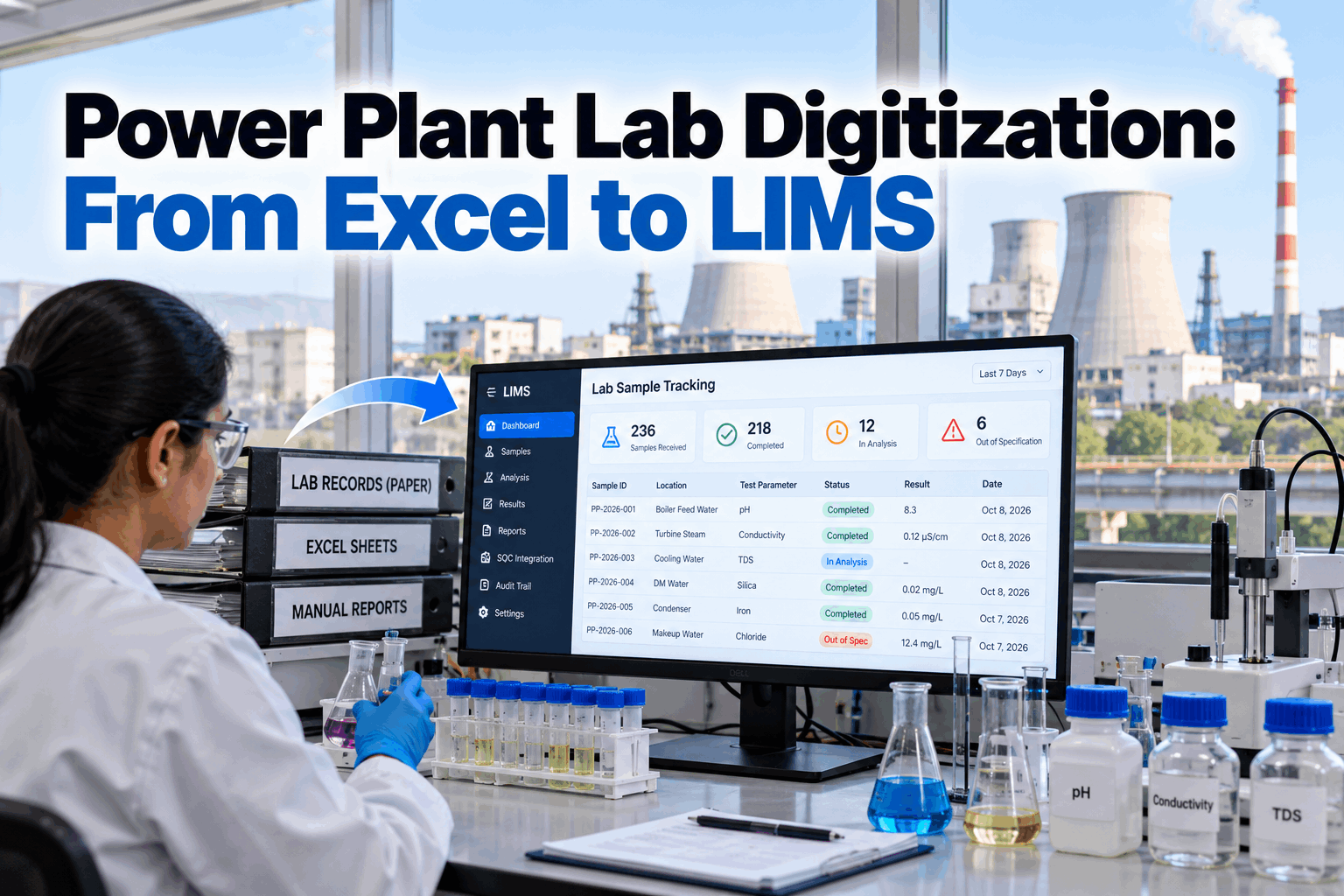
A PPAP package can wait days for one missing lab report. The tensile test was run, the hardness was checked and the salt spray finished on time, but the results sit in a notebook, a spreadsheet and an instrument PC. This guide shows how automotive labs move to LIMS so results reach PPAP faster and hold up in IATF audits. Start with a lab review.
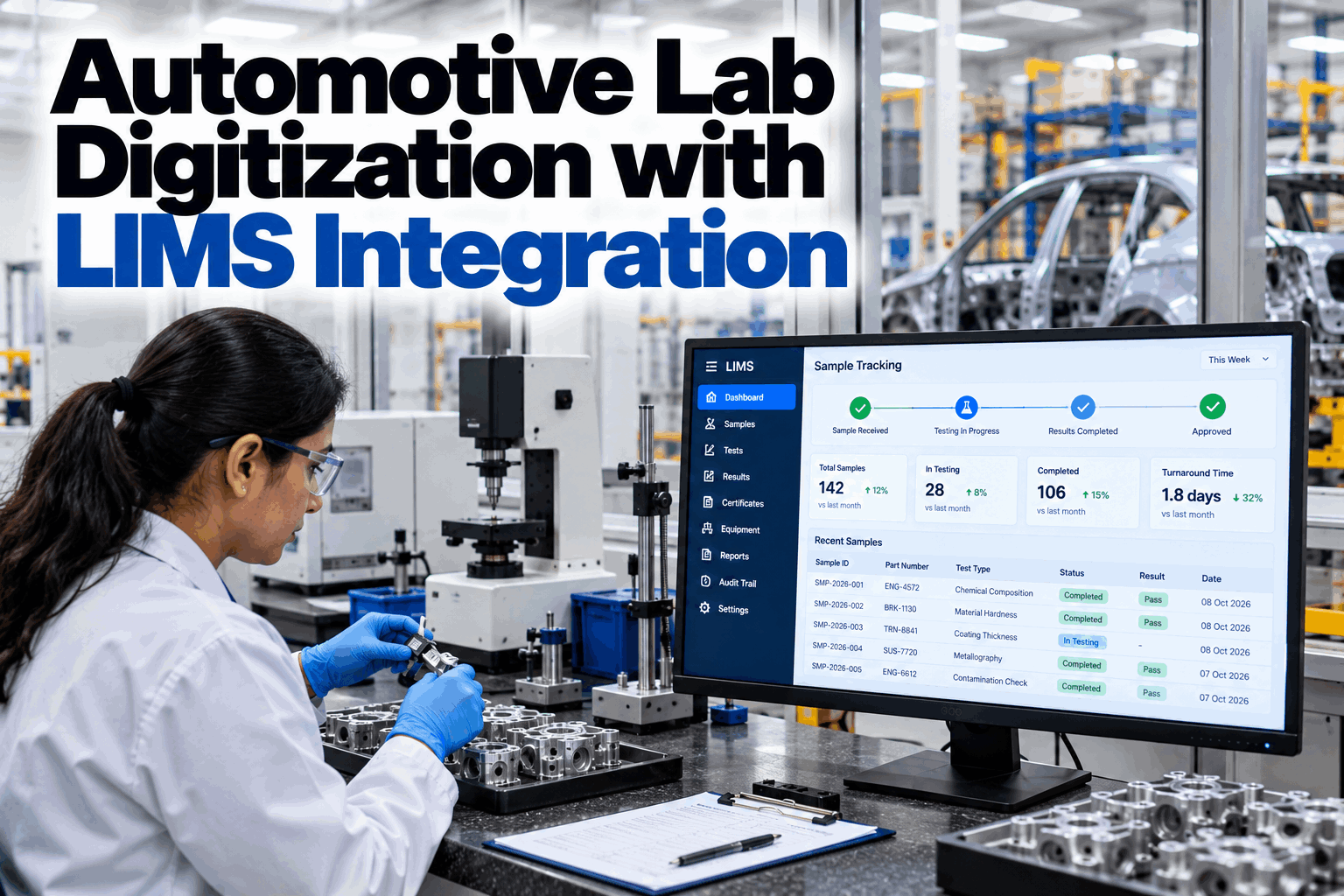
Automotive Lab Digitization with LIMS Integration
Move lab work off paper and into one connected system. Samples are logged once, instrument data flows in on its own, results are checked against spec and approved records are ready for PPAP and the next audit.
- Where paper labs lose time and audit defensibility
- What IATF 16949 expects from an internal lab
- How LIMS links to PPAP, SPC and the plant floor
Where Paper Labs Lose Time and Defensibility
The test takes an hour. Finding and proving the result takes a day.
Most automotive labs are good at testing. The trouble starts after the test. Results are copied from instrument screens into notebooks, then into spreadsheets, then into reports. Each copy is a chance for error, and each step is hard to prove later. When a customer or auditor asks for one result with its method, analyst, equipment status and approval, the answer is a search, not a click. Our lab specialists can map where your lab loses this time.
Follow one result from the instrument to the final report and count how many times a person rewrites it. Every copy is a place for error and a gap in the audit trail. That number is your first digitization target.
What IATF 16949 Expects From an Automotive Lab
The lab is part of the quality system, and auditors treat it that way.
Clause 7.1.5.3.1 asks an internal lab to have a defined scope, written into the QMS documentation, covering the inspection, test or calibration work it does. ISO/IEC 17025 accreditation can be used to show conformance but is not required for internal labs unless a customer asks for it. External labs used for these services generally need ISO/IEC 17025 accreditation or customer acceptance under 7.1.5.3.2. To check your lab scope against the clause, book a scope check.
Adequate procedures
Written technical procedures for each test the lab runs.
Competent people
Records showing each analyst is trained for the tests they sign.
Product testing
The ability to test the product as the customer requires.
Traceable methods
Tests traceable to the relevant standard, such as ASTM, EN or ISO.
Methods with no standard
A defined way to verify measurement capability when no standard exists.
Customer rules and records
Customer requirements met and related records reviewed.
IATF 16949 clause 7.5.3.2.1 expects records such as PPAP and design records to be kept while the part is active for production and service, plus one calendar year, unless the customer sets a longer period. Paper archives make that promise hard to keep.
How the Lab Feeds PPAP
Several PPAP elements come straight from lab records.
The AIAG PPAP manual lists 18 elements. The lab supplies the evidence for several of them, and a delay in any one holds the whole submission. When lab records live in a LIMS, these elements can be pulled together for a part number in minutes, with the method, analyst and approval attached. Our PPAP team can show how this looks for your parts.
Highlighted elements usually come from the quality lab or metrology room. Which elements a customer requires depends on the submission level.
When the PPAP pack is assembled by copying results into a new document, the pack and the raw data can drift apart. Generate the pack from approved LIMS records instead, so every number in it points back to the original test, the instrument and the analyst who signed it.
What a LIMS Digitizes in an Automotive Lab
Every step from sample to signed result, in one record.
A LIMS is not only a results database. It runs the lab workflow: what was received, which tests it needs, who ran them, on which equipment, against which spec and who approved the result. That full chain is what makes a result defensible. Plan your scope with a LIMS scoping session.
Blocking a test on overdue equipment, or by an untrained analyst, stops the two findings auditors raise most often in labs. Build those checks in from day one.
What a Digital Lab Saves on One PPAP
Most of the time in a lab PPAP pack is spent finding, copying and checking results, not testing. That is the time a connected LIMS takes back.
Connecting LIMS to the Plant Floor
A lab result is most useful when production sees it in time.
A LIMS on its own speeds up the lab. Connected to the rest of the plant, it does more. Results can hold or release a lot automatically, feed SPC charts and show up next to process data when a defect appears. Questions about integration go to our support desk.
Instruments
Tensile testers, hardness testers, CMMs, spectrometers and coating gauges.
LIMS
Samples, tests, specs, approvals and equipment status in one record.
MES and SPC
Lot hold or release, charted results and alerts on the line.
ERP and QMS
Material status, supplier quality and nonconformance records.
The fastest containment is the one nobody has to remember. When an out-of-spec result automatically places the lot on hold in the MES, suspect parts stop moving within minutes, and the hold record itself becomes audit evidence of a working reaction plan.
Rolling Out LIMS Without Disrupting the Lab
Start with the tests that hold up PPAP most often.
Labs cannot stop testing while a new system goes in. The safest path is to start with one test family, prove the instrument links and the approval flow, then add more. Plan the first phase with a rollout plan session.
Map the current flow
Follow a few samples end to end and record every copy and signature.
Clean the master data
Part numbers, specs, methods and equipment lists in one agreed format.
Link the first instruments
Start with the tests that feed PPAP and release decisions most often.
Run in parallel briefly
Compare LIMS results with the paper record for a short set period.
Retire the paper
Set a date, remove paper forms and add the next test family.
What works
- Instrument data captured directly, not typed
- Specs held once and reused by every test
- Equipment and training checks built into sign-off
- Analysts involved in screen design from the start
What slows projects
- Copying every paper form onto a screen as is
- Migrating years of old records before go-live
- Leaving instruments unconnected to save time
- Running paper and LIMS side by side for months
How iFactory Works With Your Lab
Lab results joined to production, quality and AI.
iFactory connects lab instruments, your LIMS and plant floor systems to an on-prem AI platform inside your network. It captures results at the source, links them to lots, parts and process data, and uses AI to spot patterns between lab results and production conditions. Fit questions go to our solutions team.
Instrument capture
Results read from testers and gauges straight into the record, with no retyping.
LIMS and MES links
Works with your existing LIMS or adds lab workflow where none exists, linked to lots and the MES.
Lot hold and release
Out-of-spec results hold the lot in production systems until review.
PPAP lab packs
Material, performance and dimensional results pulled together for a part number.
Result trends
Lab results charted by supplier, lot and test, with drift flagged before failure.
Cause hints
AI links lab failures to process conditions, suppliers and shifts.
Results depend on your instruments, data quality and how fully paper is retired. We measure turnaround time, transcription errors and PPAP pack time on your own data during the pilot, rather than promising a general figure.
Turnkey AI: Delivered, Connected and Live in 6–12 Weeks
You do not build this. It arrives ready.
iFactory ships as a pre-configured NVIDIA AI server with the software pre-loaded, racked and ready. Rack it, plug in power and Ethernet, and the AI is live on your network. Our team handles cabling, network setup, instrument, LIMS, MES and PLC integration, team training and 24×7 remote monitoring. Data stays on your network. For a scope matched to your lab, request a turnkey quote.
Ship, network and data
Server installed. First instruments and your LIMS or lab records connected.
Model training and pilot
Specs and workflows set. AI trained on lab and process history. Pilot live on one test family.
Go-live and training
Lot hold links live. Analysts and quality engineers trained. 24×7 monitoring begins.
Frequently Asked Questions
What is a LIMS in automotive manufacturing?
A laboratory information management system runs the lab workflow: sample login, test assignment, instrument data, spec checks, approvals, equipment status and reports. In automotive plants it also supplies the lab evidence for PPAP and IATF 16949 audits.
Does IATF 16949 require a LIMS?
No. It requires a defined lab scope, adequate procedures, competent people, traceable methods and reviewed records. A LIMS makes those far easier to show, especially when an auditor asks for one result with its full history.
Does our internal lab need ISO/IEC 17025 accreditation?
Not under IATF 16949 alone. Accreditation is one way to show the internal lab meets clause 7.1.5.3.1, but it is only required when a customer asks for it. External labs generally do need it or customer acceptance.
Which PPAP elements come from the lab?
Usually MSA studies, dimensional results, material and performance test results and qualified lab documents. Which ones are needed depends on the submission level the customer sets.
Can a LIMS connect to our existing instruments?
Most modern testers export results through files, serial links or network interfaces. Older instruments may need a small adapter. The pilot starts with the instruments that feed PPAP and release decisions most often.
How long must lab records be kept?
Clause 7.5.3.2.1 expects records such as PPAP records to be kept while the part is active for production and service, plus one calendar year, unless the customer sets a longer period.
What is the difference between a LIMS and an MES?
A LIMS manages lab samples, tests and results. An MES manages production orders, lots and line activity. In an automotive plant they work best together: the LIMS decides whether a lot passes, and the MES acts on that decision by holding or releasing material.
How do we start?
Start with one test family that holds up PPAP most often. A 6-week pilot connects those instruments, sets specs and approvals, and links results to lots. To plan it, contact our team.
Turn Lab Results Into Ready Evidence
In thirty minutes we look at your lab flow, your instruments and how results reach PPAP today. You keep the notes whether or not you go further with iFactory.
- 1Your lab scope document
- 2A list of instruments and how they export data
- 3One recent PPAP lab pack
- 4Your last audit findings on the lab
- 5The test that most often delays release