Andon started as a light. On a Toyota line decades ago, an operator who spotted a defect could pull a cord, a lantern would glow above the station, and the line would stop until the problem was fixed. It was a small idea with a big principle behind it — that the person closest to the work has both the authority and the responsibility to stop it when something is wrong. That principle, part of Jidoka in the Toyota Production System, is still the heart of every Andon system running today. What has changed is everything around the light. A light tree tells you a station has a problem only if someone happens to be looking at it. It doesn't say for how long, it doesn't call anyone, and it remembers nothing. Digital Andon keeps the principle and fixes the rest: the moment an operator raises a flag, the right person is alerted, a timer starts, the escalation climbs on its own if no one responds, and every event is logged for the analysis that stops it from happening again. iFactory Digital Andon is built to run exactly that, station by station, in real time.
iFactory Digital Andon
From a Light on the Line to Real-Time Escalation in Seconds
The moment an operator raises a call, the right responder knows — and the clock is running. Automatic escalation, full event logging, and response-time analytics on every station.
Seconds
from call to alert
Auto
escalation on no-response
Live
response-time analytics
The Idea Behind the Light: Jidoka
Before Andon is a screen or a light tree, it is a rule: never let a defect move to the next station. In the Toyota Production System, that rule lives inside Jidoka — building quality in by empowering the line to stop itself the instant something goes wrong. The Andon call is how a person exercises that authority. Everything a digital system adds — alerts, timers, escalation, data — exists to serve that same idea faster and more reliably than a lantern ever could.
Green
Running to plan. Station healthy, takt met, nothing raised.
Yellow
Call for help. A problem is developing — line still moving, but a responder is needed now.
Red
Line stopped. The defect can't pass. Every second here is measured and counted.
Where the Light Tree Falls Short
The physical Andon board did its job for decades, and the principle it carries is timeless. But as a system for actually resolving problems fast, a light on a pole has real gaps — and every one of them is a place where minutes leak out of the response.
It only works if seen
A red light helps no one if the person who can fix it is on the other side of the shop, in a meeting, or off the floor.
It has no clock
The board shows a station is down. It can't tell you it's been down for eleven minutes, or that this is the third time today.
It never escalates
If the first responder doesn't come, nothing happens automatically. The light just keeps glowing while the line bleeds.
It remembers nothing
When the light goes green again, the event is gone. No record, no cause, no way to see the pattern of recurring stops.
Digital Andon: The Escalation Ladder
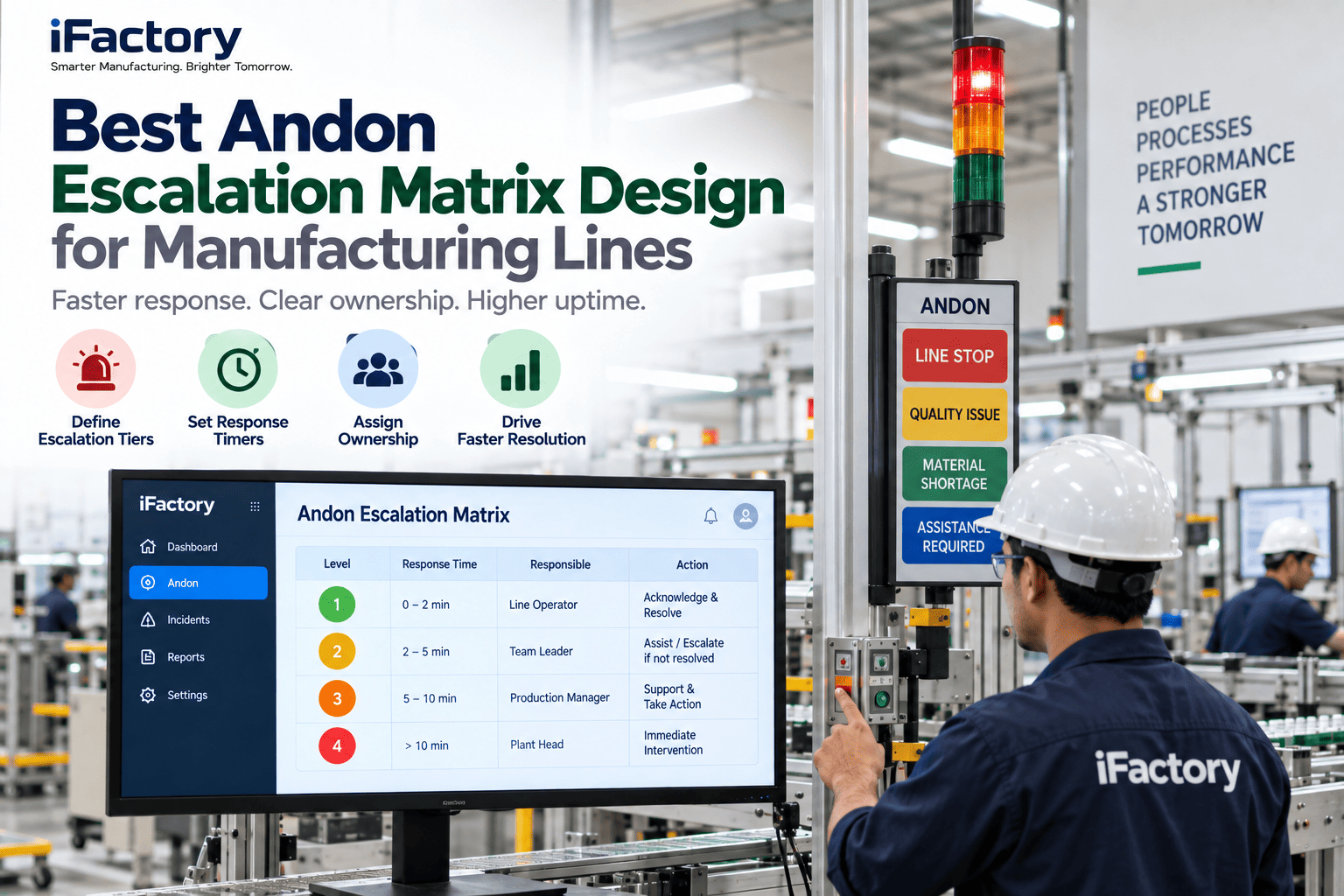
The single biggest upgrade digital Andon delivers is automatic, timed escalation. A call doesn't sit on a light waiting to be noticed — it climbs. If the closest responder handles it, it never goes further. If they don't, the system escalates to the next tier on its own, so no stop ever gets stuck waiting on one busy person.
0s
Operator raises the call
Button, cord, or tablet. The alert fires instantly to the assigned team lead's device and the line screen.
60s
Team lead notified
If unacknowledged within the target window, the call escalates automatically — no one has to chase it.
5m
Supervisor engaged
The stop is now costing real output. Supervisor and maintenance are pulled in with full station context.
15m
Plant leadership alerted
A stop this long is a plant-level event. Leadership sees it live, with the timeline and everyone already engaged.
Escalation timers and tiers are yours to set — by line, station, or issue type. Book a demo and we'll configure the ladder around how your floor actually runs.
Light Tree vs. Digital Andon
Same principle, two very different systems for acting on it. The light keeps the culture. Digital keeps the culture and closes the response gap.
Traditional Light Tree
"Someone will see it."
Alerts only whoever is looking at the board
No timing, no record of the stop
Response depends on who's nearby
No way to analyze recurring problems
Digital Andon
"The right person knows in seconds."
Targeted alert to the assigned responder
Every event timed and logged automatically
Auto-escalation if no one responds
Analytics reveal the repeat offenders
What Digital Andon Captures — and What You Do With It
Because every call is logged with a timestamp, a station, a cause, and a full escalation trail, the data stops being anecdotal. Patterns that were invisible on a light tree become the shortlist for your next improvement.
Response Time
How long from call to acknowledgment, and from acknowledgment to fix, on every station — trended over time.
Stop Frequency
Which stations raise the most calls and why, so the recurring offenders rise to the top of the list.
Downtime by Cause
Minutes lost sorted by reason — material, quality, equipment, manning — so effort goes where it pays.
Escalation Rate
How often calls climb past the first tier, showing where staffing or coverage is falling short.
What Operators and Plants Get
The value lands where it matters most — a faster floor, a calmer response, and a record that turns every stop into something you can actually fix for good.
Seconds
Faster response
alert reaches the right person instantly
Shorter
Line stops
escalation prevents the stuck call
Fewer
Repeat stops
data exposes the recurring causes
Empowered
Operators
Jidoka authority, backed by real support
Curious what your response times actually look like today? Talk to our team — most floors are surprised by the gap between call and fix.
Frequently Asked Questions
Do we have to remove our existing light trees?
No. Digital Andon runs alongside the physical boards, not against them. The light tree stays as the visual signal on the floor; the digital layer adds the alerting, timing, escalation, and logging on top. Operators keep raising calls exactly the way they do now — the difference is what happens in the seconds after.
How does this connect to Jidoka and our lean program?
It strengthens it. Jidoka depends on operators feeling able to stop the line and trusting that help will come when they do. A stop that sits on an unseen light quietly teaches people not to bother pulling it. Digital Andon closes that trust gap: the call is guaranteed to reach someone, and if it doesn't get answered, it escalates. The authority stays with the operator; the reliability improves.
Can operators still trigger a stop themselves?
Always. The operator remains the trigger — by button, cord, or tablet, whatever fits the station. Digital Andon never takes the stop authority away from the person on the line; that would break the whole principle. It simply makes sure the call is heard, timed, and escalated, so the operator's decision to stop actually gets the fast response it deserves.
How hard is implementation on a running line?
Lighter than most teams expect. Because the physical signaling can stay in place, rollout is mostly configuration — mapping stations, assigning responders, and setting the escalation timers and tiers. It can go live one line or one zone at a time, so the floor keeps running throughout and you prove the value in one area before expanding.
Can we see it on our own line first?
Yes. Pick one line, and we'll set up digital Andon with your stations, responders, and escalation rules, then run it live. Within a short window you'll see real call-to-response times, the escalation trail on every event, and the first patterns in stop frequency and cause. Book a demo and we'll scope it to your floor.
Keep the principle. Close the response gap.
See Digital Andon Running on Your Line
Pick one line and we'll configure it with your stations, responders, and escalation timers. Run it live and watch real call-to-response times, the full escalation trail, and the first patterns in where your stops actually come from.