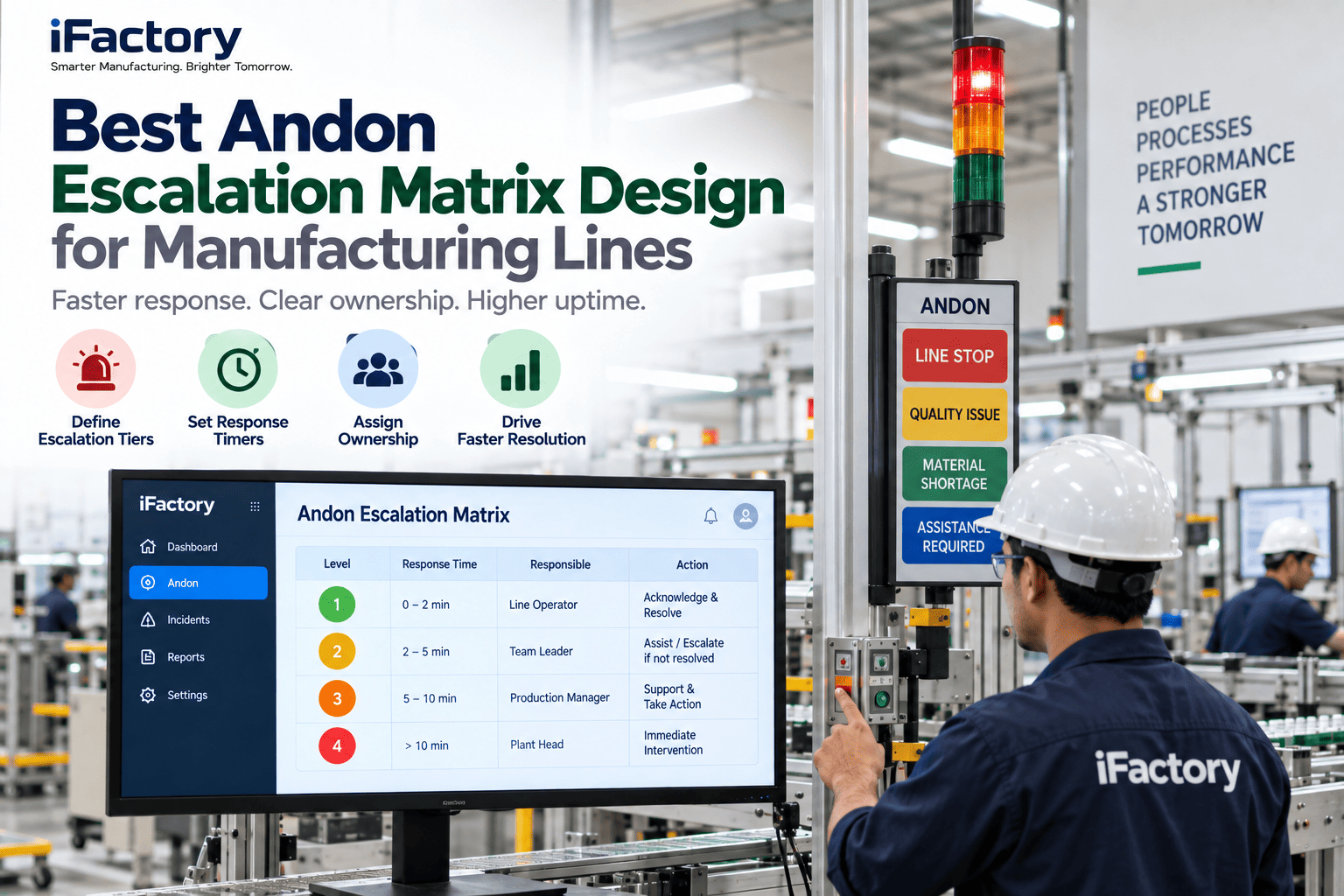
Andon is not a notification system. Andon is a line-stop authority system — the operator has the authority to stop production when something is wrong, and the notification is downstream of that authority. Implementations that copy the visual element without the authority element produce a status board that looks like andon but functions as decoration; missing operator line-stop authority is the failure mode behind roughly 70% of andon deployments that fail to change behaviour. A working andon escalation matrix defines who responds at each tier, how long the timer is before escalation, what authority each responder holds, and how the loop closes. Response tiers per Ohno and Liker: team leader in seconds, supervisor within one minute, specialist within five minutes.
iFactory / Andon escalation matrix
A True Andon System — Operator Line-Stop Authority Plus Tiered Response
Andon escalation matrix with operator line-stop authority, tiered response (team leader in seconds, supervisor in 1-2 minutes, engineer/maintenance in 5 minutes, plant manager in 15 minutes), timed escalation, and signal-to-resolution time (SRT) as the operational KPI.
T3
Engineer / maintenance
5 min
4 tiers
operator to plant mgr
Timed
escalation on non-response
The Problem in Andon Escalation Practice
A typical factory installs andon lights on every station and calls the system complete. Operators trigger them when something goes wrong. Team leaders respond eventually, if they see it. Supervisors sometimes hear about problems through a phone call rather than through the andon system. Escalation to engineering happens when the supervisor gives up. The stack light itself becomes something operators learn to ignore because response is inconsistent — and once ignored, the andon has become worse than no andon at all because it teaches the plant that visual signals do not require action. The core failure is not the technology. It is the escalation matrix that was never designed with named responders, timed tier progression, and enforced authority.
Where Andon Response Actually Breaks
Andon failure modes are consistent across 450-factory studies. Each is a specific escalation design gap.
No authority
Operators can trigger the light but not stop the line. Managers override andon triggers when production pressure is high. Operators learn triggering is symbolic — usage drops to zero within weeks.
No timer
Team leader supposed to respond 'quickly'. No timer, no escalation on non-response. Some triggers get 30-second response, some sit for 20 minutes. Consistency non-existent.
No named responder
Escalation goes to 'the supervisor' — but three supervisors are on the floor and each assumes the other will respond. Diffusion of responsibility means nobody does.
No loop closure
Team leader resolves the issue at the station. Andon reset without capturing what happened. Same problem recurs the next shift because root cause never left the resolver's head.
What Good Looks Like in Andon Escalation
A working andon system holds four disciplines together — operator line-stop authority, tiered response with timers, named responders by shift, and closure loop with root-cause capture.
Stop Authority
Operator has authority to stop the line at the andon trigger. Not overridable by production pressure. Cultural norm is that stopping the line is praised — not punished — because it prevents defect propagation.
Praised, not punished
Timed Tiers
Team leader responds within 30 seconds. Escalates to supervisor if unresolved in 2 minutes. Escalates to engineer/maintenance if unresolved in 5 minutes. Plant manager at 15 minutes. Timers enforced.
Timers, not aspirations
Named per Shift
Named responder assigned to each tier per shift, per line. Roster visible on the andon dashboard. Substitution rules for vacation, sick, or training days. No diffusion of responsibility.
Named, not roles
Closure + RCA
Every andon event closed with resolution captured. Recurring triggers flagged for root cause analysis. Signal-to-resolution time (SRT) trended as the operational KPI, not signal frequency.
SRT is the KPI
How iFactory AI Fits
iFactory AI overlays your MES, quality, and maintenance systems — providing the andon escalation logic, dashboard visibility, and SRT analytics that hardware stack lights alone cannot deliver.
Escalation Engine
Andon Layer
Configurable escalation matrix per line, per shift, per andon type (quality, material, safety, equipment). Timers per tier. Automatic escalation on non-acknowledge.
Responder Roster
Andon Layer
Named responder per tier per shift. Automatic substitution for absence. Roster visible on the shop-floor andon dashboard so operators see who is responsible right now.
Closure Capture
Andon + Quality
Every andon event closed with resolution note and category. Recurring triggers auto-flagged. Root-cause analysis workflow launched for chronic patterns.
SRT Analytics
Andon + Analytics
Signal-to-resolution time tracked per line, tier, shift, category. Trend visible to plant leadership. Response performance transparent to the team.
Ask your production manager to demonstrate the andon response protocol on the floor right now — press a button, time the response. If the timer surprises anyone in the meeting, the escalation matrix is broken. Book an andon design review.
8-Week Andon Rollout on One Line
One production line, eight weeks. The pilot deploys the escalation matrix with operator authority, timed tiers, named responders, and closure capture — and produces the first weeks of SRT data.
Weeks 1–2
Authority + Matrix
Explicit management commitment to operator line-stop authority. Escalation matrix designed per line per shift with named responders and timer values.
Weeks 3–4
Dashboard Live
Andon dashboard live on the shop floor. Responder roster visible. First andon events flow through the workflow. Response times measured from event 1.
Weeks 5–6
Closure Loop
Closure capture and root-cause workflow live. Recurring trigger patterns start to emerge. SRT trend visible to plant leadership.
Weeks 7–8
Culture Shift
Line stops praised at daily huddle. SRT trend improving. Rollout to remaining lines scoped based on culture and SRT numbers from the pilot.
Who Owns the KPI
Andon crosses production, quality, maintenance, and plant leadership. Each function owns a specific KPI or the escalation matrix reverts to stack-light-as-decoration.
Production Manager
Andon triggers per shift
Owns the front-line usage — triggers per shift as a healthy signal that operators are exercising authority. Sudden drop signals the culture is drifting back to symbolic use.
Team Leaders
Tier 1 SRT
Owns the first-response velocity — median tier 1 signal-to-resolution time under 5 minutes. Chronic escalation to tier 2 signals capacity or capability gaps at tier 1.
Maintenance Lead
Tier 3 escalation rate
Owns the specialist load — the share of andon events escalating to tier 3. Rising signals recurring reliability issues that condition-based maintenance should address.
Plant Manager
Culture around line stops
Owns the behavioural outcome — the celebration of line stops as quality wins rather than punishment. The cultural norm that determines whether andon survives.
FAQ
What's the right timer for each tier — how do we set the numbers?
The Toyota Production System's original timing per Ohno 1988 and Liker's Toyota Way (2004) sets team leader response in seconds, supervisor within one minute, specialist within five minutes. Modern implementations extend the tier ladder for larger organisations — plant manager visibility at 15 minutes for chronic non-resolution. The specific numbers configure per line based on line criticality, cycle time, and cost of stoppage. Automotive assembly lines often use tighter timers (30-second team leader) than complex batch chemical processes (2-minute team leader) because the cost of unaddressed problems differs. The principle is tier progression on timer — the specific numbers follow from the line's dynamics.
How do we handle line-stop authority when production pressure is high?
This is where most andon implementations either succeed or fail. Line-stop authority requires unambiguous management commitment — codified in policy, reinforced at daily huddles, and demonstrated when the first high-cost stop happens. Toyota's cultural norm that stopping the line is praised rather than punished is not a slogan; it is the specific management response the first time a stop reveals a real problem that would have caused escapes. When management celebrates the stop rather than questioning the operator, authority is real. When management questions the stop, authority evaporates within days. The workflow supports the discipline by making SRT transparent and by trending line-stop-driven quality improvement — but the cultural commitment is management's, not software's.
Book a demo to see the analytics that support the culture change.
How does this integrate with our MES and CMMS?
MES integration provides the line status context — which product is running, which operator is at the station, which order the andon event belongs to. CMMS integration provides the maintenance follow-up — an andon event triggered by equipment issue automatically opens a work order to the right technician with the machine, symptom, and time captured. Where the plant runs Rockwell FactoryTalk, AVEVA Wonderware, Siemens Opcenter, or Ignition for MES, and IBM Maximo, SAP PM, or eMaint for CMMS, the andon workflow reads and writes to both without disrupting the validated production or maintenance workflow. What the operator sees is one clean escalation experience; what the systems see is coordinated event handling.
Stop treating andon as decoration.
Design an Escalation Matrix That Actually Escalates — Live
Bring one production line's current andon setup, response history for the last two weeks, and the shift-by-shift responder roster. We'll design the escalation matrix with operator authority and timed tiers, and walk one live andon event through the new workflow.
Operator
line-stop authority