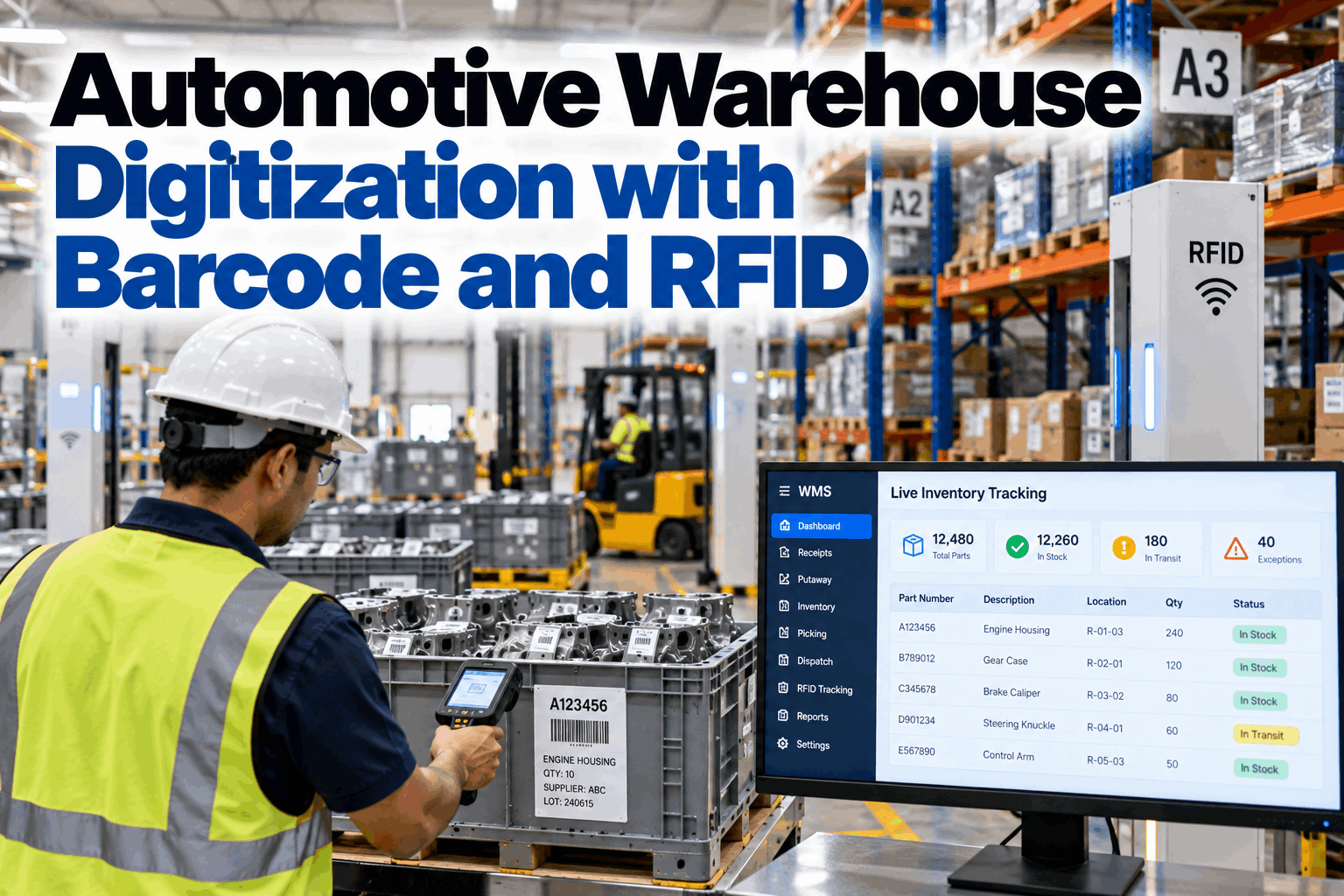
A paper receiving log looks harmless until a supplier lot goes on hold and nobody can say which racks, kits or vehicles it reached. In an automotive warehouse, every keyed part number is a chance for error, and every error travels toward the line. This guide shows how barcodes and RFID close that gap, one move at a time. Start with a dock review.
Automotive Warehouse Digitization with Barcode and RFID
Replace clipboards and keyed receipts with scans that check every pallet against the ASN, put stock where the system knows it is and feed the line on time. Every move becomes a traceability record your IATF auditor can follow.
- Why keyed receipts quietly break JIT supply
- Where barcode fits, where RFID earns its cost
- How scans become IATF 16949 traceability
Why Paper Warehouses Fail Automotive Plants
The error is small at the dock and expensive at the line.
Automotive plants run on thin buffers. JIT and JIS supply keep only hours of parts near the line, so the warehouse has no slack to absorb a wrong count. On paper, a receiving clerk reads a label, writes or keys the part number, lot and quantity, and files the slip. Each of those steps can slip, and nobody sees the slip until a picker finds an empty location or a kit arrives short. If your stores team wants to see where this happens on your own docks, our stores specialists can walk through it.
Keyed slip
A digit swapped on a part number or lot at receiving.
Ghost stock
The system shows parts in a location that is actually empty.
Line shortage
The kit arrives short and the line waits or builds out of sequence.
Trace gap
A held lot cannot be traced to the vehicles it reached.
The keystroke math behind "1 in 50 receipts"
Manual entry is often benchmarked at about one error per 300 keystrokes. A single receipt line needs far more than one field, so the risk adds up quickly before any checks are applied.
Ask how many characters a person types or writes between the truck and the line. Each one is a place to make an error. Digitization works by taking those keystrokes away, not by making the paper form neater.
Barcode or RFID: Choose by Job
Barcodes cover most of the warehouse. RFID earns its cost where line of sight is hard.
A barcode needs a scanner pointed at a label. RFID reads tags by radio, many at once and without line of sight. That makes RFID strong for returnable containers, racks and fast cycle counts, and barcodes strong for everything that already arrives labelled. Most plants end up using both. To map which mix suits your flows, book a fit check.
Labels already follow industry standards. The AIAG B-10 trading partner label guideline permits two 1D barcode symbologies and folds in the earlier B-14 guidance on 2D symbols, and the joint Global Transport Label standard builds on B-10. Odette labels play the same role in many European supply chains.
Most suppliers already ship standard labels with machine-readable codes. Scanning those labels at the dock removes the largest source of keyed errors without asking a single supplier to change anything.
Digitize Every Move from Dock to Line
Each move should leave a scan, and each scan should run a check.
A digital warehouse is not one scanner at the dock. It is a chain of small confirmations from the truck to the point of use. When every move is scanned, the system always knows what is where, and it can stop a wrong move before it happens. Our planning team can show this chain on your layout.
Receive
CapturedPart, lot, quantity, supplier, time
CheckMatches the ASN and the purchase order
Inspect and release
CapturedHold or release status by lot
CheckHeld lots cannot be put away to pick faces
Put away
CapturedPallet and location scan
CheckRight zone, right capacity, FIFO date
Pick
CapturedLocation, part and lot scan
CheckOldest valid lot first, no held stock
Kit and sequence
CapturedEach part against the build order
CheckCorrect variant in the correct slot
Deliver line-side
CapturedStation and delivery time
CheckSupermarket min and max respected
Consume
CapturedLot linked to the vehicle or serial
CheckTrace record closed and stock reduced
The value comes from what the system refuses. A put-away scan that accepts any location only records the mistake faster. Make each scan compare against a rule: the ASN, the zone, the FIFO date or the build sequence.
What Digitization Is Worth in One Warehouse
Receiving errors and long cycle counts rarely show up as one big loss. They show up as hours spent tracing, recounting and expediting, every single day.
Built for IATF 16949 Traceability
Traceability is a plan the auditor tests, not a binder on a shelf.
IATF 16949 clause 8.5.2.1 asks for documented traceability plans based on risk. Those plans must meet customer and regulatory response times, keep records in a format that makes those response times possible, and extend traceability to externally provided products with safety or regulatory characteristics. Paper logs make every one of those harder. To check how your current records would hold up, book a trace review.
Answer in minutes
Scanned lots link to locations, kits and builds, so a lot query returns its full path at once.
Searchable, not filed
Electronic records are kept in one place and can be searched by lot, part, date or supplier.
Supplier lots captured
The supplier lot is read from the label at receipt, so traceability reaches back past your dock.
Depth by part class
Safety parts carry serial-level trace, while low-risk hardware can stay at lot or date level.
Pick a real supplier lot and time how long it takes to find every pallet, kit and vehicle it reached. The result is the honest measure of your traceability, and the gaps it shows tell you which scan point to add next.
Feed JIT and JIS Lines Without Guesswork
When stock data is right, replenishment can run on signals instead of walks.
Accurate stock unlocks the rest of the material flow. Supermarket levels can trigger refills on their own, kanban can become an electronic signal, and sequenced racks can be checked against the build order before they leave the warehouse. The stores team stops walking aisles to confirm what the screen already knows. Questions about your line-feed model go to our support desk.
Supermarket min and max
Line-side levels trigger a refill before the station runs low.
Electronic kanban
A bin scan or tag read sends the signal, with no lost cards.
Sequence check
Each JIS part is confirmed against the build order before dispatch.
Rollout Mistakes to Avoid
Most digital warehouse projects stall on process, not technology.
Scanners and tags are the easy part. The hard part is deciding which checks matter, cleaning the location data and getting people to trust the screen over their memory. Plants that start small and prove accuracy on one flow move faster than plants that try to tag everything at once. A short rollout plan session helps set that first scope.
What works
- Start at receiving, the largest source of keyed errors
- Clean location data before the first scan goes live
- Test RFID read rates on your real racks and containers
- Measure accuracy weekly and share it with the team
What stalls projects
- Tagging every item before proving one flow
- Keeping paper as a backup that nobody retires
- Scans that record moves without running checks
- Assuming RFID reads well near metal without testing
Running paper and scanning side by side for too long splits trust and doubles the work. Pick a date, prove accuracy before it, and remove the paper forms on that day.
How iFactory Runs the Digital Warehouse
Scans in, decisions out.
iFactory connects your scanners, RFID readers, WMS and ERP to an on-prem AI platform inside your network. It reconciles every receipt against the ASN, keeps location data honest, reads damaged labels with cameras and warns the stores team before a shortage reaches the line. Fit questions go to our solutions team.
ASN reconciliation
Every pallet scan is matched to the ASN and order, with shortages and lot gaps flagged at the dock.
Location truth
Put-away and pick scans keep every location current, with ghost stock flagged for a quick recount.
Vision label reading
Cameras read torn, smudged or skewed labels that a handheld scanner would reject.
Shortage warning
Stock, takt and inbound ETAs combine into a warning hours before a station runs dry.
Lot trace in minutes
One query shows where a supplier lot sits, which kits used it and which builds it reached.
ERP and WMS sync
Receipts, moves and consumption post back to your existing systems, so there is one stock figure.
Results depend on your flows, label quality and how fully scanning replaces paper. We measure receipt accuracy, location accuracy and trace time on your own data during the pilot, rather than promising a general figure.
Turnkey AI: Delivered, Connected and Live in 6–12 Weeks
You do not build this. It arrives ready.
iFactory ships as a pre-configured NVIDIA AI server with the software pre-loaded, racked and ready. Rack it, plug in power and Ethernet, and the AI is live on your network. Our team handles cabling, network setup, ERP, WMS and PLC integration, scanner and reader connection, team training and 24×7 remote monitoring. Data stays on your network. For a scope matched to your warehouse, request a turnkey quote.
Ship, network and data
Server installed. ERP, WMS and dock scanners connected. Supplier labels mapped.
Model training and pilot
AI trained on your receipts and exceptions. Pilot live at one dock and one supermarket.
Go-live and training
Scanning live across the pilot flows. Stores team trained. 24×7 monitoring begins.
Frequently Asked Questions
What does automotive warehouse digitization mean?
It means replacing paper and keyed entry with scans at every move, from receiving to line-side delivery. Each scan records what moved, where and when, and checks the move against a rule such as the ASN, the location or the build sequence.
Should we start with barcode or RFID?
Most plants start with barcode at receiving, because supplier labels already carry machine-readable codes. RFID usually follows for returnable containers, racks and cycle counts, where reading many items without line of sight saves the most time.
Do suppliers need to change their labels?
Usually not. Standard automotive labels such as AIAG B-10, the Global Transport Label and Odette already carry barcodes for part, quantity and lot. You scan what arrives and print internal labels only where supplier data is missing.
How does scanning support IATF 16949 traceability?
Clause 8.5.2.1 asks for risk-based traceability plans that meet customer response times and keep records in a usable format. Scanned receipts, moves and consumption build that record automatically, so a lot trace takes minutes instead of hours of searching through logs.
Does RFID work near metal racks and steel parts?
It can, with on-metal tags and a careful reader layout. Metal and liquids affect radio reads, so read rates should be tested on your real racks and containers during the pilot before any wider rollout.
What accuracy can we expect?
It depends on how fully scanning replaces paper. In a large retail study, RFID lifted inventory accuracy from 63% to 95% and cut cycle count time by 96%. We measure your own baseline first and track the change during the pilot.
How do we start?
With one receiving dock and one supermarket, where errors are easiest to measure. A 6-week pilot connects the data, maps your labels and shows the first accuracy results. To plan it, contact our team.
Know What Is on Every Shelf
In thirty minutes we look at your docks, your labels and how stock moves to the line today. You keep the notes whether or not you go further with iFactory.
- 1A week of receipts with the errors you found
- 2Sample supplier labels from your top ten parts
- 3Your last cycle count and its variance
- 4Your IATF traceability plan or customer rules
- 5The flow that causes the most line shortages