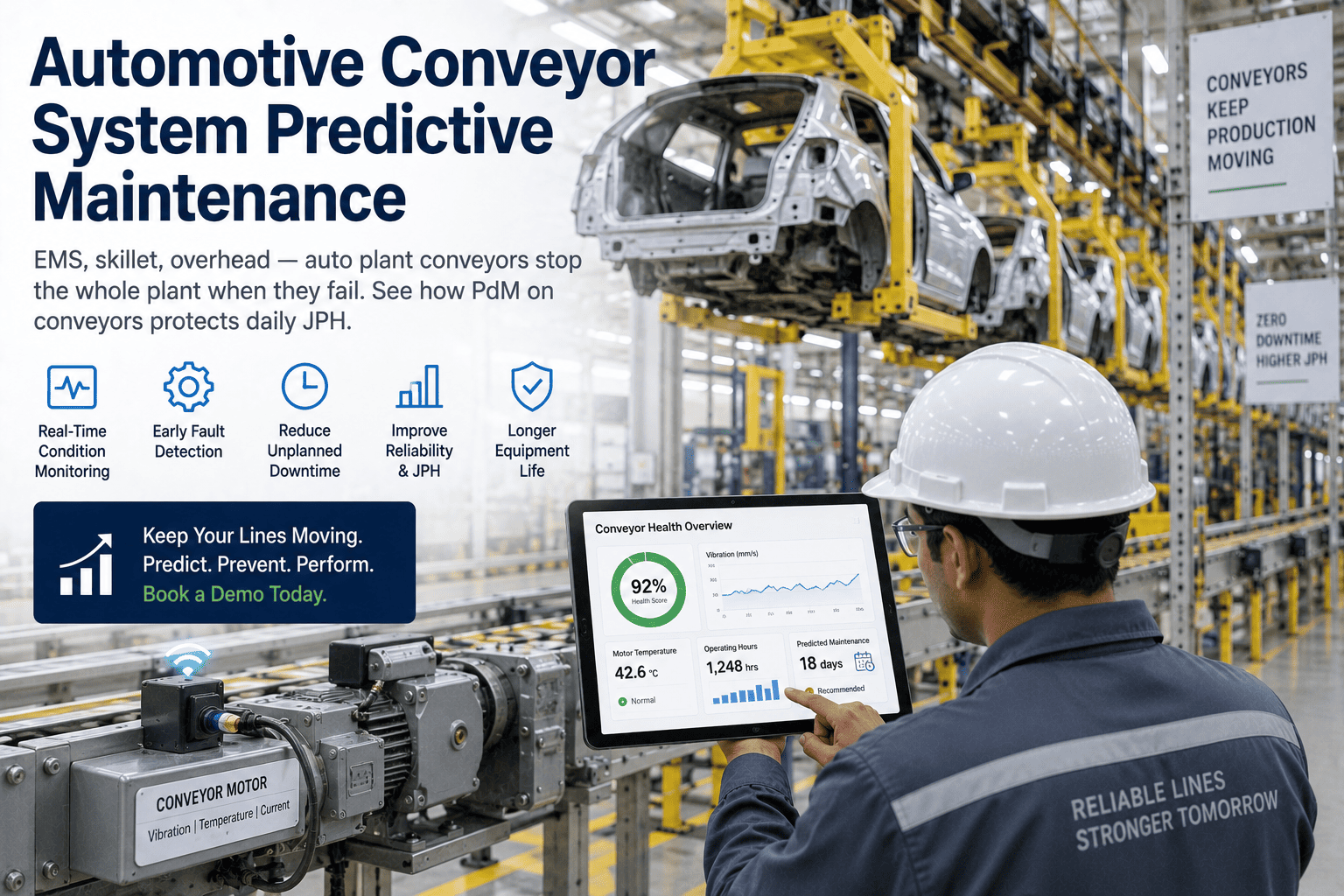
In most factories a conveyor is a piece of equipment on the line. In an automotive plant, the conveyor is the line. The EMS carriers moving doors and instrument panels, the skillets carrying bodies through general assembly while operators work on them, the power-and-free loops threading the body shop — these aren't machines that feed production, they are production. When one stops, it doesn't slow a single station; it stops jobs-per-hour for the whole plant. That's what makes conveyor reliability different here: a seized bearing on a return roller isn't a maintenance ticket, it's a line-down event measured in thousands of dollars a minute. Predictive maintenance reads the failure weeks before it reaches the floor. You can book a demo to see it on your own conveyors.
When the Conveyor Is the Line, Its Failure Is the Whole Plant's Downtime
Predictive maintenance on EMS, skillet, overhead, and power-and-free conveyors reads bearing, chain, and drive failures weeks ahead — so a conveyor fault becomes a planned repair instead of a JPH-stopping line-down event.
A Single Carrier Fault Can Stop an Entire Production Line
The reason conveyor reliability sits at the top of an automotive maintenance team's risk list is structural: the conveyor is a serial system that everything else depends on. A single EMS carrier failing on the wrong section can halt the whole line, because there's nowhere for the work to go around it. Unlike a standalone machine where a failure means one cell stops, a conveyor failure propagates upstream and downstream instantly — starving stations ahead and blocking stations behind — and the cost isn't the repair, it's the JPH the whole plant loses while the line sits idle.
This is also why conveyors are so often under-protected relative to their importance. A CNC machine or a robot cell gets attention because it's a discrete, visible asset with an obvious owner. The conveyor is infrastructure — it's everywhere and nowhere, spanning the whole plant, and no single production area owns it the way it owns its own equipment. So it tends to run on calendar-based greasing and reactive repair until the day it seizes, even though it's the single asset whose failure carries the largest downtime consequence in the building. Predictive maintenance corrects that mismatch between how critical the conveyor is and how little continuous attention it usually gets.
There's no redundant path around a stopped conveyor section. One fault stops the flow, and every station up and down the line stops with it — the definition of a line-down event.
A bearing is a few hundred dollars. The lost jobs-per-hour while the line is down, plus recovery, overtime, and expedited shipping to customers, runs to a different order of magnitude entirely.
A seized bearing left to run doesn't stay a bearing. It takes the motor shaft, the gearbox, and surrounding components with it — turning a planned part swap into a major rebuild.
Overhead and monorail conveyors run above the floor across long spans, so reaching the failure point, isolating it, and working safely at height all add hours to an unplanned stop.
The Automotive Conveyor Family, and What Kills Each One
Predictive maintenance only works when it's tuned to how a specific conveyor actually fails, and the automotive plant runs several very different types across the body shop, paint, and general assembly. Each has its own dominant failure modes and its own signatures to watch.
Autonomous carriers moving doors, front-end modules, seats, and instrument panels at process or transit speed. Fails through carrier drive-wheel wear, collector/bus-bar contact issues, and onboard drive faults — and because carriers run independently, one bad carrier on a critical section can stop the line.
Platforms that carry the vehicle through general assembly while operators walk and work on the moving line. Fails through drive-chain wear, lift and height-adjust mechanism faults, and roller or bearing degradation under continuous load — a stop here idles a whole zone of hands-on labor.
Trolleys carrying bodies and subassemblies on an overhead track. Fails through trolley-wheel wear that progressively damages the track, chain stretch, and trolley-bearing degradation — the classic derailment risk, and the hardest to reach once it stops.
Body-shop loops that can stop individual loads without stopping the whole line — robust but mechanically complex. Fails through pusher-dog and chain wear, trolley degradation, and accumulation-zone faults where the stop-and-go duty is hardest on the mechanism.
Match the Monitoring to How Your Conveyors Actually Fail
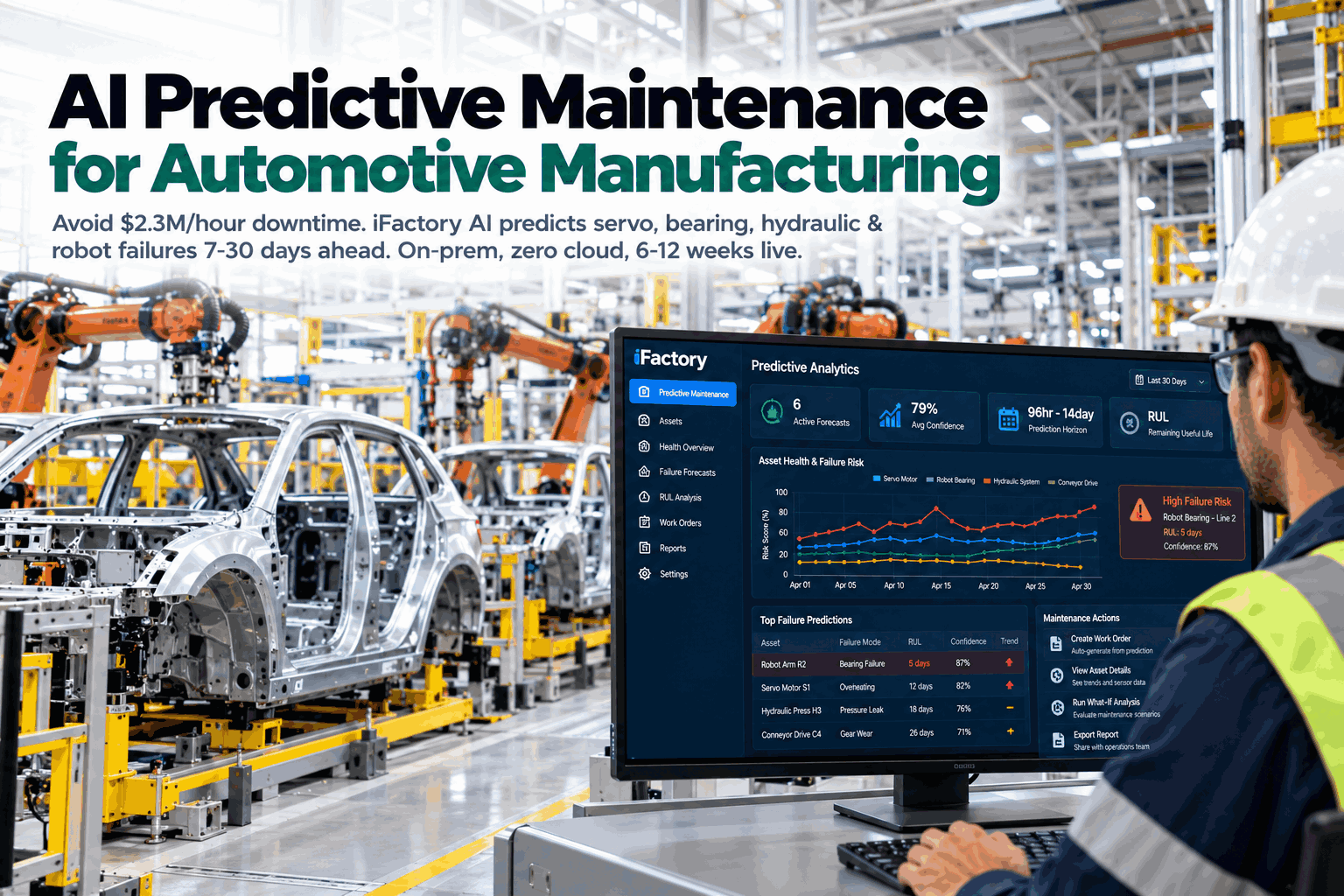
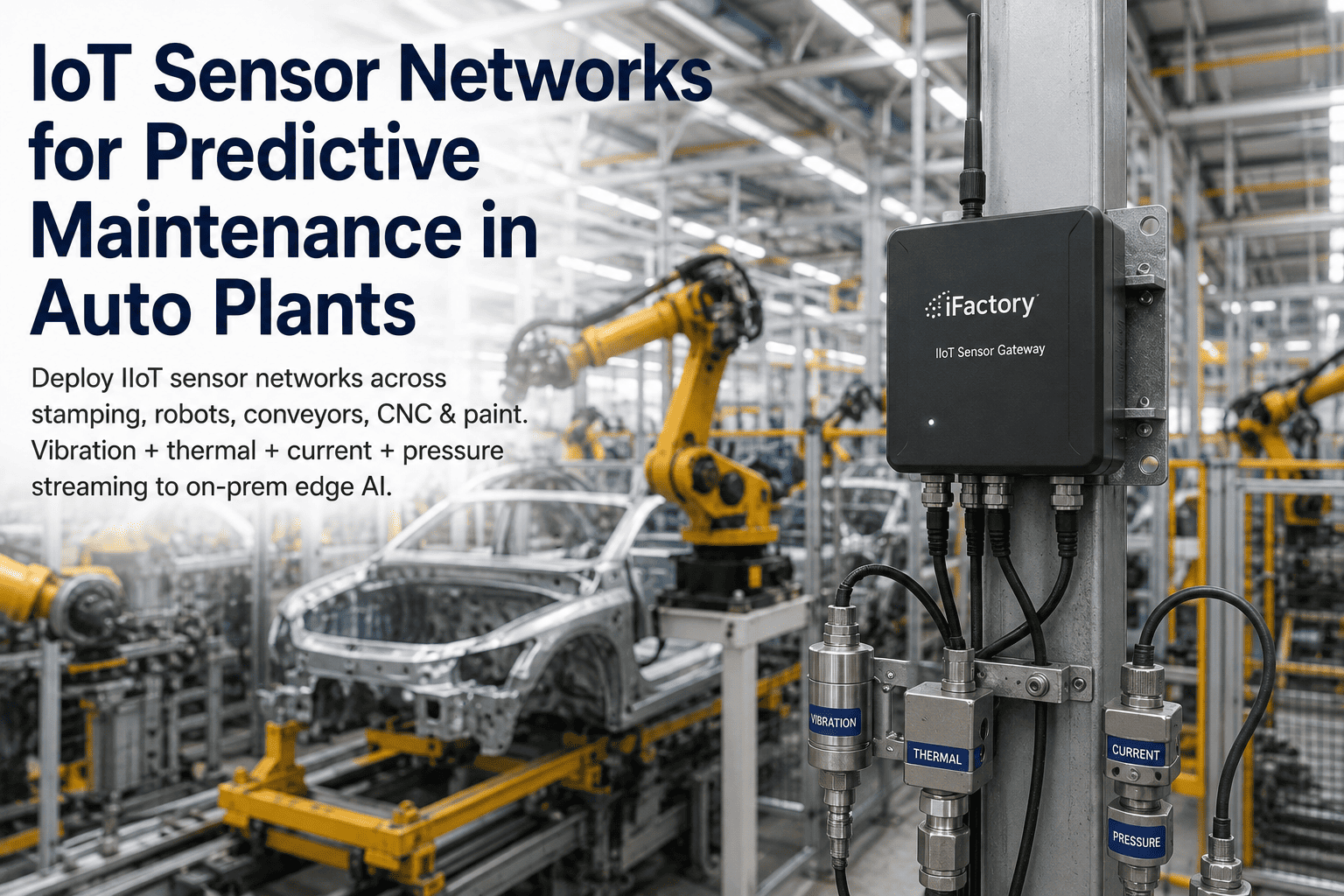
iFactory tunes detection to each conveyor type — EMS carriers, skillet drives, overhead trolleys, power-and-free chains — so the signatures that precede each failure mode get caught, not averaged away.
By the Time It Seizes, It Had Been Warning You for Three Weeks
A conveyor bearing doesn't fail in an instant. The failure begins weeks earlier as a single roller bearing starts throwing high-frequency energy into the vibration spectrum — a signature a walk-around inspection would never catch. Left unread, that early whisper becomes a chain of measurable symptoms, each one a missed chance to intervene while the fix was still small.
A documented automotive-parts case turned a single failing bearing into a $1.2 million loss — the seized bearing destroyed the motor shaft, damaged the gearbox, stopped production for days, and forced rush shipping and overtime, all from a part worth a couple hundred dollars. The bearing had been failing for weeks. Every dollar of that loss was avoidable, because every symptom in the chain above was measurable before the seizure. Predictive maintenance is simply reading those symptoms in time to act on the cheap end of the curve.
Four Signals That Cover Most Conveyor Failure Modes
Conveyors fail along a small, well-characterized set of modes, which is exactly why they're a strong predictive-maintenance target. Layering the right sensing methods across the drivetrain covers the large majority of detectable failures and turns each into an early, specific warning. No single sensor sees everything — the art is in combining methods so that a fault which is faint in one signal shows up clearly in another, and the system correlates them into one confident forecast rather than four separate alerts.
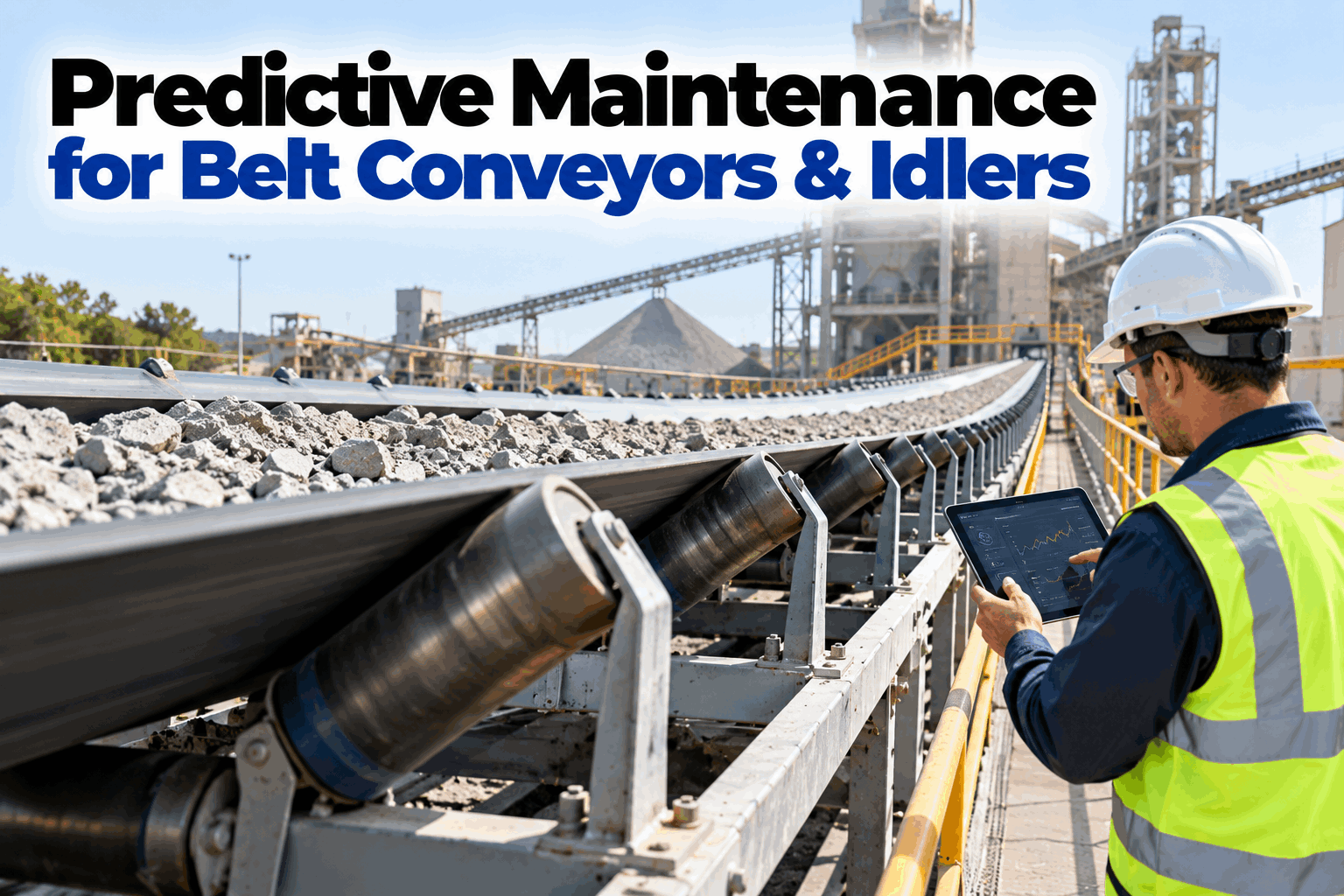
On rotating components — motor bearings, gearbox, pulleys, rollers — vibration analysis catches bearing and gear-mesh faults at the high-frequency stage, weeks before they're audible or visible.
The drive motor's current draw rises as friction grows anywhere in the mechanism, making motor-current signature analysis a whole-system early indicator of a developing load problem.
Infrared on drive motors, electrical panels, and gearboxes catches the heat rise from friction, misalignment, and electrical faults before it becomes damage.
On slow-speed rollers, chains, and pneumatic lines where vibration is faint, ultrasonic monitoring picks up the friction and leak signatures the other methods miss.
The Point Is a Work Order, Not a Dashboard
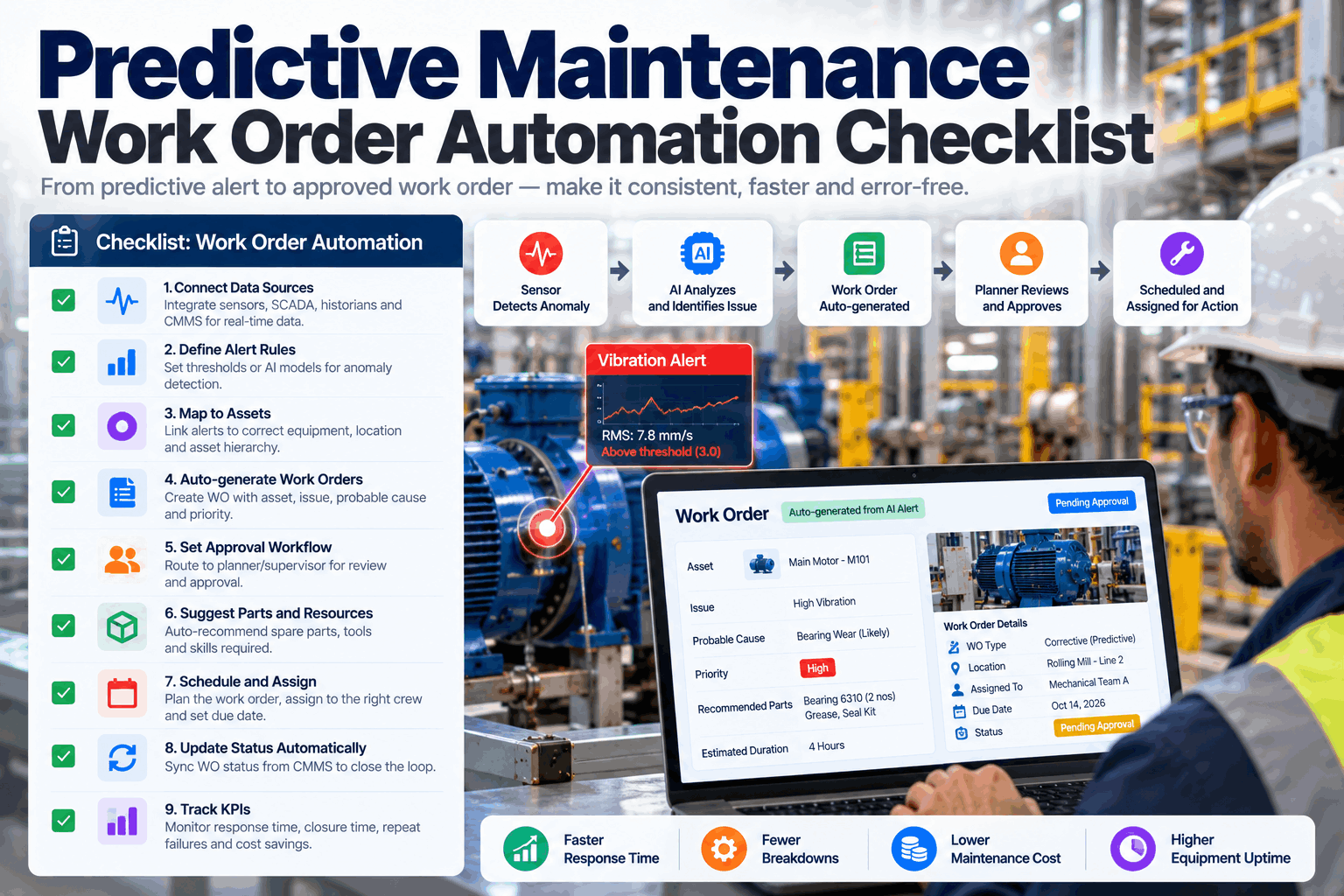
A health index nobody acts on is just a prettier gauge. The value of conveyor predictive maintenance is that it closes the loop — reading the data, forecasting the failure, and writing the work order while there's still time to plan the repair into a window that doesn't cost JPH. That last step is where most monitoring efforts quietly fail: a dashboard that shows a rising vibration trend still depends on someone noticing it, interpreting it, and deciding to act, and on a busy floor that human step is exactly where the warning gets lost. Automating the path from signature to work order is what turns a detection into a prevented failure.
What Automotive Maintenance Teams Ask About Conveyor PdM
Protect Daily JPH by Catching Conveyor Failures Weeks Early
iFactory monitors your EMS, skillet, overhead, and power-and-free conveyors continuously, forecasts each failure mode weeks ahead, and writes the work order itself — so a conveyor fault becomes a planned repair, not a line-down.