An automotive plant is a dense field of rotating, reciprocating, and servo-driven machines — stamping presses cycling under thousands of tons, welding robots repeating a motion millions of times, conveyors and CNC spindles running every shift — and most of them give no warning before they stop the line. The die-setter who recognizes a 12 Hz oscillation as a worn press bushing at 1:47 AM is the exception; the rule is that a plant has almost no visibility into equipment condition until something breaks, and a single failure on a critical asset can idle an entire line at a downtime cost measured in hundreds of thousands of dollars an hour. Calendar maintenance over-services the healthy machines and still misses the ones actually degrading. The fix is an industrial IoT sensor network: vibration, thermal, current, and pressure sensors streaming continuous condition data off every critical asset into edge-native machine-learning models that detect a failure signature two to six weeks before breakdown — running on-premise, inside the OT network, with no cloud latency and no rip-and-replace of the sensors you already own. To scope a sensor network for your plant, book a demo.
AUTOMOTIVE · IIoT SENSOR NETWORKS FOR PREDICTIVE MAINTENANCE
Stream Vibration, Thermal, Current, and Pressure Into On-Prem Edge AI.
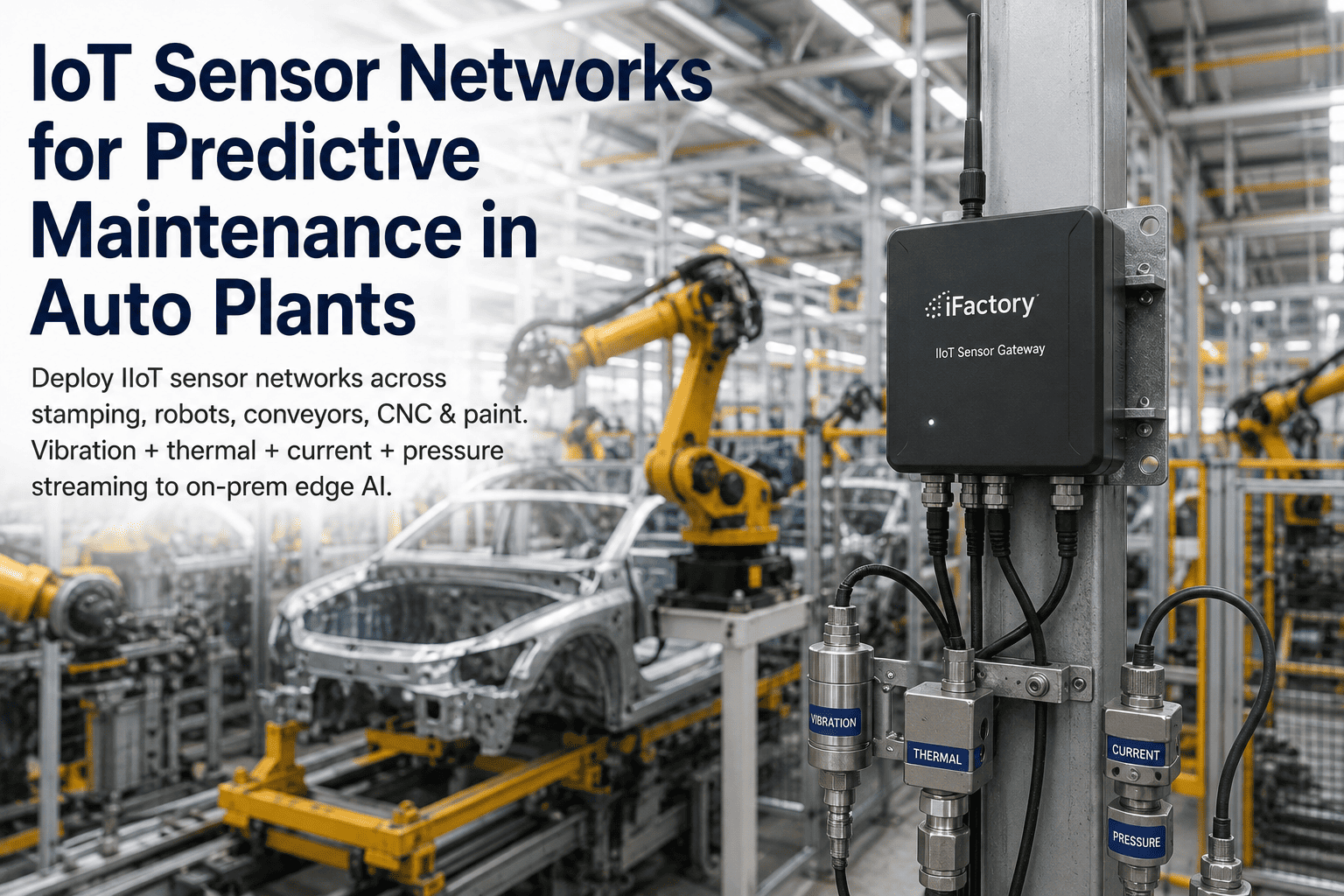
Stamping, robots, conveyors, CNC, and paint each fail in their own way — and no single sensor catches them all. iFactory deploys a multi-modal IIoT sensor network across your critical assets, fuses vibration, temperature, current, and pressure at the edge, and detects failure signatures two to six weeks out — on-premise, protocol-agnostic, and built to reuse the sensors you already have.
2–6 wks
Failure-signature warning ahead of breakdown
50–150
Sensors for strong phase-one critical-asset coverage
4 modalities
Vibration, thermal, current, and pressure fused
on-prem
Edge inference inside the OT network, no cloud latency
Why Auto Plants Run Blind Until Something Breaks
The problem isn't a shortage of machines to watch — it's a shortage of visibility into them. Traditional maintenance runs on calendar schedules and reacts to production emergencies, so a plant knows an asset's condition only at its scheduled interval or the moment it fails. In between, degradation runs unread. Every critical press, robot, and conveyor drive is a potential unplanned stoppage waiting to happen, and because a stoppage anywhere on a synchronized line idles the whole line, the cost of being caught blind is enormous — industry downtime benchmarks put the average at hundreds of thousands of dollars per hour, with emergency repairs running several times the cost of planned work.
The Calendar Fits No Individual Machine
Fixed intervals are built on an average duty cycle that no single asset actually follows, so a schedule over-services a lightly loaded robot while a hard-run press degrades past its interval. Time-based maintenance either wastes labor on machines that were fine or misses the one that was quietly failing — the schedule and the real condition drift apart.
Failure Signatures Are Subtle and Early
A bearing doesn't fail all at once — it announces itself through a gradual rise in vibration amplitude weeks or months ahead, a trend no human could spot in a spreadsheet or a walk-around. The earliest, most fixable signs are precisely the ones a periodic manual check between rounds never catches, so the plant learns of the fault only when it's advanced.
One Sensor Type Sees One Failure Mode
Vibration reveals a bearing but not a motor overheating; thermal catches the overheat but not a servo drawing abnormal current; pressure sees a hydraulic fault but neither of the others. A single-parameter program has structural blind spots, and the failure it can't see is the one that stops the line — which is why multi-modal sensing matters.
Emergency Repairs Cost Several Times More
A failure caught early is a planned part swap in a maintenance window; the same failure caught late is overtime labor, premium-priced expedited parts, and secondary damage — a failed bearing that scores a shaft turns a cheap fix into a major rebuild. Running to breakdown doesn't save maintenance money; it multiplies it several times over.
The shift a sensor network delivers is from reacting to calendar schedules and production emergencies to responding to condition intelligence. When continuous data from every critical asset feeds a model that flags a failure signature weeks ahead, maintenance stops being a scramble and becomes a scheduled, evidence-driven operation.
Four Sensing Modalities, Fused at the Edge
Because each failure mode speaks in a different physical signal, a credible network senses in four modalities at once and fuses them — cross-correlating the data types to reveal composite failure signatures that single-parameter monitoring misses entirely. These are the four streams, and what each one catches.
VIBRATION
Bearings, imbalance & servo wear
Accelerometers capture the vibration signature of rotating and reciprocating assets, where a rising amplitude at a bearing defect frequency, a 1X imbalance, or a 2X misalignment component reveals mechanical wear long before it's audible. On robotic arms and stamping presses, vibration and torque signals predict servo-motor degradation and the mechanical looseness that precedes a stoppage — the single richest early-warning stream, evaluated against recognized ISO vibration thresholds at the edge.
THERMAL
Motor, electrical & friction heat
Temperature sensors track motor windings, bearings, gearboxes, and electrical connections, catching the heat rise that signals overload, lubrication breakdown, or a developing electrical fault. Thermal is the modality that sees an overheating condition a vibration sensor is blind to, and it often confirms a fault the vibration stream first flagged — rising heat corroborating rising vibration is a far stronger signal than either alone.
CURRENT
Motor load & servo signature
Motor-current signature analysis reads the electrical draw of drives and servos, detecting load anomalies, rotor-bar and winding faults, and the gradual current-signature drift that tracks servo and motor degradation on robots and conveyors. Current monitoring reaches inside the motor without a mechanical sensor on the shaft, and it exposes an electrical or load fault that neither vibration nor thermal would attribute correctly on its own.
PRESSURE
Hydraulic, pneumatic & tonnage
Pressure transducers monitor hydraulic and pneumatic systems and press tonnage, catching a failing pump, a leaking valve, a clogged filter, or a tonnage drift that signals a die or actuator problem. On stamping presses, capturing tonnage, position, and pressure every stroke alongside vibration and cycle time builds the complete health picture of the machine — pressure is the stream that makes a fluid-power or forming fault visible before it becomes scrap or a stoppage.
Scope a Sensor Network for Your Critical Assets
Bring your equipment list and failure history. iFactory engineers will define the optimal phase-one configuration — typically 50 to 150 sensors on your highest-impact presses, robots, and conveyor drives — and show the multi-modal streams feeding live edge predictions.
Coverage Across the Five Plant Zones
A sensor network earns its place by covering the assets whose failure hurts most, and in an automotive plant those cluster into five zones — each with its own dominant failure modes and its own mix of the four modalities. Most plants reach strong predictive coverage by starting with the highest-criticality assets in these zones.
01
Stamping Presses
The highest-consequence assets on the floor — a press failure can idle a whole body line. Tonnage, position, pressure, vibration, and cycle time captured every stroke expose bushing wear, die problems, and drivetrain degradation, with the press's reciprocating loads making vibration and pressure the primary early-warning streams.
Robotic Welding Cells
02
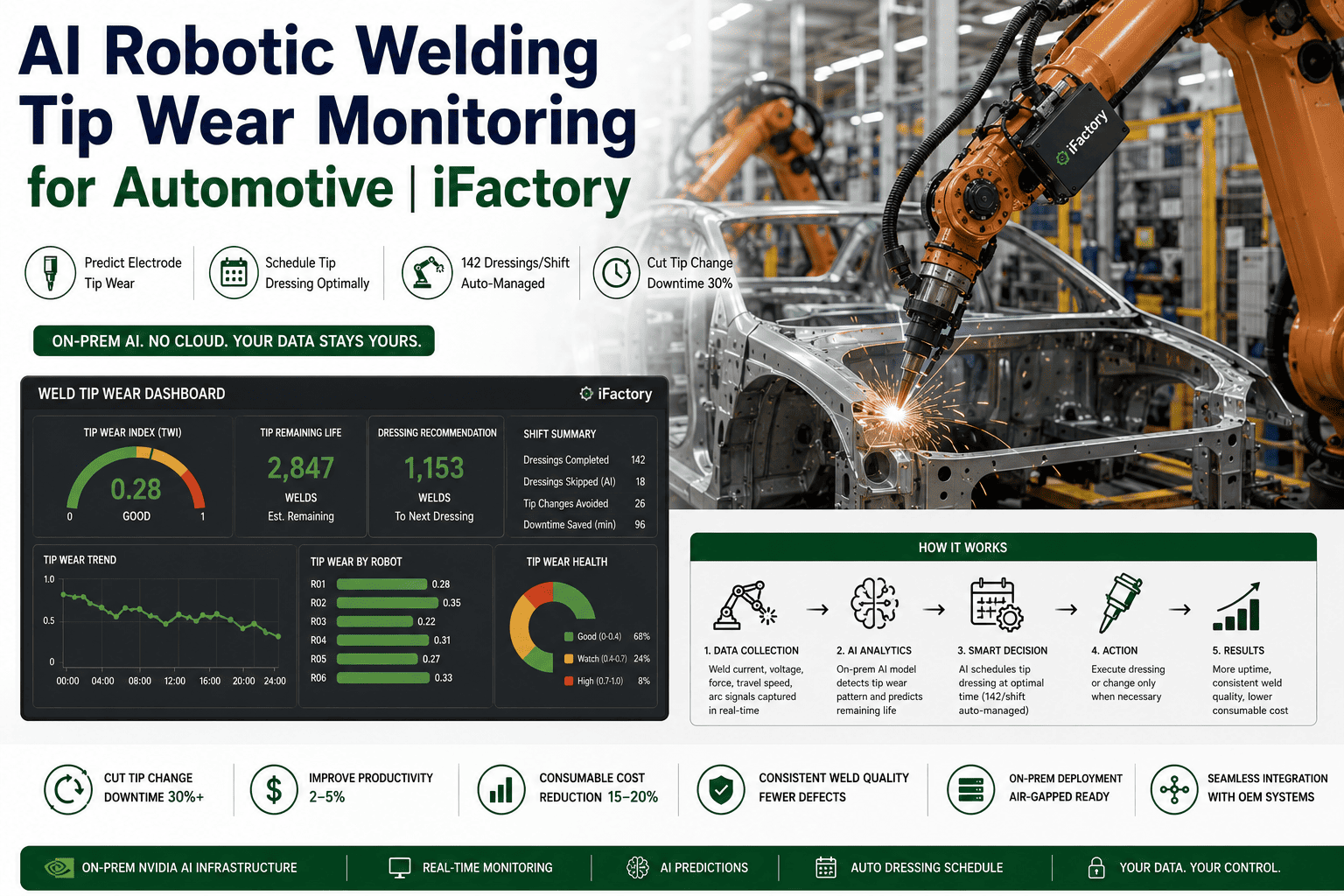
Welding and handling robots repeat a motion millions of times, and vibration plus current signatures predict servo-motor degradation and the mechanical wear that drifts weld quality. Catching a degrading servo axis early keeps a cell producing instead of dropping out mid-shift and stalling the cells downstream of it.
03
Conveyor & Drive Systems
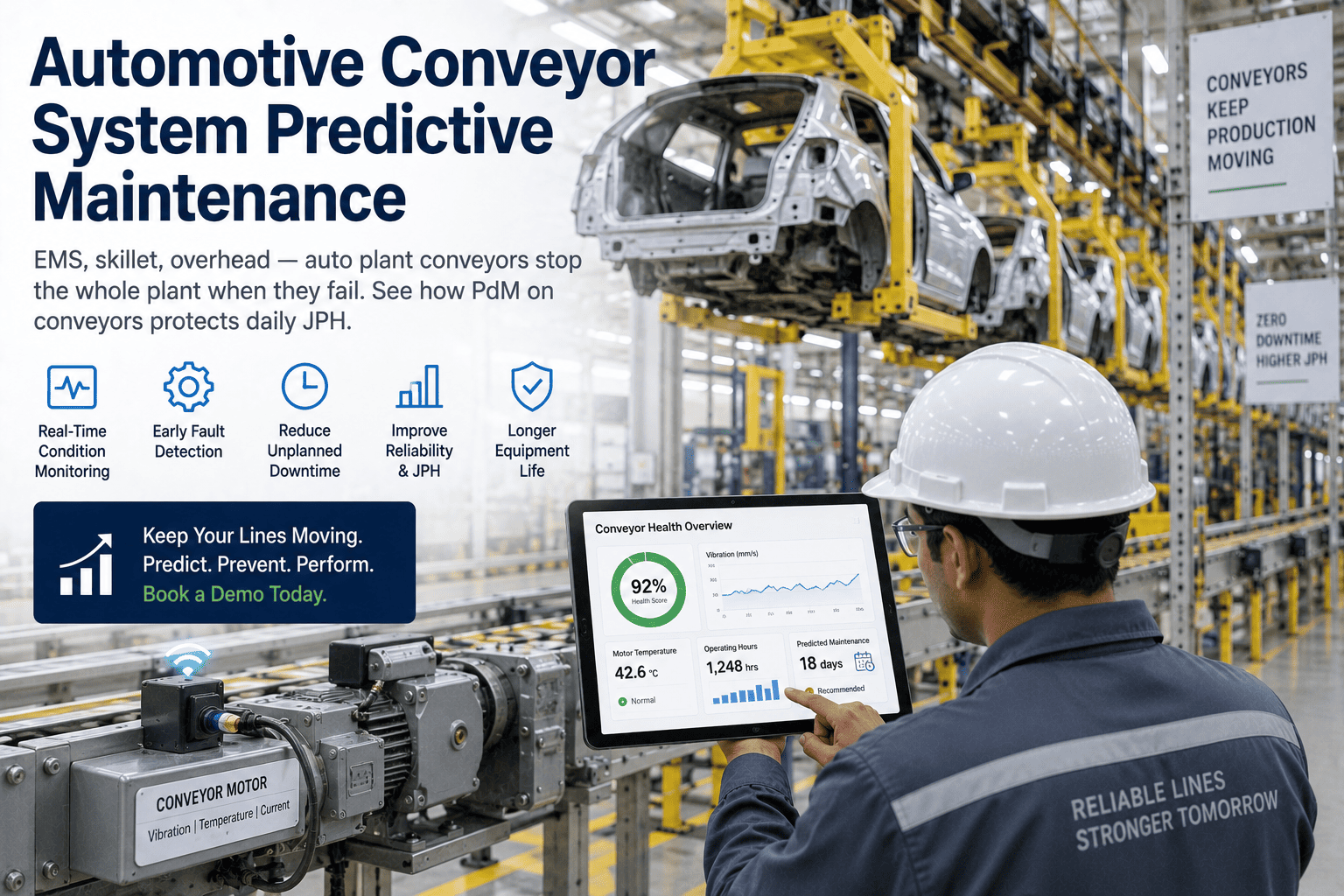
Conveyor drive motors, gearboxes, and bearings move work through the plant, and a single drive failure can halt material flow across a line. Vibration, thermal, and current together catch bearing wear, gearbox faults, and motor overload on the drives whose stoppage has outsized ripple effects downstream.
04
CNC Machining Centers
Spindles, ball screws, and axis drives in machining centers wear in ways that degrade both tool life and part quality. Vibration and current monitoring detect spindle-bearing degradation and axis-drive faults early, protecting both the machine and the parts it produces from a fault that would otherwise surface as scrap.
05
Paint Shop Equipment
Pumps, fans, compressors, and conveyors in the paint shop run continuously and are costly to recover if they fail mid-batch. Vibration, thermal, and pressure sensing catches pump and fan degradation and air-system faults before they interrupt a finish line where a stoppage risks scrapping in-process bodies.
The Edge Architecture That Makes It Work
Sensors are only as valuable as the pipeline that turns their data into a maintenance decision without latency or loss. The architecture is a layered edge design: sensors feed gateways, gateways translate and analyze locally, and only meaningful, scored alerts move onward — so a critical anomaly reaches maintenance in seconds and a network outage never loses data.
1
Protocol-Agnostic Sensor Ingest
A single edge gateway accepts wired inputs like 4-20 mA and Modbus RTU and wireless inputs like BLE mesh, LoRaWAN, and Wi-Fi 6, translating proprietary fieldbus protocols into MQTT and OPC-UA. No protocol converters or custom middleware — the network federates every standard industrial sensor type through one normalized pipeline.
2
Local Feature Extraction and Signature Detection
Each gateway performs first-pass analysis at the edge — FFT computation, ISO threshold checking, and edge-native ML signature detection — filtering noise and detecting immediate anomalies so critical alerts reach operators within seconds. The heavy lifting happens on the floor, not in a distant cloud, which is what enables sub-second response.
3
Distributed Gateways, Store-and-Forward Buffering
Gateways are distributed — often one per production cell — to keep packet loss minimal at peak polling, and each buffers data locally so a WAN outage never drops a reading. Proper gateway placement is the difference between reliable predictions and a network that silently loses the vibration packets the model needs.
4
Scored Alerts Into the CMMS
Every alert carries asset ID, fault type, severity score, and recommended action — not just "vibration high" — and flows automatically into the CMMS as a prioritized work order. The pipeline runs end to end from edge anomaly to work order to repair verification, so each measurement serves an actual maintenance decision.
On-Premise Because Automotive Demands It
For an automotive plant — especially a press shop or a Tier-1 feeding an OEM — on-premise isn't a preference, it's the default, and three hard requirements drive it. The whole network is built to run inside the plant, keeping data sovereign and inference instant.
OEM Data Governance
Tier-1 and OEM contracts impose strict data-governance requirements on where production data can live, and an on-premise architecture keeps sensor and process data inside the plant network rather than shipping it to a vendor cloud. Compliance with customer data rules becomes a property of the deployment, not an ongoing negotiation.
OT Network Isolation
Plant OT networks are deliberately isolated from external connectivity for security, and the platform respects that boundary — running inference on-premise with proper OT/IT segmentation that sharply reduces the lateral attack surface. Predictive maintenance is added without opening the OT network to the outside.
Real-Time Latency
Detecting a failure signature and acting on it can't wait on a cloud round-trip, and control-loop-adjacent timing demands local inference. Edge-native models deliver sub-second anomaly response with no cloud latency, so a critical alert is available in the moment it matters rather than seconds later.
Resilient by Design
Because inference runs locally with encrypted edge-to-CMMS transport and store-and-forward buffering, the monitoring keeps working through a WAN outage and nothing about the plant's operations leaves the building. The network is sovereign and resilient by architecture, not by add-on.
Brownfield-Ready: Reuse the Sensors You Have
A working plant can't be re-instrumented from scratch, and it doesn't need to be. The platform is built for brownfield deployment — reusing existing sensor investment, adding only where there's a gap, and scaling in phases from a pilot to full coverage without re-architecting.
1
Zero Sensor Replacement
The platform integrates existing sensors from the major IIoT vendors through OPC-UA, MQTT, Modbus, and REST API, so current vibration, temperature, pressure, and current monitors feed the edge pipeline without being ripped out. A federation layer reuses the investment already in the plant.
2
Add Sensors Only Where Uncovered
New wireless MEMS vibration and temperature sensors are added only for critical assets that have no existing coverage, packaged with edge gateway and configuration so an uninstrumented press or drive gets visibility quickly without a plant-wide install.
3
Phase One on the Critical Few
Deployment starts with 50 to 150 sensors on the highest-criticality presses, welding robots, and conveyor drives — the assets where a single failure causes the most production impact — proving predictive coverage and ROI on the machines that matter most before expanding.
4
Scale Without Re-Architecting
The same edge architecture that runs a phase-one pilot scales to a full enterprise deployment of thousands of points, so growth is a matter of adding gateways and sensors, not redesigning the network. Pre-built equipment templates for presses, motors, conveyors, and CNC speed each expansion.
What Changes for the Plant
A multi-modal IIoT sensor network changes maintenance from a calendar-and-emergency operation into a condition-driven one — with measurable effects on uptime, cost, and how the maintenance team spends its day.
01
Weeks of Warning on Critical Assets
Failure signatures surface two to six weeks ahead, so a degrading press bushing or servo axis becomes planned work in a maintenance window instead of a line-down emergency at 2 AM. The most disruptive failures convert into scheduled part swaps with the crew and parts arranged.
02
Composite Signatures, Fewer Blind Spots
Fusing vibration, thermal, current, and pressure catches composite failure modes no single sensor would, so the fault that used to slip past a one-parameter program gets seen. Cross-correlation turns four separate streams into one reliable diagnosis.
03
Emergency Costs Come Down
Catching failures early replaces overtime labor, expedited-parts premiums, and secondary damage with planned repairs, removing the several-times multiplier that breakdown maintenance carries. Uptime rises and per-repair cost falls at the same time.
04
Data Stays Home, Alerts Come Fast
On-premise edge inference keeps production data inside the OT network for OEM compliance and delivers sub-second alerts with no cloud dependency, so the plant gets both the governance it needs and the speed the line demands. Sovereignty and responsiveness at once.
Frequently Asked Questions
The questions plant and maintenance engineers ask most often when evaluating an IIoT sensor network.
Do we have to replace our existing sensors?
No — the platform commits to zero sensor replacement. It integrates existing sensors from the major IIoT vendors through standard industrial protocols like OPC-UA, MQTT, Modbus, and REST API, so your current vibration, temperature, pressure, and current monitors feed the edge processing pipeline without being ripped out. A federation layer reuses the investment already in the plant, and new sensors are added only for critical assets that have no existing coverage — typically packaged as wireless MEMS vibration and temperature units with an edge gateway for a quick install. This brownfield-first approach is deliberate: a working automotive plant can't be re-instrumented from scratch, so the network layers onto what you already run and fills gaps rather than demanding a wholesale replacement. To assess compatibility with your current sensor estate,
book a demo.
How many sensors do we need to start?
Most plants achieve strong predictive coverage on critical assets with 50 to 150 sensors in phase one, focused on the highest-criticality stamping presses, welding robots, and conveyor drive systems where a single failure causes the most production impact. The right number depends on your specific equipment list and failure history, which is exactly what a scoping session determines — iFactory engineers define the optimal starting configuration rather than applying a generic count. Starting on the critical few proves predictive coverage and ROI on the machines that matter most before expanding, and because the same edge architecture scales from a pilot to a full deployment of thousands of points, phase-one is a genuine starting point rather than a throwaway trial. You expand by adding gateways and sensors, not by re-architecting, so the initial network is the foundation the full rollout builds on.
Why does this need four sensor types instead of just vibration?
Because each modality sees a different failure mode, and the most dangerous faults show up as a pattern across several. Vibration reveals bearing wear, imbalance, and misalignment but is blind to a motor overheating; thermal catches the overheat but not a servo drawing abnormal current; current exposes an electrical or load fault that neither would attribute correctly; and pressure sees a hydraulic, pneumatic, or tonnage problem the others miss. A single-parameter program has structural blind spots, and the failure it can't see is often the one that stops the line. Fusing all four lets the edge models cross-correlate the streams and detect composite failure signatures that single-parameter monitoring misses entirely — rising vibration confirmed by rising temperature and a current-signature shift is a far stronger, earlier, and more specific diagnosis than any one stream alone. Multi-modal sensing is what turns raw monitoring into reliable early prediction.
Does the AI run in the cloud, and will our data leave the plant?
No — inference runs on-premise at the edge, and your data stays inside the plant network. For automotive, on-premise is the default for three concrete reasons: OEM and Tier-1 data-governance requirements dictate where production data can live, plant OT networks are deliberately isolated from external connectivity for security, and detecting and acting on a failure signature can't wait on a cloud round-trip. Edge-native models deliver sub-second anomaly response with no cloud latency, running inside the OT network with proper OT/IT segmentation that reduces the lateral attack surface, and encrypted edge-to-CMMS transport with store-and-forward buffering keeps the system working even through a WAN outage. So the network is sovereign and resilient by architecture: the plant gets the data governance its customers require and the real-time responsiveness the line demands, without production data ever leaving the building. Contact
iFactory support to review the on-premise architecture for your site.
How do sensor alerts turn into actual maintenance work?
Through an end-to-end pipeline that runs from edge anomaly detection to a work order in your CMMS. Each edge gateway performs first-pass analysis — FFT computation, ISO threshold checking, and ML signature detection — and every alert it generates carries the asset ID, fault type, severity score, and recommended action, not just a bare "vibration high." That scored alert flows automatically into the CMMS as a prioritized work order, so a maintenance planner receives a diagnosed, ranked task rather than a raw reading to interpret. After the repair, the loop closes with verification against the sensor trend, confirming the fault is resolved. The design principle is that every measurement must serve a maintenance decision — the network isn't a dashboard to watch but a pipeline that converts condition data into prioritized, actionable, verified work, which is what actually reduces downtime rather than just displaying it.
STREAM · FUSE · PREDICT — ON YOUR FLOOR, INSIDE YOUR NETWORK
Give Every Critical Asset a Voice — Two to Six Weeks Before It Fails.
A multi-modal IIoT sensor network across stamping, robots, conveyors, CNC, and paint — vibration, thermal, current, and pressure fused by edge ML into failure signatures, scored into your CMMS as work orders. On-premise for OEM data governance and sub-second response, protocol-agnostic over OPC-UA and MQTT, and brownfield-ready to reuse the sensors you already own. Start on the critical few and scale without re-architecting.