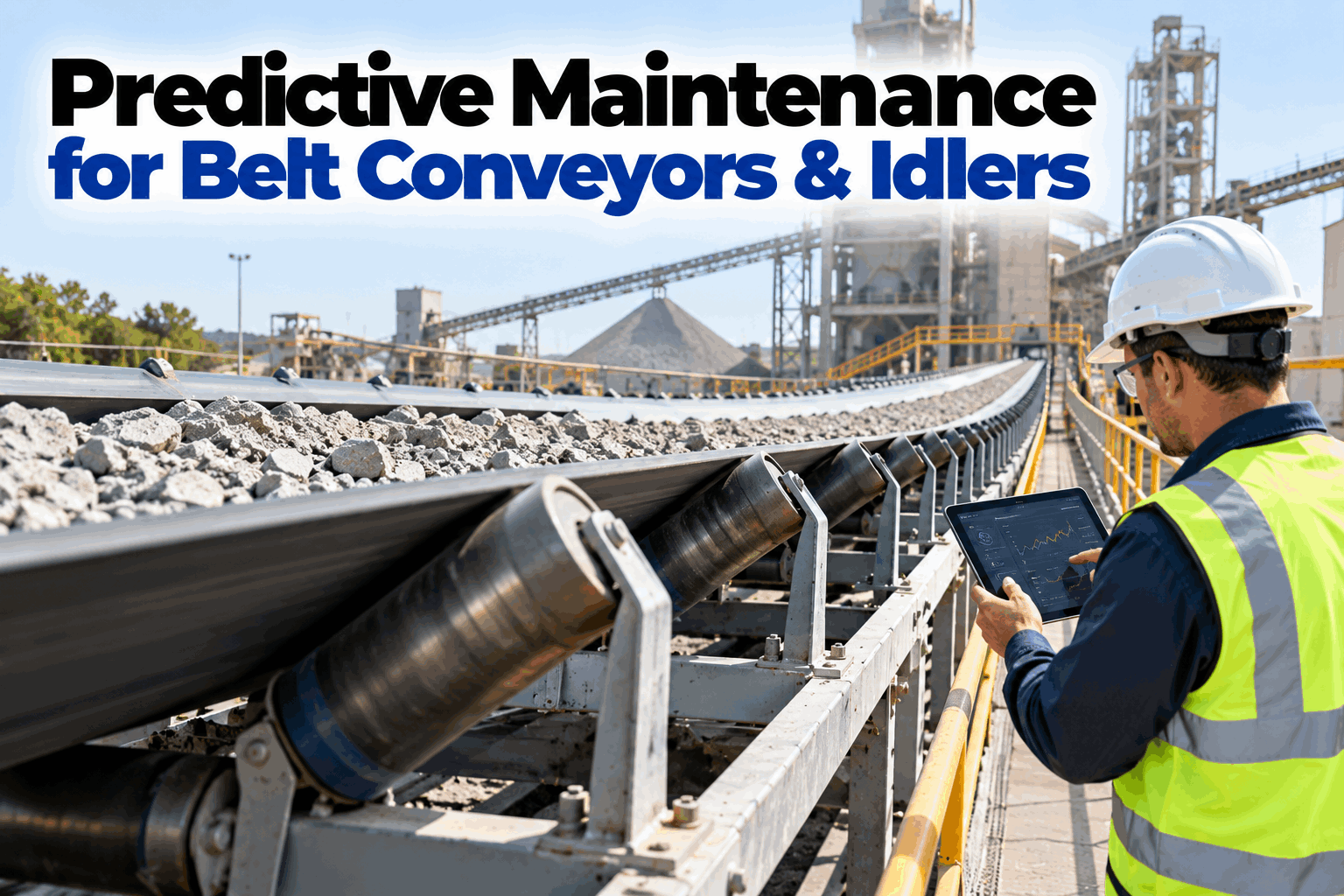
A cement plant belt conveyor rarely fails on the day it looks worst. It fails on the day a splice that has been flexing for eleven months finally lets go, or when one seized idler roller wears a groove into the belt cover that nobody saw because the walkway inspection happens once a shift and the idler is 400 metres from the nearest door. On a mine-to-mill conveyor system, a single belt tear stops the crusher, starves the raw mill and puts a repair crew on a live structure at height. Calendar-based greasing and visual rounds find what is already broken. iFactory Predictive Maintenance with AI Vision is built to find splice fatigue, idler bearing wear, mistracking and belt-tear risk while there is still time to plan the stop.
iFactory Predictive Maintenance + AI Vision - Cement Material Handling
Predictive Maintenance for Belt Conveyors and Idlers
Splice fatigue, idler bearing failure, mistracking and belt-tear risk tracked continuously along the mine-to-mill belt system, ranked by consequence and delivered as planned work orders.
4 failure modes
splice, idler, tracking and tear risk monitored on one belt health view
AI Vision
camera detection of edge damage, spillage, belt wander and surface cuts
Idler-level
every roller scored by temperature and vibration trend, not by walkway round
Planned stop
repairs scheduled into kiln or mill outages instead of emergency call-outs
Why Cement Plant Belt Conveyors Fail Without Warning
Belt conveyors in a cement plant carry abrasive limestone, clay, coal, clinker and additives over long distances with very little redundancy. The failures are slow to build and sudden to arrive. These are the six reasons they are missed.
01
Splice fatigue is invisible
A vulcanised or mechanical splice weakens over thousands of flex cycles. From the walkway it looks intact until cords start to pull out, and by then the repair window is hours, not weeks.
02
Idlers fail one at a time, then in groups
A seized roller is a minor item until it wears through its shell and cuts the belt. Idler counts run into the thousands on an overland conveyor, so no round can listen to every one.
03
Mistracking is treated as a nuisance
A belt running 60 mm off centre is adjusted and forgotten. The same drift repeating every week points to a frame, roller or loading problem that is quietly damaging the belt edge.
04
Tear risk builds at transfer points
Oversize rock, tramp metal and impact at chutes cause longitudinal rips. The warning signs are surface cuts, edge damage and spillage that nobody logs as a risk.
05
Remote belts get the fewest inspections
The longest conveyors between quarry, crusher and stockpile are also the hardest to walk. Inspection frequency falls exactly where the consequence of failure is highest.
06
Safety exposure on every intervention
Emergency repairs mean people working near moving belts and rotating idlers at height. Fewer unplanned interventions is a direct conveyor safety gain, not only an availability gain.
Belt Health by Conveyor - The View a Walkway Round Cannot Build
The belt health table scores each conveyor on splice condition, idler condition and tracking, then ranks the risk so the maintenance planner knows which belt to open at the next outage. The figures below are an illustrative example of the output.
Conveyor
Splice fatigue
Idlers flagged
Max drift
Risk
Recommended action
C1 - Crusher to stockpile
22%
3 of 410
18 mm
Low
Routine greasing at next round
C2 - Limestone overland
48%
17 of 1,260
42 mm
Medium
Replace 6 idlers at next planned stop
C3 - Raw mill feed
81%
9 of 380
64 mm
High
Re-splice and check frame alignment
C4 - Clinker transfer
35%
4 of 290
21 mm
Low
Monitor, no action
C5 - Coal and additive feed
57%
8 of 220
38 mm
Medium
Inspect chute edge damage
System summary
1 splice near limit
41 of 2,560
64 mm
1 high
A routine round would not have found C3
The Four Failure Modes - Signal, Detection and Action
Each failure mode has a different early signal and a different detection method. Predictive maintenance for belt conveyors works because it matches the sensor to the signal instead of relying on one inspection method for everything.
Splice fatigue
Early signal
Rising splice flex strain, edge lift and cord exposure trend across passes
Detection
AI Vision on the return run plus splice-pass counting per revolution
Action
Re-splice scheduled before the fatigue index reaches the limit
Idler bearing failure
Early signal
Bearing temperature rise and vibration or acoustic change against its own baseline
Detection
Thermal and acoustic scoring per roller position, not per conveyor
Action
Replacement list grouped by walkway section for one efficient shift
Mistracking and tear risk
Early signal
Repeating belt drift, edge damage, surface cuts and spillage at transfer chutes
Detection
AI Vision cameras at chutes and head or tail pulleys, drift measured in millimetres
Action
Alignment check, chute liner or skirt repair, tramp metal source traced
What a Belt Conveyor Alert Should Contain
An alert that says "conveyor C3 abnormal" starts an investigation. An alert that names the position, the evidence and the deadline starts a work order. These are the five elements every iFactory conveyor alert carries.
1
Exact location on the belt system
Conveyor, idler station or splice number, and side of the frame. The crew walks to a position, not to a conveyor.
Example: C3 - Splice 4 - 120 m from head pulley
2
Failure mode and trend, not a single reading
The alert shows how the signal has moved over days, so the planner can tell a worsening splice from a one-off spike.
Example: Fatigue index 62% to 81% over 21 days
3
Consequence of failure
Which downstream equipment starves if this belt stops, and for how long a typical repair would take.
Example: Raw mill feed stops, repair estimate 9 hours
4
Recommended window
The latest safe date to act and the next planned outage that fits, so the repair joins an existing stop.
Example: Act before the next kiln stop, within 12 days
5
Work order with parts and permit
A drafted work order with the spare, the isolation requirement and the camera image attached as evidence.
Example: WO drafted - splice kit reserved - LOTO required
Want to see belt health scores for your own conveyors? Book a demo - bring your conveyor list and last year's belt failure records and we will show where the early signals would have appeared.
How iFactory Turns Conveyor Signals Into Planned Maintenance
The path from a sensor or camera on the belt to a scheduled repair is five steps. Each replaces a manual judgement with a recorded, repeatable output.
01
Capture
Idler temperature and vibration, drive current, belt speed and camera feeds collected per conveyor.
02
Baseline
Each idler and splice learns its own normal, so a loaded long belt is not judged against a short empty one.
03
Detect
AI Vision and trend models flag drift, damage, hot rollers and rising splice strain early.
04
Prioritise
Findings ranked by consequence of failure and time to act, not by alarm count.
05
Schedule
Work orders created and fitted into the next planned outage with parts and permits attached.
What Predictive Belt Conveyor Maintenance Delivers
The return shows up as fewer emergency stops on the material handling line, shorter repairs because parts and people are ready, and fewer people working near moving belts at height.
Fewer tears
Found before the rip
edge damage and cuts caught while repair is a patch
Idler-level
Targeted replacement
change the failing rollers, not the whole section
Planned stops
Mine-to-mill continuity
repairs join kiln and mill outages
Safer work
Fewer live interventions
less emergency work beside moving belts
Frequently Asked Questions
How is this different from our existing belt inspection rounds?
Rounds depend on what an inspector can see and hear during a short visit. iFactory monitors continuously, scores every idler and splice against its own baseline and shows the trend, so a component that is getting worse is identified weeks before it looks damaged. Rounds still matter, but they become targeted at the positions the data points to.
What hardware is needed on a long overland conveyor?
It depends on the belt and the risk. Typical deployments combine fixed cameras at transfer points and pulleys, thermal or vibration sensing on critical idler sections, and signals already available from the drive and PLC. Most plants start with the highest consequence conveyor and extend from there, so hardware is not fitted along the whole system on day one.
Can AI Vision really detect belt damage in dusty cement plant conditions?
Dust, lighting and camera position matter, which is why placement is reviewed with your team before installation. Cameras are positioned where the belt surface and edges are visible, with housings suited to dust, and detection is validated against known damage on your own belts during the pilot before any alert is relied on.
Can we pilot on one conveyor first?
Yes, and that is the recommended start. Choose the conveyor whose failure would stop the plant fastest, or the one with the worst repair history. Run a baseline period, validate the detections against your inspectors' findings, then review which alerts led to planned work. Book a demo and we will help select the pilot conveyor from your failure records.
Stop finding belt failures after they stop the plant.
See Predictive Maintenance on Your Cement Plant Belt Conveyors
Bring your conveyor list, idler counts and last year's belt failure records. We will show which failure modes iFactory would have flagged early and what the planned repair would have looked like.