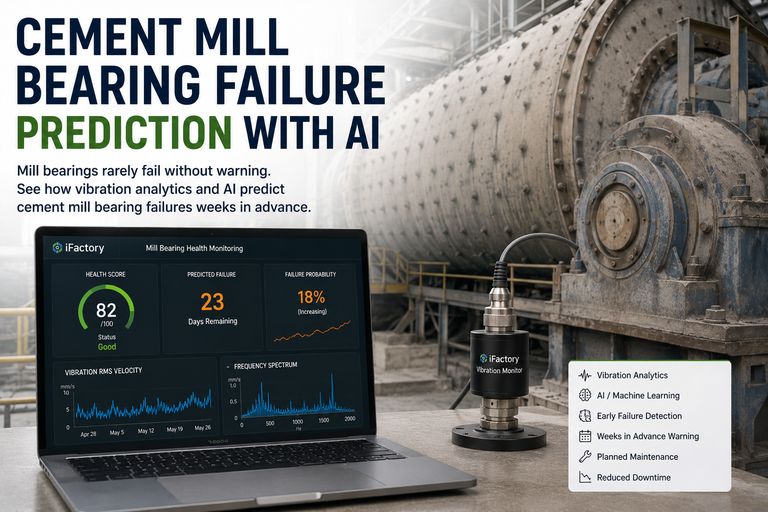
The cement ball mill is the workhorse that refuses to retire. Simple, rugged, and forgiving, it still grinds a large share of the world's cement — right up until the day it doesn't. When a ball mill fails, it fails big: a wiped trunnion bearing, a cracked pinion, a shell run bare of liners. These are the most expensive stops in the grinding hall, measured in weeks of lost output and long-lead spares. The good news is that none of them happen silently. The babbitt shows up in the oil, the gear mesh shifts in the vibration, the mill sound changes — weeks before the breakdown. iFactory ball mill predictive maintenance reads those signals and turns them into 30 to 45 days of lead time on your highest-cost failures.
Grinding Reliability for Cement Plants
AI Predictive Maintenance for Cement Ball Mills
Track trunnion bearing distress, main-drive gearbox degradation, and liner wear with iFactory's oil analytics and vibration AI. Catch the costliest grinding failures a month or more before they stop the mill.
The Ball Mill Rarely Breaks — But When It Does, It Hurts
The reason ball mills survive in an age of vertical roller mills is simple: they are dependable, and operators trust them. That trust is also the trap. Because failures are rare, they are easy to stop watching for, so when a trunnion bearing or a main drive finally lets go, it lands with no warning and the worst possible timing. The three failures that define ball-mill reliability are not equally expensive — and knowing which one is developing changes everything about how you respond.
The three ball-mill failures, ranked by what they cost you
01
Trunnion / slide-shoe bearing
Weeks down, babbitt re-pour, possible shell damage
02
Main-drive gearbox, girth gear and pinion
Long-lead gears, alignment, extended outage
03
Liner and lifter wear
Efficiency loss, then shell risk if run too far
A planned reline is routine. A bearing that wipes without warning is a plant emergency. Predictive maintenance is about knowing which failure is coming, and when — early enough to make it the first kind, not the second.
Each Failure Broadcasts on a Different Channel
The art of ball-mill condition monitoring is knowing where each failure shows itself first. Bearings and gears speak loudest through their oil. Drive faults show in vibration. Liner wear shows in the mill's sound and its power draw. iFactory listens on all three channels at once.
Primary signal: Oil analytics
Trunnion Bearing Distress
Hydrodynamic babbitt bearings live and die by their oil film. Rising lead, tin, and copper in the oil means the babbitt is wearing; falling oil pressure or rising temperature means the film is failing. Oil analysis sees the metal weeks before the bearing wipes.
Primary signal: Vibration + oil
Main-Drive Gearbox and Pinion
Gear-mesh frequencies, pinion-bearing spectra, and misalignment show in vibration, while iron and additive depletion trend in the gear oil. Together they flag tooth wear and lubrication problems before a tooth lets go.
Primary signal: Sound + power
Liner and Lifter Wear
As liners wear, the mill's acoustic signature and power draw drift, and grinding efficiency slips. Trending these together estimates remaining liner life so relines are planned, not forced by a sudden efficiency collapse.
Oil Is the Bloodstream of a Ball Mill
For the two costliest failures — the trunnion bearing and the main drive — the oil carries the story before any other sensor. Every particle of wear metal, every drop of water, every point of viscosity change is evidence. iFactory's oil analytics reads that evidence as a live trend rather than a monthly lab report, so a rising wear-metal line becomes an alert, not a surprise found at the next sample. This is what the oil is telling you.
Oil analysis, read as a live readout
NormalWatchAlarm
Wear metals (Fe, Cu, Pb, Sn)
Which component is wearing — babbitt or gear
Viscosity
Wrong oil, oxidation, or contamination
Water and moisture
Ingress that breaks the film and corrodes
Particle count
Abrasive contamination and filter health
Additive level
Whether the oil still protects the surfaces
Oxidation and acidity
Oil aging and varnish risk over time
When did your trunnion oil last tell you something before the bearing did? Book a 30-minute demo and we'll trend your mill's oil and vibration history against live diagnostics.
Three Channels, One Lead Time
No single signal tells the whole story. A wear-metal spike could be a bearing or a gear; vibration narrows it; process data confirms the load context. iFactory fuses oil analytics, vibration, and process data into one diagnosis — the likely component, the severity, and a remaining-life window you can schedule around.
Oil analytics
Wear metals, water, viscosity, particles
Vibration AI
Gear mesh, bearing defect frequencies
Process data
Power, temperature, throughput, mill sound
One diagnosis
Likely component, severity, and a 30 to 45 day remaining-life window you can plan around
What 30 to 45 Days of Lead Time Buys You
Lead time is the entire game. A wiped bearing found the moment it fails means an emergency: no spare staged, no crew scheduled, the whole grinding circuit stopped while a long-lead part is chased down. The same fault caught a month earlier is a line on next month's shutdown plan. Here is what those weeks make possible.
Day 0
Oil and vibration trends cross the early-warning line
Days 1-40
Stage the spare, schedule the crew, plan the outage window
Planned stop
Fix on your terms, before the failure threshold
30-45
Days of warning
on the highest-cost grinding failures
↓
Emergency stops
surprises become scheduled shutdown work
Planned
Relines
liner life trended, not run to failure
Lower
Repair cost
early fixes avoid secondary damage
Frequently Asked Questions
How is this different from our routine oil sampling?
Routine sampling gives you a snapshot every few weeks, read after the fact by a lab. iFactory treats oil data as a continuous trend, combined with vibration and process signals, so a rising wear-metal line triggers an alert the moment it turns rather than at the next scheduled sample. You keep your lab program; the AI turns its data into early warning instead of a report filed after the fact.
Does it work for both trunnion and slide-shoe bearing mills?
Yes. Both are oil-lubricated hydrodynamic bearings whose health lives in the oil film, so the same logic applies: wear metals, oil pressure, temperature, and vibration together reveal distress well before failure. The models adapt to your specific bearing type and its normal operating envelope.
Can it really give a month of warning on a bearing failure?
Bearing and gear degradation is usually gradual, which is exactly why it is detectable. Babbitt wear releases metal into the oil and shifts the vibration signature over days and weeks, not seconds. Trending those signals against your mill's healthy baseline is what makes a 30 to 45 day lead time realistic for slowly developing faults. Sudden damage from a foreign object is the exception, and even then contamination and vibration usually still give some notice.
How does it handle liner wear, which is not an oil signal?
Liner wear shows in the mill's acoustic signature and power draw, and in a gradual drift in grinding efficiency. iFactory trends these together to estimate remaining liner life, so a reline is planned into a shutdown rather than forced by a sudden drop in throughput or a bolt failure.
What do we need to get started?
Most ball mills already produce the core signals: bearing temperatures, oil pressure, motor power, throughput, and often vibration on the drive. Add your existing oil-analysis results and the picture is largely there. The best next step is a demo on your own mill history, where we show where the early signals were in your past events and how much lead time you would have had.
Catch the Costliest Grinding Failures a Month Early.
See Your Ball Mill's Warning Signs Before the Bearing Does
Bring your oil-analysis history, bearing and drive data, and any past trunnion or gearbox events. We'll show where the early signals lived, how much lead time AI would have delivered, and what a planned fix would have saved.