A rotary kiln gives very little warning in the language most plants are listening for. The support roller bearing that seizes on a Tuesday was already telling you something six weeks earlier, in vibration sidebands and a two-degree drift in bearing temperature that nobody was reading. By the time the noise is audible or the thrust is visibly wrong, the decision has been made for you: stop the kiln now, lose the clinker, lose the brick, and spend three days doing an emergency job that a planned stop would have absorbed. iFactory's predictive maintenance AI reads the kiln's mechanical signals continuously and forecasts rotary kiln failures 30 to 45 days out, while you still have a choice about when to stop.
AI Predictive Maintenance for Cement Plants
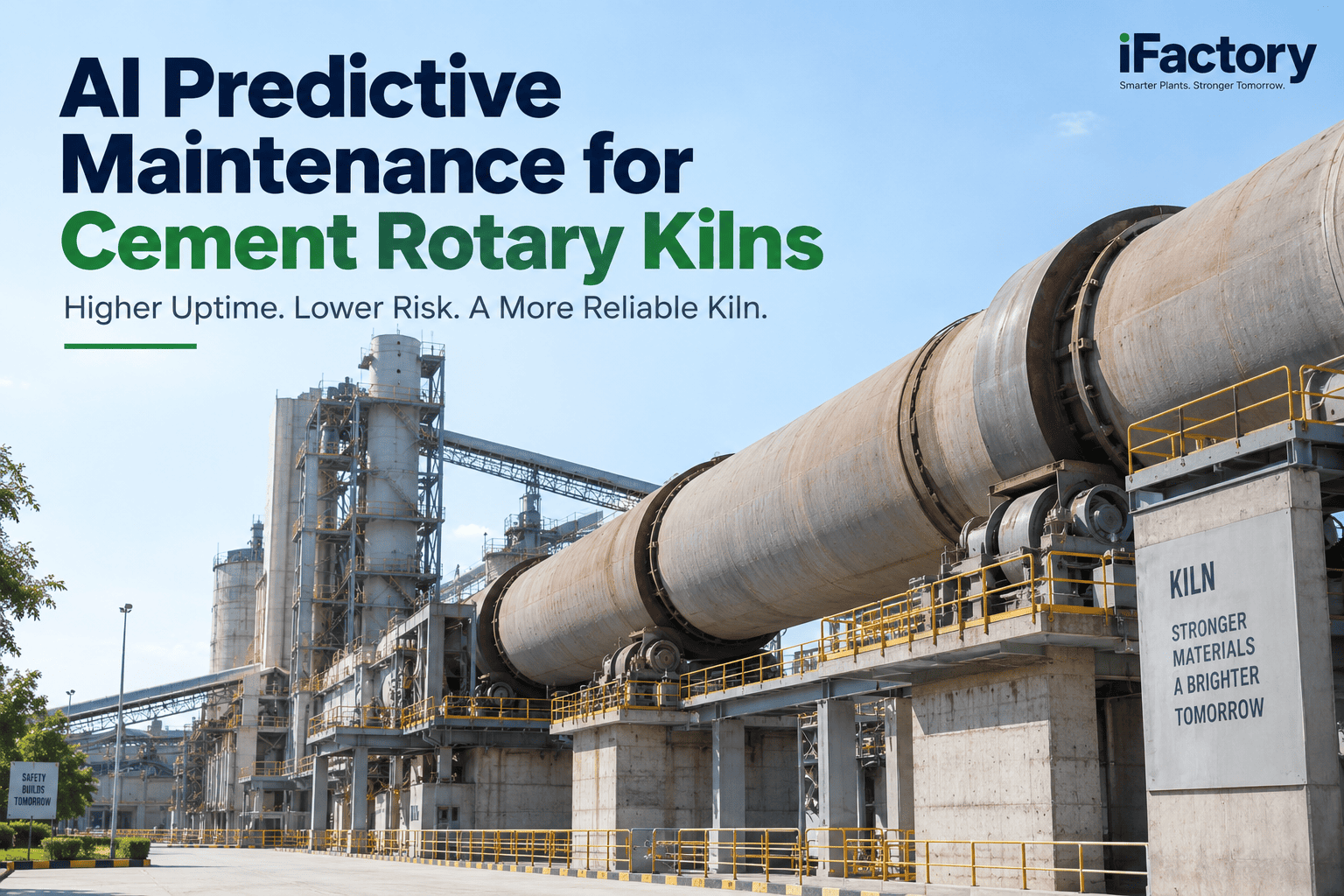
AI Predictive Maintenance for Cement Rotary Kilns
Vibration, shell temperature and drive analytics fused into one model of kiln health — support rollers, girth gear, thrust and alignment watched continuously, with failures forecast 30 to 45 days before seizure.
The repair is the cheap part. A kiln that comes down hot and unplanned takes the coating with it, stresses the lining, and often costs brick that had months of campaign left. Then there is the cool-down and heat-up cycle, the clinker you did not make, the cement mills running short of feed, and the overtime crew doing under pressure what a planned crew would have done calmly at the next stop. Plants carry this cost because mechanical condition is usually checked on a route — monthly readings, a walk-down, an oil sample — and a bearing that degrades between rounds simply is not seen. Continuous monitoring with an AI model on top of it changes the question from whether the kiln will fail to when, and how much notice you get.
What the Model Watches on the Kiln
Kiln health is not one measurement. It is the relationship between roller bearing vibration, bearing and shell temperature, drive torque, thrust position and axis alignment — signals that only mean something together, because the same rising vibration means one thing on a well-aligned kiln and something far more urgent on a kiln whose axis has drifted.
Monitored points on a three-pier rotary kiln
Roller bearings, the drive train, the shell and the kiln axis are one mechanical system. The AI model learns their normal relationship on your kiln, then flags the drift that a single-sensor alarm limit would not catch until it is already severe.
Failure Announces Itself Early, in the Right Signal
Mechanical degradation follows a curve. Long before a bearing is hot or loud, its vibration spectrum changes — sidebands appear around running speed, bearing defect frequencies grow, the envelope energy rises. Temperature moves much later. Audible noise and visible symptoms arrive last, usually with days, not weeks, left. Watching the earliest signal is what converts a breakdown into a scheduled job.
How early each signal detects the same failure
The same failure is visible in vibration weeks before it is visible in temperature. Predictive maintenance is not about better alarms at the end of the curve; it is about acting at the start of it.
What an Early Warning Actually Looks Like
An alert is only useful if it names the asset, the evidence and the time you have. The model reports the specific component, the signals that moved, and how long the trend gives you before the risk becomes unacceptable — so maintenance planning can start immediately.
Kiln health alert — support roller, pier 2
AssetPier 2 support roller, downhill bearing
Forecast window34 days
Bearing defect frequency energyrising 6 weekswatch
Bearing temperature+6°C vs baselinewatch
Roller load distributionunevenwatch
Drive motor torque signaturenormalOK
Kiln axis and thrust positionwithin toleranceOK
Change the bearing at the next planned stop and correct roller skew while the kiln is down. No production risk in the window, and no emergency cool-down.
The Signals the AI Reads
Each stream answers a different question about kiln condition, and the model reads them against each other rather than one alarm limit at a time.
Vibration analytics
Spectral and envelope analysis on roller, pinion and gearbox bearings, detecting defect frequencies and looseness long before heat or noise.
Thermal and shell data
Bearing temperatures and kiln shell scanner profiles, separating a mechanical problem from a refractory or coating problem.
Drive current and torque
Motor current and torque signatures reveal rising friction, gear mesh faults and the load a struggling kiln is quietly drawing.
Alignment and thrust
Axis deviation, tyre creep and thrust position explain why a bearing is loaded wrong, so you fix the cause and not only the part.
What Predictive Maintenance Delivers on the Kiln
The benefit is not an extra dashboard. It is a different maintenance calendar, where kiln work moves into slots you chose.
40-60%
Fewer unplanned stops
failures caught while still repairable
30-45
Days of notice
time to order parts and plan crews
Longer
Refractory campaigns
fewer hot, unplanned cool-downs
Lower
Maintenance cost
planned work instead of emergency work
Frequently Asked Questions
How far ahead can the AI predict a rotary kiln failure?
For the common mechanical failures on a kiln, typically 30 to 45 days. Support roller and thrust bearing degradation, gear mesh problems and drive faults all develop over weeks, and the vibration signature changes early in that period. The exact notice depends on the failure mode and how the kiln is running: a bearing starved of lubrication can move much faster than one wearing normally, which is why the model reports a window and updates it as the trend develops rather than issuing a single fixed date.
Do we need to install new sensors on the kiln?
Usually a mix. Most plants already have bearing temperatures, drive current, a kiln shell scanner and a historian, and a lot can be done with those alone. Continuous vibration on the support rollers, pinion and gearbox is the stream that buys the most warning, and where periodic route readings exist we normally recommend permanent sensors on the critical points. We scope this against what you already have, so the first phase uses existing data and only the additions that materially improve the forecast.
How is this different from the vibration alarms we already have?
A conventional alarm compares one channel against a fixed limit, so it fires when the value is already high, and it fires on load changes, kiln speed changes and process upsets that are not faults. The AI model learns the normal relationship between vibration, temperature, load, kiln speed and torque on your kiln, so it detects a change in pattern while every individual value is still inside limits, and it suppresses the noise that makes operators ignore alarms. It also attributes the change to a component rather than a channel.
Does it work on an older kiln with limited instrumentation?
Yes, and older kilns often gain the most, because their failure history is long and their mechanical condition is less uniform. The model is trained on your plant's own data, so it adapts to an old three-pier kiln with a well-known list of recurring problems just as readily as to a new line. Where instrumentation is thin we start with the highest-value points, usually roller bearing vibration and the drive, and extend coverage once the first predictions have proved themselves.
How does it fit with our CMMS and planning process?
A prediction is only worth anything if it becomes a work order. Alerts carry the asset, the evidence, the recommended action and the forecast window, and they are raised into your maintenance system so planners treat them like any other job. That means parts can be ordered and crews scheduled against the next planned stop, and the kiln team sees one list of work rather than a separate monitoring tool nobody opens.
Stop the Kiln When You Choose To.
See Your Kiln's Failure Risk Before It Costs You a Shift
Bring your vibration, bearing temperature, shell scanner and drive data. We'll build the kiln health model, show what it flags today, and demonstrate the warning you would have had on the last failure you took.