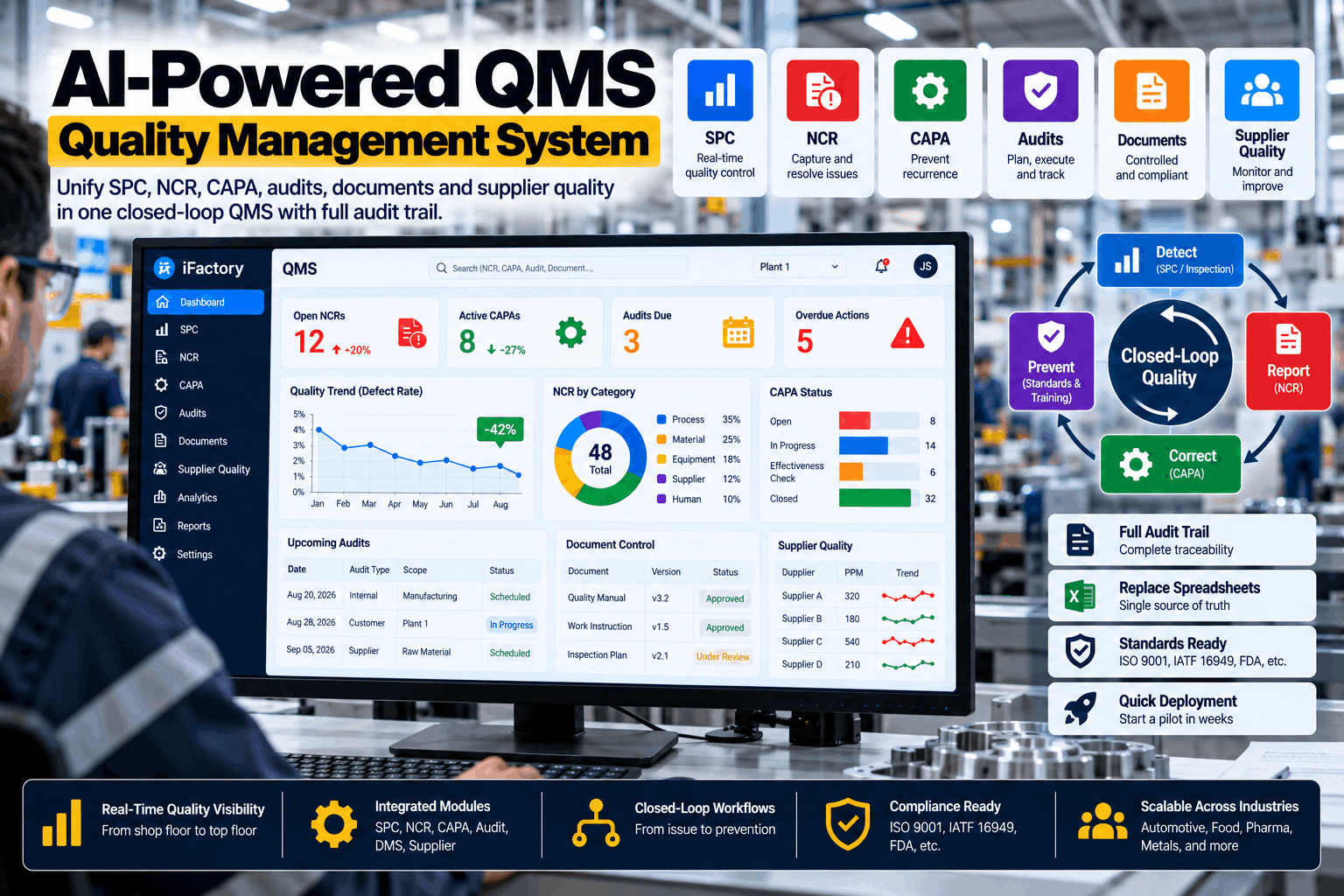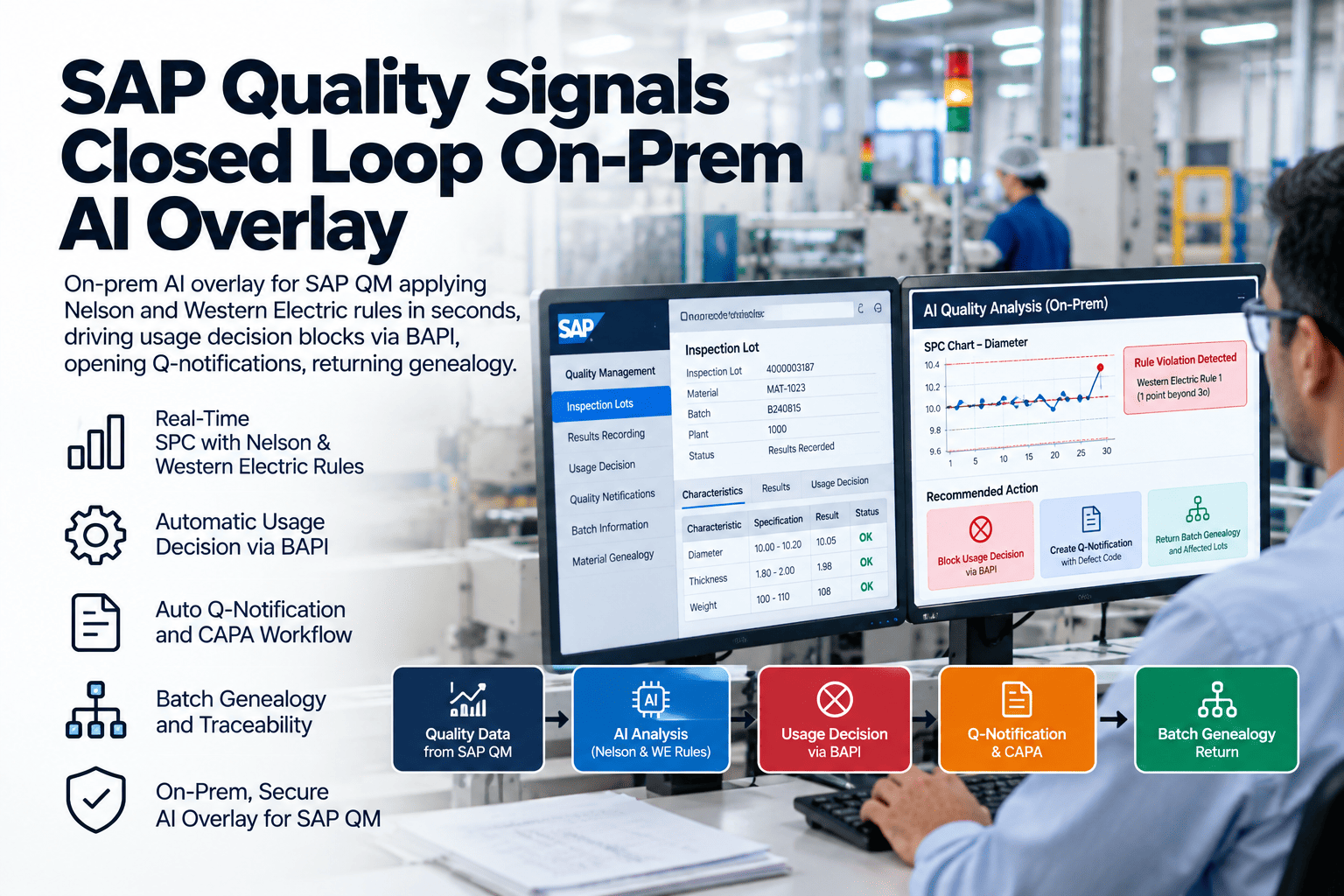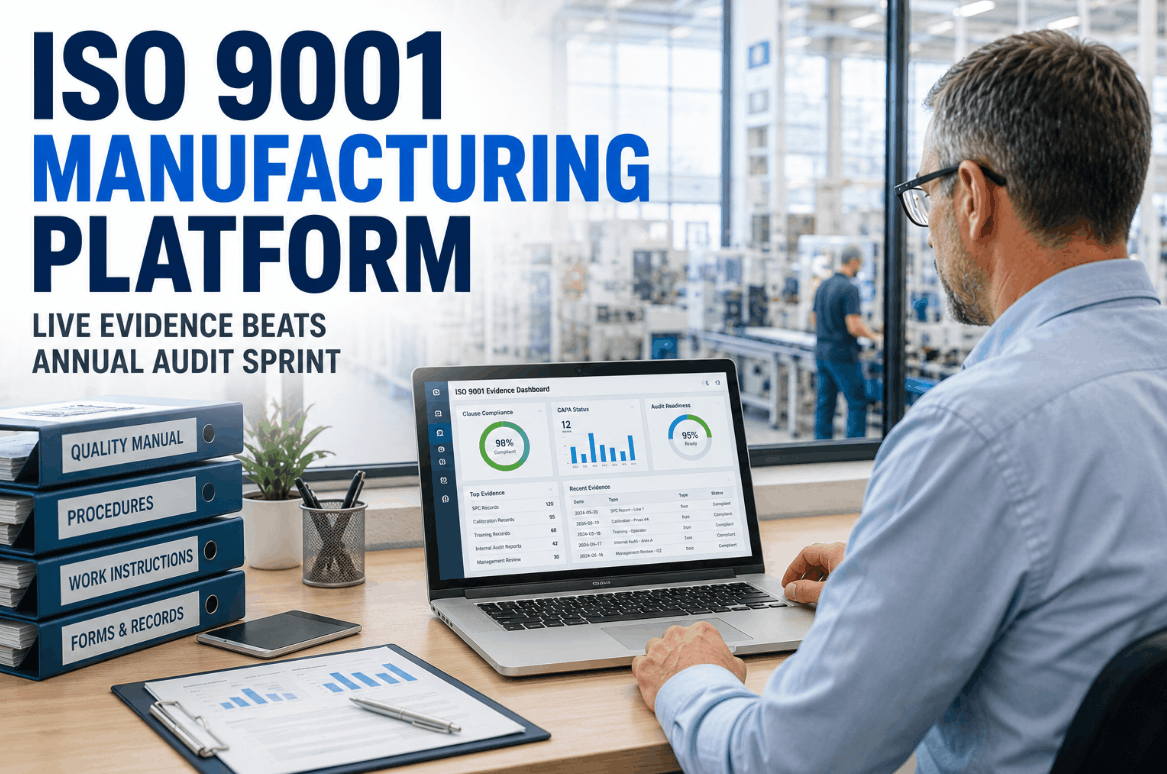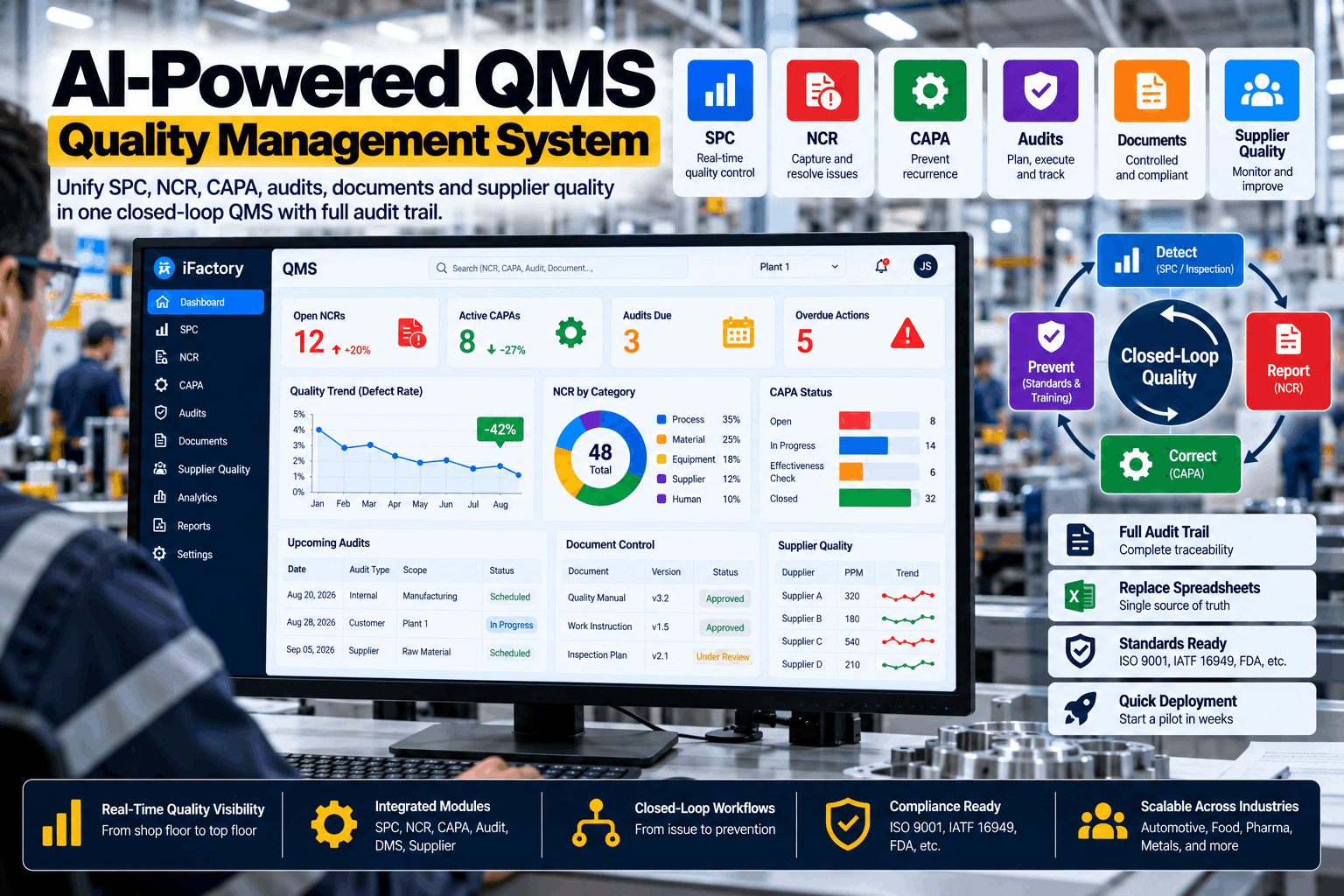
Most quality systems are not one system. SPC charts live in one package, nonconformances in a spreadsheet, corrective actions in email, procedures on a shared drive and supplier issues in someone's inbox. Each works on its own; nothing connects them, so the same defect is investigated three times and an audit means two weeks of gathering evidence. iFactory brings SPC, NCR, CAPA, audits, documents and supplier quality into one closed-loop QMS with a full audit trail and AI that learns from every record — replacing spreadsheets and paper. To see it on your own processes, book a QMS walkthrough.
One Closed-Loop QMS for SPC, NCR, CAPA, Audits, Documents and Suppliers
In iFactory a process signal becomes a nonconformance, the nonconformance becomes a corrective action, the action changes a procedure, and an audit later confirms it worked — all on one record, with every step signed and time-stamped. The AI finds repeat problems, suggests causes from your own history and tells you which actions are overdue before an auditor does.
- Six quality modules on one data model
- Full audit trail with electronic signatures
- Runs on an NVIDIA AI server inside your plant
Six Tools, Six Silos — and the Gaps Between Them
The modules of a quality system are well understood. What fails is the handover between them. A control-chart signal that nobody turns into a nonconformance. A nonconformance closed without a corrective action. A corrective action that changes a procedure nobody reads. Each gap is a place where a known problem is allowed to return — and in an audit, each one is a finding. If you recognise more than two of these, our quality specialists can map where your loop is open.
Records that do not link
The NCR number is typed into the CAPA form by hand, if at all. Nobody can say which corrective actions came from which nonconformances, or whether they worked.
Actions that age unseen
Due dates live in separate lists. Overdue items surface at management review, months late, when the only question left is why nobody noticed.
Evidence assembled by hand
Preparing for an audit means pulling charts, forms, sign-off sheets and emails into a folder. The work proves the system exists on paper, not that it runs.
Six Modules, One Data Model
iFactory covers the six areas a quality manager is asked about most, and it treats them as stages of one process instead of six applications. Every record carries the same part, lot, process, supplier and person references, so anything can be traced to anything. To see the modules against your current forms, book a module review.
Statistical process control
Control charts and capability on critical characteristics, fed directly by gauges, CMMs and line sensors.
AI: flags drift before a limit is crossedNonconformance reporting
Raised by a person, an inspection or a chart signal, with lot, quantity, evidence and containment recorded at once.
AI: matches it to similar past NCRsCorrective and preventive action
Root cause, actions, owners and due dates, with an effectiveness check that must pass before closure.
AI: suggests causes that held last timeInternal, supplier and layered audits
Schedules, checklists, findings and follow-up on mobile or desktop. Findings become NCRs or CAPAs in one step.
AI: groups findings into themesDocument control and training
Procedures and work instructions with versions, approvals by electronic signature, and read-and-understood records.
AI: answers questions from your own proceduresSupplier quality
Incoming inspection results, supplier corrective action requests, scorecards and approved-supplier status.
AI: scores supplier risk from live resultsThe Loop in Practice: One Problem, Followed to Closure
The example below follows a single out-of-tolerance characteristic through all six modules. Nothing is retyped between steps, and the final step uses the first module's data to prove the fix worked. That last link is what "closed loop" means — and it is the one most quality systems are missing. Our application engineers can walk the same path with one of your recent nonconformances.
- SPCA trend is flagged
A critical dimension runs seven points on one side of the mean. The chart signals before any part is out of tolerance.
- NCRA nonconformance is opened
The signal raises an NCR with the lot, the measurements and the station attached. 1,240 parts are placed on hold.
- CAPACause and actions are set
Root cause: a worn fixture locator, made worse by variation in one supplier lot. Two actions are assigned with owners and dates.
- DocumentsThe procedure changes
The work instruction moves to revision D with a locator-wear check, approved by electronic signature. Operators acknowledge it.
- SuppliersThe supplier is asked to act
A corrective action request goes out with the measurement data. The supplier's scorecard reflects the issue.
- AuditsThe fix is checked
A 30-day effectiveness check is scheduled, and a question on locator wear is added to the layered audit.
- SPCThe data confirms it
Capability on the characteristic is back above target for 30 days. The CAPA closes with the chart as evidence.
What one record holds at the end
Illustrative example. The point is the chain: an auditor can open the CAPA and reach the original chart, the hold, the revised instruction and the proof of effectiveness without leaving the record.
Close One Loop in Six Weeks
Pick one product family or one line. We load its control plan, forms and procedures, connect its measurement data, and run NCR, CAPA and document control on it end to end — beside your current system, so the two can be compared.
Built Around the Standards You Are Audited Against
2026 is a year of change for quality standards. ISO 9001:2026 was published on 16 September, adding explicit expectations on quality culture and ethical behaviour and a clearer split between risks and opportunities, with around three years to transition. In the United States, FDA's Quality Management System Regulation took effect on 2 February 2026, bringing ISO 13485 into Part 820 and opening management review, internal audit and supplier audit reports to inspection. The clause structure of ISO 9001 is unchanged, so the map below holds for both editions. To review your own transition plan, book a standards session.
The same records serve sector standards built on ISO 9001 — IATF 16949 in automotive, AS9100 in aerospace, ISO 13485 in medical devices and the food-safety schemes — each of which adds its own requirements on top. iFactory supports the evidence; conformity is still decided by your certification body or regulator.
What the AI Adds to a QMS
A conventional eQMS is a well-organised filing cabinet. It stores what people enter and reminds them of dates. iFactory's AI reads the records as well as storing them, on a GPU server in your plant so that quality data stays on site. Ask our support engineers to show it working on sample records.
- Finds repeat problems. Each new NCR is compared with past ones by defect, part, process and wording, so a recurrence is recognised on day one.
- Suggests causes that held. Root causes and actions from similar closed CAPAs are shown with whether the problem came back.
- Predicts from process data. SPC trends are watched for drift, so some nonconformances are prevented instead of recorded.
- Answers from your documents. Operators and engineers ask a question in plain language and get the answer from the current approved procedure, with the source shown.
An Audit Trail You Do Not Have to Assemble
In a regulated or certified business, a record is only as good as the proof of who made it and when. iFactory records that proof as a by-product of normal work, and it is designed to support the controls expected under 21 CFR Part 11 and similar rules. Validation for your intended use remains your responsibility, with our documentation to support it.
Who, what, when and why
Every entry, change and approval is logged with user, time, old value, new value and reason.
Electronic signatures
Approvals are signed with individual credentials and bound to the exact version signed.
Nothing overwritten
Records are versioned, never replaced. Superseded documents are archived and withdrawn from use automatically.
Access by role
People see and sign what their role allows, with training status checked before a task is released to them.
Paper, Point Tools and a Unified QMS Compared
The quality management software market is forecast to grow from about USD 11.7 billion in 2026 to more than USD 20 billion by 2031, with established suites from Hexagon ETQ, Veeva, MasterControl, Siemens, Honeywell and SAP. Most began as document or CAPA systems and added modules over time. The useful question when comparing is not how many modules are listed, but whether the loop closes without a person carrying data between them.
Delivered as a Turnkey AI System — Hardware and Software Together
iFactory ships as a complete bundle: a pre-configured NVIDIA AI server, racked and ready, with the QMS modules and AI models pre-loaded. Rack it, plug in power and Ethernet, and the AI is live on your network — quality records stay under your control. Our team handles cabling, network setup, PLC, SCADA and measurement-system integration, ERP links, user training and 24×7 remote monitoring. For a scoped proposal, book a deployment call.
Ship, network and data
Server delivered and racked. Procedures, forms, control plans and open NCRs and CAPAs loaded. Gauges, CMMs and line data connected for SPC.
Model training and pilot
Workflows and approval routes configured to your procedures. AI trained on your record history. One product family runs the full loop in pilot.
Go-live and training
All areas live. Users trained by role, spreadsheets and paper forms retired, and the first management review pack produced from live data.
Frequently Asked Questions
What is a closed-loop quality management system?
One in which each quality record leads to the next and the last confirms the first. A process signal or inspection raises a nonconformance; the nonconformance drives a corrective action; the action changes a document or a supplier requirement; an audit or the process data then verifies the result. If any link depends on someone retyping information, the loop is open.
Which modules does the iFactory QMS include?
Statistical process control, nonconformance reporting, corrective and preventive action, audit management, document control with training records, and supplier quality. They share one data model, so a record in any module can be traced to related records in the others.
Does it support ISO 9001:2026 and sector standards?
It holds the evidence the standards ask for — controlled documents, nonconformance and corrective action records, audits, supplier monitoring and management review inputs. The 2026 edition of ISO 9001 keeps the same clause structure, so existing workflows carry over. The same records support IATF 16949, AS9100 and ISO 13485; certification itself is decided by your auditor.
Is iFactory a cloud QMS?
It runs on a server in your own facility, reached by users over your network, including from other sites. If you are comparing cloud QMS products, the practical difference is where regulated records and process data are held and who controls access to them. Some customers prefer that to be their own data centre.
Can we keep our ERP and MES?
Yes. The QMS takes part, lot, order and supplier data from ERP and MES and returns quality status and dispositions. It replaces the spreadsheets, paper forms and stand-alone quality tools around them, not the systems of record for planning and production.
How are electronic signatures and audit trails handled?
Each user signs with individual credentials. Every entry and change is recorded with user, time, previous value and reason, and records are versioned instead of overwritten. The design supports the controls expected under 21 CFR Part 11; validating the system for your intended use is part of your own quality system.
How long does deployment take, and what do we need to provide?
A typical site is live in 6–12 weeks. You provide rack space, power, an Ethernet connection, your procedures and forms, open quality records, access to measurement data and a quality lead. iFactory supplies the pre-configured NVIDIA AI server, software, integration and training. To scope your site, contact our scoping team.
Replace Spreadsheets and Paper With One Quality System
One turnkey system — NVIDIA AI server, six QMS modules, integration and training — delivered and live inside 12 weeks. Start with a pilot on one product family and extend site by site.
- 1Can a chart signal open a nonconformance without retyping?
- 2Can you list every CAPA that came from an NCR last year?
- 3Does a CAPA need proof of effectiveness before it closes?
- 4Could you show an auditor the full chain in five minutes?