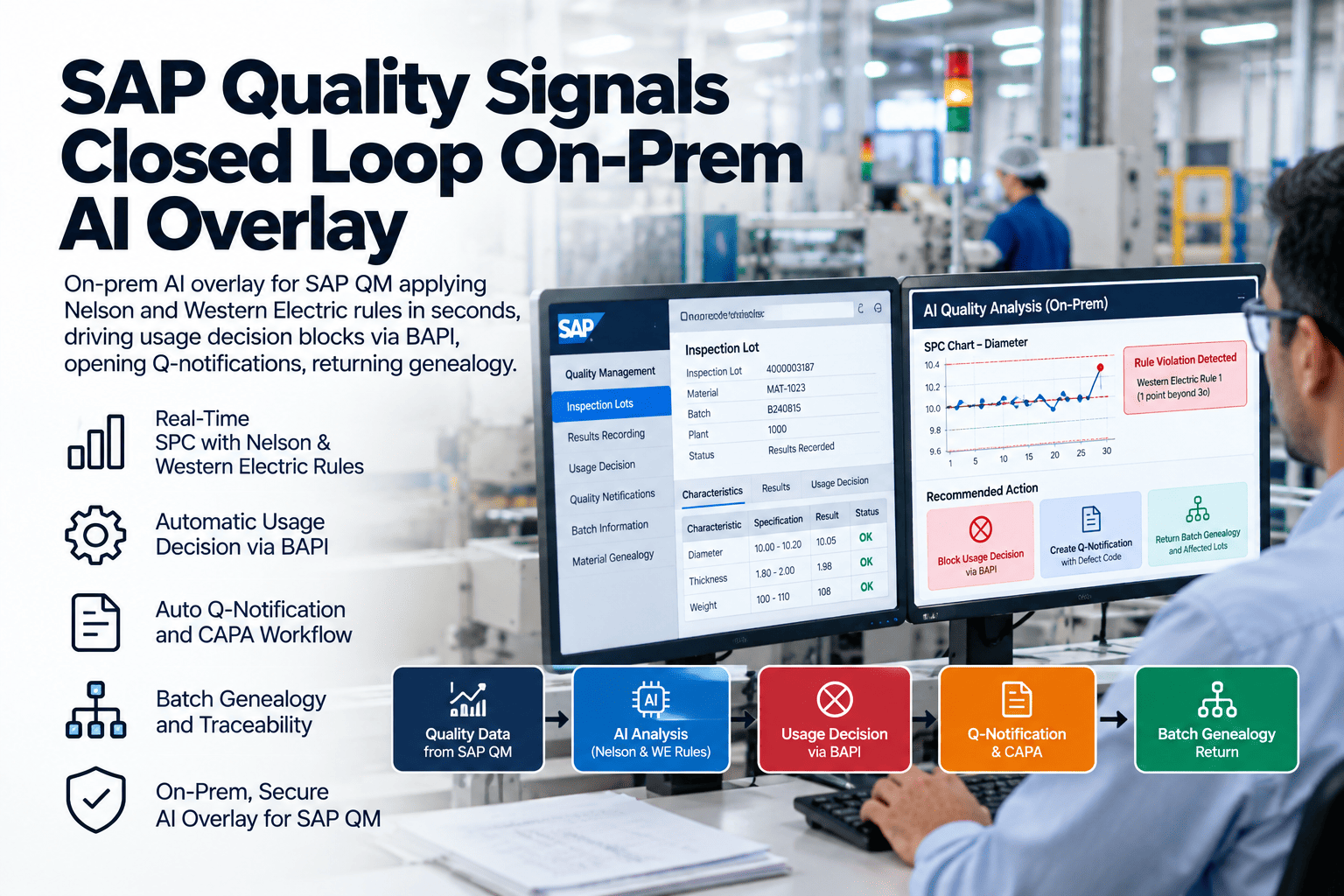
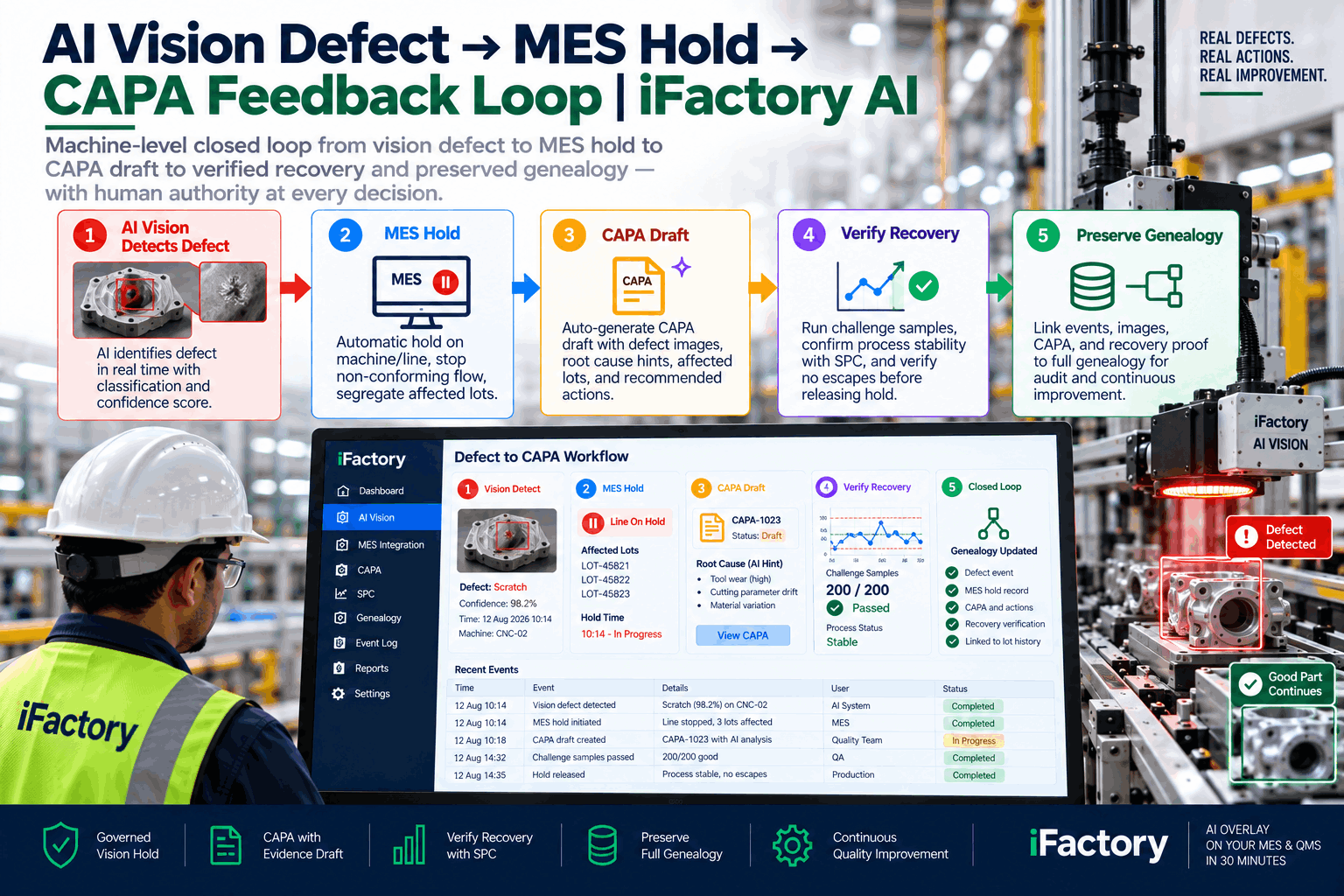
SAP QM captures inspection lots and records usage decisions — but the loop between an out-of-control signal on a control chart and the hold that actually stops nonconforming stock from posting to unrestricted is manual, human-paced, and often takes shifts. The Nelson rule fires; the operator sees it on a chart; a supervisor may or may not raise a Q-notification; downstream production keeps consuming affected material until somebody blocks the lot. On-prem AI overlay sits beside SAP QM (not replacing it), reads the same MIC values, applies Western Electric and Nelson rules in seconds, and drives the usage decision block via BAPI before the shipment posts. Data stays inside the plant firewall.
iFactory / SAP QM closed-loop overlay
Turn SAP QM Signals into Automatic Holds — On-Prem, No SAP Change
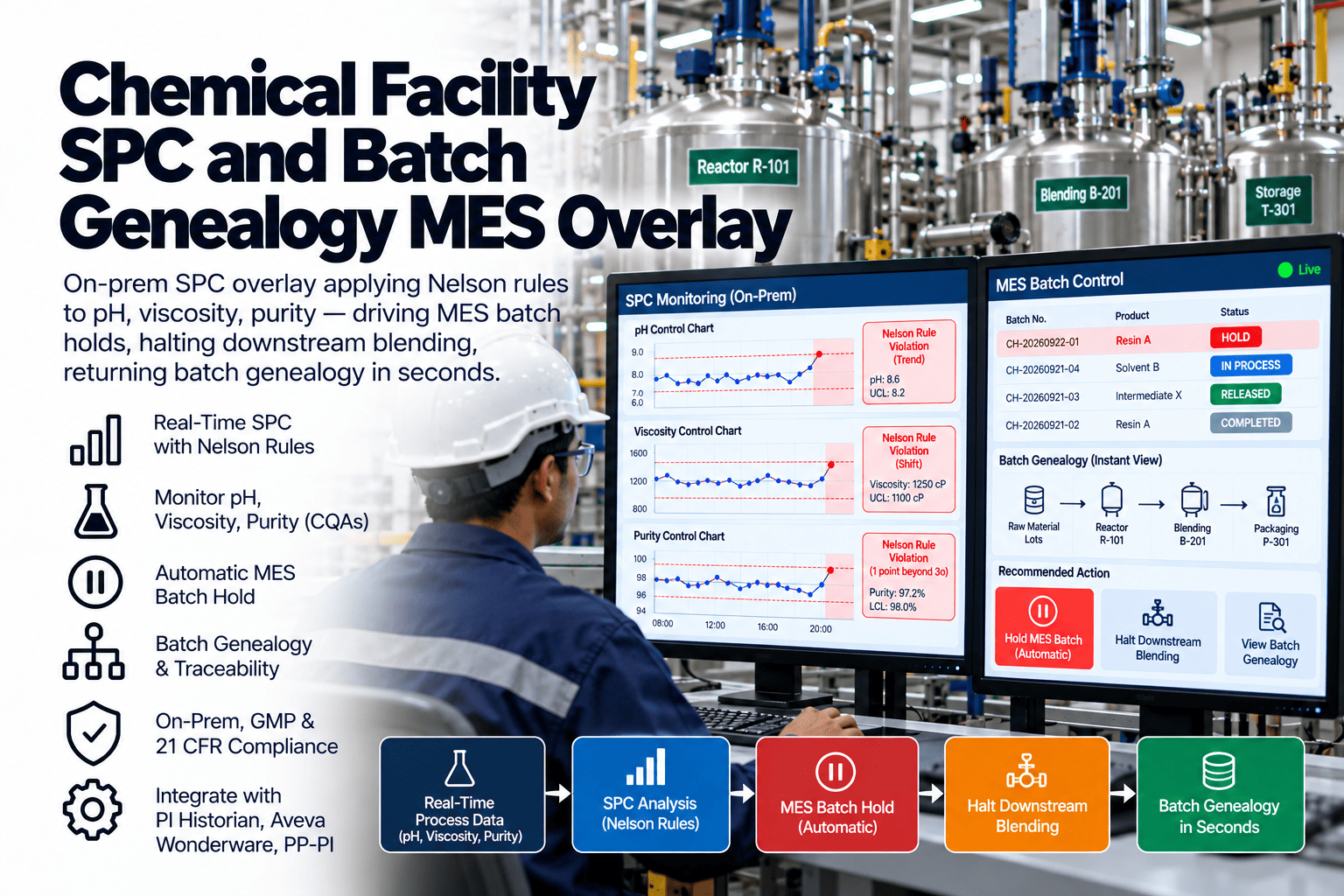
On-premise AI overlay reading SAP QM inspection results and plant historian data — applying Nelson and Western Electric rules in seconds, driving usage decision blocks via BAPI, opening Q-notifications, and returning full lot genealogy without cloud handoff.
1
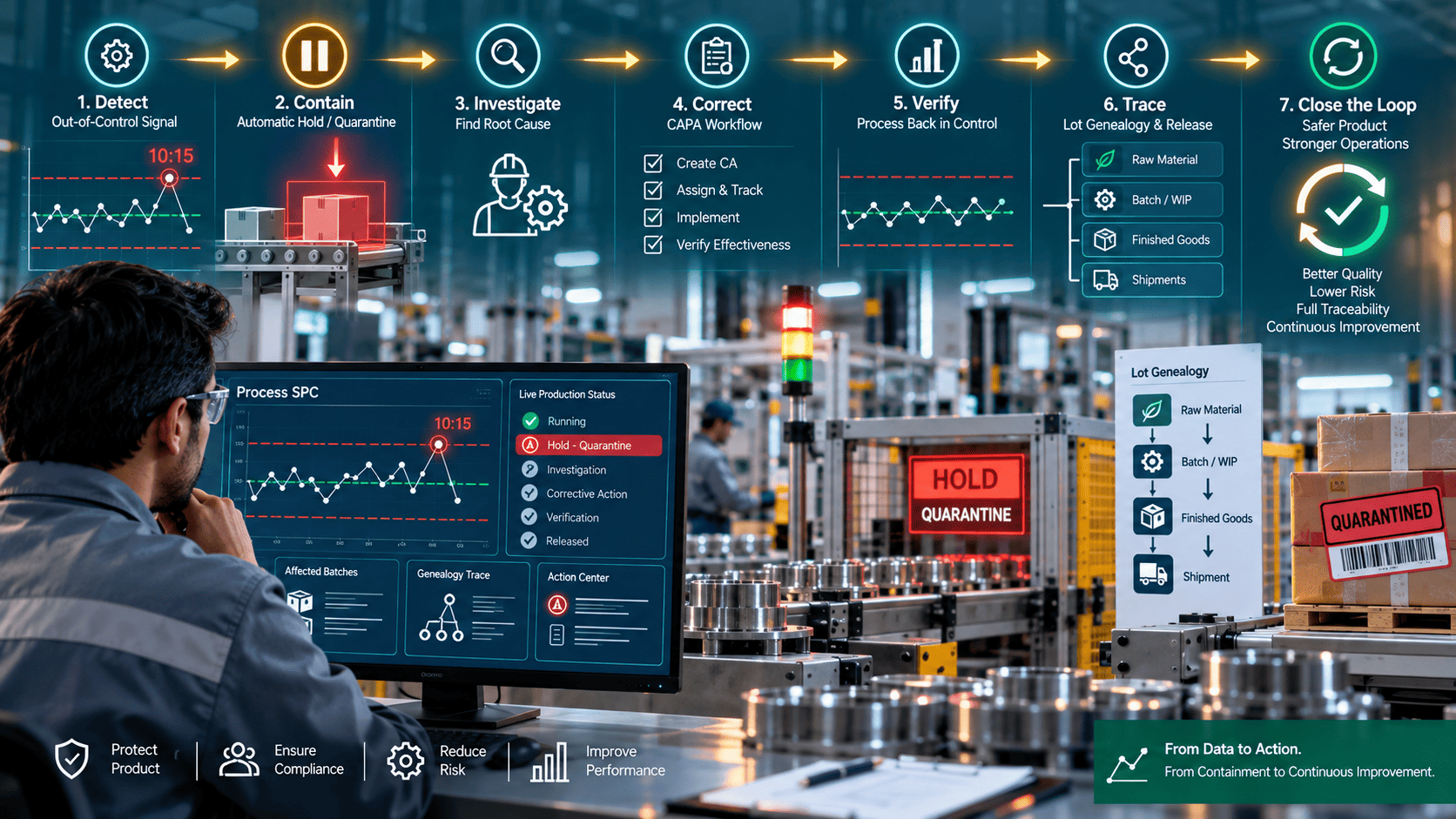
SAP inspection lot · MIC value 47.8 · above UCL
2
Nelson rule 2 fires · 9 points same side · overlay detects
3
BAPI_INSPLOT_SETUSAGEDECISION · block posting · Q-notification opens
4
Genealogy query · 14 downstream lots · 3 shipped · customer notice ready
Nelson + WE
rules in seconds
BAPI-driven
usage decision block
100% on-prem
no cloud handoff
The Problem in SAP QM Closed-Loop Quality
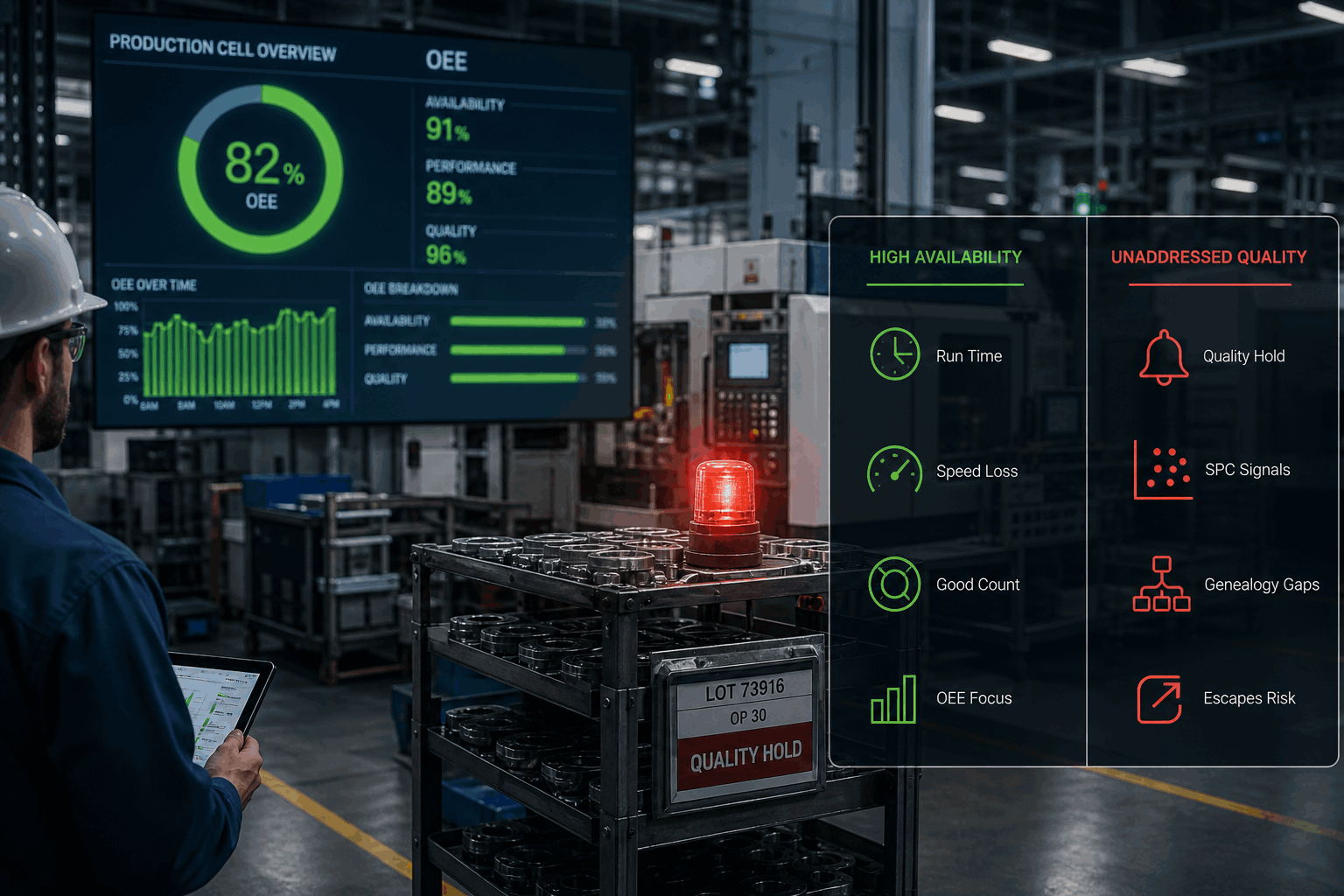
A typical SAP QM environment captures inspection lots (goods receipt, in-process, final release), records results against master inspection characteristics, and drives usage decisions that post stock to unrestricted, blocked, scrap, or return. What SAP QM doesn't do natively is apply modern SPC pattern rules in real time — Nelson's eight tests, Western Electric zone rules, capability trend monitoring — and drive the resulting containment action back into the same SAP transaction chain automatically. Charts get plotted; supervisors may or may not raise Q-notifications; downstream production consumes suspect material for hours while the loop closes manually. By the time a batch is blocked, some of the affected inventory has already moved to another plant or shipped to a customer.
Where Manual SAP Quality Loops Actually Bleed
SAP QM loop failures are consistent across plants running standard QM configuration. Each is a specific timing gap between chart and hold that overlay closes.
Nelson rule silent
Nelson pattern (9 points same side, 6 ascending, 2 of 3 in zone A) fires visually on the chart but SAP native QM doesn't raise a Q-notification. Supervisor may or may not notice.
Usage decision lag
Result rejected on MIC but usage decision transaction hours or a shift behind. Stock posted to unrestricted before the decision blocks it. Suspect material distributed.
Downstream consumption
Batch used as component in downstream production while its inspection lot sits pending. Genealogy shows the propagation only in post-facto forensics.
Cloud-refusal blocker
Regulated site or IP-sensitive process can't push production data to cloud analytics. On-prem overlay is the only path that meets the security posture.
What Good Looks Like in Closed-Loop SAP Quality
A working SAP-integrated closed loop holds four disciplines together — rule-based detection at MIC/historian, automated usage decision block, Q-notification with context, and genealogy queryable in seconds.
Rule-Based Detection
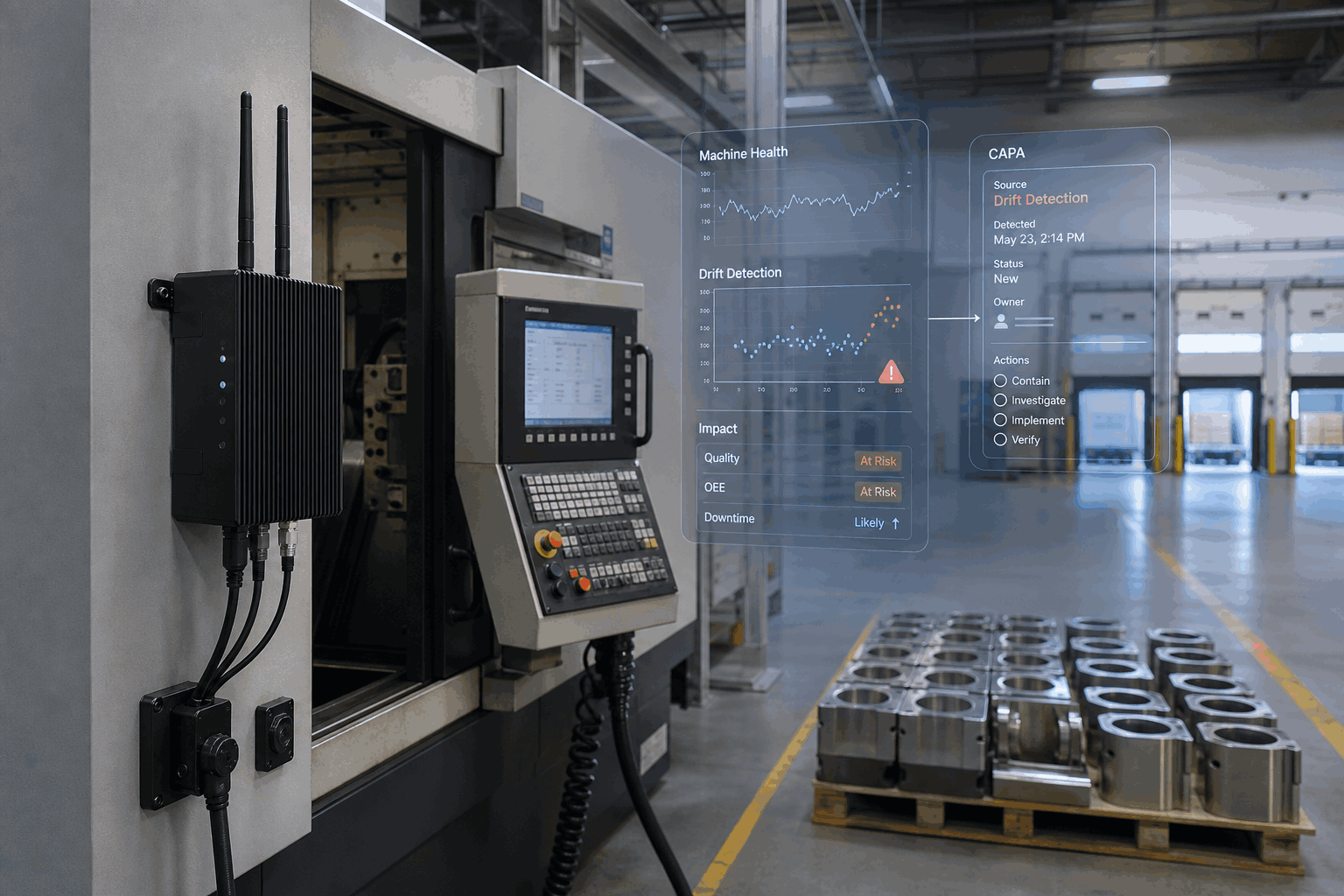
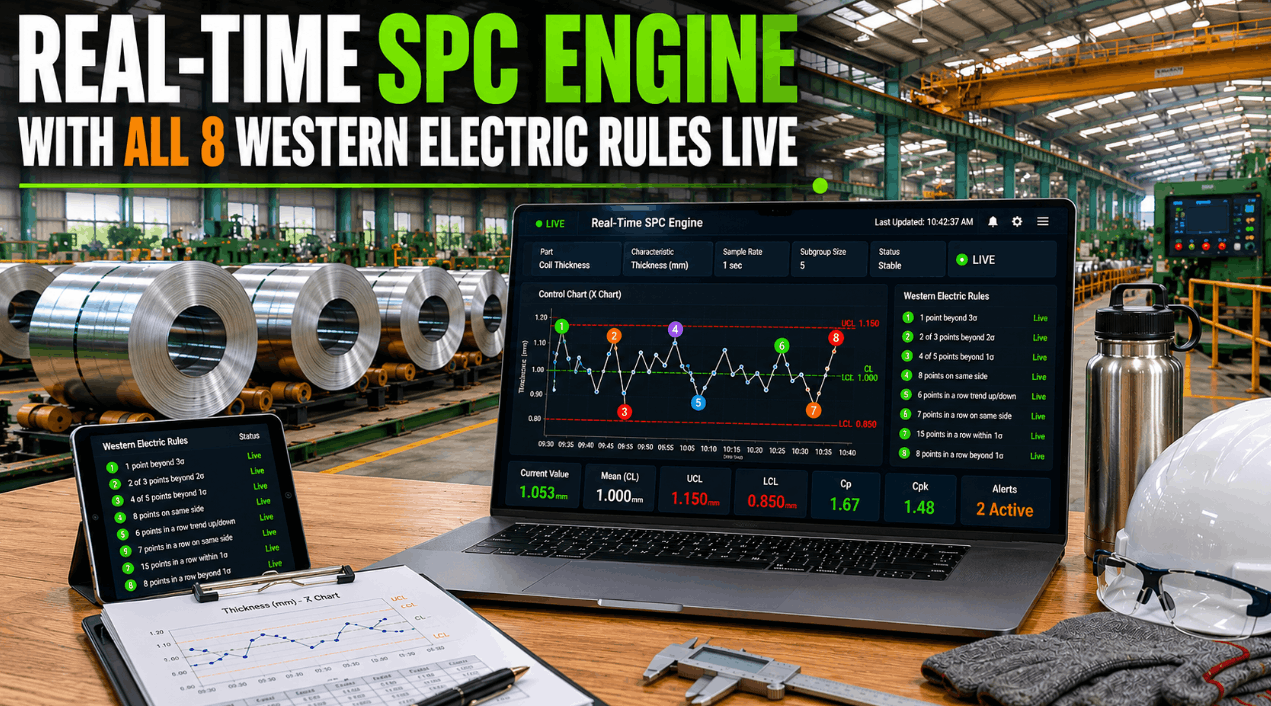
Nelson 8-rule set and Western Electric zone rules applied to MIC values from SAP QM and to continuous variables from plant historian (PI, Aveva, Wonderware). Detection in seconds, not shifts.
Seconds, not shifts
Usage Decision Block
Rule fire drives BAPI_INSPLOT_SETUSAGEDECISION with block valuation code — stock stays in quality inspection, doesn't post to unrestricted. Handled by SAP the same as manual UD.
Automatic UD block
Q-Notification Open
Q-notification opened via BAPI with rule fired, MIC affected, chart context, and operator note. Investigation and CAPA workflow use standard SAP transaction chain.
Standard SAP CAPA
Genealogy in Seconds
Batch genealogy query — from affected batch to every downstream component consumption, work order, shipment, and customer — returns in seconds via SAP batch determination and MB51 movement history.
Query, not forensics
How iFactory AI Fits
iFactory AI overlays SAP QM (ECC or S/4HANA), plant historian (OSIsoft PI, Aveva PI, Wonderware, Ignition), and validated CMMS — sitting on-premises alongside SAP, reading data via BAPI, IDoc, and OData, driving SAP transactions the same way a human user would.
Rule Engine
Overlay Layer
On-prem engine applying Nelson 8-rule set, Western Electric zone rules, and custom plant rules to MIC values (from SAP QM via BAPI_INSPCHAR_GETRESULT) and continuous variables (from historian).
SAP Actuator
Overlay + SAP QM
Rule fire triggers BAPI_INSPLOT_SETUSAGEDECISION with block valuation code and BAPI_QUALNOT_CREATE for Q-notification. Standard SAP audit trail; standard SAP transaction chain.
Genealogy Query
Overlay + SAP
Batch genealogy queries via SAP batch determination (MB51 movements, batch classification) — affected batch to component consumption, work order, delivery, customer. Query in seconds.
On-Prem Deploy
Overlay Layer
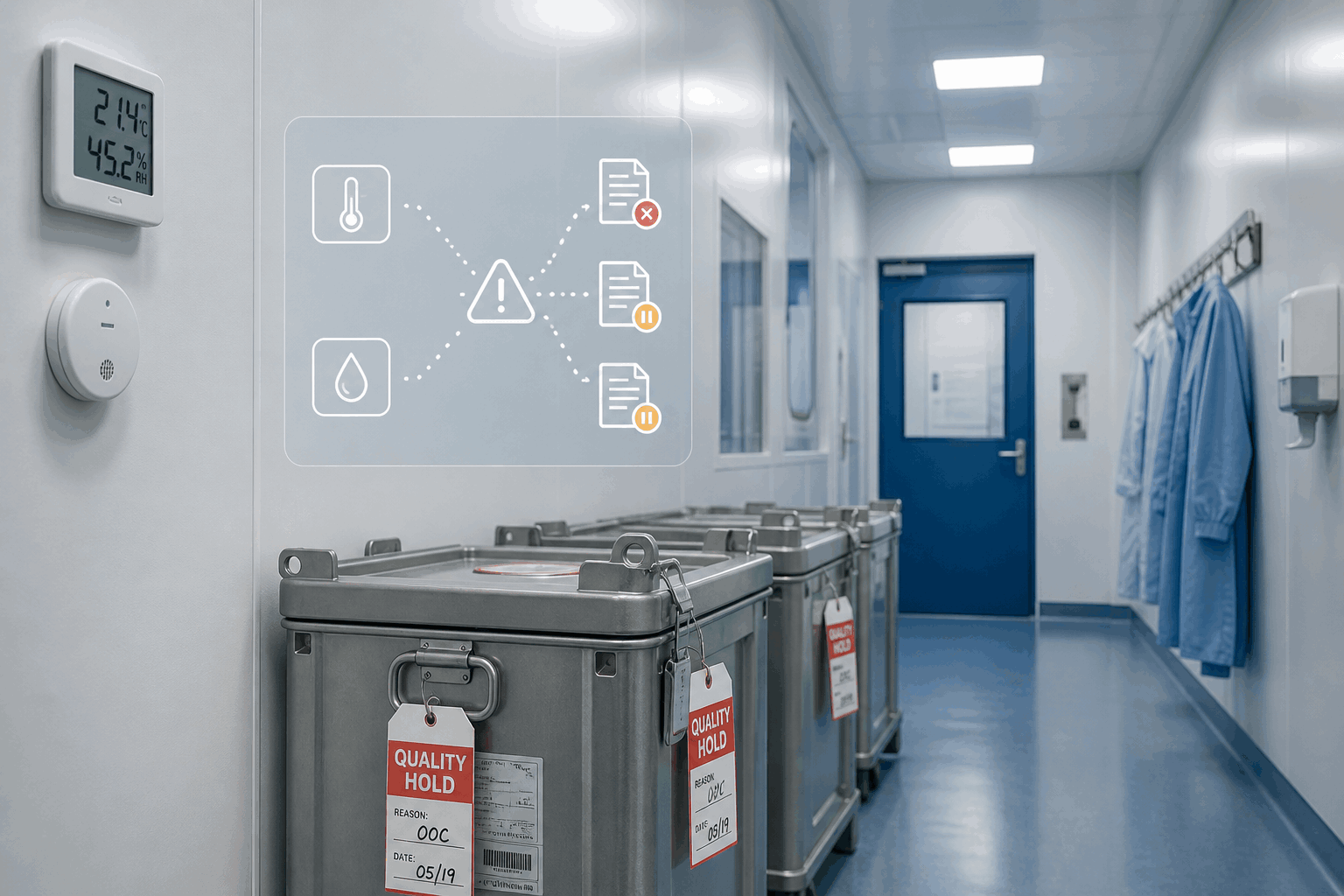
100% on-premises deployment inside plant firewall. No cloud data egress. Compatible with ITAR, GxP, and IP-sensitive process data policies that block cloud analytics.
Ask your SAP QM manager how long between a Nelson rule pattern being visible on a control chart and the usage decision block posting on the affected inspection lot. If the answer is measured in hours or shifts, the on-prem overlay is the specific closure — because SAP QM was not built for seconds-scale rule-based blocking. Book an SAP QM overlay walkthrough.
10-Week SAP QM Overlay Pilot
One plant, one SAP QM inspection type, ten weeks. The pilot deploys the overlay on-prem, connects to SAP QM and historian, activates rule-based detection, drives first automated usage decision blocks, and closes the first month of second-scale loop discipline.
Weeks 1–2
On-Prem Deploy
Overlay deployed inside plant firewall. Connectors to SAP QM (RFC/BAPI) and plant historian (PI OLEDB, OPC UA) established and read-tested. Baseline current-state loop cycle time.
Weeks 3–5
Rules Live (Read-Only)
Nelson and Western Electric rules live on selected MICs and historian tags in read-only mode. Rule fires surface to supervisor without SAP write. Fire accuracy tuned against operator ground truth.
Weeks 6–8
SAP Write Active
Overlay writes usage decision blocks and Q-notifications via BAPI in production. Change control per site's SAP change process. First automated blocks in service.
Weeks 9–10
Genealogy + Report
Genealogy queries active for automated blocks. First-month report on loop cycle time, blocks issued, false-fire rate, and Q-notifications closed. Rollout to remaining inspection types scoped.
Who Owns the KPI
Closed-loop SAP quality crosses SAP QM, plant IT, quality operations, and downstream production. Each function owns a specific KPI or the loop stays manual.
SAP QM Manager
OOC-to-UD-block cycle time
Owns the loop outcome — time from Nelson/WE rule fire on a MIC to usage decision block posting. Overlay drives cycle from shifts to seconds.
Plant IT Lead
On-prem overlay uptime + SAP transaction success
Owns the integration reliability — overlay availability, BAPI call success rate, and no adverse impact on SAP performance. Standard SAP monitoring covers both sides.
Quality Manager
Q-notifications with rule-fire context
Owns the CAPA quality — Q-notifications carrying rule fired, chart context, and MIC history. Faster root-cause than manual notification workflows.
Production Planner
Downstream material affected by escape
Owns the propagation outcome — material used in downstream production before its inspection lot blocked. Faster loop reduces propagation directly.
FAQ
Does this require SAP QM configuration changes or custom development?
No SAP configuration changes and no ABAP development. The overlay uses standard SAP QM BAPIs (BAPI_INSPCHAR_GETRESULT to read results, BAPI_INSPLOT_SETUSAGEDECISION to write usage decisions, BAPI_QUALNOT_CREATE to open Q-notifications) that are available on ECC 6.0 through S/4HANA 2023 without customization. The BAPI calls run under a dedicated technical user with the same authorizations a quality engineer would have — same audit trail, same change documents, same authorization objects. Where a plant uses custom Q-notification types, the overlay's Q-notification creation configures against those types the same way SAPGUI does. What the overlay adds is the rule engine that triggers those calls; what it doesn't add is any change to how SAP QM itself works.
How does this deploy without cloud connectivity for our regulated / IP-sensitive site?
Full on-premises deployment inside the plant firewall — no cloud egress, no external service dependencies, no data leaving the plant network. The overlay runs on standard Linux or Windows Server infrastructure (physical or VM) alongside the SAP application servers, connects to SAP via RFC/BAPI on the SAP internal network, and connects to plant historian via OPC UA or the historian's native protocol on the OT/plant network. For regulated environments (GxP, ITAR, CMMC 32 CFR Part 170) the deployment supports the site's existing computerized system validation (CSV) approach with installation qualification (IQ), operational qualification (OQ), and performance qualification (PQ) artifacts. For IP-sensitive processes where cloud analytics is blocked by policy, on-prem is the only viable architecture — and that's this overlay's default posture.
Book an SAP QM overlay walkthrough to see the deployment architecture.
How does batch genealogy actually query — SAP batch determination is notoriously complex?
Batch genealogy queries navigate SAP's batch determination and material movement records the same way a human user would via MB51 (material document list), MSC3N (batch display), and CO03 (production order display). The overlay pre-indexes the batch-to-batch consumption relationships (which batches were used as components in which higher-level batches) and the batch-to-shipment relationships (which batches went out on which deliveries to which customers). A genealogy query returns the propagation tree in seconds rather than the hours it takes to walk manually through SAP transactions. For plants running batch classification with process order integration, the genealogy tree includes process conditions at each step (temperature, pressure, additions) captured via batch record. Complexity is real; pre-indexing is what makes it queryable.
Stop letting SAP QM loops close on human time.
Close One Inspection Type's Loop on SAP — Live
Bring one SAP QM inspection type, its last month of usage decision cycle time, and current Nelson/WE rule practice. We'll walk what the on-prem overlay would have blocked automatically, and demonstrate the BAPI-driven usage decision and Q-notification workflow.