Western Electric and Nelson Rules in Power Plant SPC
By Larry Eilson on July 30, 2026
Every SPC deployment on a power plant faces the same crossroads in the first month. Somebody — usually a consultant, sometimes the tool itself — enables all four Western Electric rules plus all eight Nelson rules on every tag, and within two weeks the operators have stopped reading the alerts. Combined-cycle heat rate flags three times a shift. Vibration flashes on every load ramp. The DCS engineers roll their eyes. Six months later, a real special-cause signal appears and nobody notices. This is not a story about the rules being wrong — they're right, they've been right since 1958. It's a story about the false-alarm rate compounding when you turn them all on at once. The full Western Electric set alone runs about 7.5% in-control false-alarm rate over ten subgroups; adding every Nelson rule pushes it higher still. Operator trust dies in eight to ten weeks. What power plants need is not more rules — it's the right rules on the right signals, tuned to the physics of the loop they're watching. iFactory SPC ships with a calibrated rule set for thermal generation, so heat rate, vibration, emissions, and cold-end trends catch real drift without firing on every load change.
iFactory SPC Rule Calibration
The Right SPC Rules on the Right Signals — Not All of Them on Everything
Western Electric and Nelson rules calibrated to power-plant physics: fast enough to catch real drift, quiet enough to keep operator trust.
Western Electric and Nelson are not competing frameworks — they are two generations of the same statistical idea, refined 26 years apart. Western Electric came first, from telephone-equipment manufacturing in 1958. Nelson published his extension in 1984 at Bell Labs. Nelson kept four of the original WE rules and added four new pattern tests. Knowing which rule came from where tells you which to enable for which type of power-plant signal.
1958
Western Electric
Original 4 rules
Developed for telephone manufacturing lines with continuous data streams. Focused on the zone-based tests that catch the most common shifts and trends.
1 point beyond 3σ
2 of 3 beyond 2σ, same side
4 of 5 beyond 1σ, same side
8 in a row on one side
1984
Nelson
8-rule extension
Extended the WE set with tests for trends, alternation, and overcontrol. Also relaxed the "8 in a row" to 9 in a row for slightly lower false-alarm rate.
Adds: 6 in a row trending
Adds: 14 in a row alternating
Adds: 15 in a row hugging center
Adds: 8 in a row outside 1σ, both sides
The Eight Rules, Illustrated
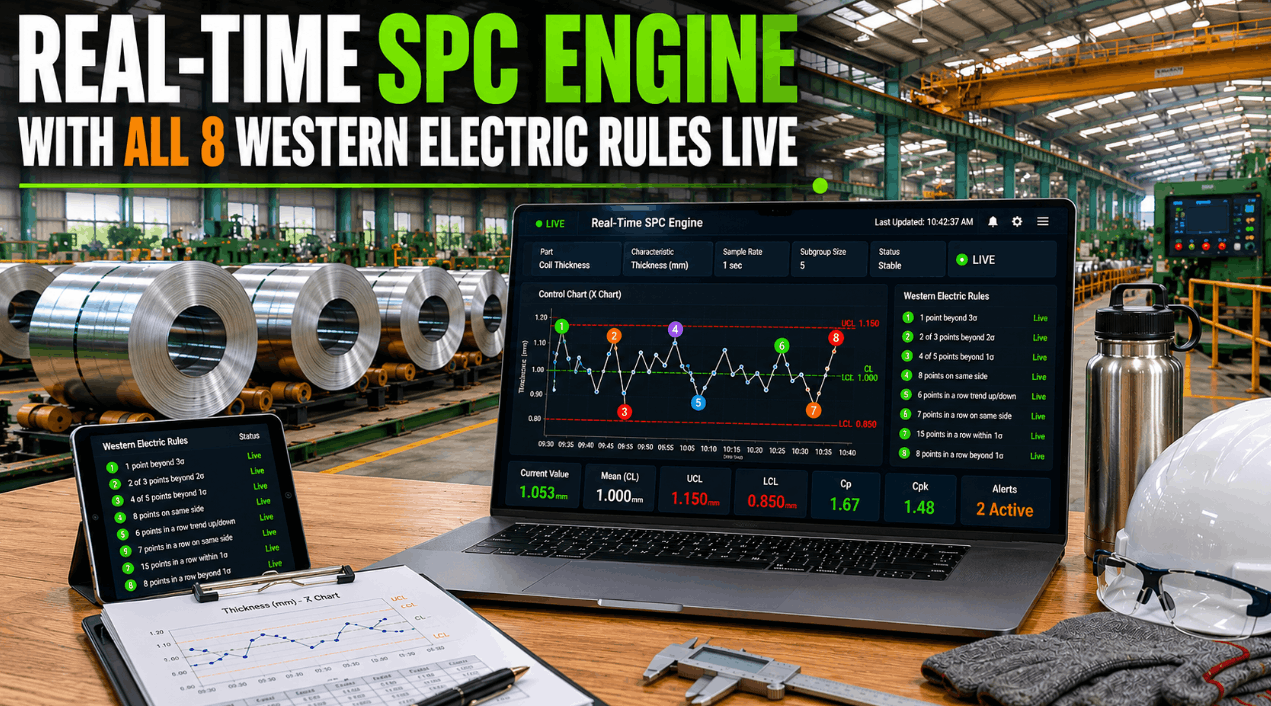
Every rule describes a specific pattern shape. Once you can see the shape, the rule becomes intuitive — and choosing which to enable on which signal becomes obvious. These are the eight patterns.
1One point beyond 3σ
Sudden special cause — analyzer fault, sensor spike, sudden process upset
Best for: emissions spikes, protection trips
29 points on one side
Sustained shift in mean — new baseline after outage, setpoint drift
Best for: heat rate, TTD, cleanliness factor
36 points trending
Slow drift — fouling, wear, degradation, seal creep
Best for: vibration, APH leakage, condenser fouling
Best for: control-loop diagnostics, rarely useful on physical signals
52 of 3 beyond 2σ
Early warning — process moving toward the limit before crossing 3σ
Best for: high-value tags where early notice matters (emissions, vibration)
64 of 5 beyond 1σ
Sustained mid-range shift — small but real change in mean
Best for: heat rate, CF, emissions long-term trending
715 points within 1σ
Stratification — over-correction, over-smoothing, or wrong subgroup basis
Best for: data-quality diagnostics, rarely a physical process signal
88 points outside 1σ
Bimodal or mixed-source data — two populations sampled together
Best for: mill-to-mill or unit-to-unit comparison catch
Want to see which rules fire on your own tags? Book a demo — bring 90 days of DCS history and we'll show every pattern.
The False-Alarm Compounding Problem
Every rule you add raises the probability of a false alarm on a perfectly in-control process. The math is the reason so many SPC deployments die — not because the rules are wrong, but because operators stop trusting them when every shift starts with three alerts on a machine that is running fine.
Rule 1 only (3σ)
~0.3%
Rules 1 + 2 (3σ + shift)
~1.5%
Rules 1 + 2 + 3 (add trend)
~3.5%
All 4 WE rules
~7.5%
All 8 Nelson rules
~11%+
False-alarm rates over ~10 subgroups on an in-control process. Multiply across every tag on the plant to see why "turn everything on" ends in alert fatigue.
Which Rules to Enable Where
The right calibration is not about turning rules off — it's about turning the right rules on for the physics of the signal. Rules that work for a slow degradation signal don't work for a spiky protection signal, and vice versa.
Heat rate / Efficiency
Rule 2Rule 3Rule 6
Slow drift signals — you want trends and sustained shifts, not spike detection. Skip rule 1 to avoid load-transient noise.
Turbine vibration
Rule 3Rule 5Rule 2
Watch for slow trend + early warning band. Rule 1 is already covered by the ISO 20816 threshold — no need to duplicate.
CEMS emissions
Rule 1Rule 3Rule 5
Both spike (analyzer fault) and drift (scrubber degradation) matter. Rule 5 gives the warning-band signal before the permit line.
Condenser / cooling tower
Rule 2Rule 3Rule 6
Fouling is a slow drift, not a spike. Same set as heat rate — trend, shift, sustained mid-range shift.
Protection / trips
Rule 1
These already have hard threshold alarms in DCS. Rule 1 for statistical spike detection is enough — don't add pattern rules on protection signals.
Control-loop diagnostics
Rule 4Rule 7Rule 8
The rarely-useful rules on physical signals are exactly what you want on controllers — hunting, over-tuning, and stratification.
How iFactory Ships the Calibrated Set
Every deployment gets the same starting recipe — proven rule sets per signal family, load-band aware baselines, and analyst-facing tuning after the first month.
01
Signal Classification
Every tag classified as spike-prone, drift-prone, or both — the classification chooses the rule set, not the operator.
02
Baseline Learning
30-60 days of steady-state data define the real σ per load band, per operating condition — no textbook defaults.
03
Preset Rule Recipes
Heat rate, vibration, emissions, and cold-end signals each get the calibrated rule subset that fits their physics.
04
Tune After 30 Days
Analyst review of first-month fires — rules driving false alarms get dropped, rules missing real signals get added.
05
Operator Trust Held
Fire rate stabilizes at a level operators will actually respond to — the metric that decides whether SPC survives past month three.
What Right-Sized Rules Deliver
Calibrated rule sets are what separate SPC that lives past year one from SPC that dies in month three. These are the outcomes plants see when the rules match the physics.
Lower
False-alarm rate
vs. "all rules on everything"
Trust
Held past month 3
the metric that kills most deployments
Faster
Real-drift catch
signals reach operators who still read them
Audit
Traceable
every fire logged with the rule that caught it
Curious how the false-alarm rate on your current SPC compares? Talk to our analytics team — we'll benchmark your fire log against a calibrated set.
Frequently Asked Questions
Should we use Western Electric or Nelson rules?
You use both — because Nelson is an extension of Western Electric, not a replacement. Four of the eight Nelson rules are the original WE set with minor changes. The four Nelson-added rules catch patterns WE misses (trends, alternation, stratification). The real question is not which framework, but which subset of the combined set makes sense for each signal.
Why not just turn everything on and be safe?
Because "safe" statistically becomes "unusable" operationally. Every rule you add raises the in-control false-alarm rate. The full 8-rule Nelson set runs above 11% on ten subgroups — multiply across every tag in a plant and you get alerts operators stop reading in eight to ten weeks. A ruleset that operators ignore catches nothing at all.
Which single rule matters most if we can only enable one?
Rule 1 — one point beyond 3σ. It has the lowest false-alarm rate, catches the most obvious problems, and is the classical Shewhart signal. If you can only enable one across the plant, Rule 1 covers the highest-value ground. But for slow-drift signals like heat rate or vibration, Rule 3 (six trending points) is often more useful than Rule 1 by itself.
Do these rules work on load-following units?
Yes — but only with load-band-aware baselines. The problem isn't the rules; it's using a single sigma across all load conditions. iFactory computes the baseline per load band, so a normal load ramp doesn't fire Rule 2, but a real drift under the same conditions still does. Rule choice matters less than baseline honesty.
Can we tune the rules after deployment?
You should. Every deployment should get an analyst review after 30 days — rules that are firing on noise get dropped, rules that are missing real signals get added. iFactory ships a starting recipe per signal family and then adapts based on the first-month fire log. Book a demo and we'll show what the tuning cycle looks like.
Stop losing operators to false alarms.
See a Calibrated Rule Set on Your Own Plant
Bring one unit and 90 days of DCS or historian history. We'll classify every signal, apply the calibrated rule recipe, and show the fire rate — real signals surfaced, false alarms suppressed, operator trust protected.